Václav Havel believed that truth was better than fear, freedom was worth fighting for, and Europe’s future belonged to everyone. He devoted his life to those convictions and helped change the course of history.
On what would have been his 90th birthday, I’m remembering my friend with gratitude for his courage, his love of our common humanity, and the work we did together to bring the Czech Republic into NATO and build a Europe no longer divided.
We also shared a love of music. So today, I’m playing a few notes in his honor. Happy birthday, my friend. The world could use more of your spirit.
China: BYD präsentiert E-Autos mit Reichweiten von über 1000km, 7 Minuten Vollladezeit und forscht mit Hochdruck an neuen Batterie-Generationen.
USA: Tesla präsentiert ein vollautonomes, steuerloses und ultraleichtes E-Taxi und läutet gerade das Ende des Privatautos ein.
Deutschland: Mercedes präsentiert stolz den beheizten Sicherheitsgurt. Derweil fordert Markus Söder ein komplettes „Aus vom Verbrenner-Aus“
Ja, die 🇩🇪 Deindustrialisierung ist real. Aber wehe ich höre noch einmal, dass das an den Ökos oder am Klimaschutz läge. Diese Misere haben sich die Industrie und konservative Verbrenner-Aktivisten zu 100% selbst zuzuschreiben.
This is the most popular analog computer ever produced.
And you never knew you used it.
But what is it?
It is the automatic transmission in a gasoline car.
For more than eighty years the automatic transmission has been quietly performing continuous real-time computation using pressurized fluid instead of electricity or silicon. Vehicle speed, throttle position, and the current gear are converted into their physical analogs—fluid pressures. Those pressures are then compared, summed, and routed through a network of valves. The result is a precise decision: which gear should be engaged right now. No binary digits. No clock cycles. Just physics doing arithmetic.
The heart of this analog computer is the valve body. It is a precision-machined block of aluminum containing a labyrinth of channels, spools, springs, and orifices. In pure hydraulic form it is the entire program. A governor valve generates a pressure proportional to output-shaft speed. A throttle valve (or vacuum modulator) generates a pressure proportional to engine load. These two pressures meet at shift valves. When one pressure overcomes the other by a designed margin, the shift valve moves, redirecting high-pressure fluid to a clutch or band servo and the transmission changes gear.
The logic is written in the diameters of the spools, the strengths of the springs, and the sizes of the orifices. Change any of those physical dimensions and the “software” changes.
This system worked with remarkable perfection. It was continuous. There was no sampling delay. As road speed rose or the driver pressed harder on the accelerator, the pressures changed smoothly and the transmission responded in real time. It was robust. Heat, vibration, and electrical noise that would cripple early digital electronics were largely irrelevant to a hydraulic circuit.
It was self-powered: the same oil pump that lubricated the gears also supplied the computational fluid. And it was cheap enough, once mass production began, to put sophisticated control into every family car.
The first production automatic, General Motors’ Hydra-Matic of 1940, already contained the essential analog elements. By the 1950s and 1960s the valve body had become a masterpiece of fluidic computation.
Engineers could tune shift points, firmness, and part-throttle behavior simply by altering spring rates and orifice diameters. For decades this purely analog machine handled everything from city traffic to highway cruising with a smoothness digital systems still struggle to match.
Then the modern car demanded more information. Engine temperature, altitude, wheel slip, and emissions constraints all needed to influence shift strategy.
Adding dozens of extra hydraulic sensors and valves would have made the valve body impossibly complex. The elegant solution was hybridization. A small digital computer was given authority over a few solenoid valves. Those solenoids open or close hydraulic passages, translating binary commands into pressure changes. The original analog computer still does the heavy lifting—comparing pressures and applying force—while the digital computer supplies higher-level intelligence and adaptation.
The two copper-colored solenoids visible on many modern valve bodies are the interface between the two computational worlds. The digital side can now take engine coolant temperature into account so the transmission stays in a taller gear longer when the engine is cold, improving both fuel economy and emissions. It can delay upshifts during hard acceleration or command a downshift the instant the driver demands more power. Yet the fundamental decisions still occur in the continuous domain of fluid pressure.
So the next time you feel a seamless gear change, remember: you are riding with one of the most successful and widely produced analog computers in history. It has been calculating with oil for longer than most of us have been alive, and it still works almost perfectly.
The analog computer:
Wow! This Changes Everything We Thought We Knew About Memory
It is a groundbreaking big deal.
TOU ARE MAKING GENERATIONAL MEMORIES RIGHT NOW IN EACH CELL!
Scientists just found that your brain doesn’t just store memories — it stores the rules for how those memories will change in the future.
A brand-new preprint from Stanford’s Greenleaf and Schnitzer labs (led by PhD student Yuxi Ke) drops a bombshell that feels like science fiction becoming reality overnight.
For decades, neuroscientists have suspected that chromatin the DNA packaging material inside every cell nucleus might somehow “store” memory-related information. But what kind of information? Content? Timing? Rules?
Now we have the answer!
Using activity-dependent genetic tagging, fear conditioning, and single-nucleus multiome sequencing in the mouse medial prefrontal cortex (the brain’s long-term memory vault), the team tracked engram neurons for a full *month* after a memory was formed.
What they discovered is electric:
- One month after encoding, engram neurons have acquired a completely new chromatin landscape.
- These chromatin changes are almost invisible at 7 days… but roar into existence by 28 days.
- At recall, these engram cells don’t just “remember” better — they rewrite their entire transcriptional response.
They preferentially fire up chromatin regulators, RNA processing machinery, and protein-turnover systems instead of simply boosting classic plasticity genes.
In other words: the chromatin doesn’t just hold the memory of the past.
It holds metaplastic instructions— rules that dictate how the neuron will respond the next time the memory is triggered.
They call it chromatin metaplasticity.
This is the “future tense of memory.”
It is a massive deal
1. Memory is not just synapses. For 70+ years we’ve been obsessed with synaptic weights. This work proves the nucleus itself is a computational device that stores history-dependent rules.
2. It explains remote memory. The chromatin signature keeps maturing for weeks after the experience, perfectly matching the time course of systems consolidation into the cortex.
3. It’s energy-efficient genius. Instead of constantly maintaining memory proteins, the cell stores a silent, writable program that only activates when needed. Nature’s version of lazy evaluation.
4. It links development to adult memory. The late chromatin state is enriched for the exact same transcription-factor motifs used in embryonic development. Your adult brain is still running developmental software to lock in lifelong memories.
5. Huge therapeutic potential. If we can read or rewrite these chromatin metaplastic rules, we might one day boost failing remote memories in Alzheimer’s… or selectively dampen traumatic ones.
This isn’t incremental. But a brand new layer of the memory code.
And it explains WHY a person can receive memory from an organ transplant.
It also explains generational traumas.
Link:
https://t.co/7yJiC7XOjy
The future of neuroscience just got a lot more exciting and a lot more nuclear.
Your chromatin is writing tomorrow’s memories today.
And we finally have the first page of the instruction manual.
This is a brilliant explanation by the Vice-President of the European Commission, Kaja Kallas on why it is senseless to “negotiate” with russia.
There is a clear pattern to russian negotiations and it was best summed up by the former Soviet foreign minister Andrei Gromyko:
- First, demand the maximum, do not meekly ask but demand.
- Second, present ultimatums.
- Third, do not give one inch of ground because there will always be someone in the west that will offer you something maybe half that you did not previously have.
If we allow russia to get something from the war against Ukraine, that would mean that aggression pays off and that others should do the same what russia did.
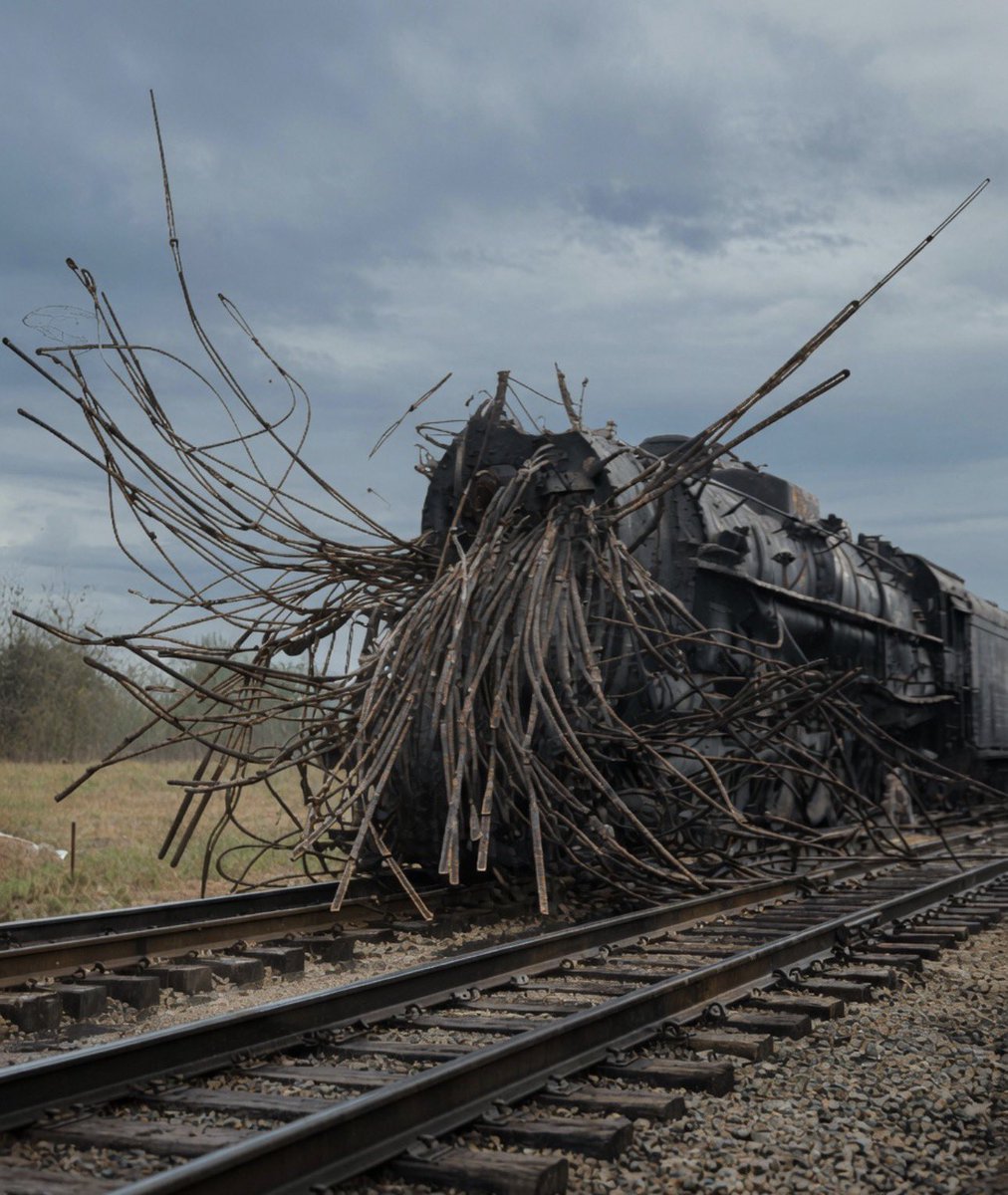
It looks like a creature from science fiction, but what you’re seeing in this photograph is absolutely terrifying.
Those are not loose wires. They are not mechanical tentacles from some forgotten B-movie.
They are not the insides of an alien machine that crashed in the desert.
They are the superheater tubes and fire tubes of a giant steam locomotive, violently ejected through the front of the boiler after it exploded under thousands of pounds of pressure.
What you’re looking at is the aftermath of a crown-sheet failure—one of the most catastrophic failures a steam engine can suffer.
The boiler is essentially a high-pressure bomb filled with superheated water and steam.
Hundreds of thin steel tubes run through it, carrying hot gases from the firebox to heat the water. When the water level drops too low (often on a grade, when the water sloshes backward), the crown sheet overheats, softens, and fails.
The sudden release of pressure turns the remaining water into flash steam with explosive force. The tubes are blasted forward like a frozen spray of metal spaghetti, splaying outward in every direction.
The photograph captures that moment frozen in time: a once-powerful machine transformed into something that looks alive, wounded, and wrong.
The tubes hang and twist like the arms of some industrial Cthulhu, still steaming, still dangerous.
This particular image (and others like it) usually shows the Chesapeake & Ohio T-1 class locomotive No. 3020 after its boiler exploded near Chillicothe, Ohio, in May 1948.
The three men in the cab—engineer, fireman, and front brakeman—were scalded to death by the superheated steam and water.
The force was so violent that the tubes were driven clean out through the smokebox, creating the nightmare silhouette that still unsettles people decades later.
Steam locomotives were rolling pressure vessels.
Treat the water wrong, and the machine could turn itself inside out in a fraction of a second. The photograph doesn’t show a creature from science fiction. It shows what happens when the physics that once made these machines gods of the rails turns against them.
The real terror isn’t that it looks alien.
It’s that it was real, it was common enough to be documented in multiple wrecks, and every one of those twisted tubes once carried the heat that moved mountains of freight across a continent.
Kyiv Pushes European Missile Development Into Wartime Speed—
Ukraine is pushing the Freyja anti-ballistic missile project toward a working prototype by the first half of 2027.
The system is intended to combine Ukrainian launchers and interceptors with European radars, sensors, and electronics from companies including Thales, Leonardo, Saab, Hensoldt, and Eurosam. Its open architecture is designed to prevent the project from becoming dependent on one state or manufacturer. The timetable is exceptionally aggressive for European missile development, but deliberately so: Ukraine needs an affordable ballistic defence layer before Patriot scarcity becomes a permanent strategic ceiling on its war effort.
https://t.co/82RlGJaE9w
Get our daily insights: https://t.co/B67VPpaGCS
(Ending unanimity 🇪🇺)
🇩🇪Germany calls for end to EU unanimity rule
Recent blockages by Greece and Hungary have intensified the debate over Europe’s dependence on unanimity.
🔸 The EU’s six largest economies represent nearly 75% of its population and GDP
🔸 Unanimity allows a single government to delay or block decisions affecting the entire continent
European leaders are intensifying efforts to expand majority voting.
https://t.co/loJPWavykT
I’ve worked on Iran for nearly 20 years. Our options are never great, but I’ve never seen things this bad. For the first time in my career, I’m at a loss.
When this war began, I warned that Iran would likely emerge weakened but more aggressive and risk-tolerant—leaving the region trapped in a cycle of military clashes and chronic instability. That has happened. What I underestimated was the leverage Iran would gain through its stranglehold over the Strait of Hormuz.
For a moment, the MOU offered a possible way out. It was deeply flawed, but better than the alternatives. Then vague terms and shoddy negotiating caused it to collapse: Iran believed it could retain some control over the Strait; Washington believed the Strait would reopen to international shipping.
But the fundamental problem wasn’t the negotiation. It was Trump’s catastrophic decision to go to war in the first place.
The result: higher oil prices, economic shocks, depleted US missile-defense stocks, immense regional damage and civilian suffering, alienated allies and very little achieved in return.
So what now?
We could pay Iran off through sanctions relief, oil exports and access to the international banking system. But after surviving forty days of war, Tehran is angry, distrustful and convinced it holds the stronger hand. Its price is so high – and so humiliating – that Trump will never accept it.
We could escalate militarily, which is what the US is doing. But bombing has not produced meaningful Iranian concessions, and Trump appears unwilling to bear the costs of the maximalist alternatives. More pressure means an expensive, dangerous and potentially endless war, with serious risks to US forces and the entire region as we tragically saw this weekend. And it has little chance of success.
Or we could encourage the Gulf states to negotiate a regional arrangement. That may ultimately be the most promising path, but the Gulf states are divided, this remains fundamentally a US-Iran conflict, and any agreement will require major American concessions while leaving Iran strategically stronger than it was before the war. So this isn’t very appealing and hard to get to as well.
The likeliest outcome is therefore that we are looking at a new normal: recurring US-Iran clashes, periodic American or Israeli strikes on Iran’s nuclear program, Iranian control over the SOH, higher oil prices and a larger, longer-lasting American military presence in the Middle East. But since the costs of all out escalation are too high both sides try to keep it from going there, though there is always a risk.
Iran’s leverage will eventually depreciate as countries build pipelines, diversify energy supplies and establish alternative trade routes. But that could take years.
Eventually, exhaustion may produce a deal. Iran may decide that controlling the Strait while living under blockade is unsustainable. Washington may accept that it must offer more. The Gulf states may finally unite around a workable diplomatic framework. But not soon.
Trump took a situation in which better options plainly existed, started an unnecessary war and produced a strategic disaster that will take years to unwind.
For now, we are all stuck with this mess.
For the past year, MAGA has been screaming “Europoor” like a cheap car alarm going off at three in the morning. Nobody asked for it, nobody knows how to turn it off.
But then along comes this chart.
America sits at number four in average wealth. Except “average” is the statistic billionaires hide behind. Put Elon Musk in a room with 500 broke MAGA guys, and on average, everyone in that room is a multibillionaire. That’s the trick!
Now look at the median. The actual middle American, the real one with the pickup truck, the missing teeth and the medical debt. Fourteenth place. Behind Belgium. Behind Italy. Behind Spain. And the ordinary European? The man MAGA calls a Europoor pays $9 for his insulin, glances over at the American paying $900 for the exact same vial, shrugs, and goes back to being more than twice as wealthy. He’d feel sorry for you, but honestly, he’s too busy being on vacation.
And that gap between fourth and fourteenth? That’s not a statistical quirk. That’s the entire scam laid bare. America’s wealth exists. It’s just not yours. It belongs to about eleven people in Palo Alto, and you’ve been guarding it for them for free, like an unpaid nightclub bouncer, shouting at Europeans on the internet while the owners drink champagne inside.
American exceptionalism. No other nation on Earth has ever been this successfully convinced to cheer for its own fleecing.
So by all means, keep shouting Europoor. We’ll be over here with our healthcare, our six weeks of vacation, and our double-your-median wealth, trying very hard to hear you over the sound of how sorry we feel.
A lot has changed in the Russian-Ukrainian war. Let's sum it up:
1. Europe has replaced the US in finances & arms deliveries. Ukraine's financial situation is better than Russia's. Ukraine has better arms than Russia.
2. Ukraine has got rid of harmful US military advice & restrictions.
3. Ukraine is now shooting more drones than Russia & it has bombed both Moscow & St. Petersburg. The Russian elite is finally feeling the war.
4. Ukraine is gradually cutting off the supply lies to Crimea & many Russians leave Crimea.
5. Ukraine has managed to cause a petroleum shortage in large parts of Russia, which Russians feel.
6. While territory is no longer key, Ukraine has gained territory the last few months.
7. Many more public manifestations of opposition in Russian videos.
8. Europe is more united behind Ukraine than ever after Orban's demise.
Conclusions:
Ukraine is winning, but slowly.
The Ukrainians know what they are doing.
Maintain full European support & keep Trump out!
The Czech Republic is an important EU partner and NATO ally. We had excellent discussions with @PrezidentPavel, particularly on the economy and security.
By working closely together, we punch above our weight.
Beautiful new paper from Harvard, Stanford, UC Berkeley and other top labs.
Shows that DeepLearning is finally becoming the kind of thing science can explain, not just optimize.
Because we still do not have a compact, predictive theory that tells us ahead of time how a neural network will learn, scale, and respond to training choices without mostly testing it first.
Not that we will soon explain every weight, but that we may learn the coarse laws governing training, representation, and performance.
That shift matters because neural nets are not hidden systems. We know the architecture, the data, the objective, and the update rule. The obstacle is not secrecy. It is the complexity of many simple parts interacting at once.
So the authors propose “learning mechanics,” a physics-like program that studies the motion of learning itself.
“Learning mechanics” is their name for a hoped-for set of broad laws, similar to how physics explains gases without tracking every molecule, that explains the overall behavior of neural nets instead of just describing one model at a time.
Physics became useful by ignoring microscopic detail when the right aggregate variables were enough, and this paper says deep learning theory is maturing in exactly that direction through solvable toy models, infinite limits, scaling laws, hyperparameter theories, and universal behaviors.
The claim is that training a neural net may be less like recipe tweaking and more like physics, where you stop tracking every tiny part and instead predict the large patterns that keep showing up.
That means studying how gradients move parameters, how representations form, and why behavior changes in regular ways as model size, data, and compute grow.
The paper says this theory is taking shape through 5 routes: solvable toy models, simplifying limits like infinite width, simple laws like scaling laws, theories of hyperparameters, and behaviors that look universal across many systems.
The central bet is that useful laws can exist even when full microscopic detail is hopeless, just like thermodynamics explains gases without tracking every molecule.
This also fits neatly beside mechanistic interpretability, because one tries to find local circuits while the other tries to find global laws of learning.
----
Paper Link – arxiv. org/abs/2604.21691
Paper Title: "There Will Be a Scientific Theory of Deep Learning"
In 2022, Ukraine's neon supply collapsed. The semiconductor industry panicked, then adapted. It accelerated the migration from deep ultraviolet to extreme ultraviolet lithography. EUV machines do not need neon. Problem solved. The industry congratulated itself for learning the lesson.
Here is what it actually did.
EUV machines generate so much heat that they require helium for cooling. TSMC's most advanced fabs consume 500,000 cubic feet of helium per year. There is no substitute. The semiconductor industry escaped the neon chokepoint by walking directly into the helium chokepoint. It traded one noble gas vulnerability for another. And the second is worse.
Neon could be synthesised from air. Helium cannot be synthesised at all. Neon concentration was roughly 50 percent in Ukraine. Helium concentration is 30 to 33 percent in Qatar. Neon's end uses were narrow: excimer lasers. Helium's end uses span semiconductors, MRI machines, rocket fuel pressurisation, missile leak testing, and fibre optic manufacturing. The diversification of one noble gas deepened the concentration of another. Nobody mapped it. Nobody priced it. Nobody noticed until March 2026.
Two days ago, Air Liquide rushed to open an emergency semiconductor materials factory in Taichung, Taiwan. Its Group Vice President Armelle Levieux stated publicly: "There is today a shortage of helium." Richard Brook of Garrison Ventures told the New York Times: "There is a tsunami coming, but it is still a thousand miles offshore." Approximately 200 specialised cryogenic containers sit stranded near the Strait of Hormuz. We are now at Day 28 to 30 of a 35 to 48 day boil-off window. When the helium warms past its threshold, it vents into the atmosphere. It does not wait. It does not negotiate. It escapes Earth's gravity and drifts into space. Permanently.
Phil Kornbluth, the industry's most cited helium analyst for four decades, says we are looking at a minimum two to three month production shutdown and four to six months before the supply chain returns to normal. South Korea imported 64.7 percent of its helium from Qatar in 2025. Samsung's in-house recycling system, even if scaled across all lines, cuts consumption by only 18.6 percent. SK hynix claims diversified supply but has not disclosed alternative volumes. DRAM contract prices already surged 90 to 95 percent quarter on quarter, a record, before the helium constraint fully bites.
The $4 trillion AI buildout runs on chips. The chips run on EUV machines. The EUV machines run on helium. The helium runs through one strait that is closed, from one gas field that is struck, processed by five manufacturers with full order books stretching to 2028.
The semiconductor industry survived the 2022 neon crisis by creating the 2026 helium crisis. The lesson it learned made the next lesson worse. And the Federal Helium Reserve that might have served as strategic buffer was privatised in June 2024 for $460 million, sold to Messer Group, a German company with Chinese operations.
The market has priced a temporary disruption. The physics has priced a structural shortage. One of them is wrong.
Falsifier: Samsung achieves 95 percent or higher helium recycling with zero capacity loss, and Qatar restarts within six weeks. No credible source has argued either is feasible.
Full analysis in The Last Molecule Standing, live on Substack now.
https://t.co/NUvK1kwQqN
BREAKING: Qatar just told four countries their gas is not coming. For up to five years.
QatarEnergy declared force majeure on long-term LNG contracts with Italy, Belgium, South Korea, and China on March 24. This is not a temporary disruption notice. This is the world’s largest LNG supplier telling major industrial economies that contractual obligations are suspended indefinitely because Iranian missiles destroyed the infrastructure required to fulfill them.
The specifics matter.
Iranian strikes on March 18 and 19 hit LNG Trains 4 and 6 at Ras Laffan Industrial City. Combined capacity: 12.8 million tonnes per annum. That is 17% of Qatar’s total LNG export capacity. QatarEnergy CEO Saad al-Kaabi told Reuters the damage will take three to five years to repair. Estimated annual revenue loss: $20 billion. ExxonMobil holds a 34% stake in Train S4 and 30% in Train S6. Shell is a partner in the damaged Pearl GTL facility, which will take approximately one year to repair.
Train S4 supplied Italy’s Edison and Belgium’s EDFT. Train S6 supplied South Korea’s KOGAS, EDFT, and Shell’s operations in China.
Those are not abstract numbers. Edison heats Italian homes. KOGAS powers South Korean industry. Shell’s China volumes feed the world’s largest energy importer. All of them just received force majeure notices with a repair timeline measured in years, not months.
Al-Kaabi’s quote to Reuters is worth reading in full: “I never in my wildest dreams would have thought that Qatar would be in such an attack, especially from a brotherly Muslim country in the month of Ramadan, attacking us in this way.”
Qatar accounts for roughly 20% of global LNG production. Approximately 80% of that went to Asia before the war. The country was in the middle of a $30 billion expansion to increase capacity from 77 MTPA to 142 MTPA by 2030. Al-Kaabi said the scale of the damage has set the region back 10 to 20 years.
Now connect this to the rest of the matrix.
Beyond LNG, QatarEnergy confirmed “materially reduced output” of condensate, LPG, helium, naphtha, and sulfur. Qatar produces one-third of the world’s helium. South Korea imports 64.7% of its helium from Qatar. Samsung and SK Hynix hold roughly six months of semiconductor-grade helium inventory. Helium spot prices have doubled.
Even undamaged trains cannot export through a Strait of Hormuz where traffic has collapsed 95%, where 2,000 vessels are stranded, and where Iran is operating a selective vetting and toll system near Larak Island with at least two confirmed yuan-settled payments per Lloyd’s List.
This force majeure is not a blip. It is three to five years of lost production compounding with a naval blockade, an insurance market that has priced itself out of the corridor, and a toll regime that Iran’s parliament is actively legislating into permanent law.
Kuwait and Bahrain have also invoked force majeure. The dominoes are falling in sequence, not in parallel.
The market is pricing a temporary oil shock. The molecule map says this is a multi-year structural reordering of global energy, semiconductors, and fertilizer supply chains running through a single contested waterway.
https://t.co/32ixeQpN7N
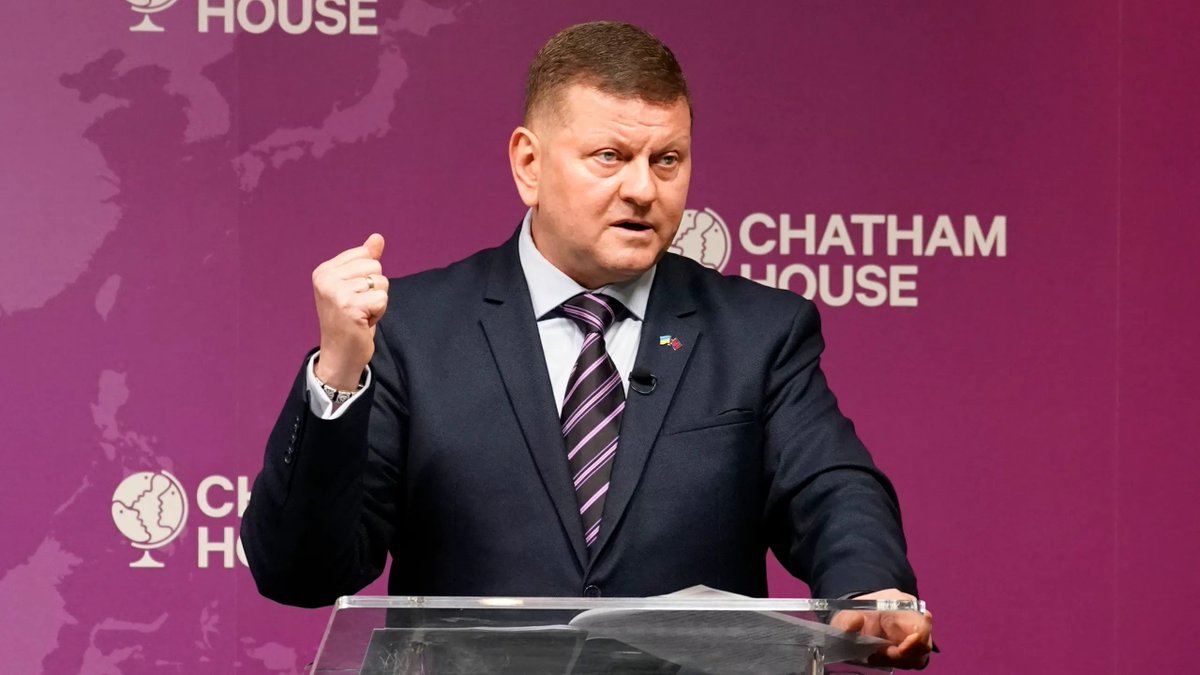
In a @Telegraph op-ed, former Ukrainian commander-in-chief @ZaluzhnyiUA argues that Ukraine's resistance to Russiaa has already shattered the old global order.
He writes that Ukraine’s battlefield innovations, especially the widespread use of cheap, highly effective drone technologies, have fundamentally transformed warfare, enabling even smaller nations to wield disproportionate power and turning traditional strategies obsolete.
Applying these lessons to the Middle East, General Zaluzhnyi, now the Ukrainian ambassador to the UK, cautions that any ground invasion of Iran would be catastrophic, as modern “kill zones” dominated by drones make conventional troop deployments suicidal and economically devastating.
His central message is stark: the world is entering a new era of war that few fully understand, where technological asymmetry and attritional conflict replace decisive victories, and where Ukraine, paradoxically, is among the few nations already adapted to this harsh new reality.
What do you think of General Zaluzhnyi's ideas?
https://t.co/ScchxjWwfj
https://t.co/0OqCEk5ob2