How do Circle’s Nanopayments work?
@circle has unveiled a new feature called Nanopayments.
It allows transfers as small as $0.000001 while claiming zero gas fees. How is that possible?
The secret lies in batched settlement.
If every payment created its own onchain transaction, gas costs would quickly add up.
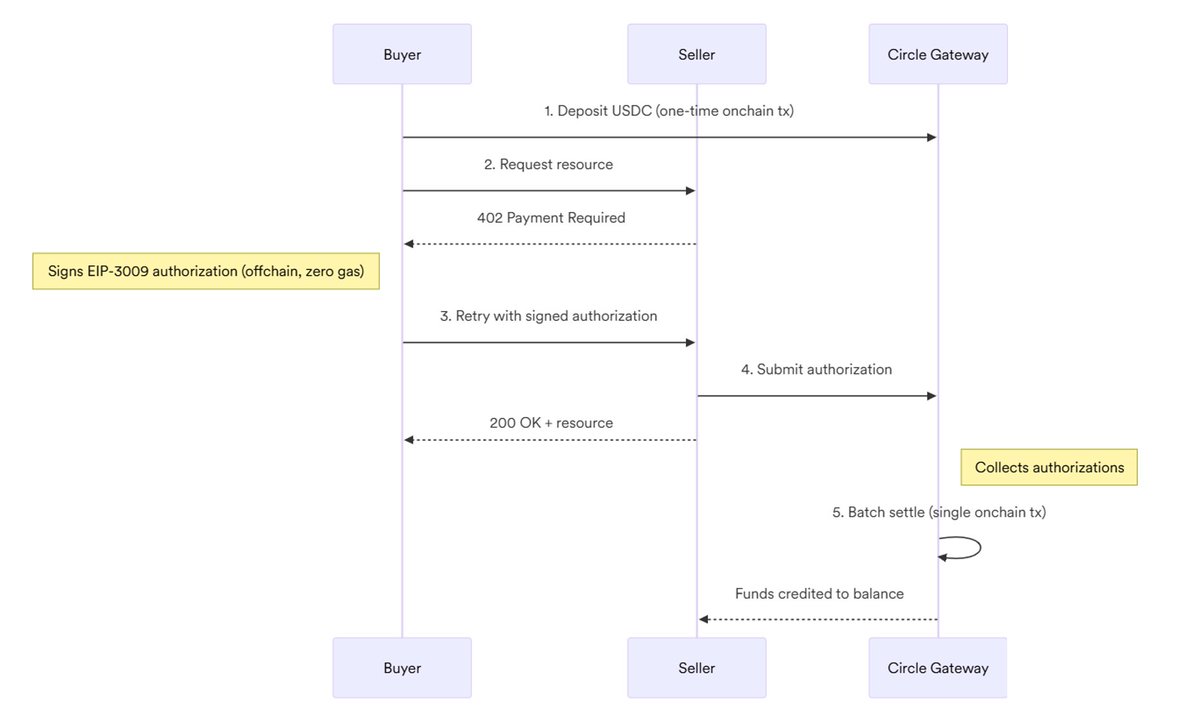
Instead, Nanopayments collects users’ offchain payment signatures through the Circle Gateway. The system calculates net balances and periodically settles accumulated payments in a single batch.
How Nanopayments Work
Here is a simplified look at the process:
1. Deposit: The buyer sends USDC from their wallet to the Circle Gateway Wallet. This is an onchain transaction and gas is paid only once at the initial deposit.
2. Request and negotiate: The buyer requests a paid resource from the seller. The seller can respond through the x402 protocol.
3. Sign authorization: The buyer signs an EIP-3009 message. This is an offchain signature that authorizes payment to the seller and requires no gas.
4. Settle and serve: Circle Gateway verifies the signature and checks the buyer’s balance. The corresponding amount is locked. The seller immediately delivers the paid resource to the buyer.
5. Batch settlement: The Gateway periodically aggregates pending offchain signatures, calculates net balances, and settles them onchain in a single transaction.
In other words, thousands of offchain payment transactions are consolidated into one onchain transaction. That is why the effective gas cost approaches zero.
Security Model
One point worth highlighting is that the offchain payment authorization process might appear custodial at first glance. However, Circle Gateway is designed to be non custodial.
Circle Gateway runs inside an AWS Nitro Enclave TEE. Within this environment, the system verifies EIP-3009 signatures, computes batch settlement results, and signs the final batch transactions. The TEE signing keys are securely protected using AWS KMS. Even Circle employees cannot access the enclave or the keys.
Thoughts
There have been many attempts to implement micropayments. Most approaches simply relied on sending transactions on networks with extremely low gas fees.
Nanopayments takes a different path. By aggregating offchain transactions and processing them in batches, it dramatically reduces gas costs. (For reference, the USDT chain @Stable has implemented a similar concept at the network level called the USDT Transfer Aggregator.)
This approach could become especially meaningful in the future. As the agentic economy evolves, AI agents may increasingly stream payments in real time. Nanopayments creates the infrastructure that makes that model viable.
What is ETH actually worth?
The crypto industry deserves better than price speculation.
I built a dashboard to think about ETH's intrinsic value with 8 models:
https://t.co/CanopzxSz5
Far from perfect and open to feedback.
If you like this initiative, please share it 🙏
Huge moment for Agentic Commerce.
EMVCo (the technical body behind Visa, Mastercard, Amex) is creating global standards for "agentic payments."
This is the biggest change in card payments since "tap to pay"
Here's how it works 🧵
I am excited to announce that I will be joining Tempo. This last year has been a turning point for crypto, where we have finally seen the outlines of our vision being materialized. While payments used to be front and center in the early days of crypto, I see a special opportunity to finally achieve this ambitious goal with relentless execution on both the technical and distribution fronts.
I believe that the real world moment is now, and I want to make sure we do not miss this window to touch normal people’s lives everywhere in the world. I have dedicated the past several years to architecting and scaling blockchains, and I’m excited to leverage my learnings together with the very strong team being assembled at Tempo.
My journey in Ethereum first started when I began working with the EF research team in 2018, and later joining full time in 2019. The project has greatly matured since then and with the soon coming Fusaka upgrade will implement PeerDAS, a significant scaling milestone I am proud to have contributed to. I am very happy to have played a role in leading to more people being able to use Ethereum and I look forward to continuing being able to do that. Over the last year, I have been involved in advancing Ethereum Foundation’s strategy and roadmap and I will remain a research advisor to the three strategic initiatives (Scale L1, Scale Blobs, Improve UX) at the Protocol Cluster at the EF.
Ethereum has a strong set of values and technical choices that make it unique in the world. And Tempo will be a great complement, built using similar technology and values, whilst being able to push the boundaries on scale and speed. I believe that this will be of great benefit to Ethereum. Tempo’s open-source technology can easily integrate back into Ethereum, benefiting the entire ecosystem. Ethereum and Tempo are strongly aligned, as they are built with the same permissionless ideals in mind. I am looking forward to staying involved with the community and continuing to push Ethereum forward!
1/5 Wall Street 2.0 is here.
NVDA, TSLA, AAPL, SPY, GME,…the largest-ever selection of tokenized U.S Stocks & ETFs is now fully ONchain, powered by @OndoFinance.
100+ assets live to trade on Fizen Super App.
@jessepollak You should definitely check this out. QR payments are very popular in Vietnam and other Asian countries (even more than cards). With the Fizen Super App, people can now use crypto for everyday payments via local QR codes at almost any shop.
https://t.co/Gfo43RQSMy
Today Tether publishes (a portion) of its investment/venture portfolio.
Overall Tether group invested in more than 120+ companies and this number is expected to grow significantly in the next months and years.
https://t.co/aGQDHiZSAn
* these investments have been made with Tether's own profits (13.7B in 2024), outside of USDt (and other stables) reserves and are part of Tether Investments arm.
Crypto space needs more practical products that solve real problems for consumers and generate sustainable profits. It's exactly what Fizen has been pursuing since day 1. A very challenging road, but investment from Tether affirms we're on the right track https://t.co/KAvRz0aERp
What is MCP & why it's a big (huge) deal:
(model context protocol)
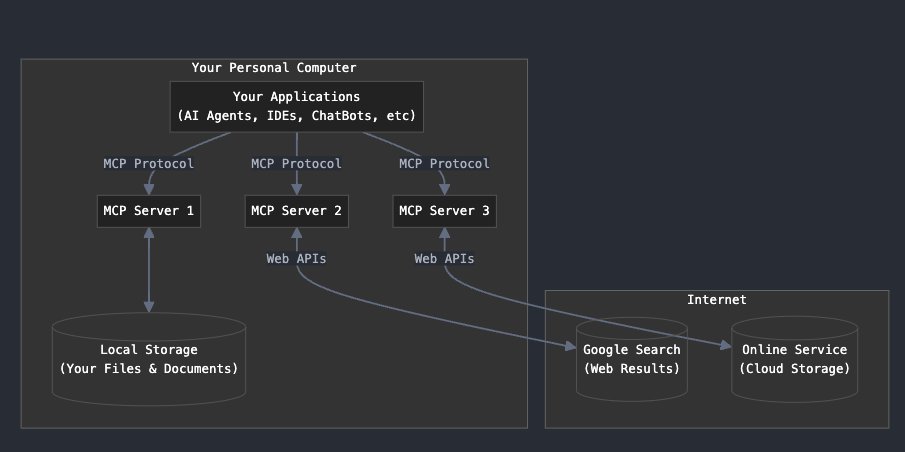
TLDR: MCP makes it possible for AI Tools to use external tools. E.g. Chatbot/IDE/AI-Agent can use Gmail/GoogleDrive/WeatherApp etc.
Detailed explanation for both, tech & non tech people (+demos):
1) AI Tools (chatbots, wrappers, agents, code generator, etc) wanna talk to external systems.
In pre-MCP world, one would have to write code to connect AI tool to the external system via API. Which meant every connection had to be pre-coded.
It also meant that every AI tool had to hard code its connection to every other tool. So if there are 1000 AI tools and 1000 external tools, then 1000000 hard-coded connections via API.
2) MCP is a standard protocol. This means that every AI tool has to implement this once, and then it can connect to thousands of external tools via this protocol.
3) The same goes for external tools. They all have to create an MCP server just once, and all AI tools that support MCP can connect to them.
4) It's a huge deal. Imagine 10k AI tools and 10k external tools now all have to implement MCP just once each. So it's 20k implementations. Versus 10k*10k=100M implementations.
5) This whole thing can also run on the cloud or on local computer.
See demos: