every time i take nurofen i think of when my cousin first immigrated to aus and he got sick and had to take nurofen but he thought everyone was telling him to eat 牛肉粉 (beef noodle soup) and he was so excited
being [redacted] will have you standing barefoot in the kitchen at 4am, eating a kiwi with the skin on, followed by a spoonful of ricotta cheese. i’ve never felt more unhinged in my life and i have…. lived a lot
This is an absolutely fascinating interview of @kejimao, one of China's upcoming scholars and a Research Fellow at the powerful NDRC (the top organization for China's economic planning and policymaking).
As a member of the post 1990s generation, he speaks about young Chinese people today, and their attitude towards the West.
What I found most interesting is how he describes Chinese youths' attitude towards ideology, and how, contrary to popular belief, they're actually much more pragmatic than their Western peers.
Here's what he says:
---
"Having lived and worked in both the West and China for many years, one thing I’ve observed is that most young Chinese tend to avoid issues that are overly ideological, especially those framed in the binary 'left vs. Right' or 'Socialism vs. Capitalism' terms defined by the West. They are neither particularly drawn to Western left-wing, anti-capitalist views nor are they particularly inclined to sympathize with the right-wing, anti-socialist positions.
Indeed, while they might occasionally adopt these left-wing or right-wing perspectives when critiquing Western shortcomings, I don’t believe this leads them any closer to those ideological camps. To truly understand this pragmatic tendency, we need to examine China’s own path of development. Western interpretations of socialism may be varied, often shaped by stereotypes, but in contemporary China, socialism has been clearly defined as a system aimed at significantly raising the material and cultural standards of living through the full liberation and development of productive forces. In other words, in China’s political and social context, 'embracing socialism' essentially means a relentless pursuit of economic growth, reflected in improvements in technological capability, living standards, and national wealth.
From this perspective, whether young Chinese people are drawn to a particular ideology may largely depend on the tangible benefits it brings, rather than its predefined ideological characteristics or value orientations. For example, when young Chinese admire European technologies, they care little about whether it’s driven by state-owned enterprises in France or family-owned businesses in Italy.
An interesting case is the term 'Bai Zuo' coined by Chinese youth to mock some Western liberals. In the eyes of many young Chinese, while the values of 'Bai Zuo' may have a progressive side and may attempt to address the negative aspects of capitalism, they ultimately seem out of touch with reality. These liberal views are seen as costly moral posturing that proposes high-cost solutions without addressing the fundamental problems. For example, many Chinese youth dislike Western environmental organizations not because they don’t care about the environment, but because they believe there are more urgent issues that need attention. Overemphasis on environmental protection, they argue, diverts precious resources from solving other pressing problems, rendering all efforts ineffective. Therefore, from their perspective, 'Bai Zuo' represents misguided moralizing from an condescending position, rather than something rooted in 'socialist' ideology.
At the same time, it’s likely that Chinese youth are also averse to the rising Western right-wing.
What many in the West may not realize is that after enduring China’s civil war, revolution, and decades of education on internationalism, secularism, and egalitarianism, most Chinese have been deeply influenced by progressive values.
If 'Bai Zuo' represents misguided progressivism, then the Western right-wing is seen as nakedly barbaric—religious superstitions, anti-immigrant populism, and unchecked corporate greed all combine to form the most toxic forces in both domestic and international politics. For Chinese youth, this is perhaps the most worrying political force in the West today, one that could provoke substantial geopolitical risks and conflicts."
---
This all completely aligns with my own impression: the only discernable ideology I've been able to consistently witness in China is pragmatism. Essentially "what's good is whatever works to improve our own, our country's, and the world's condition."
This actually has a very long tradition in China, arguably all the way to the roots of its core philosophical system.
Take the concept of Yin-Yang for instance: at its heart, what it says is that absolutes are destructive and that one needs to seeks balance in all things. There is no such thing as "good" or "bad" in the Yin-Yang framework - only balance and imbalance, harmony and disharmony. The only thing "bad" is to actually optimize for an absolute "good".
This is partly why it's often so incredibly difficult for the West to understand China: we're so profoundly framed by our fundamentally binary view of the world and our thinking built on absolute moral categories and ideological purity that we simply cannot comprehend a civilization that operates based on radically different premises.
In fact, as Mao Keji explains with his explanation of the term "Bai Zuo" (literally "white left"), the feeling is mutual: the Chinese largely find our Western ideological obsessions both baffling and counterproductive. They see 'Bai Zuo' progressivism not as genuinely socialist but as "costly moral posturing that proposes high-cost solutions without addressing the fundamental problems." This perspective isn't rooted in rejection of environmental or social concerns, but in questioning the effectiveness of absolutist approaches that prioritize ideological purity at the expense of practical improvements.
This critique extends to Western right-wing politics as well, which they perceive as "nakedly barbaric" with its combination of "religious superstitions, anti-immigrant populism, and unchecked corporate greed."
All in all, what's most fascinating is how this defies Western views of China as either a "communist" state or an increasingly "nationalist" one. Instead, Mao portrays a generation that has integrated progressive values ("internationalism, secularism, and egalitarianism") while maintaining a ruthlessly pragmatic focus on outcomes rather than ideological consistency.
Perhaps this is in fact ironically the West's greatest weakness when it comes to competing with "communist China": our inability to escape ideological tribalism, leaving us trapped in gridlock and ineffective solutions while China steadily builds power through a philosophy that values concrete results over ideological consistency.
This is the link to the whole interview: https://t.co/E5eWTLrZH4
Below are testimonials from ten victims of the Nanjing Massacre, with all texts and photographs provided by The Memorial Hall of the Victims of the Nanjing Massacre by Japanese Invaders.
Eight survivors have passed away since the beginning of 2025, reducing the number of living registered survivors to 24.
China will observe its 12th National Memorial Day for the victims of the Nanjing Massacre on Dec. 13, commemorating the day in 1937 when invading Japanese troops captured Nanjing -- then the Chinese capital -- and began six weeks of slaughter that claimed the lives of more than 300,000 Chinese civilians and unarmed soldiers.
Only by remembering past can we hope to achieve a peaceful future.
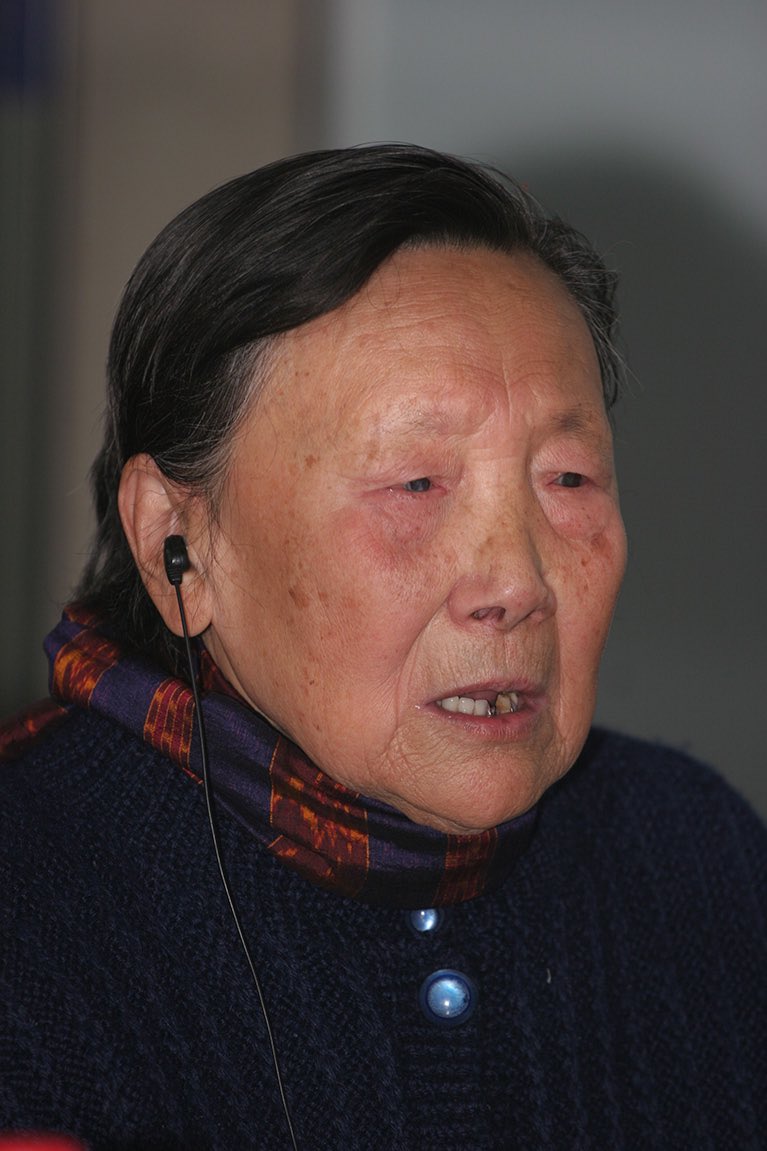
-"𝗠𝘆 𝘀𝗶𝘀𝘁𝗲𝗿 𝗮𝗻𝗱 𝗜 𝘄𝗲𝗿𝗲 𝘁𝘄𝗼 𝗰𝗵𝗶𝗹𝗱𝗿𝗲𝗻 𝗽𝗶𝗰𝗸𝗲𝗱 𝗼𝘂𝘁 𝗳𝗿𝗼𝗺 𝘁𝗵𝗲 𝗱𝗲𝗮𝗱 𝗽𝗶𝗹𝗲𝘀." (𝗧𝗲𝘀𝘁𝗶𝗺𝗼𝗻𝘆 𝗼𝗳 𝗫𝗶𝗮 𝗦𝗵𝘂𝗾𝗶𝗻, 𝗮 𝘃𝗶𝗰𝘁𝗶𝗺 𝗼𝗳 𝘁𝗵𝗲 𝗡𝗮𝗻𝗷𝗶𝗻𝗴 𝗠𝗮𝘀𝘀𝗮𝗰𝗿𝗲)
My name is Xia Shuqin, born in May of 1929, Nanjing. Before the Japanese invasion of Nanjing, my family had nine people, including my grandfather Nie Zuocheng (in his 70s), my grandmother Nie Zhou (in her 70s), father Xia Ting’en (in his 40s), mother Xia Nie (in her 30s), the eldest sister Xia Shufang (16 years old), the second sister Xia Shulan (14 years old), the second younger sister Xia Shuyun (4 years old), the youngest sister Xia Shufen (1 year old) and the 8-year-old me.
We lived in the house of a (Mohammedan) whose last name was Ha at No. 5 of Xinlukou, Chengnan. At that place, except my sister Xia Shuyun and me, the whole family was killed by the Japanese army. My sister and I were two children picked out from the dead piles.
On the morning of December 13, 1937, a group of Japanese soldiers (about 30 people) came to knock on our door. They shot the owner of the house Mr. Ha immediately when he opened the door. Seeing this, my father kneeled down in front of them, begging them not to kill any more people, but was shot dead by them as well.
My mother was scared to hide under the table with the 1-year-old youngest sister, but she was dragged out by the Japanese soldiers. They grabbed my sister away from my mother, throwing her to the ground to kill her. Then they tore away my mother’s clothes and several soldiers gang raped her before killing her with the bayonet. They cruelly stuck a bottle into my mother’s private part.
Later several Japanese soldiers forced into the neighboring room where hides my grandfather, grandmother, and two elder sisters. They tried to rape my elder sisters, but were strongly resisted by grandfather and grandmother, so they killed the two old people brutally.
Then the Japanese soldiers tore away all the clothes of my two elder sisters, they gang raped them before killing them with the bayonet. The soldiers stuck my grandmother’s walking stick into my eldest sister’s private part.
I was hiding in the quilt on the bed. I cried aloud out of scare, then I was stabbed on the back by the Japanese soldiers three times, so I fainted. I didn’t know how long had passed, when I was awakened by the cry of my 4-year-old younger sister, I found we were surrounded by the bodies of my family. We could do nothing but cried loudly, wishing to wake up mother…
We looked for food everywhere. Fortunately, there were some parched rice and rice crust left in the kitchen. We lived on these food and the cold water in the water vat for 14 days, accompanying by the bodies of our families. Later, we were successively adopted by the “Hall of the Old” (a charity institute) and my uncle. My uncle’s family was also very poor. In order to reduce the life burden, since 12, I had to support myself. I once sold vegetables and worked as the servant.
In this way, seven people in my family were killed by Japanese soldiers in a very short time. Whenever I thought about it, I couldn't help crying and I almost cried my eyes out every time.
https://t.co/CXvPktNGuK
Cigarettes are modernist & vapes are late-capitalist, bc a cigarette has an inherent duration which requires you to take a break, and allows for contemplation or conversation, whereas a vape can be hit again at any chosen time, without interrupting the tempo of postmodernity