Commissioned by the Bundela Rajput ruler, Maharaja Bir Singh Deo, the palace was constructed as a welcoming gesture and pitstop for his close ally, the Mughal Emperor Jahangir, on his way to Orchha. It took nine years and 35 lakh rupees to build, spanning from 1614 to 1623. Perched on an isolated rock near the Karna Sagar Lake, it is a brilliant fusion of Rajput robustness and Mughal grace.

@Maratha_Ren Key aspects of evaluating Shivaji Maharaj's influence on Indian nationalism. The Maratha Empire revived Hindu temples rituals that had been abolished and destroyed by invaders. Impact of Shivaji Maharaj is priceless & invaluable
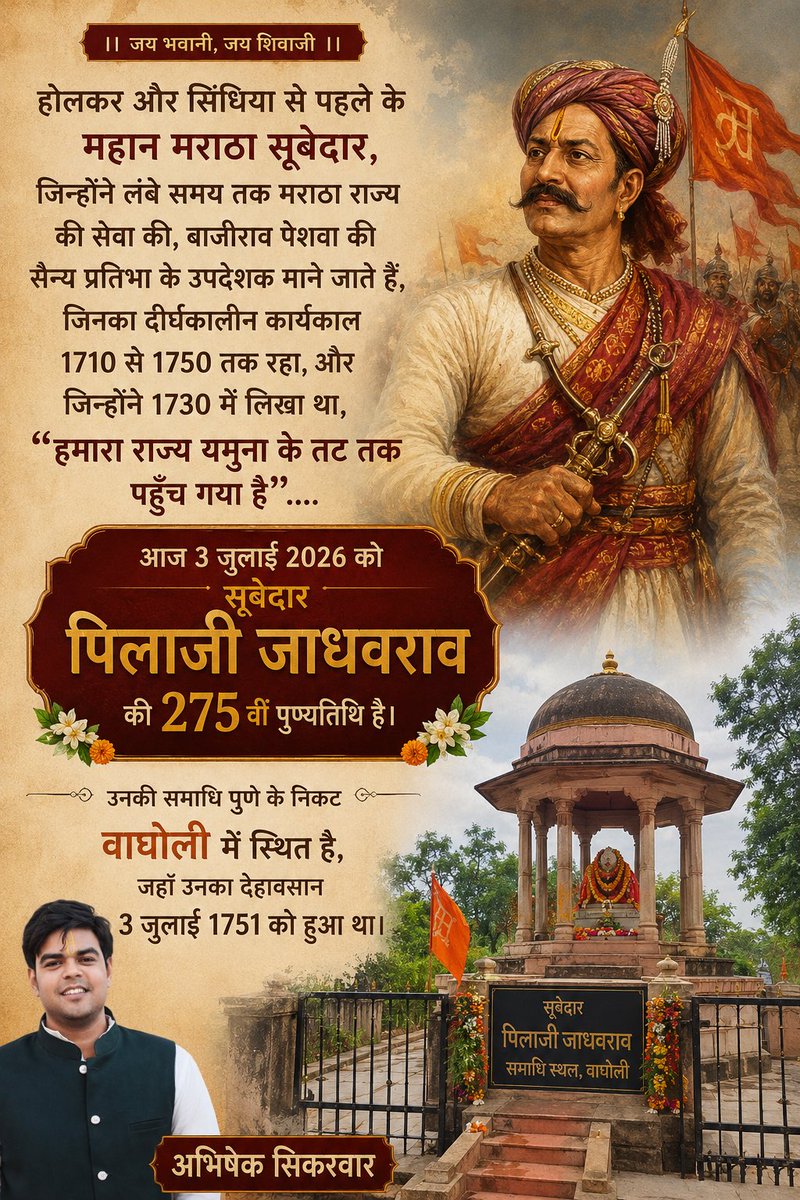
One of the greatest Maratha subedars, before Holkar and Scindia, who served the Maratha state for long, is considered a preceptor to Bajirao Peshwa’s military genius, who had a long career from 1710 to 1750, and who wrote in 1730, ‘Our realm has reached the banks of the Yamuna’…. today 3 July 2026 is the 275th death anniversary of Subedar Pilaji Jadhavrao.
His samadhi is at Wagholi near Pune where he passed away on 3 July 1751.”
Rohilkhand is a historical region in present-day northwestern Uttar Pradesh, comprising districts such as Bareilly, Rampur, Moradabad, Bijnor, Shahjahanpur, Badaun, Pilibhit, and Amroha. The name “Rohilkhand” comes from Roh, the Pashto word for “mountains,” referring to the Rohilla Pashtuns who settled in the region.
Ancient Period: Known as Katehr, the region was ruled by various Hindu dynasties, including the Panchalas of the Mahabharata era, followed by the Mauryas, Guptas, and later the Rajputs, especially the Katehriya Rajputs.
Mughal Period: During the late 17th and early 18th centuries, Pashtun (Afghan) warriors known as the Rohillas migrated to Katehr, many serving in the Mughal army as the empire weakened after the death of Aurangzeb.
Foundation of Rohilkhand (1721): Ali Mohammed Khan united the Rohilla chiefs and established the independent Kingdom of Rohilkhand with its capital at Bareilly, taking advantage of the declining Mughal Empire.
Golden Age: Under leaders such as Hafiz Rahmat Khan, Rohilkhand became a prosperous state known for agriculture, trade, military strength, and cultural development.
First Rohilla War (1774): The British East India Company allied with the Shuja-ud-Daula and defeated the Rohillas in the Battle of Miranpur Katra. Hafiz Rahmat Khan was killed, and most of Rohilkhand came under Awadh’s control.
Rampur State: Faizullah Khan established the princely state of Rampur under British protection, preserving a part of the Rohilla legacy.
British Rule (1801): The British acquired Rohilkhand from Awadh and incorporated it into the British East India Company territories, later making it part of the United Provinces.
1857 Revolt: Rohilkhand became a major center of the Indian Rebellion of 1857. Bareilly emerged as a key rebel stronghold under Khan Bahadur Khan before British forces recaptured the region.
Modern Era: After India’s independence in 1947, Rohilkhand became part of Uttar Pradesh. Today, it remains one of the state’s most fertile agricultural regions, producing sugarcane, wheat, rice, and mentha, while preserving a rich blend of Rajput, Rohilla, Mughal, and local cultural traditions. #pathan #afghan #deoband #uppcs #upgk
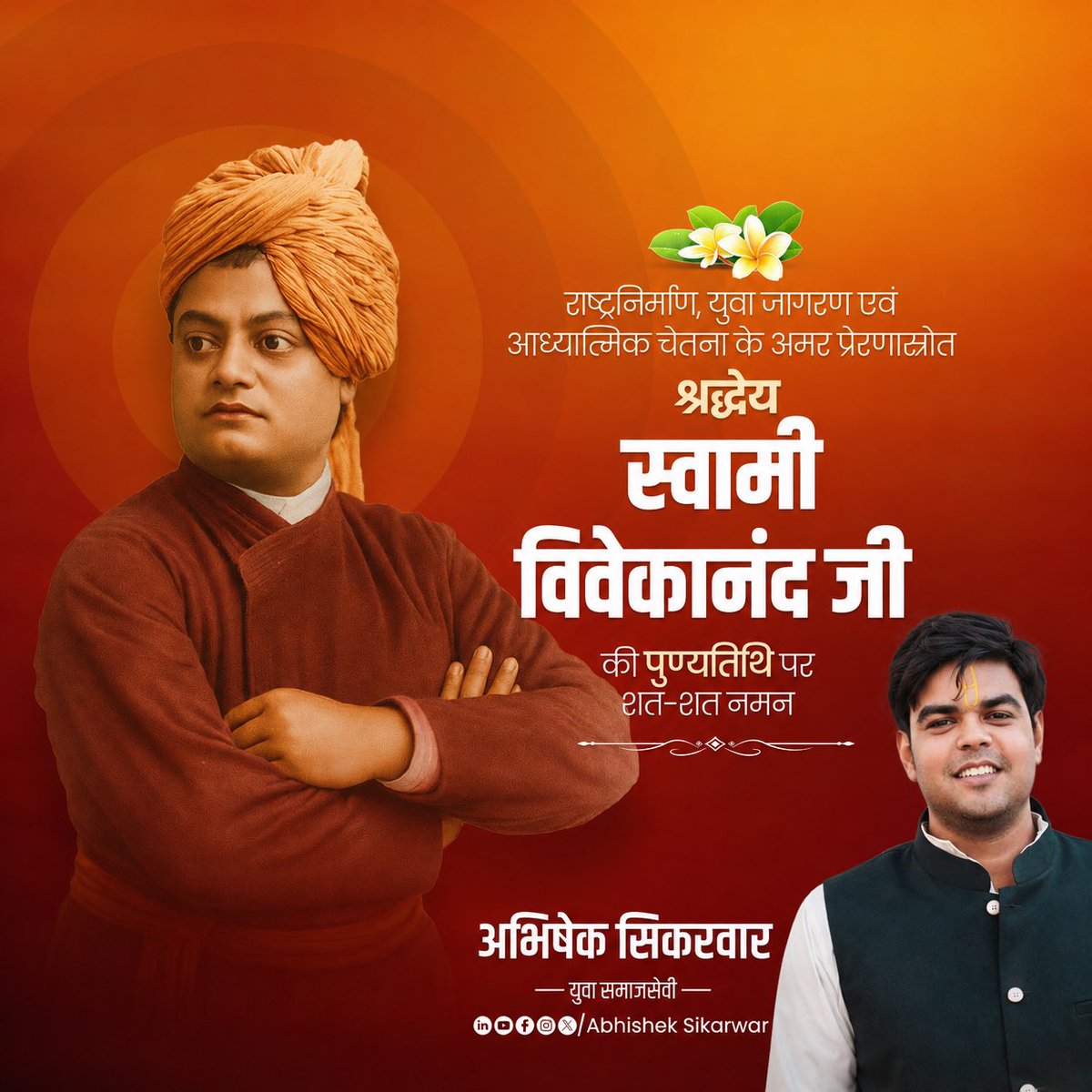
राष्ट्रनिर्माण, युवा जागरण एवं आध्यात्मिक चेतना के अमर प्रेरणास्रोत, श्रद्धेय स्वामी विवेकानंद जी की पुण्यतिथि पर कोटि-कोटि नमन करता हूं।
उन्होंने ओजस्वी विचारों, अद्भुत आत्मबल और राष्ट्र के प्रति समर्पित दृष्टि से भारत की सनातन सांस्कृतिक चेतना को विश्व पटल पर गौरवान्वित किया। युवा शक्ति के लिए उनके संदेश विकसित, आत्मनिर्भर और सशक्त भारत के निर्माण का प्रेरक आधार हैं।
#स्वामी_विवेकानंद
#SwamiVivekananda
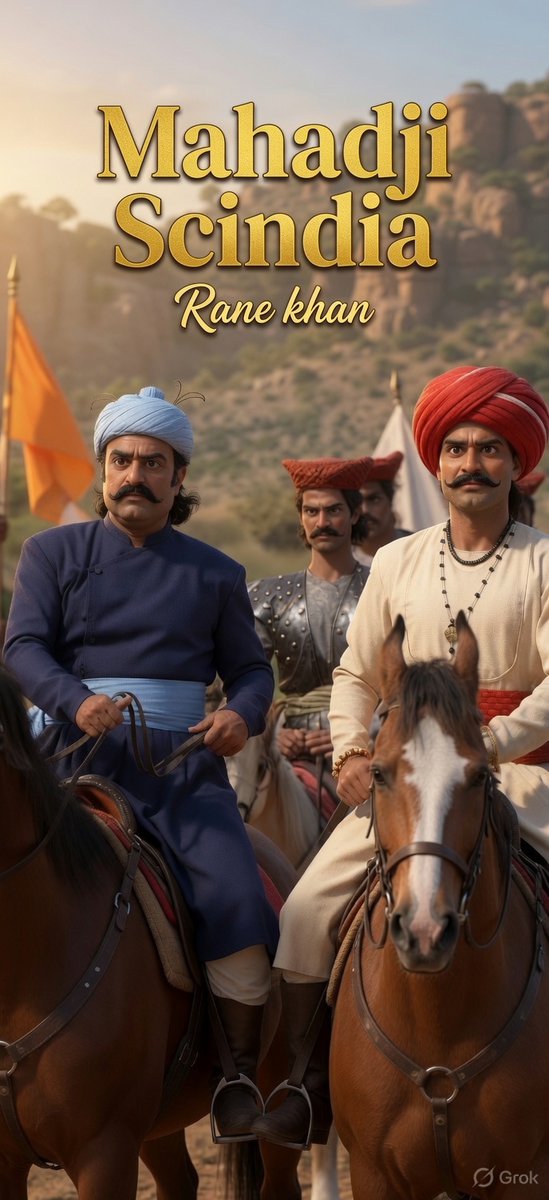
Ranoji Scindia (1692–1745), the founder of the Scindia (Shinde) dynasty of Gwalior, played a significant role in expanding Maratha influence across Malwa during the 18th century. Beyond his military achievements, he is remembered for supporting the revival of religious and cultural institutions.
His legacy includes the restoration and redevelopment of several Hindu temples in Ujjain, including patronage for the rebuilding of the Mahakaleshwar Temple, which had suffered destruction in earlier centuries. He also supported the construction and restoration of ghats along the Shipra River, helping revive Ujjain as a major center of pilgrimage and contributing to the renewal of the Simhastha Kumbh traditions.
Ranoji Scindia’s efforts left a lasting impact on the religious, cultural, and architectural heritage of Malwa, and laid the foundation for the continued prominence of the Scindia dynasty in central India.
“Pathano se kehna Chauhan aa gaya hai”
2 hours film cannot deny the contribution Indian Pathans have made to their Indian motherland.
#muslim#pathan#musalman#hindustan
The Maratha-Nizam Wars were a series of 18th-century conflicts between the Maratha Empire and Nizam of Hyderabad for Supremacy in Deccan .
1 Battle of Palkhed (1728)
•Date: February 1728
•Overview: Fought near present-day Maharashtra, this battle is considered a masterclass in guerrilla warfare by Peshwa Baji Rao I. The Marathas outmaneuvered and decisively defeated the Nizam, forcing him to acknowledge Shahu as the Chhatrapati and agree to pay tribute. [1, 2, 3]
2. Battle of Bhopal (1737)
•Date: December 1737
•Overview: Seeking to curb Maratha expansion, the Nizam marched against the Marathas but was outflanked and besieged in Bhopal by Peshwa Baji Rao I. The Marathas cut off his supply lines and poisoned water sources, forcing the Nizam to sign the Treaty of Bhopal, yielding the entire Malwa region to the Marathas. [1, 2]
3. Battle of Udgir (1760)
•Date: February 1760
•Overview: Maratha forces under Sadashivrao Bhau decisively defeated the Nizam's modernized artillery and infantry by completely encircling and cutting off his supplies. The subsequent treaty forced the Nizam to surrender major forts (including Daulatabad and Asirgarh) and highly lucrative territories. [1]
4. Battle of Kharda (1795)
•Date: March 11, 1795
•Overview: The final major conflict between the two empires, fought near the fort of Kharda. It marked the last time all major Maratha chiefs (Peshwa, Scindia, and Holkar) united. The Marathas heavily outnumbered and defeated the Nizam, who received no aid from his British allies. The crushing defeat forced the Nizam to cede vast territories and pay a massive indemnity. [