You dont want a yacht. You dont want a big house. You dont want a super car, a $40,000 watch, or shoes you worry about getting dirty. You want free will.
You want to wake up naturally on a Tuesday and you want to go to bed when you’re done having fun. You want to say yes to everything that excites you without having to request time off. You want to go to the the gym at noon, in absolutely no hurry. You want to spend 18 hours a day doing what you love. You want to be exactly where you desire being, always. You want to spend as much time with the people you care about as possible.
You’re saying you wanna be rich? In what?
The fact that everyone is not just naturally a libertarian is something I have a really hard time understanding.
Like what gives so many people the compulsion to want to control other people's lives? Can't wrap my head around where the desire to do that even comes from..
Hello Julia, sans aucune ironie, c'est top que tu prennes le temps de te renseigner. Mais le problème quand on lit Marx aujourd'hui, c'est qu'on prend pour acquis sa prémisse de départ, alors qu'elle a été démontée scientifiquement il y a plus de 150 ans.
Toute la pensée de Marx repose sur la théorie de la valeur-travail. L'idée que la valeur d'un bien vient de la quantité de travail nécessaire pour le produire. Si tu acceptes cette prémisse, alors oui, tout son raisonnement tient. Le capitaliste "vole" la plus-value du travailleur, l'exploitation est mathématique, la révolution est inévitable.
Sauf qu'en 1871, trois économistes (Menger en Autriche, Jevons en Angleterre, Walras en Suisse) découvrent indépendamment la même chose : la valeur n'est pas objective, elle est subjective et marginale.
Un verre d'eau dans le désert vaut une fortune. Le même verre à côté d'une rivière ne vaut rien. Le travail incorporé est identique. Donc le travail ne détermine pas la valeur. C'est le consommateur qui valorise un bien selon son utilité marginale dans un contexte donné.
Exemple concret : tu peux passer 1000 heures à tricoter un pull moche que personne ne veut. Selon Marx, ce pull a énormément de valeur (beaucoup de travail incorporé). Selon la réalité, il ne vaut rien. Parce que personne n'en veut.
À l'inverse, Bernard Arnault crée des milliards de valeur non pas parce qu'il "exploite" mais parce qu'il a su anticiper et organiser des désirs humains à grande échelle. La valeur est créée par la coordination, pas extraite par le vol.
Cette découverte (la révolution marginaliste) a invalidé tout l'édifice marxiste. Pas pour des raisons idéologiques, pour des raisons scientifiques. C'est pour ça que plus aucun département d'économie sérieux au monde n'enseigne Marx comme un cadre d'analyse valide. On l'enseigne en histoire de la pensée.
Maintenant, le truc important. Si ton intention en lisant Marx c'est d'aider les pauvres (c'est une intention noble), alors tu vas être surprise par ce qui suit.
Regarde les chiffres de la Banque mondiale. En 1820, 90% de l'humanité vivait dans l'extrême pauvreté. Aujourd'hui, moins de 9%. Cette chute historique ne s'est PAS produite dans les pays qui ont appliqué Marx. Elle s'est produite dans les pays qui ont libéralisé leur économie.
Chine post-1978, Vietnam post-1986, Inde post-1991, Pologne post-1989. À chaque fois qu'un pays libéralise, des centaines de millions de gens sortent de la pauvreté en une génération. À chaque fois qu'un pays applique Marx (URSS, Cambodge, Corée du Nord, Venezuela), c'est la famine et les goulags.
Ce n'est pas une opinion, c'est l'expérience la plus massive jamais menée en sciences sociales. Plusieurs milliards de cobayes humains, sur un siècle.
Donc paradoxalement, si tu aimes vraiment les pauvres, la position la plus cohérente n'est pas d'être marxiste. C'est d'être pour la liberté économique. Parce que c'est empiriquement la seule chose qui a jamais sorti massivement les gens de la misère.
Pour creuser, je te recommande trois lectures qui vont changer ta vision :
"La Loi" de Frédéric Bastiat (court, lumineux, gratuit en ligne)
"La Route de la Servitude" de Hayek
"Économie en une leçon" de Henry Hazlitt
Bonne lecture, et vraiment chapeau de chercher à comprendre plutôt que de rester dans tes certitudes. C'est rare.
The funny thing is that it isn't necessarily a first-hand knowledge of physics that allows you to see quantum computing for the bullshit that it is.
It's the possession of a firm grasp on epistemology, and an understanding of "how do I know what I know?"
It's the same way that a bunch of non-doctors knew not to take the vax, or that a bunch of non-finance guys see that the Fed will do structural inflation forever.
In all three cases, the experts mislead you *systematically* because of entrenched interests unmoored from quality within the domain itself.
A personal note. After years of public discussion/work: the podcast, social media, venture capital, everything — I'm stepping back to focus on my family.
My kids are growing fast. My wife deserves the best of me. To everyone who listened, read, grew, and built alongside me — thank you. What a blessing you all have been!
Note the hand wave here. China’s quoted 10 year yield is for “onshore” borrowing. It’s an internal yield actively managed by the CCP and the PBOC. It’s a huge market now, on par with the UST. But, it has no external liquidity.
It is just as likely a massive debt-fueled bubble as we’ve ever seen.
By contrast offshore CNY bonds is a sub $500 billion market.
One of these two countries is a big energy exporter, not borrowing to buy oil, but rather selling its excess. Luke making this equivalence here is really disingenuous.
Both of these countries sell USD debt into the global market. One does it to encourage the use of its currency. The other does it because people want it. The borrowing spread between the two in international markets is negligible and very volatile.
China isn’t the US’s adversary, and it won’t be our replacement, but it will have to become less mercantilist while the US becomes more so.
Ryan from the O.C. lacks objectivity. He’s emotionally committed to hating Bitcoin. Host @LynAldenContact on this topic for a fair, unbiased perspective.
Today, you’re sending your hard-earned capital to the government.
You don’t get a receipt. You don’t get a progress report. You don’t get a choice. You’re just funding a system that no longer represents you and an education model that doesn't prepare the next generation for the world we’re building.
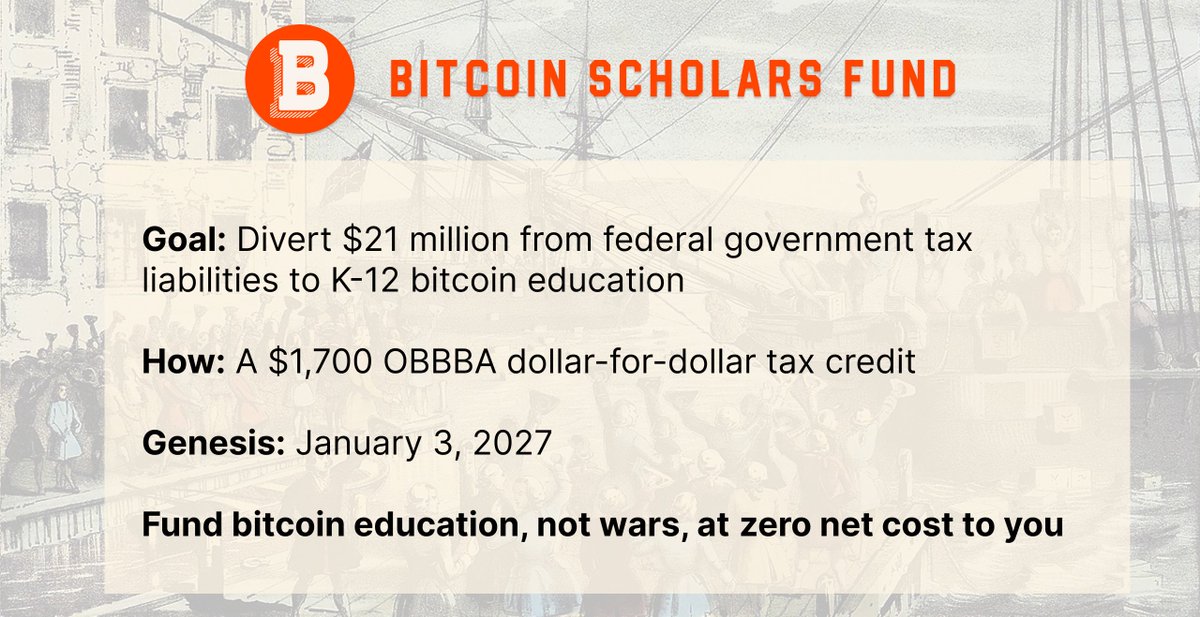
It’s time to opt out. Today we are launching the Bitcoin Scholars Fund, a new non-profit scholarship granting organization.
Our mission? To redirect $21 Million from the federal government in 2027 directly into K-12 Bitcoin education.
How it works: Starting in 2027, your first $1,700 ($3,400 per couple) donated to BSF is a 1:1 Federal Tax Credit thanks to the One Big Beautiful Bill Act. Net cost to you: $0.
We aren't just building a non-profit; we’re architecting an innovative "Zero-Leakage" treasury powered by $STRC to ensure nearly 100% of your principal hits the classroom, not our overhead.
Stop funding the legacy machine. Start funding financial education for kids.
The scholarship fund goes live on January 3rd, 2027, but the "Proof of Work" starts today.
Follow along as we help fix the schools by fixing the flow of capital.
Fund Education. Not Wars. 👉 https://t.co/hxZNlCLTkl
@coldhardsats IMO it really depends on your alternative options. In AK my alt options are ~$190/mo for garbage, so Starlink is great. In Boston gigabit fiber was $65mo, so I wouldn’t have used Starlink there
@coldhardsats Ya it’s great for me. Every couple hours there’s a short period, maybe 30 secs, where theres latency. Maybe a satellite handoff or something, but I think that’s unique to AK. I don’t play video games or power use. Just streaming which buffers so I don’t even notice.