$ROSE is building where the next cycle is headed.
AI agents are taking over crypto, and almost none of them can keep a secret. Every strategy, every key, every piece of user data sits out in the open on a public chain. That is the problem Oasis was built to solve.
Sapphire gives builders a confidential EVM, so smart contracts can hold private state without giving up composability.
ROFL lets AI apps run off chain inside secure enclaves and prove on chain that they ran exactly as promised. Verifiable, private AI is not a roadmap slide here. It is shipping.
A full UX overhaul for the wallet and explorer is on deck for Q4, making onboarding simpler for the next wave of users.
Privacy plus AI is one of the strongest narratives in this market, and $ROSE has been building the infrastructure for it while everyone else was chasing memes. @OasisProtocol
Everyone's staring at the chart. Almost nobody's looking at what's underneath it.
$AMP isn't a meme with a roadmap. It's the collateral layer behind Flexa, a payments network that's been plugging crypto into real store checkouts since 2019. When you pay with crypto through Flexa, the merchant gets paid instantly and AMP stakers are the ones guaranteeing it. That's the job. Real payments, real merchants, real fees.
And Flexa owns the playbook. Patents on collateral backed crypto payments, on locking collateral at checkout, on paying stakers from merchant fees, on point of sale hardware built around it. Anyone who wants to do instant crypto payments the way Flexa does has to work around that.
The team never stopped building while the price bled. They shipped Tap to Pay, so you can tap a hardware wallet at a register with no phone at all. They added Base Pay as a checkout option. They rebuilt staking from scratch with Capacity v3 and audited vaults. You don't rebuild your staking system for a token you're walking away from.
Supply is fixed. A huge chunk of it sits locked as collateral. Retail has been shaken out for years. Weak hands are gone.
So here's the setup: a working payments network, a patent moat, a fixed supply, a team still shipping, and a token sitting near the bottom of its entire history while the market forgot it exists. If crypto payments finally have their moment, AMP is already plugged into the registers.
Nobody cares about AMP right now. That's usually when it gets interesting.
Avalanche, you're sleeping on this one.
$zAVA is mined with $AVAX.
Supply is capped at 21 million and released over 32 cycles, modeled on Bitcoin's halvings. Each cycle mints half as much as the last, and the cost to mine doubles.
@zAVA_Money@avax#Avalanche 🔺 $btc
Most people missed the first halving of $BTC
zAVA is in cycle 1 of 32. Every cycle, the cost to mine doubles.
This is what early looks like. @avax $AVAX
Most people think $AMP is only for crypto payments at checkout. That's just the first use case.
$AMP was built as universal collateral. Anywhere value moves and someone needs a guarantee before it's final, collateral has a job. Here's where that could go.
Live today:
1Retail payments. Flexa uses $AMP collateral so merchants get paid instantly while the blockchain confirms.
2Wallet payments. Wallets like Zashi plug into Flexa so their users can spend at stores, with $AMP backing each payment.
Already patented or built, not yet scaled:
3Instant exchange settlement. Flexa holds a granted patent for trades backed by locked collateral. You lock tokens as a guarantee and the swap completes immediately, instead of waiting on deposits to clear.
4Open collateral pools. Capacity v3 runs on Anvil, an open collateral protocol. Pools are governed onchain, so other apps can tap the same collateral layer without building their own.
Where the model fits next:
5Remittances and payouts. Flexa says its Europe launch lays the groundwork for cross border payments, remittances and disbursements. Every one of those has a settlement gap that collateral can close.
6AI agents. Software agents are starting to pay for things on their own. A machine can't wait days for a card to settle or fight a chargeback. Instant, guaranteed payments are what they need.
7Tokenized stocks and real world assets. In September the SEC granted relief for tokenized stock trading venues. When trades settle onchain, someone has to cover the gap between trade and final settlement.
8Bridges and cross chain transfers. Moving value between chains means waiting on two networks. Collateral can make the receiving side instant while the transfer finishes in the background.
9Deposits and escrow. Rentals, bookings and marketplaces all hold money as a guarantee. A token built to be locked, released or claimed on conditions does that natively.
Why $AMP is leading:
• It was purpose built for this. Partitions let collateral stay in your wallet while it's locked, which most tokens can't do. • It has been backing real payments at real stores since 2020. • The design is protected by Flexa's granted patents. • The company using it holds money transmission licenses in 40 US states and is live across Europe. • Fixed supply. No new $AMP is ever minted.
Most tokens are searching for a use case. $AMP has one working today, and the same design fits nearly everywhere money needs to move faster than it can settle.
Not financial advice. Do your own research.
One thing almost nobody in the $AMP community talks about: Flexa's patents.
@FlexaHQ has been granted patents covering the core mechanics of collateral backed payments, plus a long list of pending applications. Here are the granted ones that matter:
1Conditional access rights to assignable tokens (granted 2023 and 2024) Your tokens sit in a partition of your own wallet. When you pay, a smart contract locks part of them and gives the network limited rights over them. You never hand them over. If the payment goes through, the lock releases. If it fails, the collateral covers it. That's how $AMP collateral works.
2Distribution of collateral token rewards (granted August 2025) The merchant pays a fee, the network converts that fee into collateral tokens, and those tokens go back to the people providing collateral as rewards. That's the reward loop behind staking $AMP on Capacity, written into a granted patent.
3Assignable token backed real time exchange (granted December 2024) The same collateral model applied to instant asset swaps, not just retail payments. Lock tokens as backing, and the trade completes right away.
The inventors include Trevor Filter, now Flexa's CEO, and Tyler Spalding.
Why this matters for $AMP:
• The patents run to around 2040. • Anyone who wants to copy collateral backed instant payments has to license from Flexa, design around it, or risk a fight. • The design they protect is built around partitioned collateral tokens, which is exactly how $AMP is designed. • Payment rails are winner take most businesses. Visa and Mastercard didn't win on technology alone. They won on network, trust and legal moats.
Most crypto payment projects are a white paper and a hope. This one has the IP and the licenses, and the token was purpose built to fit both.
Not financial advice. Do your own research.
A lot of people are asking why @trev and @FlexaHQ have gone so quiet on X. I don't have inside info, but if you look at what's actually changed, the silence makes more sense than people think.
1Flexa is a licensed company now. It holds money transmission licenses in 40 US states, more than any other digital asset payments company. Licensed money transmitters answer to regulators in every one of those states. You don't hype on social media when that many regulators are watching.
2The leadership change in June set a new direction. Trevor took over as CEO, and Flexa's chief legal officer became President. Read that again. The person running compliance is now second in command. The stated mission is "compliant, meticulously crafted" money movement. That's not a team built to post moon tweets.
3$AMP has history with the SEC. It was named in an SEC case back in 2022, and that label has followed it ever since. In August the SEC proposed a new crypto rule, which includes a safe harbor for tokens whose issuer has stepped away. Flexa handed $AMP stewardship to an independent foundation back in 2023. Talking up the token now could work against that separation at exactly the wrong moment.
4They're shipping, just not tweeting. Since summer, Flexa has gone live across Europe with euro settlement and is preparing for MiCA, the EU's crypto rulebook. Enterprise and regulated launches get announced through press releases and partners, not timelines.
Silence can mean trouble. It can also mean a company is doing the boring, regulated work that lets it plug into real money. The SEC rule and Flexa's next moves in Europe will tell us which one this is.
Not financial advice. Do your own research.
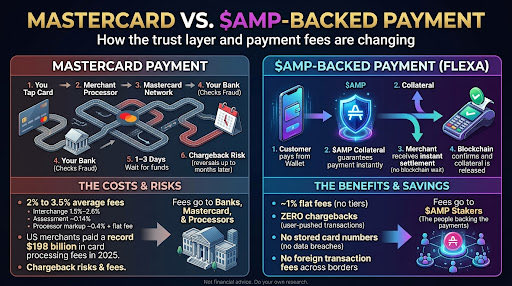
Let's compare how a Mastercard payment works to how an $AMP backed payment works.
When you tap a Mastercard at checkout:
1The terminal sends your card details to the merchant's processor.
2The processor sends it through the Mastercard network to your bank.
3Your bank checks for fraud and approves or declines.
4The approval travels back the same way.
5The merchant waits 1 to 3 days to actually get the money.
6For months afterward, that sale can still be reversed with a chargeback.
What the merchant pays for that:
• Interchange to your bank, usually 1.5% to 2.6%, and over 3% on some cards • An assessment fee to Mastercard, around 0.14% • A markup to the processor, often 0.4% plus a flat fee per sale • All in, typically 2% to 3.5% of every sale • Chargebacks can cost more than the sale itself once fees are added
US merchants paid a record $198 billion in card processing fees in 2025.
Now the same purchase through Flexa:
1The customer pays from their wallet.
2$AMP collateral guarantees the payment the instant it's sent.
3The merchant is paid right away, without waiting for the blockchain to confirm.
4Once the network confirms, the collateral is released to back the next payment.
What changes for the merchant:
• Reported fees around 1%, with no interchange tiers • No chargebacks, because payments are pushed by the customer, not pulled from a card • No card numbers stored, so there's nothing to steal in a breach • No foreign transaction fees across borders
The biggest difference is who gets paid.
With Mastercard, the fees go to banks, the network and processors.
With Flexa, the network fees are used to reward the people staking $AMP as collateral.
The people backing the payments earn from them.
That's the model. Mastercard built a business on being the trust layer between buyer and seller. $AMP is trying to be that trust layer, open to anyone who wants to back it.
Not financial advice. Do your own research.
Most people look at $AMP and see a payment coin. It isn't one, and that's the part they're missing.
Every digital payment has a gap. You tap your phone, and the merchant wants to be paid right now. But the blockchain still needs time to confirm the transaction. Someone has to guarantee the money during that window.
That's what $AMP does. It's collateral. It sits behind the payment and guarantees it until the transaction is final. If anything goes wrong, the collateral covers it. The merchant never waits and never takes the risk.
Here's why that matters going forward. $AMP doesn't care what you're paying with. It can be Bitcoin, Zcash or stablecoins, on any chain, in any country. Anywhere value moves and something has to be final before the network finishes confirming, there's a job for collateral.
Payment coins compete with each other. Collateral can sit behind every one of them.
That's the real thesis. Not that people will spend $AMP, but that $AMP could sit underneath much of what people spend.
Not financial advice. Do your own research.
Everyone is talking about $ZEC right now. Almost nobody is talking about what makes it spendable.
When you pay with Zcash at a store through Zashi, the payment settles instantly through Flexa. That speed comes from Flexa Capacity, and Capacity is collateralized by $AMP.
Flexa runs dedicated Zcash and Zashi pools on Capacity. More private payments moving through that rail means more need for $AMP collateral sitting behind it.
Privacy is back in the conversation. The rails that make private money usable in the real world are worth paying attention to.
Not financial advice. Do your own research.
@FlexaHQ
It's October 8th and the timeline is already calling it Downtober.
Eight days in.
Same crowd that was screaming Uptober on the 1st flipped the second their bags went red. No conviction, no patience, just whatever gets the most engagement that afternoon.
Crypto influencers are the worst scum in the world. They pump you on the way up, dump on you on the way down, and act like they called both.
The month isn't even a third over. Zoom out, tune them out, and let Uptober play out.