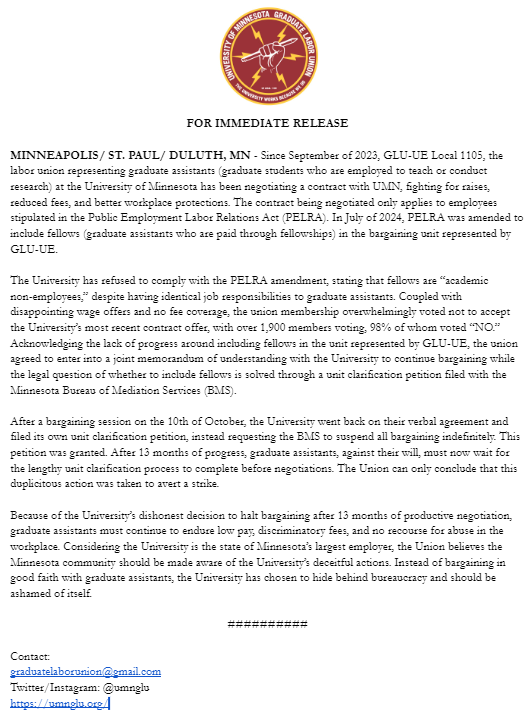
In response to the University of Minnesota's decision to stop bargaining with GLU-UE Local 1105, we need YOUR help to put pressure upon the university to return to the bargaining table.
Templates for phone calls and email templates can be found at https://t.co/JRToy73hfU
MINNEAPOLIS/ ST. PAUL/ DULUTH, MN - Since September of 2023, GLU-UE Local 1105, the labor union representing graduate assistants (graduate students who are employed to teach or conduct research) at the University of Minnesota has been negotiating a contract with UMN, fighting 1/X
Make sure you all submit your reports to Aurorasaurus if you saw the aurora this week! Retroactive reports will help create a database of auroral visibility to track how this storm evolved. Also, your privacy will be protected! Report away!
Here's a summary of recent events and how to catch (potential) auroras from these latest CMEs.
What happened?
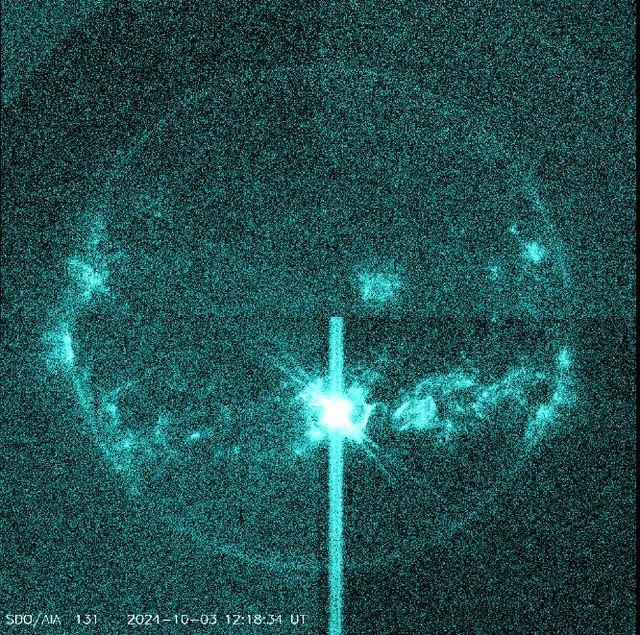
We had a couple strong solar flares on the Sun (X7.1 and X9). Along with the flares, the Sun sneezed out a bunch of charged particles, and they're headed our way. It's easy to say "Earth-directed" when the flare is pointed right at us, but with sophisticated models, the situation becomes more complex. For example, even though the X7.1 flare was strong, the CME was pretty slow-moving... still forecasted to give a glancing blow to Earth, though! There are space weather forecasting offices that take in all the data we have and make predictions about what will happen. The official forecasting office in the United States is @NWSSWPC. They will take in the CME models and all the data and give an impact time and estimated geomagnetic storm intensity measured on the G-scale. The G-scale translates to Kp values (i.e., G1=Kp 5 and G5=Kp 9). These storm forecasts are more for their customers (e.g., power grids, telecomms, satellite ops) and not for aurora chasers, but obviously it's more exciting to see a G3 prediction than a G1 or no storm forecasted at all. Take these forecasts with a grain of salt when it comes to predicting the aurora. Kp and auroral strength are not correlated well, so the view line maps you see won't be accurate. It's not like a total solar eclipse totality path, don't worry if you're not in the shaded area, you likely still have a chance of seeing something this weekend.
What now?
Well, we have these massive clouds of charged particles traveling through space many times faster than a speeding bullet, but we can only guess about where they will go and how fast and strong their magnetic fields are. We won't know for sure what kind of aurora we may expect from these eruptions until the clouds actually hit satellites that are located near Earth. We have a couple CMEs expected to hit now, so keep your eyes on solar wind data. If you don't know how to look for CME impacts, there are a couple things you can do.
1. Read my free e-book (https://t.co/5WZqpPjDcD) and blog articles (https://t.co/oqhs9Mw45R) that will lend some insights into how to look at solar wind and analyze the data for yourself.
2. Subscribe to SMS alerts from Space Weather Live and NOAA SWPC that will tell you when CME impacts have been detected.
3. Follow the right people on social media who know what they're talking about, preferrably those who are in operations or have degrees in space physics.
When the CME hits?
When the CME hits, check aurora webcams, social media, and Aurorasaurus.
Aurora webcams: https://t.co/6p6lf2217i
Aurorasaurus: https://t.co/QxEz9WcDug
Real-time auroral visibility will not abide by the Kp. The aurora fluctuates on timescales on the order of minutes. You may be able to see the aurora suddenly from low latitudes then nothing thirty minutes later, these are typically from auroral substorms. Auroral substorms are not detected by Kp or the OVATION model, meaning your app will not tell you when they happen (unless you are using an app that is magnetometer-based like Glendale).
You can also monitor auroral substorms using the GOES magnetometer (most useful for North American chasers; https://t.co/iUmaFk7PN8).
You want to watch out for auroral substorms when the CME hits. These substorms create the most fantastic displays of aurora you will ever see and can push visibility to low latitudes as the tops of the aurora become illuminated with reds which are visible over the curvature of the Earth from long distances.
For more information on aurora chasing, check out my FREE e-book (available with this link: https://t.co/5WZqpPjDcD)
I will add more to this post--just jumping into the Zoom room for my Space Physics class now, but I want to get this out early.
I've been staring at this for five hours now. Allie's piece for my article "Draco Ex Astris" in the upcoming Issue 1 of Horizons is absolutely out of this world! Wow :o
Hey folks you should check out this kickstarter I'm doing some design work for with my friend
@water___enjoyer, we're making some pretty cool monsters! https://t.co/xOw2ynvSf4