Fresh off the press! First publication has a medicine resident! It took a lot of hard-work, commitment, and passion. It’s just the beginning. #Cardiotwitter#Research#Casereports#WIC https://t.co/mdJtIhR1GN
🚨 A CAC score of zero told 205 patients their arteries were clean. Nearly five years later, their plaque volume had almost doubled and the most dangerous, rupture-prone type tripled in prevalence.
A zero score is not a clean bill of health.
It is a snapshot of a fire that has not been detected yet.
"But the data says otherwise."
I am a cardiologist. I have patients walk into my office holding a CAC score of zero like it is a permission slip to stop caring about their arteries. NATURE-CT proves that permission slip is fiction.
🩺 Here is what the study actually did.
205 adults. Average age 55. Average LDL 111 mg/dL. No prior cardiac events. No diabetes. No lipid-lowering medication. No familial hypercholesterolemia. Researchers used AI-assisted quantitative CT to track plaque over a median of almost five years.
54% of these people started with a CAC score of zero.
💓 Here is what happened to their arteries while they felt fine.
✅ NATURE-CT: Total plaque volume grew from 30.3 mm3 to 59.2 mm3. That is nearly double, an annualized increase of 6.7 mm3 per year.
✅ NATURE-CT: Non-calcified plaque, the soft unstable kind, rose from 27.5 mm3 to 53.5 mm3. This is the plaque type most linked to future heart attacks.
✅ NATURE-CT: Low attenuation plaque, the lipid-rich subtype most likely to rupture, jumped from 9% prevalence to 23%.
✅ NATURE-CT: 3% of participants met criteria for rapid plaque progression. 11% more hit an intermediate progression threshold.
✅ SCOT-HEART already showed us that low attenuation plaque burden predicts future myocardial infarction. NATURE-CT shows that burden is building in people the current system calls low risk.
🔬 Why this matters.
CAC only detects calcium. Non-calcified plaque does not show up on that score. A patient can have a zero and still be growing the exact plaque subtype most associated with heart attacks. That is not a flaw in the patient. That is a blind spot in the test.
⚠️ The real problem is not the plaque. It is the framework.
🔸 Waiting for symptoms before taking atherosclerosis seriously is the wrong strategy.
🔸 An LDL of 111 mg/dL sitting untreated for five years is not a neutral number. It is fuel.
🔸 Standard risk calculators did not flag this cohort. The disease grew anyway.
I will say this plainly. This study was retrospective, the cohort was 72% white men from clinically indicated scans, and there was no outcome adjudication linking plaque growth directly to heart attacks. I am not telling every patient they need a CCTA or a statin tomorrow. I am telling you a single number at one point in time is not the finish line.
❤️ Bottom line:
A zero CAC score is reassuring. It is not proof your arteries are safe.
This is 205 patients, tracked for close to five years, with AI-quantified imaging. That is real data, not speculation.
Ask about ApoB. Ask about Lp(a). Ask whether imaging beyond a single CAC number makes sense for you.
The question is no longer whether you have a zero. The question is what is growing underneath it.
If your last cardiac workup stopped at a CAC score, what do you think it missed?
#Cardiology #HeartDisease #HeartHealth #CardiovascularHealth #ApoB #Lpa #CACScore #Atherosclerosis #PreventiveCardiology #LifestyleMedicine
☝️Atherosclerosis starts earlier than we think
👉New data from the REACT study, published in NEJM, provide a striking picture of silent atherosclerosis across adult life:
1️⃣ 16,808 adults, aged 18–70 years, without known ASCVD.
2️⃣ Multimodal imaging included 3D carotid and femoral ultrasound plus coronary CT angiography.
3️⃣ Silent atherosclerosis was present in 57.1% of participants.
4️⃣ Even at 18–29 years, plaque was already present in 8.7% of men and 6.7% of women.
5️⃣ By age 30–39, prevalence reached 34.6% in men and 21.3% in women.
6️⃣Atherosclerosis appeared 5–10 years earlier in men, while women showed a later but steeper rise in midlife.
7️⃣ In younger adults, disease was usually peripheral and single-territory, especially carotid; with age, plaque burden increased exponentially and disease became increasingly multiterritorial.
8️⃣ ☝️Importantly, CAC = 0 did not exclude coronary plaque: among 30–39-year-olds with coronary atherosclerosis, ~42% of men and ~48% of women had zero coronary calcium
9️⃣ SCORE2 showed major discordance with actual disease burden: high SCORE2 had only 1.9% sensitivity for silent atherosclerosis.
☝️Key message: low short-term cardiovascular risk does not mean absence of atherosclerosis.
👉Risk scores estimate events. Imaging detects disease. REACT reminds us that prevention should begin long before cardiovascular risk becomes “high.”
🔗 https://t.co/SXmyy57V2h
@society_eas
I think if I hear another cardiologist or physician endorse #redyeastrice I will scream. We should be using our evidence based guidelines when caring for patients. We have more than statins in 2025
We need to be the voice of reason & not selling/endorsing unproven supplements
I just spoke at length to @EPotterMD and I have asked her for all of the supporting documents, emails, call records, etc which she has agreed to provide. I found her and her story totally credible. @UHC has publically called her a liar, and UHC’s general counsel has told my CLO that Dr. Potter is not telling the truth.
We have asked UHC to explain with particularity what Dr. Potter has said and/or written that is false. They have yet to respond to this request.
I took down my original post on this matter because UHC’s outside counsel told my CLO that I was wrong and that Dr. Potter was not telling the truth.
Based on what I have heard so far, I believe that Dr. Potter is telling the truth and that UHC appears to have denied coverage for a necessary post-surgical overnight stay and interfered with a surgeon mid-operation without good reason. They have also threatened the doctor with defamation and significant financial liabilities. And they have complained to the @SECGov about me.
I await UHC’s side of the story and supporting facts before I can conclusively form a view on what has happened here.
In the meantime, I have told Dr. Potter that I will cover her legal expenses to defend her from UHC’s claims, and to make sure that she has proper representation so that this is a fair fight.
Stay tuned. This should be interesting. And there is a possibility that good will come from this. Healthcare and our insurance system is in trouble and needs a reboot.
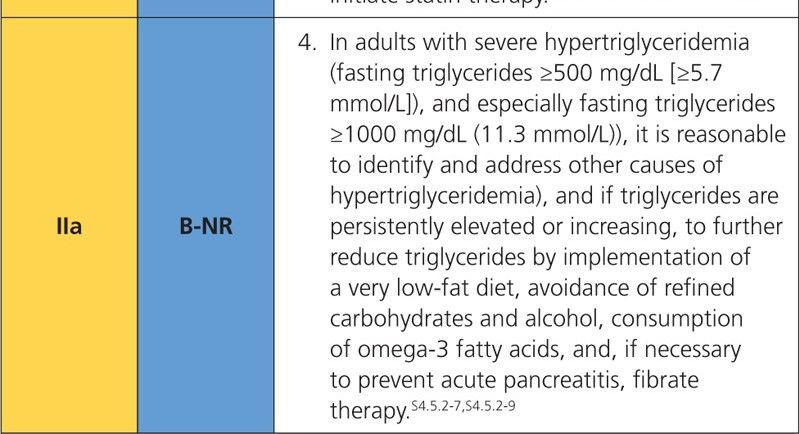
In patients with severe hypertriglyceridemia, consider (Class IIa):
🩸Very low-fat diet
🩸Avoiding refined carbohydrates & alcohol
🩸Taking Omega-3 fatty acid Supplements
🩸Fibrates (if needed to reduce risk of acute pancreatitis)
Ref: click ALT on image
#CVBoardPearl#MedX
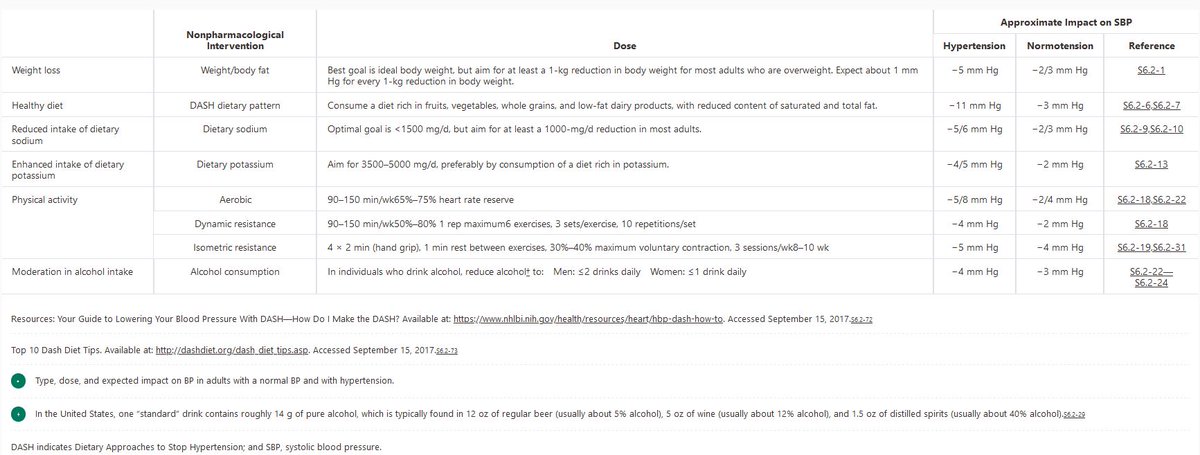
What Non-Pharm Interventions Have the Most BP Lowering in Patients with HTN?
1: Healthy Diet (-11 mmHg)
2: Weight Loss & Isometric Resistance (Physical Activity) (- 5 mmHg)
3. Dynamic Resistance (Physical Activity) & Moderation of ETOH Consumption (-4 mmHg)
#CVBoardPearl#MedX
CABG+GDMT can improve all-cause and cardiovascular mortality in patients with left main/LM equivalent disease AND HFrEF (when compared to GDMT alone). Benefits are greatest in those with 3V disease or lower EF but diminishes with older age (Class I, LOE B-R).
#CVBoardPearl#MedX
What are consequences of cardiac dyssynchrony from LBBB?
🫀When walls contract at different rates, the most myocardial work is done by the latest-activated wall, leading to myocyte overstretch, ⬆️ energy consumption, sarcomere disruption, and ⬇️ myocyte survival.
#CVBoardPearl
Q. Is statin use associated w/ a lower risk of mortality & MACE in patients who have #HFpEF?
A. Among Veterans w/ HFpEF & no known #ASCVD, new statin use was associated w/ reduced all-cause mortality, MACE, & hospitalization.
Read more: https://t.co/2rWOHWz7ch #JACCAdvances
Abbott/Thoratec Corp. is recalling the Heartmate II and Heartmate 3 Left Ventricular Assist System due to long-term buildup of biological material causing an obstruction. Learn more ➡️ https://t.co/iagyOh9YYK #ACCAdvocacy#FDAUpdate
🔑 Colchicine 0.5 mg daily is FDA-approved for secondary prevention in patients w/ coronary artery disease.
Read key points to remember from a state-of-the-art review on the long-term safety of low-dose colchicine for atherosclerosis: https://t.co/dklamPVGii #cvPrev
The PREVENT trial showed that preventive #PCI of focal non-FFR-positive plaques that are angiographically >50% & have evidence of vulnerability on intravascular imaging along w/ OMT is superior to OMT for clinical outcomes at 2 years.
Read more: https://t.co/vmsq7FRdYH
#ACC24
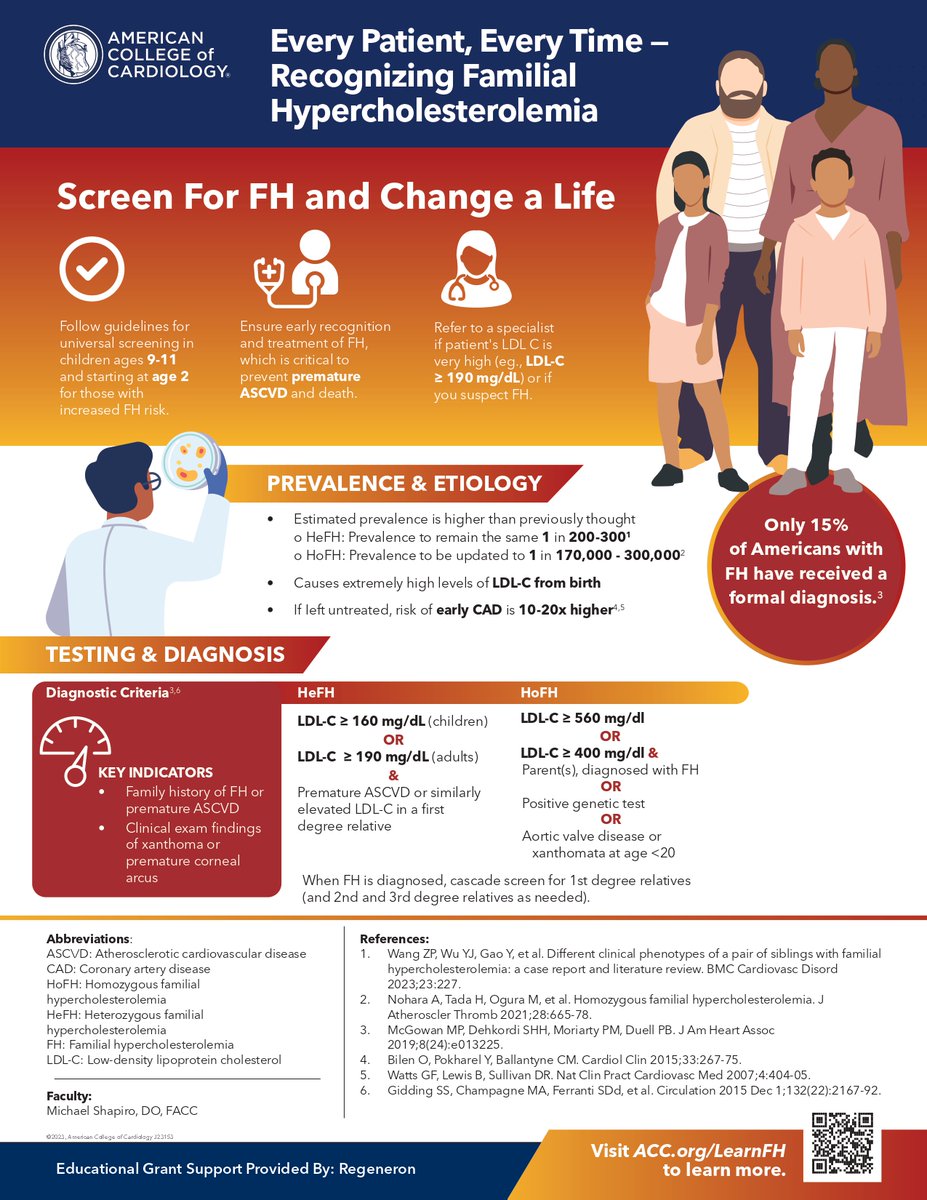
Learn more about screening for FH with the Recognizing #FamilialHypercholesterolemia infographic 👇. Plus, listen to podcast episodes discussing the epidemiology, genetics & pathophysiology of FH, & how FH is detected & treated. ➡️ https://t.co/cKgZKFtlhd
#ACCEd#KnowFH
#LpaAwarenessDay Join us in 10 minutes @TheFHFoundation for the tweet-a-thon to increase awareness of #Lpa
🚨This is very common!
🚨1 in 5 persons have ⤴️ Lp(a)
🚨Get your Lp(a) checked ✅
Gross negligence not to check Lp(a) in yourself, in your loved ones and of course in all patients. At present time it is pretty much a once per lifetime test
First line therapy for hypertension?
1️⃣ Calcium channel blockers
2️⃣ Thiazide diuretics
3️⃣ ACEi/ARBs
Beta blockers, once used by many as first line, were shown to be inferior.
These first line therapies were deemed in large part by this landmark trial. ASCOT Trial, Lancet 2005 ♥️
The MINT trial showed in patients w/ acute MI & anemia (Hgb <10 g/dL), a liberal transfusion goal (Hgb ≥10 g/dL) was not superior to a restrictive strategy w/ respect to 30-day all-cause death and recurrent MI.
Read an expert analysis for more: https://t.co/7W1GViiFYh #cvACS