$FLETCH is now live on @RobinhoodApp Chain.
Fletch provides a machine-native financial service layer where autonomous agents can discover specialized services, pay through x402 and execute them within a single programmable workflow.
CA: 0x12026ec282bbab31d94a201a0c577e97f7635591
The goal is not only market access, but accountable economic agency through structured discovery, bounded permissions, granular settlement and verifiable execution.
The Fletch docs are already live.
The docs explain how agents discover services, evaluate machine-readable capabilities, authorize x402 payments and execute on @RobinhoodApp mainnet.
Docs: https://t.co/U8A7X56L9M
Read ahead and the next tutorial will connect every layer into one autonomous execution flow.
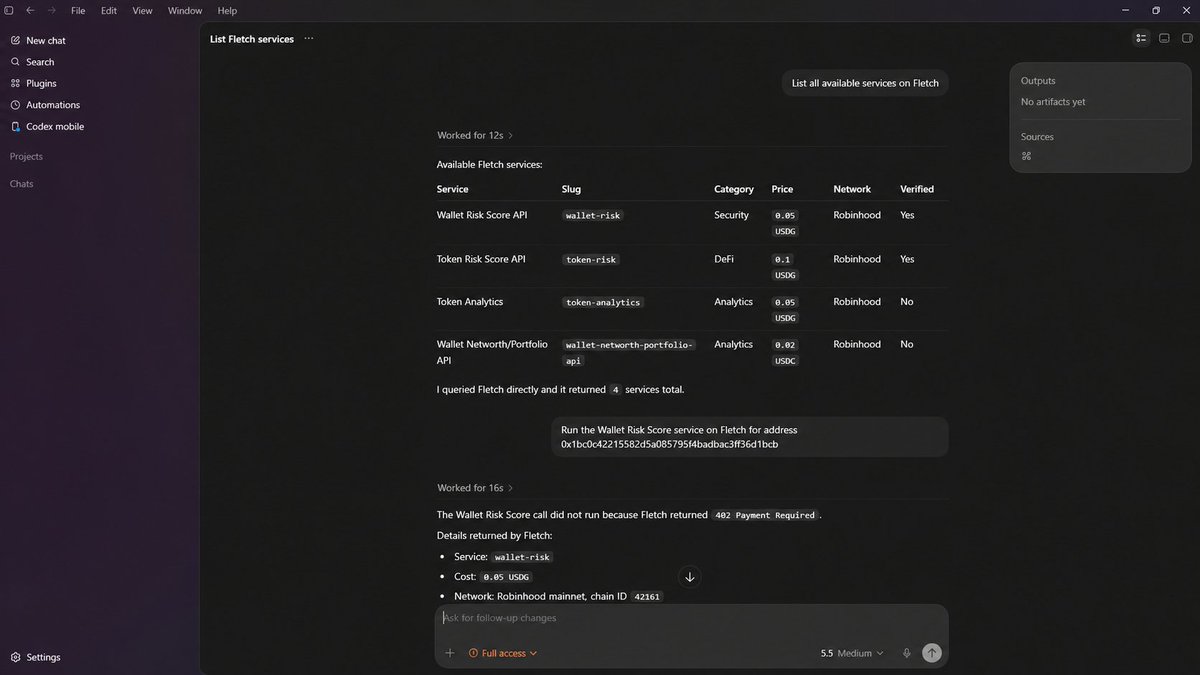
This is where it gets interesting, @OpenAI Codex is now interacting with $FLETCH services on Robinhood mainnet.
Discover service → Receive 402 → Settle in USDG → Execute → Return a verifiable result, all inside one autonomous workflow.
We’ll release the complete end-to-end flow on Codex, Claude and more integration. Builders should watch this closely.
Finance 1.0 digitized institutions.
Fintech digitized interfaces.
Finance 2.0 made assets programmable.
Finance 3.0 makes the operator programmable.
AI agents will not merely analyze markets. They will acquire data, evaluate risk, authorize payments, select counterparties, and execute financial services autonomously.
With @RobinhoodApp building toward programmable, agent-native finance, the missing layer is the service economy surrounding those agents.
That is where $FLETCH fits: discovery, payment, execution and verifiable outcomes for machine-native financial services.
Machine-native finance cannot scale through anonymous endpoints and opaque execution.
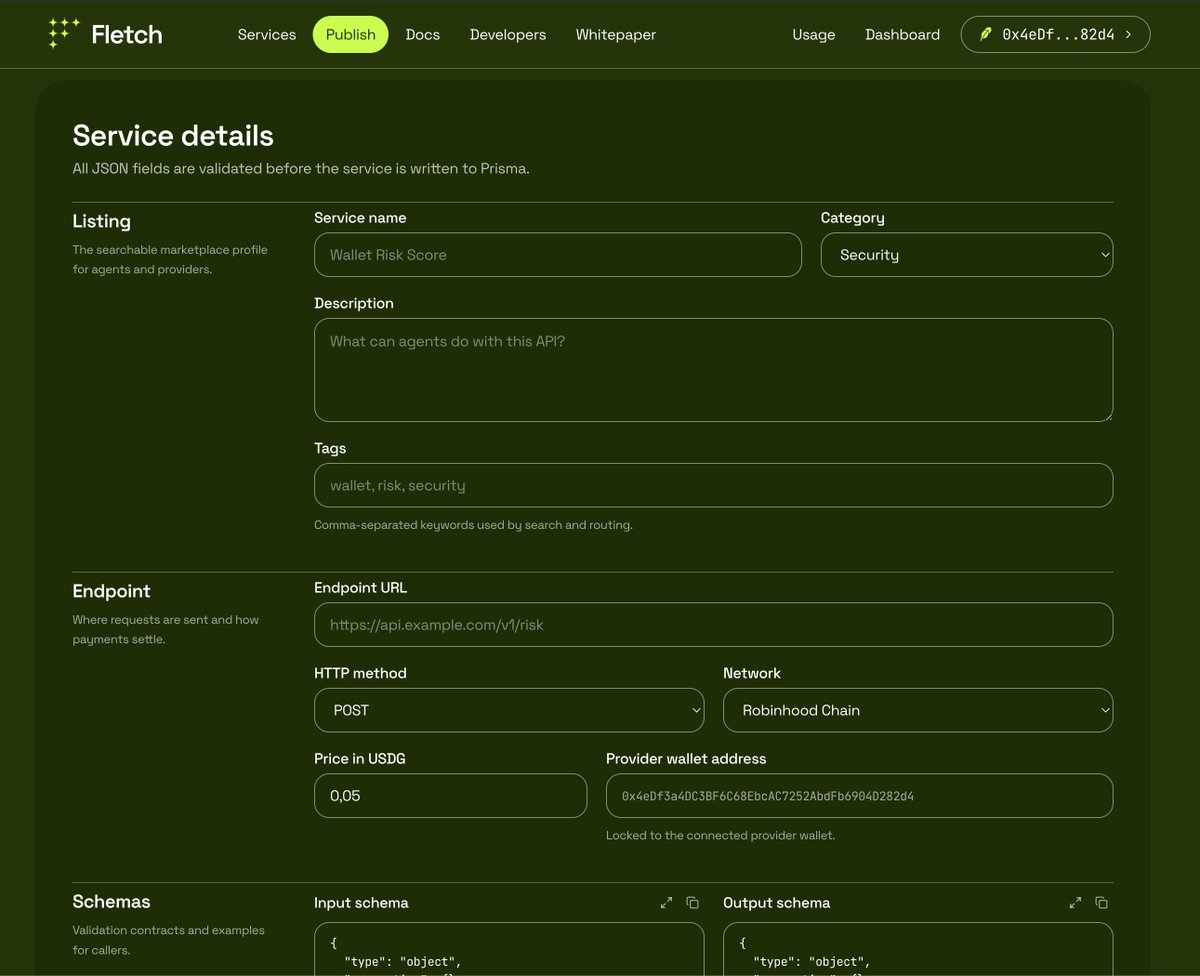
$FLETCH now gives providers a structured operating layer for identity, service publication, wallet settlement, and measurable performance.
Every call, latency profile, success rate and revenue stream can be observed from one dashboard.
Publish now: https://t.co/dxa8Qehe0z
Infrastructure for accountable autonomous demand.
Connect & Accessing $FLETCH takes less than a minute:
1. Select Connect Wallet
2. Authenticate using email or an existing wallet
3. Confirm the session to access services, usage data, and the provider dashboard
The authentication flow is powered by @privy_io, separating account access from service execution and preserving explicit wallet authorization before any onchain action.
This creates a cleaner interface for both human users and autonomous agents: authenticated access, programmable permissions and verifiable execution through one unified workflow.
The first version of the machine-native service market is now running with:
• 5 published services
• 5 verified services
• x402-ready payment flows
• agent-readable schemas
• reliability-aware discovery
This is the first step toward a service layer where autonomous agents can discover, evaluate, and execute financial capabilities through a programmable workflow.
Early services already cover:
wallet risk scoring, wallet portfolio analysis, and token market snapshots.
Marketplace: https://t.co/gQLQ6lNvWq
Research is becoming infrastructure.
We’ve converged on an initial architecture for Fletch, at a high level, the system models the full lifecycle of a machine-native financial transaction:
AI Agent / App
→ Intent + Discovery
→ Capability Evaluation
→ Policy Checks
→ x402 Payment Authorization
→ Service Execution
→ Result + Receipt
Underneath that flow, three infrastructure layers matter:
→ Service Registry for discoverable APIs, MCP tools, data, risk, and execution services
→ Smart Account Controls for ERC-4337-based permissions and bounded spending
→Robinhood Chain for settlement, receipts, and onchain state
Beneath all of it sits the ERC-8004 trust layer:
→ identity
→ reputation
→ validation
Whitepaper: https://t.co/MbljYlbX2o
The goal is not simply to let agents call financial services. It is to make those interactions discoverable, payable, constrained, verifiable, and trust-aware by design.
Our research began with a simple question:
What infrastructure will autonomous agents need once they begin committing capital?
The answer became the architecture behind Fletch.
Discovery, payments, permissions, execution, and verifiable receipts, designed as one machine-native service layer.
Autonomous agents are moving from generating recommendations to committing capital.
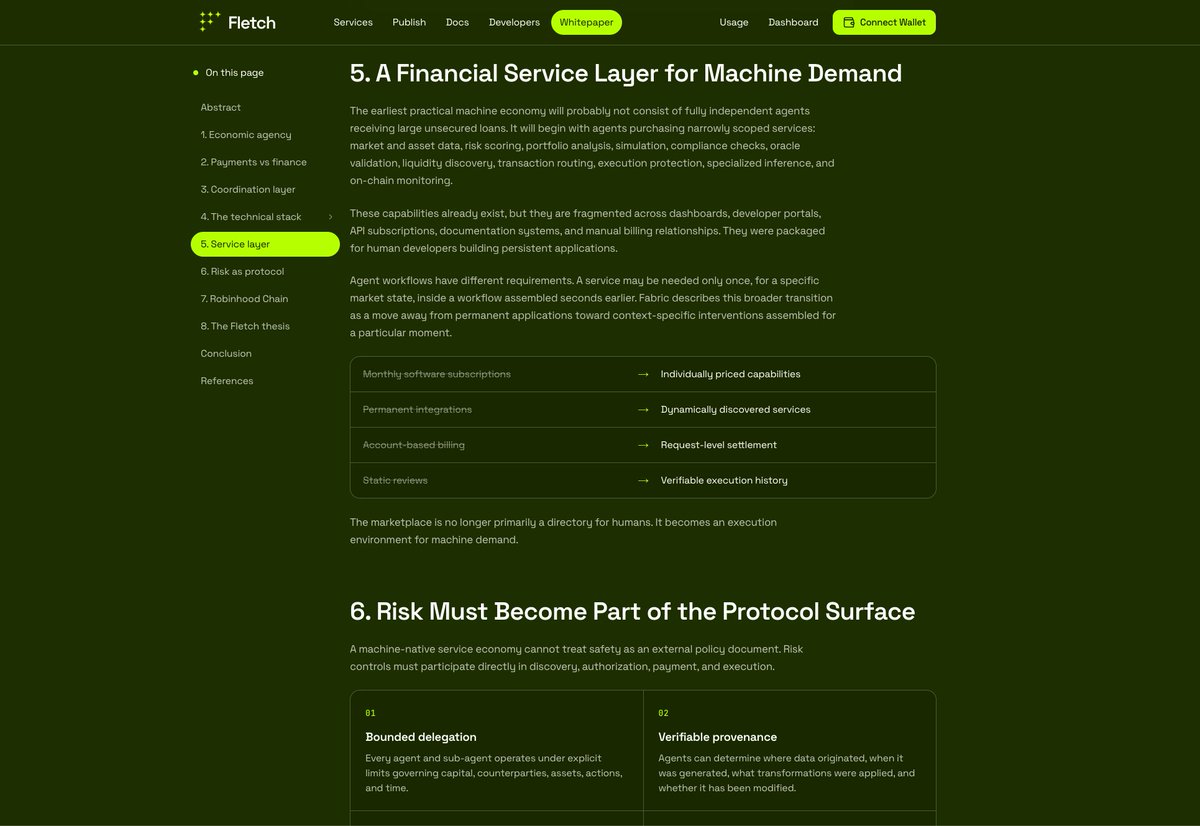
Our first research note explores the missing financial service layer behind that shift: identity, permissions, settlement, reputation, risk, and accountable execution. https://t.co/ivC5Kchs2f
The agentic economy will not be built by intelligence alone.
@UniofOxford’s financing thesis and Fabric’s machine-economy thesis point to the same conclusion: economic agency requires access to resources, counterparties, permissions, settlement, identity, reputation, and trust.
https://t.co/KxPX9bbGJN
https://t.co/EUu1xDbCKj
As autonomous systems move from generating recommendations to committing capital and coordinating services, the infrastructure surrounding them becomes as important as the models themselves.
The real question is no longer whether agents will transact, but whether the systems enabling those transactions will be transparent, bounded, and accountable, or opaque and difficult to govern once they reach economic scale.
The foundations are being designed now. In our upcoming research article, we’ll explore the thesis behind Fletch in depth.
We’ve spent the past month researching Robinhood Chain, x402, MCP and other stuff that emerging agentic finance stack.
Our conclusion is simple: the next generation of financial agents will need more than trading access.
They’ll need data, risk intelligence, APIs, and execution services they can discover and pay for autonomously.
We’re building that layer with Fletch.