@NormWimberg@MrWhiplash_ A lot of sugar and grains were eaten before the first recorded heart attack in the US.
Heart disease did not show up until seed oils came along.
The prefamine poor Irish ate up to 14 lbs.+ of potatoes with skim milk/buttermilk per day.
Contemporary writers wrote that they were robust, athletic, and healthy. Able to do work which would exhaust all others.
Low fat did not harm them nor did high amounts carbohydrates.
High PUFA consumption blocks the ability to properly use carbohydrates along with many other negative things.
The lower-fat craze demonized saturated fat and praised PUFA consumption as healthy.
Restaurants in the 1950s, 1960s, and 1970s had a big bottle of sugar next to the salt and pepper on every table.
Back then things were fried with butter, French fried were deep fried in tallow, and movie theater popcorn and commercial snacks used coconut oil.
If our beaches could look like they did in the 1950s, 1960s, and 1970s, it would be considered the greatest health miracle of all time.
Go after the PUFAs/seed oils, sugar is not the problem.
Restaurants used to have a big bottle of sugar next to the salt and pepper on every table back in the 1950s, 1960s, and 1970s.
Back then things were fried in butter, French fries were deep fried in tallow, and movie theater popcorn and commercial snacks used coconut oil.
If our beaches could look like they did in the 1950s, 1960s, and 1970s, it would be considered the greatest health miracle of all time.
Refiners refine gasoline so as to have enough vapor pressure to start an engine.
RVP is the measure of VOCs' (volatile organic compounds) vapor pressure in psi at 100 degrees F only.
So refiners, even before ethanol was around, would refine gasoline in wintertime with higher RVP to aid winter starting.
In summertime they would refine it with lower RVP since the summer temperatures did not need the high RVP for starting and would even be detrimental in causing vapor lock which used to be very common before fuel injection came along.
The other reason RVP was made lower in summer was because E0 gasoline's VOCs are toxic and highly ozone forming which contribute to our air pollution and smog.
After the disastrous octane booster lead was finally outlawed, the petroleum industry gave us MTBE which was not only an octane booster but also an oxygenate to reduce gasoline's toxic exhaust pollution.
During this same time ethanol was modestly sold in the Midwest, proving itself an effective and economical octane booster and oxygenate.
When it became apparent that MTBE was another disaster, ethanol was chosen to replace it.
The petroleum industry went along with the legislation because hidden in the bill was legal immunity from their MTBE. That was revealed and taken out but the bill still passed.
This is why we have ethanol at today's levels.
Ethanol synergizes with gasoline at lower levels to produce more octane than each of their respective octane levels. It also synergizes to produce more RVP at lower levels despite ethanol itself being very low with RVP.
The RVP law is obsolete in that it was written before and has no consideration for ethanol's properties.
The VOC vapor pressures given off by ethanol are not toxic and produce less ozone/smog than the toxic and highly ozone forming VOC vapors gasoline gives off.
So rather than updating the old RVP law, lawmakers simply granted E10 a 1 psi RVP waiver to the law.
The reason for this is E10 produces less ozone/smog at 10 psi RVP than E0 does at 9 psi.
E10 at 10 psi RVP ≤ E0 at 9 psi RVP with ozone formation.
E85 has such low RVP that it never needed a waiver. In fact, the only reason we have 15% gasoline in it is to have more RVP for starting.
In Brazil where E100 is sold, they use heated injectors in flex fuel vehicles for starting somewhat similar to glow plugs diesel engines use for starting.
RVP is not much of an issue as it used to be because of pressurized fuel caps and the advent of carbon filters on fuel systems.
Ethanol increases RVP only at low blends in non-linear fashion from 2% to around 40% with the peak around E7 or 7%.
The waiver E10 had received did not account for higher blends which would come along.
So we ended up with this illogical scenario:
E10 = 1 psi rise in RVP = legal in summer
E15 < 1 psi rise in RVP = illegal in summer, go figure.
If smog is your concern, you should use E15 over E10 which has less smog than E0 with RVP.
If cost per mile is your concern, then you should go with E15 as well. E15 gets 1% less fuel economy than E10 but E15 costs 10% less for a net savings of 9% to drive with E15.
Of course, exhaust pollution reductions with ethanol blows everything completely out of the water.
Denver in 1988 was the first government entity to require E10 when they were on the EPA list of ozone non-attainment zones. Soon with ethanol they were off that list.
Even with just 10% ethanol added to E0, the Swiss Federal Laboratory for Materials Science and Technology found that the health devastating ultra fine or nano particulate emissions were lowered by 97%, carbon monoxide lowered by 81%, carbon dioxide lowered by 13%, aromatic hydrocarbon emissions lowered by 67-96%, and genotoxic emissions lowered by 72%. https://t.co/wPS7h14Dbm
Henry Ford's very favorite fuel was ethanol.
He designed his quadcycle for it along with his Model T. Production models were flex fuel.
Henry Ford also designed his Fordson tractor for ethanol. His dream was for farmers to grow their own fuel. He researched using a Model T to provide electricity and hot water for farmsteads too.
Henry famously said there is enough energy in an acre of potatoes to farm that acre for 100 years.
John D. Rockefeller's funded Prohibition took away ethanol fuel to Henry's chagrin.
There is no cleaner nor more efficient fuel for an internal combustion engine than ethanol when optimized to take advantage of its superior burn characteristics.
Here is an excerpt about the ethanol optimized engine Ricardo built and drove around for GM. Better fuel economy than even diesel engines.
FROM RICARDO: The new federal CAFE standards are calling for a doubling of fuel mileage performance, which, Vint says, is going to send OEM’s looking for high octane numbers to improve efficiency and ethanol is the best source. Ricardo, an engineering firm with over 100 years in the business of engine design, has developed an extreme boosted direct injection engine (EBDI) to optimize ethanol blends. The 3.2 V6 gasoline engine rivals the power and torque of a much larger GMC Sierra 6.6 diesel, he said, and it delivers 3.5 percent better fuel economy than the diesel. https://t.co/p86HQhFhG5
Ford's first prototype EcoBoost engine was optimized for E85 and achieved 15 to 20% better fuel economy on E85 than with E0 with load performance similar to a diesel engine. https://t.co/whEWz7AyZi
We could and should refine natural gas, oil, and coal into pollution free non-toxic ethanol.
China, Indonesia, India, and others are using and/or looking at an efficient and economical process to do that from a Texas company named Celanese with their TCX Technology. https://t.co/hVKmPzEgmm
With enough ethanol we could have pollution free hyper efficient ethanol optimized engines with more power and more mpg than gasoline, even more mpg than diesel engines (at half the size/twice the power).
This is not new technology or knowledge; it was known long ago. It is suppressed technology.
Rear Admiral C.M. Chester wrote Henry Ford a letter on Dec.15, 1916:
"...I also pointed out in the article that as governmental laboratories had developed from 40 to 55% efficiency in alcohol engines as against 20% in gasoline machines, the use of alcohol at double the cost of gasoline for power purposes, was cheaper for motor[s] than gasoline in common use today."
Scientific journals from 1890 – 1920 contain hundreds of references to alcohol fuel at the dawn of the automotive era.
Studies of alcohol as an internal combustion engine fuel began in the U.S. with the EdisonElectric Testing Laboratory and Columbia University in 1906. Elihu Thomson reported that despite a smaller heat or B.T.U. value, “a gallon of alcohol will develop substantially the same power in an internal combustion engine as a gallon of gasoline. This is owing to the superior efficiency of operation…”
The USDA tests in 1906 also demonstrated the efficiency of alcohol in engines and described how gasoline engines could be modified for higher power with pure alcohol fuel or for equivalent fuel consumption, depending on the need.
The U.S.Geological Service and the U.S. Navy performed 2000 tests on alcohol and gasoline engines in 1907 - 1908 in Norfolk, Va. and St. Louis, Mo. They found that much higher engine compression ratios could be achieved with alcohol than with gasoline.
When the compression ratios were adjusted for each fuel, fuel economy was virtually equal despite the greater B.T.U. value of gasoline. “In regard to general cleanliness, such as absence of smoke and disagreeable odors, alcohol has many advantages over gasoline or kerosene as a fuel,” the report said. “The exhaust from an alcohol engine is never clouded with a black or grayish smoke.” USGS continued the comparative tests and later noted that alcohol was “a more ideal fuel than gasoline” with better efficiency despite the (*then*) high cost.
Little more history:
Contrary to what our Rockefeller funded school textbooks might say, kerosene did not take over from whale oil as the fuel used for lighting.
Whale oil quickly and steeply rose and fell with a peak in 1845 of just 17 million gallons. The number one fuel used for lighting in the 1800s was ethanol which was called burning fluid/camphene.
The first oil well was discovered in 1859 and by 1862 ethanol production for lighting was 100 million gallons.
But in 1862, a Civil War tax was passed on ethanol of >$2.00/gal. The tax placed on kerosene was $.10/gal.
Literally overnight, dirty kerosene became the number one fuel used for lighting.
(Note, it was not a free market that brought that about contrary to what our school textbooks might say. Ethanol detractors used to quibble about ethanol having a $.45/gallon subsidy which ended in 2011 with no knowledge of history along with the fact that the G7 Nations have been trying to end petroleum subsidies for many years which have done nothing but increase.)
That exorbitant tax remained on ethanol for 44 years until trust-busting Theadore Roosevelt came along with his "Free Alcohol" bill in 1906 just in time for Henry Ford's Model T which he designed for his favorite fuel ethanol.
Then John D. "competition is a sin" Rockefeller massively funded Prohibition with a Constitutional Amendment no less. Someone the likes of Teddy would not so easily get in his way.
Are you completely sure of that? See Nissan link:
https://t.co/Y44pVfBt2e
Corn ethanol is a value-added product of already existing feed production acres which preserves the feed in a healthier, more digestible, and more productive form called distillers grains.
No corn is grown for ethanol only, far too uneconomical to do so. But with the feed factor, few other courses of ethanol, if any, can compete with corn.
Believe it or not the corn belt grew more acres of corn in 1980 before ethanol than they do today with record ethanol production.
If we ended ethanol with another Rockefeller style of Prohibition we would still grow the same amount of corn we always have.
In fact, we grew the most corn acres ever in 1932 during Prohibition.
The ethanol subsidy (VEETC) ended in 2011 so that has been subsidy free since then.
There was a law in 2025 passed that ethanol can qualify for with the lion's share going to CO2 pipelines.
I am against the folly of taking this valuable resource and spending billions hauling it across the country in dangerous high-pressure pipelines only to bury it as garbage.
100% of the CO2 produced by the fermentation (& burning) of ethanol just came from the atmosphere and 100% of it needs to be back in the atmosphere to make the new gallon of ethanol.
The CO2 pipelines in reality are another petroleum subsidy since petroleum is the only reason we supposedly need to have them.
Since the 1996 Freedom to Farm act passed, farmers are free to plant any crop they choose without fear of losing a subsidy payment.
Since then, end users have had to bid for acres to be planted.
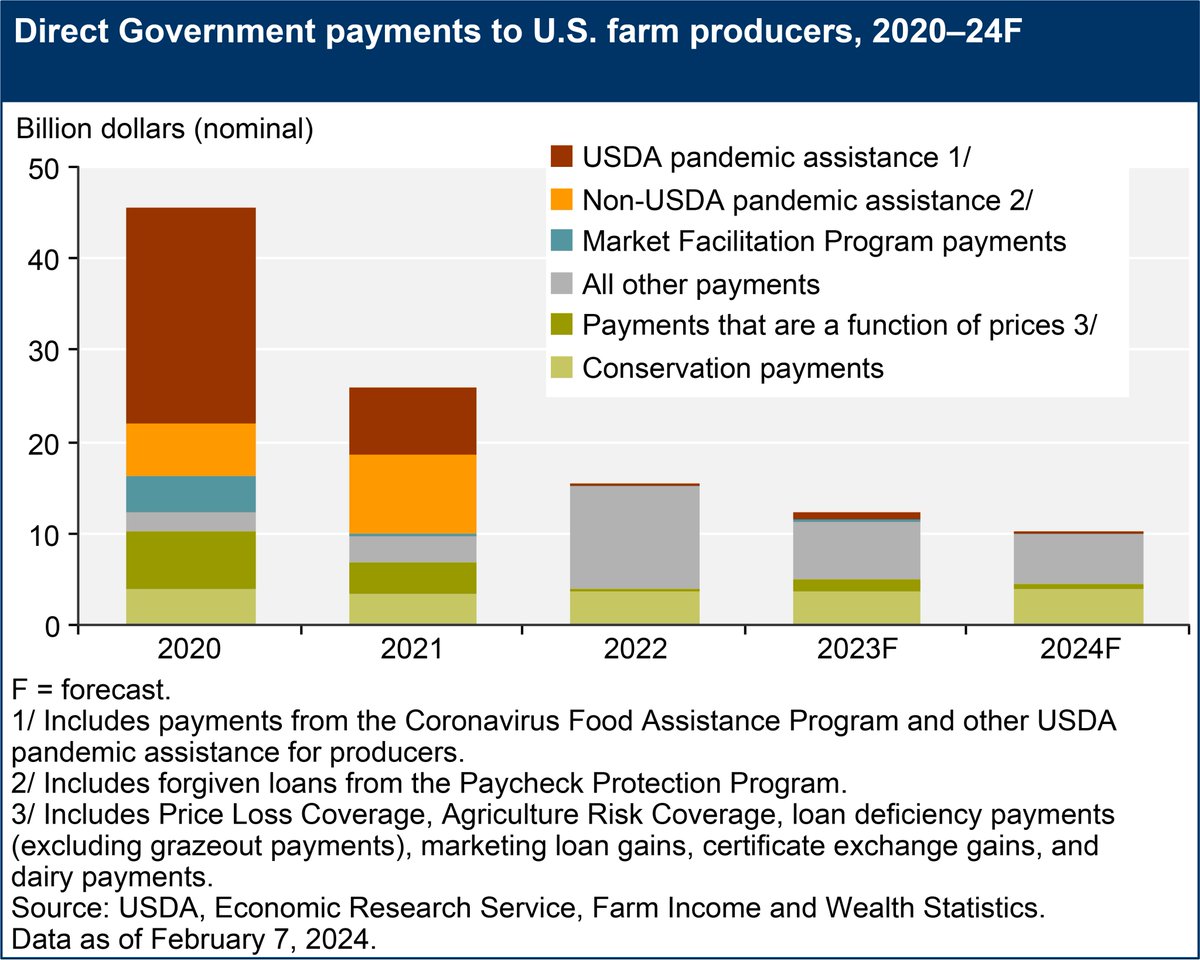
Farm program farmer paid subsidies went from around 25 billion dollars in 2005 to around 10 billion dollars in 2024, not counting inflation.
Not sure of any other government program which ever did this.
New Zealand is a prime example of removing farm subsidies that could be looked at.
Since the 1996 Freedom to Farm Act passed, farmers have been free to plant any crop they want without fear of losing a government payment.
Since then, end users have had to bid for acres to be planted.
North Dakota in 1980 was not very diverse in crop rotation, heavy with small grains and is more diverse today with corn, soybeans, pulse crops, canola, etc..
Disease pressure from head scab impacted North Dakota wheat and durum acres greatly around 1998 onward.
Barley feed falling from favor with cattle feeders along with the advent of high yielding early maturing corn varieties contributed to corn acres moving to shorter growing season areas like North Dakota.
US barley acres were 8.32 million acres in 1980 before ethanol and declined to 2.55 million acres in 2018, a long-standing record >16 billion gallon ethanol year.
Corn acres in 1980 were >84 million acres before ethanol and during forced government land set aside programs and were 88.9 million acres in 2018.
Combine the two and we get:
1980 = 92.32 million acres of the two feed crops
2018 = 91.45 million acres of the two feed crops
The US grew more acres of corn in the 1910s, 1920s, 1930s, and into the 1940s than today with 1932 (during Prohibition) the greatest at >113 million acres.
The corn belt grew more acres of corn in 1980 than they do today.
@michaelgermain@HackForumsNet@BowTiedYukon The Inuit did develop a unique mutation to handle high omega 3 diet from fattier fish for a reason.
Warm water fish have different fat profiles and a lot of cold water fish are low fat. I’m not Inuit so prefer those.
PUFAs are very unstable, not a fan.
Saturated and monosaturated fats are not essential.
Do you advocate eliminating them from the diet? If not, why not?
Carbohydrates are so essential that if one restricts them, the body will produce stress hormones to break down muscles/connective tissues/etc. to produce them.
Chronic exposure to stress hormones over time will lower/hurt thyroid which in turn will lower sex and other hormones and ultimately destroy metabolism.
Overexercising produces the very same stress hormones. This is why female athletes often have fertility issues.
A prefamine Irishman at 14 lbs. of potatoes a day with skim/buttermilk.
Contemporary writers said of them that they were (surprisingly) physically robust, athletic, and healthy. Able to do work which would exhaust all others.
Carbs are not the cause of our health problems.
Nobody was low carb, keto, carnivore, fasting, or buying gym memberships in the 1950s, 1960s, and 1970s, yet the majority of people were effortlessly thin.
Nobody ate PUFAs like we do today. PUFAs lower metabolism too, blocking the ability to make ATP and lots of protective CO2 out of carbs. We instead make lactic acid and less CO2.
Low carb does not fix this condition.
(side note, the prefamine Irish diet was about void of PUFAs, the so-called essential fats.)
In the 1950s, 1960s, and 1970s things were fried in butter, French fries were deep fried in tallow and movie theater popcorn and commercial snacks used coconut oil.
We ate more carbs in those years than today.
China has consumed huge amounts of rice forever but did not have their obesity and diabetes explosion until they had their seed oil/PUFA consumption explosion.
The explosion of seed oil/PUFA consumption is the novel food item that appeared just before our obesity and diabetes explosion.
If our beaches could look like they did in the 1950s, 1960s, and 1970s, it would be considered the greatest health miracle of all time.
@thalesnemo@markeatsmeat Contemporary writers said of those Irish that they were (surprisingly) physically robust, athletic, and healthy. Able to do work which would exhaust all others.
Keto long term will destroy your metabolism too.
Using stress hormones to produce the very necessary carbs/glucose for the body over time will lower/hurt thyroid which in turn will lower sex and other hormones, all ultimately destroying metabolism.
Overexercising produces the same stress hormones which is why female athletes often have fertility issues.
I too thought keto was great for many years.
One day when reading about metabolic viewpoint, I went out and bought a thermometer and was shocked to find my body temperature in the 96s.
When I reintroduced carbs, I soon had a full night's sleep which I had not had in years. On low carb I used to wake up at night then needing to urinate. often multiple times. Thought it was a prostrate problem at the time.
Getting my body temperature back to 98.6 degrees F took a long time but I did get there. Not out of the woods, OMD is a hard habit to break and my occupation produces stress hormones greatly.
A prefamine Irishman at 14 lbs. of potatoes a day with skim/buttermilk.
Contemporary writers said of them that they were (surprisingly) physically robust, athletic, and healthy. Able to do work which would exhaust all others.
Carbs are not the cause of our health problems.
Nobody was keto, carnivore, fasting, or buying gym memberships in the 1950s, 1960s, and 1970s, yet the majority of people were effortlessly thin.
Nobody ate PUFAs like we do today. PUFAs lower metabolism too, blocking the ability to make ATP and lots of protective CO2 out of carbs. We instead make lactic acid and less CO2.
Low carb does not fix this condition.
In the 1950s, 1960s, and 1970s things were fried in butter, French fries were deep fried in tallow and movie theater popcorn and commercial snacks used coconut oil.
If our beaches could look like they did back then, it would be considered the greatest health miracle of all time.
Linen shirts and pants can be very comfortable and look great. Problem is that they often just look like crap after one washing.
At least ethanol retains 100% of the proteins, fats, minerals, fiber, vitamins, all the fertilizer, and everything from the soil for food in the healthier, more digestible, and more productive triple concentrated feed called distillers grains.
Ethanol detractors often naively say ethanol takes away acres that could be for food yet likely wear and like cotton or linen which unlike ethanol actually do take acres away from food.
Take a look at a study done in India comparing alcoholics in the northern areas where ghee is used to the southern areas where seed oils are used.
Seed oils/PUFAs make it so we can't properly use carbohydrates. Instead of making ATP and lots of beneficial CO2, we instead make lactic acid and less CO2.
Funny how the obesity and diabetes explosion coincided with the explosion of seed oil consumption.
Take a look at beach pictures from the 1950s, 1960s, and 1970s compared to today.
Back then things were fried in butter, deep fried in tallow, and movie theater popcorn and commercial snacks used coconut oil.
If our beaches could look like they did in the 1950s, 1960s, and 1970s, it would be considered the greatest health miracle ever.
We could and should at least in the short run fully hydrogenate seed oils into healthier and stable saturated fats and steric acid.
Note only partial hydrogenation produces trans-fats, not full, many conflate the two.