I think a lot of folks rightly observe and articulate the problems of modernity—atomized communities, deteriorating metabolic health, ever-more industrial consolidation, etc—and assume they result from the natural progression of a humanity imperfectly directed by a central planning authority.
In their view, fixing them requires a better authority rather than no authority at all. Examples: Wendell Berry advocates for price controls in agriculture and different types of price supports, many New Urbanists seek new/different land use prescriptions and federal infrastructure subsidies, etc.
My sense is they advocate for these things with a kind of resignation: "It's just too that bad people, if left to their own devices, can't freely collaborate toward a better world. It's just too bad that people must have some sort of authority giving them direction."
But the more I pick at any failure of modernity, the more it seems to me that it is precisely the authorities' inevitable misdirection that caused the problem. In the case of land use and the changing patterns of human settlement (an area about which I know more than a little) it seems so inescapably obvious nowadays that even those who are politically inclined toward central planning reluctantly acknowledge it. And the more I learn about agriculture, the more I see the same pattern repeating itself there.
So, I don't quite get the pessimism. We don't need to try to solve the unsolvable problem of creating a better authority. If someone hangs on to that as the necessary path, I can see why they'd be pessimistic; history shows us that can't be done!
But we can begin cutting Gordian knots. Ending intervention. Ending interference. Ending micromanagement. Ending central planning. Etc etc. When enough people appreciate that the central planners caused the problems, we will end the central planning. And more people appreciate that now than a decade ago. And more appreciated that a decade ago than the decade prior.
So while I hear weariness and pessimism in the voices of some wise and battle-scarred critics of modernity, I'm optimistic: The path forward seems so obvious to me, and every year that passes, it seems to become increasingly obvious to more and more people. Before one can walk the way, one needs to know the way.
An excellent discussion with @GGunthorp on @DoomerOptimism about how our food system came to be what it is. So many parallels with our built environment. Sprawl didn’t “just happen”. Neither did industrial agriculture.
I just listened to a short thing about how many Americans (who can work remotely) are moving to cool little European towns these days. The journalist interviewed all sorts of expats and every one of them seemed to exasperatedly mention traffic, commuting, etc in some sort of way. Then the journalist gave his summary of the reasons people are moving (housing cost, health insurance, etc) and he never mentioned the cost and pain of auto-dependence.
Yes, healthcare and housing are real issues, but you know what else is a painful reality for more and more Americans today? Spending your life sitting in traffic.
@theistinthought@ggraham Ok, it's less just, blanket hate of cars, and more over reliance and being FORCED to use a car to do anything. I love walking, but the dollar general that is like a mile away from my home. EASILY walkable, is impossible to walk to because the area wasn't built to be walkable
It is dang near impossible to get a permit to build something in most downtowns, so there is almost no family friendly housing, and what little there is tends to be insanely expensive. It is comparably easy to get a permit to build things in the suburbs. Of course, there are additional reasons families tend to favor the suburbs, but the regulatory throttle on housing options is certainly a huge one.
@z3r0_burn@theistinthought I want them to have their avocado toast, on the condition that they pay the toast's full cost.
As it is, the further a good travels the more federal subsidy it receives, and that subsidy is covered with debt that's laid on future generations.
We’ll make big gains in healthspan, but I doubt we’ll make more than marginal gains in lifespan. And I think the former is a lot more important than the latter.
I don’t believe we’ll be able to meaningfully alter maximum human lifespan. That said, it is extremely rare to find someone working on it, that understands the evolutionary constraints—because the evolutionary picture is damming, and in the anti-aging buisness, optimism pays. So there is A LOT of lying to the public and to investors.
At least in this clip, @jacobkimmel is telling it like it is. Very refreshing.
A number of factors created the modern pressure to develop once-agricultural land that surrounds villages. It’s complex (it involves monetary policy, tax policy, infrastructure policy, and contemporary land use regulations) and a full explanation requires a lot longer than a tweet.
Suffice it to say, 1) the reason the land surrounding villages and small cities was mainly agricultural and wilderness in ye olden days and largely remained such for thousands of years is definitely not because it’s development had been tightly restricted and then those restrictions were lifted, and 2) the reason we suddenly switched from a human scale environment and began building everything for cars is not because the market demanded sprawl. There is a ton of central planning involved (financially and land-use-wise), plus some plain old terrible policies that changed incentives.
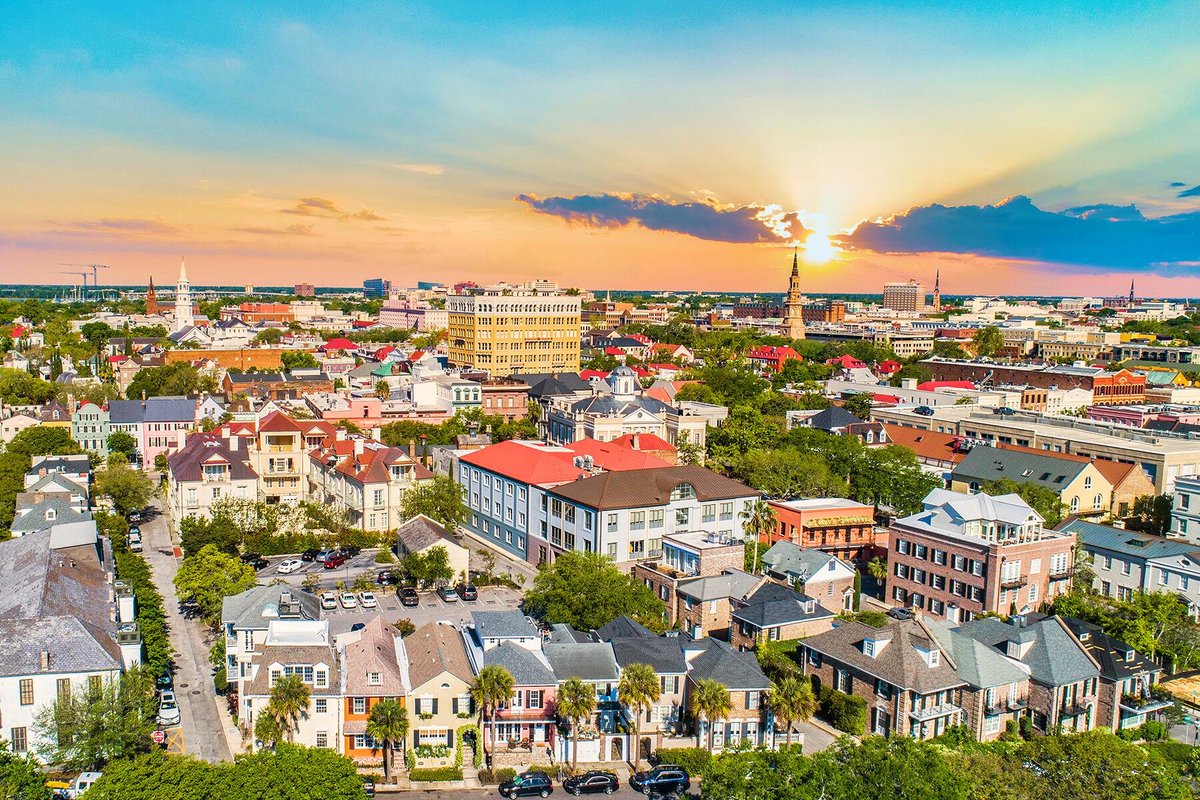
Of course. A huge portion of the current population of the US presently lives in places like the one in this picture. Which do you think is more land efficient?
The pictures I shared above are of the sorts of places that have been largely illegal to build in the United States for many decades, and this picture is what is generally prescribed by contemporary zoning, subsidized by infrastructure policy, and developers can generally build "by right".
@Medical_Nemesis He lost me during the covid insanity. I can't recall exactly when or why. I think maybe it was gender-related stuff. But I do think he is correct here.
A lot of people went crazy then. Some recovered quickly. Others were permanently broken. Sad.
Kevin Carson affectionately but firmly critiques the brilliant Ivan Illich. Illich advocated for limiting tools that, used beyond a certain scale, undermine community. Carson notes that it's not the tools themselves that cause the problem; it is the socialization of their negative externalities and the institutionalized concentration of their benefits that result in their metastization. Carson and Illich explore many examples (medicine, housing, transportation, schooling). HT @VincentGGraham https://t.co/cwXXO7Co3q
Here is Carson on Illich on cars:
In the case of car culture, the problems of sprawl and automobile dependency did not inevitably result from the automobile itself, but from the power interests that redesigned society around it. The problem was created by subsidies to monoculture development, freeways systems imposed by eminent domain, and legal prohibitions — like zoning — against mixed-use development.
Before the rise of car culture and car-centered urban design, the norm was the compact, mixed-use city or town where residences were within foot, bicycle, bus or streetcar distance of the downtown district where people worked or shopped. Increased population was accommodated primarily by modular proliferation — e.g. the railroad suburb — rather than outward sprawl.
Absent the imposition of car culture by the federal and local governments and by the local real estate industry, the automobile would have served a useful niche function in cities laid out in the old fashion. Its primary market would have been people like farmers in the areas outside cities, where population concentrations were insufficient to be served by streetcar or rail lines. For periodic trips into town and back, perhaps in a small truck capable of conveying a load of vegetables to the farmers’ market or bringing home groceries and dry goods, a light internal combustion engine or electric motor would have been sufficient. With no need for rapid acceleration on the freeway, there would be no point for heavy engine blocks with six cylinders, and the overall weight of the vehicle could be reduced accordingly. With flat body panels capable of being produced on a cutting table, there would have been no need for Detroit’s two- or three-story stamping presses. The automobile industry would have been an affair of hundreds of local factories.
I think a giant imperial military blob with an unwieldy and overfunded warfare state making catastrophic tactical decisions by misusing expensive equipment in unsuitable conditions is among the most believable things in that entire movie
@grok@PhilWMagness@EricBoehm87@grok How might the principles laid out in the book How to Lie With Statistics apply to the creators of this poll and these results?
Kevin Carson affectionately but firmly critiques the brilliant Ivan Illich. Illich advocated for limiting tools that, used beyond a certain scale, undermine community. Carson notes that it's not the tools themselves that cause the problem; it is the socialization of their negative externalities and the institutionalized concentration of their benefits that result in their metastization. Carson and Illich explore many examples (medicine, housing, transportation, schooling). HT @VincentGGraham https://t.co/cwXXO7Co3q
Here is Carson on Illich on cars:
In the case of car culture, the problems of sprawl and automobile dependency did not inevitably result from the automobile itself, but from the power interests that redesigned society around it. The problem was created by subsidies to monoculture development, freeways systems imposed by eminent domain, and legal prohibitions — like zoning — against mixed-use development.
Before the rise of car culture and car-centered urban design, the norm was the compact, mixed-use city or town where residences were within foot, bicycle, bus or streetcar distance of the downtown district where people worked or shopped. Increased population was accommodated primarily by modular proliferation — e.g. the railroad suburb — rather than outward sprawl.
Absent the imposition of car culture by the federal and local governments and by the local real estate industry, the automobile would have served a useful niche function in cities laid out in the old fashion. Its primary market would have been people like farmers in the areas outside cities, where population concentrations were insufficient to be served by streetcar or rail lines. For periodic trips into town and back, perhaps in a small truck capable of conveying a load of vegetables to the farmers’ market or bringing home groceries and dry goods, a light internal combustion engine or electric motor would have been sufficient. With no need for rapid acceleration on the freeway, there would be no point for heavy engine blocks with six cylinders, and the overall weight of the vehicle could be reduced accordingly. With flat body panels capable of being produced on a cutting table, there would have been no need for Detroit’s two- or three-story stamping presses. The automobile industry would have been an affair of hundreds of local factories.