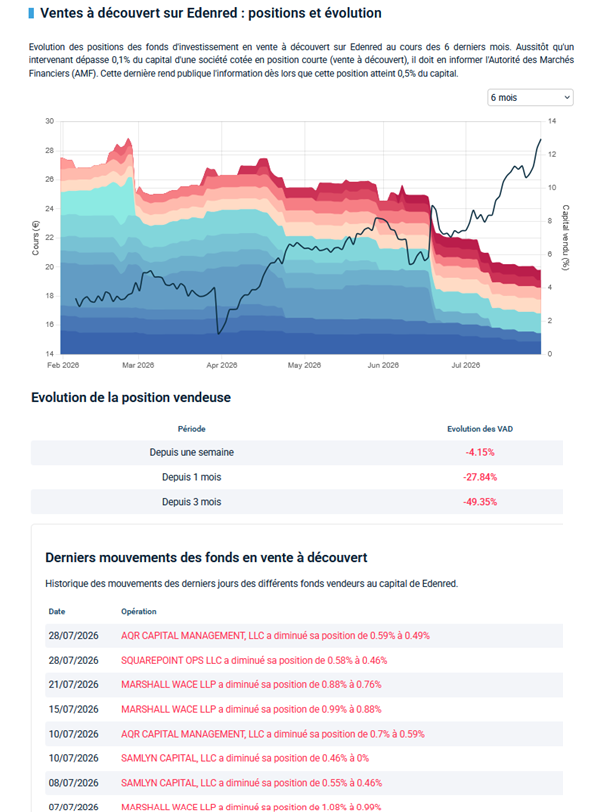
Edenred : Illustration de comment le narratif change à vitesse grand V.
- De dossier paria, sans avenir, secteur méprisé
- 90% de hausse depuis mars, une approche de rachat, une vad qui se rachète à une vitesse rarement vue
- Et des Edenred on voit qu'il y en a plein la cote FR
Ma banque m’a proposé un crédit à la consommation pour financer mes vacances.
Moi, Jean-Jacques, 52 ans, trente ans de cotisations.
On en est là.
La clochardisation, ce n’est pas un mot d’extrême droite.
C’est une trajectoire comptable.
Ça commence doucement.
Tu ne t’en rends même pas compte.
D’abord tu renonces au restaurant.
Pas par principe, par arithmétique.
Puis tu renonces au dentiste, parce que la couronne c’est 900 balles et que la Sécu te rembourse le prix d’un sandwich.
Puis tu renonces à changer la voiture, alors tu la répares.
Encore.
Encore une fois.
Puis tu renonces au chauffage à 20 degrés, et tu appelles ça “faire un geste pour la planète” pour te donner une contenance.
Voilà.
Tu es devenu pauvre sans jamais avoir cessé de travailler.
C’est ça, la grande innovation française : on a inventé le travailleur pauvre à 3 200 euros brut.
Pendant ce temps, l’État s’endette pour financer des dispositifs que personne n’a demandés, des agences dont personne ne connaît le nom, des rapports que personne ne lira.
Et quand il manque de l’argent, il ne coupe jamais dans son propre gras.
Il coupe dans le tien.
Une taxe ici.
Un plafond qui ne bouge pas là.
Une niche qu’on rabote.
Un point de CSG qui glisse.
Toujours la même méthode : jamais frontal, toujours par petites tranches.
On ne te tond pas, on t’épile.
Et le plus beau, c’est qu’ils appellent ça la solidarité.
La solidarité, c’est quand tu paies.
Quand tu demandes des comptes, c’est de l’égoïsme.
Alors on descend.
Lentement.
Une marche par budget.
Nos parents ont acheté leur maison avec un salaire.
Nous, on négocie un prêt sur 25 ans à deux revenus.
Nos gosses, eux, loueront un studio jusqu’à 40 ans en remerciant le ciel d’avoir un garant.
Trois générations. Une seule direction : vers le bas.
Ce n’est pas un accident.
C’est un choix politique répété quarante ans de suite par des gens qui, eux, n’ont jamais eu à choisir entre le dentiste et les vacances.
Si toi aussi tu bosses depuis trente ans et que tu te demandes où est passé l’argent, bienvenue. 🥖
On nous vole des sommes folles pour les reverser à la terre entière, mais lorsqu'il s'agit de restaurer notre patrimoine, ça passe par des dons volontaires.
Après la défaite des Bleus face à l’Espagne, Lucas Digne est la cible d’un déferlement de commentaires racistes sur les réseaux sociaux, les gens sont dingues.
Le racisme est un poison, quelle que soit la couleur de peau de la victime.
Il n’y a pas de bon ou de mauvais racisme !
Je vais signaler ces propos au procureur de la République. Face au racisme, notre main ne doit jamais trembler.
J’espère que SOS Racisme aura la même indignation et défendra Lucas Digne avec la même détermination.
Le silence serait une honte absolue.
Soutien à ce prodige de l’équipe de France.
Portefeuille d'une pas abonnée qui m'a même bloquée ⛔️
🐩 Manon A. - 36 ans
❌ "C'est compliqué", sans enfants
👩💼 Députée Européenne 🇪🇺
💰 Revenus : ~6000 € nets par mois
🤑 Patrimoine estimé :
- un vélo 🚲 Btwin ~350€
- une carte de militante LFI
- plusieurs millions de points Miles grâce à l'avion
- 2 maillots de foot "Mélenchon 27" made in Polska 🇵🇱
💸 Capacité d’épargne actuelle : quasiment rien vu ses voyages ✈️ et ses locations de voilier ⛵️
🎯 Ses objectifs :
▪️Taxer jusqu'à la moelle Bernard Arnault ✊️
▪️Nationaliser TotalEnergies 🇨🇵
▪️Smic à 1700€
▪️Retraire dès obtention d'un diplôme 👨🎓
▪️Atteindre à long terme, 1 M€ de patrimoine comme le chef de la meute 🔻💪
❓ Ses questions/remarques aux fachos de X :
1️⃣ Pas encore attrapé la grippe à rester le cul sous ta clim ? ❄️
2️⃣ On se sent bien en tant que gros parasite d'actionnaire ?
3️⃣ Si t'as chaud, c'est que t'as pas voté gaucho ! ✊️
* photo non retouchée par IA
Manon Aubry a déclaré pour patrimoine qu'une seule chose : un vélo.
Un parlementaire européen qui déclare un patrimoine quasi nul après plusieurs années de mandat à 10 000€ nets mensuels soulève une question simple.
Soit le patrimoine déclaré est incomplet (ce qui est un problème légal).
Soit le patrimoine est effectivement nul, ce qui signifie que la totalité des revenus est dépensée sans épargne ni investissement.
Les 2 hypothèses interrogent sur la compétence à gérer les finances publiques de quelqu'un qui ne gère pas les siennes.
La gestion des finances publiques commence peut-être par la gestion des finances personnelles.
@Tino_Bourse@JulienTechInvst Bonjour Tino, PRU a 8 USD, ton avis sur l’extension possible pour cette nouvelle jambe de hausse. Je vise 24-25 USD possible.
1/7 : L'héritage d'une "gauche caviar" 🥂
Qui est Mathilde Caillard. Fille d’un directeur associatif et d’une psychologue, Mathilde a grandi dans le confort ouaté de la classe moyenne supérieure intellectuelle. Un milieu où l'on refait le monde autour d'un dîner avant d'envoyer les enfants dans les meilleures écoles.
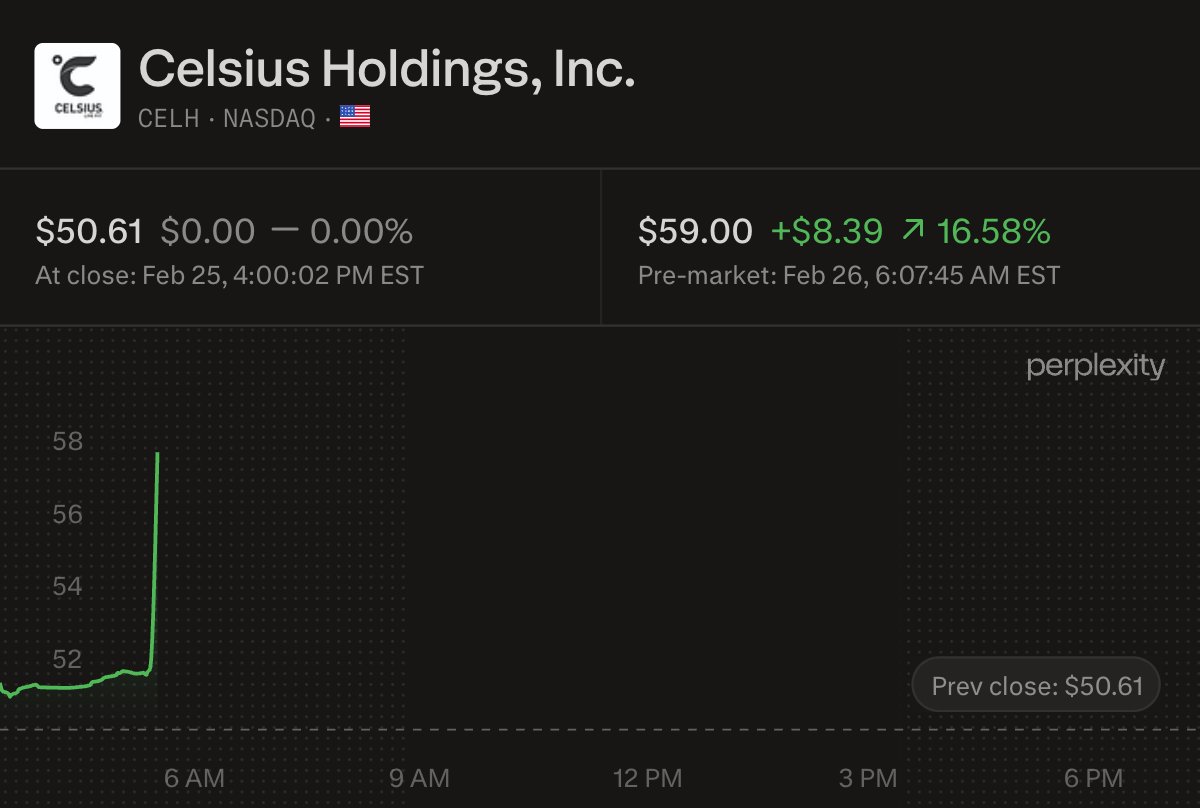
$CELH Q4’25 EARNINGS HIGHLIGHTS
🔹 Revenue: $721.6M (Est. $639.14M) 🟢; UP 117% YoY
🔹 Adj. EPS: $0.26 (Est. $0.19) 🟢
🔹 Gross margin: 47.4%; DOWN 280 bps YoY
🔹 Adj. EBITDA: $134.1M; UP 113% YoY
🔹 FY25 revenue: $2,515.3M; UP 86% YoY
Segment Performance:
🔹 North America revenue: $699.5M; UP 124% YoY
🔹 International revenue: $22.1M; UP 9% YoY
Other Metrics:
🔹 Portfolio share of zero-sugar U.S. energy category growth (2025): 33% (of $3.3B growth)
Capital Return:
🔹 Debt repayment: $197.8M
🔹 Share repurchases: $39.8M
Commentary:
🔸 “2025 was a defining year for Celsius Holdings as we delivered record full-year revenue of $2.5 billion...”
🔸 “...we reached an approximate 20% dollar share of the U.S. energy drink category in Q4 2025.”
Thanks for all the support on my $UPST interview with Paul. I spent a lot of time thinking about the questions I wanted to ask him, so I want to unpack some of my thinking.
For the first part of the Q&A, I wanted to dive into the significance of Paul's experience in building the models from Zero to One, and why that's so important as he steps into the role of CEO.
From there, I wanted to explore just how far the technology and business has progressed since 2022. While Upstart is exposed to all the noise of fintech, at their core, Upstart is fundamentally an AI company sitting at the application layer. Model improvements are at the core of the thesis.
Having said that, it is shocking to me that analysts do not spend more time seeking a greater understanding of the models. But if we take it a layer deeper than that, it's easy to say that Upstart's technology has improved since 2022, but for those not looking deeply it's hard to quantify.
Paul gave very thorough answers here and even quantified the improvements in tech, stating that UMI would have allowed Upstart to avoid 80% of the 2022 disruption to credit outcomes. Similar language was shard at AI Day.
I then moved onto the future, where Paul elaborates on how all of these developments impact Upstart's long-term prospects. He also provided an in-depth explanation on some of the asymmetry he is seeing in Upstart stock, evidenced by his $3.9M insider buy. That is an extremely large insider purchase.
With all of that now as context (his experience in building the models, Upstart's turnaround & improved technology, rosy future prospects & insider buying) I then transition the conversation to the models.
Upstart is rarely asked for color on the granular details of the data flywheel or machine learning techniques on the conference call. The analysts covering the company appear to be skewed more towards financials than they are technology, with some exceptions of course.
The big takeaway here is that Upstart's data flywheel is exploding. It took them 14 years to hit 100M repayment events. It will only take them a few years to double that. And that weaves into my next question on margins for Auto & HELOC. These products, when you exclude intention margin levers (such as prioritizing life-time value/market share efforts) will grow at expanding margins as the underwriting gets better.
Put together the largest TAM possible (lending) with the most transformative technology humans have every created (AI) and not only do you have a business with extreme growth prospects, but you also have a business that can grow into that market increasingly more profitable as the technology gets better.
That is incredibly powerful. Upstart is effectively going after the lending trifecta of growth, profits, and credit performance. Traditional lenders can not achieve all three. If you grow your originations, normally you sacrifice profits/credit performance. That's because traditional underwriting is static (or constant) and not improving over time.
Upstart has dynamic underwriting. Their models are continuously and autonomously updating to real time borrower behavior and macro signals. New models have a much shorter feedback loop because Upstart utilizes PTCC (making prepayment and default predictions by month) whereas legacy models only look at the terminal state of a loan (paid or default). In my opinion, Upstart's models are not only improving, but the rate by which they are improving is also accelerating.
Dynamic underwriting allows for origination growth with better credit performance, which leads to more profits. Upstart accomplished this seemingly impossible trifecta in 2025.
Now, the fruits of that labor are currently being overshadowed by 1) the macro and 2) by intention efforts to take market share. Upstart is forgoing the maximization of take rate in exchange for a larger piece of the lending pie. That's why I then asked Paul about Upstart's marketing strategy.
His answer makes it clear Upstart is spending increased attention on this front. They are in the process of a complete rollout of a new mobile app that will deepen borrower engagement with the brand. The launch of new products also enables Upstart's marketing to cast a wider net, making marketing dollars more efficient.
And so naturally the last piece of the puzzle after we understand that 1) Paul's experience in building the models is foundational to Upstart's next chapter 2) Upstart's technology today is much better than in years past 3) Paul sees an incredibly rosy future for the business, supported by a sizable insider purchase 4) the data flywheel of models is improving and accelerating 5) Upstart is waning back margins short-term intentionally for market share ... becomes partner growth.
If Upstart is to be everywhere - they have to integrate with more partners. In particular, I really want to see them partner with a big bank. So, I asked Paul about that. The answer? Big banks 1) need more than just personal loans and 2) are naturally risk averse to new technology by nature.
Given Upstart's evolution across product set and increased positive press about AI-driven value creation, these obstacles seem surmountable. That gives me confidence that if Upstart's technology is truly the best, in the end they will win with banks.
So that brings you 360 on my thoughts for this interview. The Upstart thesis at the core is one of AI and technology, with the macro effects pouring gas or water that fire. They have grown quite substantially in the face of elevated macro risk (UMI). That is only possible if the underwriting is getting so much better that they can grow via model improvements (with lower APRs) despite elevated macro risk.
I believe Upstart is building something very special and very unique. It's been a volatile journey, but the fundamentals are improving and management is executing. Hope you enjoyed the discussion.
@Quiet_Wealth@PetitRentier FDJ et Edenred value trap ?
Je ne suis pas d’accord, elles se sont fait laminer par le risque réglementaire mais le business est solide pour les deux et les cours largement sous les valeurs intrinsèques
Cher Emmanuel Grégoire,
Vous vous révélez enfin. 😏 Je suis l’adversaire n°1 du bilan Hidalgo, vous êtes son défenseur n°1. Parlons de fond, pour une fois. Ça vous changera.
Vous brandissez la notation de S&P comme un trophée. C’est soit de l’ignorance, soit de la mauvaise foi.🤷♀️
1️⃣ S&P évalue la solvabilité de long terme, pas la bonne gestion. Oui, EN THÉORIE, Paris pourrait rembourser ses 10 milliards de dette, doublée depuis 2014, en liquidant son patrimoine estimé à 47 milliards. Oui, les impôts locaux pourraient encore augmenter, après la hausse de 52% de la taxe foncière sous votre mandature. Mais vous ne comptez pas vendre le patrimoine municipal pour rembourser la dette, n’est-ce pas ? Alors peut-être comptez-vous encore faire les poches des Parisiens ? Vous appelez ça de la bonne gestion ? 🤔
2️⃣ Être solvable n’est JAMAIS une raison pour continuer à s’enfoncer dans la dette. Ce sont les agences qui paient les 500 millions d’euros annuels du coût de la dette ? Non, ce sont les Parisiens 💸 Ce sont les agences qui voient leur taxe foncière exploser pour tenter, vainement, de contenir vos déficits ? Non, ce sont encore les Parisiens.
3️⃣ Vous affirmez que Paris « a la meilleure note possible », une note « meilleure que celle du pays ». C’est tout simplement TOTALEMENT FAUX. ❌ AUCUNE collectivité française ne peut être notée au-dessus de l’État. C’est une règle de base. Paris est notée A+ après avoir été dégradée par S&P en octobre, exactement comme la France. Se féliciter d’une note plafonnée par la situation nationale elle-même catastrophique, c’est un terrible aveu d’ignorance. Pendant que vous révisiez la grille tarifaire Navigo, vous avez manifestement oublié les véritables compétences exigées d’un maire.
4️⃣ Ce qui parle vraiment, c’est la Chambre Régionale des Comptes. 📊 Une dette multipliée par 2 depuis 2014, à 10 milliards d’euros. Des intérêts annuels en hausse de 40 millions depuis 2019. Des dépenses de fonctionnement en hausse de 13% depuis 2021. Qui peut regarder ces chiffres et parler de bonne gestion, à part un mauvais gestionnaire qui cherche à se dédouaner ? 🧐
5️⃣ Votre objectif est de communiquer (avec de grossières erreurs) sur une note de Standard & Poor’s. Le mien est de rendre leur argent aux Parisiens. Chacun son ambition.
👉 En tout cas, pour un ancien adjoint au budget, on ne peut pas dire que votre niveau de connaissance du sujet mérite un AAA. Notre argent fut définitivement mal utilisé. Vivement que vous quittiez la Mairie ! 🎯
PS : vous bloquez toujours vos commentaires. Cela en dit long sur votre conception de la démocratie !