@evansall as a top 3 shareholder in $UMAC, you have our permission @Rebellionaire to order the equipment for the future automated lines today
At $4M/line - why not order 4 right now ($16M) so they are at your door in 4-6 months or however long it takes? Let them sit in a warehouse if you don't yet have the space - at least they are then in the country and ready to be deployed when able.
We understand proof of concept on the first line is important, but we are also okay with a $16M mistake in the pursuit of something much greater - absolute dominating scale in this market vaccum.
Just a thought, we know you're cooking like crazy over there 🧑🍳💜
$UMAC
Unusual Machines appears on planning to use OSC capital to parallelize their 100,000 motor / month automated line that they plan on having online by year end (4Q26).
Last week, CFO Brian Hoff suggested UMAC seeks 6-8 additional lines which could produce 8-10M motors per year with extra flux capacity if needed (10M motors / 7 lines = 1.4M per line / 12 months = ~119,000 motors per month per line).
Brian also suggested these additional 6-8 production lines would fulfill Group 2 and Group 3 drones - which are larger in size - therefore potentially dragging ASP (average selling price) higher on components.
Not financial advice - but I took a swing at modeling out what the Defense ONLY portion of Unusual Machines' motor business could look like with an OSC capital infusion.
By Q3 2028, this model assumes UMAC has 8 automated motor equipment lines up and running, kicking 9.6M motors per year at an ASP of $57.
We learned from Allan that in 2Q26 UMAC made and shipped just under 50,000 motors in the quarter. Further, 13% of 2Q26 revenue was attributable to their largest product. Assuming that's motors, you arrive at an ASP of ~$43.47 ((0.13 x $16.7M) / 50,000).
That's why this model starts at ~ $43 ASP in 2Q26 before being dragged up ~33% in totality by the end of 3Q28 on the assumption of additional lines being used for Group 2 and 3 drones. To state the obvious, there's a lot of guesswork here. On 9.6M motors at a $57 ASP, you land at ~$550M run rate on motors alone in 3Q28.
Gross Margins are assumed at 38% throughout - the midpoint between 2Q26's ~35% and UMAC's 40% LT target. That yields ~$208M of annualized gross profit in 3Q28.
CapEx for the tangible, physical equipment of each line is estimated to be ~$4M, with the rest (overhead, salaries, raw materials) assumed to be financed by the OSC.
The model is far from perfect - but Cumulative Gross Profit less CapEx is treated as cash generation and added back to implied Enterprise Value along with 2Q26 Net Cash.
OpEx as a % of Revenue is assumed to be ~19% for this production line - a majority of UMAC's overhead runs through COGS (which improves as employees become more efficient). D&A assumed at 1% of revenue.
That leaves us with an implied 20% EBITDA Margin on the motor business (38% Gross Margin - 19% OpEx as a % of revenue + 1% D&A add back). Applying an assumed 25x EV/EBITDA multiple on the implied 3Q28E EBITDA (with 8 automated lines up and running) spits ~$2.7B in implied Enterprise Value. 25x in my view is justified as by this time UMAC will be growing very fast - with drone delivery and potentially robotics as additional growth tailwinds.
After adding back Net Cash, the Cumulative Gross Profit less Capex and subtracting Working Capital OpEx (estimated a 1x annualized revenue) leaves ~$2.67B in implied equity value in the Defense Motor business alone.
That suggests UMAC's Defense ONLY Motor business may be worth $38.30/share.
Of course - there are SO many assumptions going into this (plus the $ figure isn't discounted) and the math almost certainly doesn't reconcile 100%. But - I think this analysis is directionally correct.
In my opinion, the drone industry is at the beginning of the S-Curve and Unusual Machines is ready to ride it with the help of some OSC capital.
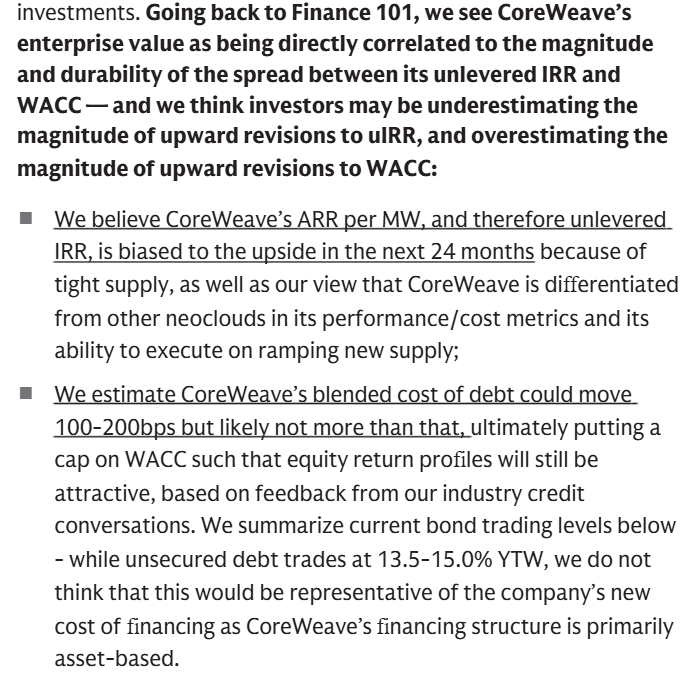
@micmat02@nerdalert both - as capital is harder to raise the debt becomes more expensive, but since the projects are so profitable it still makes sense to build them at higher WACC
I was talking with @HenryInvests this morning about the market's concerns around debt funding the AI buildout. I literally called it Finance 101 that these companies should be using debt to lever their equity returns. The market is freaking out about one of the most basic tenets of finance.
Goldman posted this note about $CRWV this morning, sounds like we weren't the only ones to notice the obvious!
Could you provide an update on recent credit performance versus expectations? When UMI rises, how much does that affect loans already originated, compared with new loans you can reprice? And should macro conditions worsen, do you believe partners will turn to Upstart for consistent credit performance in turbulent times?
Are Upstart's LTV efforts mainly focused on your D2C channel, or is B2B distribution becoming a bigger part of that strategy? How are conversations with banks, credit unions, and dealerships progressing? And on Walmart, can you give us an update on how that partnership is going and whether you see more opportunities with other similar brands?
@Upstart@paulxgu Enormous AI infrastructure projects are sucking up most of the world's available capital and this dynamic is pushing yields on both the short and long end higher. Do you expect this to continue, and if so, what impact do higher treasury yields have on Upstart's business?
Can you update us on the funding profile for Auto and Home? Are these products now at a scale where you expect them to be funded the way personal loans are? Does being secured bring in a different type of capital partner or a different structure than the personal-loan forward-flow deals?
SpaceX's earnings are inflecting now. Tesla's still depend on Robotaxi and Optimus.
Tesla says Robotaxi probably becomes noticeable in its results in Q2 2027.
Matt's view: Holding Tesla potentially has an opportunity cost while AI companies grow.
But AI isn't without its risks. Public pushback on data centers is significant.
What do you think?
Rebellionaire clients and employees own $SPCX and $TSLA stock.
*Timestamps*
00:00 SpaceX's Strong Quarter Needs Some Nuance
00:50 Elon: Highly Confident of 10 Gigawatts
09:58 Tesla Still Needs Robotaxi or Optimus
11:58 Tesla's Robotaxi Payoff Moves to 2027
16:01 Optimus Could Be Two Years Out
21:54 SpaceX Has the Larger Catalysts
23:08 SpaceX and Tesla Both Must Execute
@nerdalert
$SPCX $TSLA
@Upstart@paulxgu How do you rank the marginal Upstart investment dollar between co-investments, retiring converts, balance sheet R&D, buybacks, and internal re-investment?
@Upstart@paulxgu As earlier co-investment vintages begin returning cash, is the net new capital required to support forward-flow commitments declining, and when do you expect those returns to fund a majority of new co-investments?
Opinions needed please 🙏
Have been working on the $UPST 3Q26 Earnings Preview, should have this out next week Friday. TLDR: I think this quarter will be fine, the guidance is more dependent on 4Q26.
Trying to decide how I'm going to do coverage this time with the change in format. Earnings release 7am ET (that's 6am for me!) followed by a video webcast at 8am ET.
Currently, I'm thinking about doing a live X space for when the results drop at 7am ET. However, I don't think we should listen to the call together anymore :( - it makes the most sense for everyone to tune into the video webcast Upstart is hosting directly. (X Spaces are audio only, video is the clear draw this quarter).
Which of the following options would you prefer for coverage?
1) X Space for the Live Earnings Release Only (6:55-7:35am ET)
2) X Space for the Release (6:55-7:35am ET) plus a 2nd Space AFTER the webcast (9:05-9:40am ET)
3) No X Space - coverage via posts on X & traditional earnings review, plus a potential YouTube video.