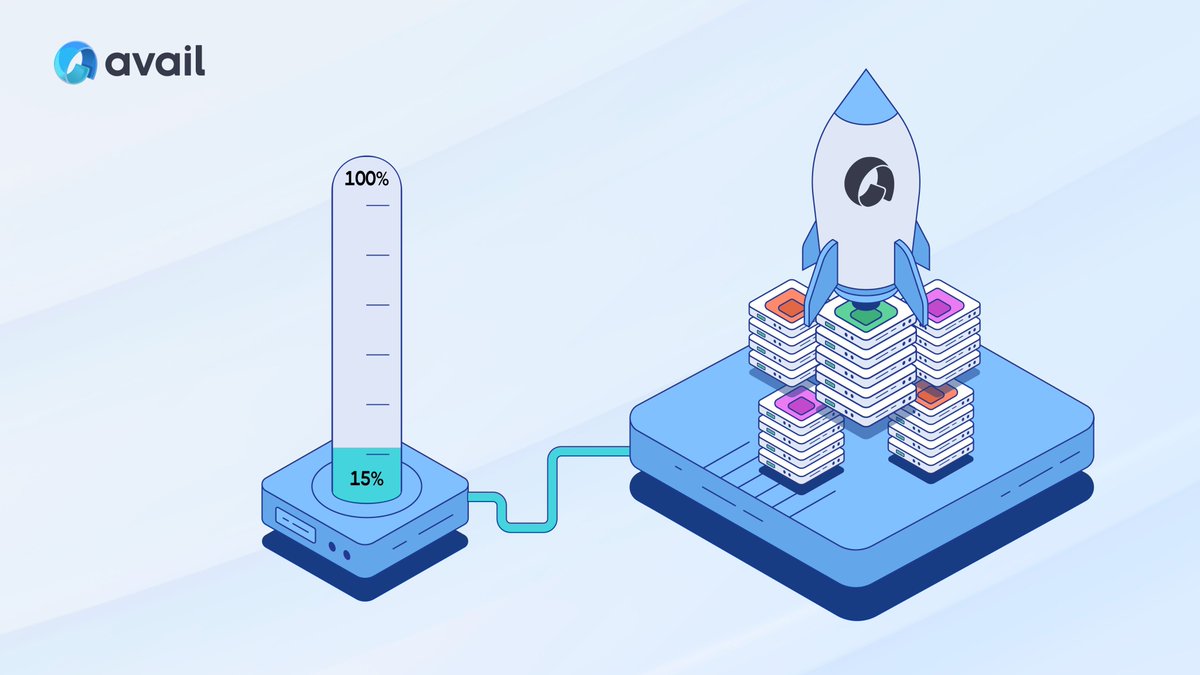
With the Avail DA mainnet approaching, it's about time we gave you a refresher on its core features. They make us different from other DA layers.
A deep-dive into
1. Validity proofs
2. Erasure coding
3. Light clients
4. Data availability sampling
5. Expandable blockspace
(1/6)
Avail gives you interoperability with all other blockchains, no matter where you choose to build. OP Stack, Ethereum, Polygon CDK, you name it.
With the foundation of a common DA layer built for security and scale (Avail DA), interoperability between chains is drastically simplified.
Why?
They share a common trust zone. DA provides transaction ordering, and then execution proofs verify state transitions.
How?
Combining both transaction ordering and execution proofs is the key.
Nexus doesn’t enforce integration requirements on developers - you can build wherever and Nexus just works.
Hear us out, if you’re building an L2 on Bitcoin, you should use Avail. Here’s why:
BTC L2s can move 99% faster when leveraging Avail DA as an intermediate fast DA layer before posting to Bitcoin for DA.
Avail DA has 20 sec blocks and takes around 2 blocks to reach finality providing DA guarantees to L2s in ~40 seconds.
Bitcoin has 10min blocks and reaches finality every 6 blocks providing finality in ~1 hour.
Your BTC L2 can post transactions to Avail DA every 20 seconds and receive interim finality in 40 seconds. Transactions can then be posted to BTC for DA every 10 min and finalize in ~1 hour.
It's time for the final few steps for Avail DA's mainnet!
So far, thousands of chains have been deployed and more than 100 million transactions have been processed on the testnet. We just have a few more things to do before we launch our mainnet.
1. Light Client Challenge to test the core part of Avail DA's infrastructure.
2. Deploying the final testnet that will run in parallel with the mainnet indefinitely for testing.
3. Tooling/Infra Optimization including bridging UI and extending hardware wallet support amongst other enhancements.
4. Getting production ready by fine-tuning incident management and critical response processes so that we can respond to any emergencies.
5. Close Clash of Nodes incentivized testnet. Information about rewards for participants is coming soon.
6. We’ll gradually increase our validator count as we establish the strongest and most decentralized security layer in the modular ecosystem.
7. Rollup Stack Integrations so that developers can build on whichever stack they like.
8. We have a lot of exciting launch partners and are working towards on-boarding more every day before the final release of mainnet!
Of course, there are also some exciting steps we’ll be taking along the way to incentivize and reward our community for their participation
Read a detailed version of Road to Mainnet here - https://t.co/d08KfyD103
🔔 $JUICE RINGS THE BELL 🔔
@ProtocolRing will have @Juice_Finance as our 2nd guest for Ring The Bell X Spaces!
We’ll talk about $JUICE now being live on Ring + many more! Hear alpha they have to share to the Ring Family
⏰ THURS, 8PM PST / FRI, 11AM HKT
More info below ⬇️
UPDATE: RING TVL HITS 300 MILLION+ 💍💍💍
We are excited to report that Ring Protocol has accrued over $300M TVL (currently at $304M+)
Ring Protocol is only the 3rd protocol to hit $300Mn+ TVL on @Blast_L2 👏
See real-time protocol rankings here: https://t.co/2LcWSGcMKL
✨Introducing Mitosis: The Modular Liquidity Protocol
Digital Money’s Modular Expansion👇
Using smart contracts to operate financial products is the core value that DeFi brings to the table, especially in terms of composability. DeFi can maximize composability via complex, creative strategies implemented by smart contracts, unburdened by traditional finance’s legal and bureaucratic hurdles. Naturally, the maturation of the DeFi market has been about further optimizing composability. In other words, digital money is bound to flow into positions that maximize the crypto asset’s composability, i.e., its capital efficiency.
Derivative token is the prime example of maximizing the composability of crypto assets. By tokenizing an asset and creating its representation, derivative tokens can become liquid financial instruments that retain multiple layers of yields, utilities, and rights. For example, Lido’s $stETH is a liquid asset that tokenizes the $ETH staking position, providing its holders the staking rewards while retaining the characteristics of a digital asset, such as fungibility and transferability. Liquid Restaking, spearheaded by LRT protocols, imbues staked $ETH further composability by adding an additional yield layer in return for extending Ethereum’s economic value to power other use cases through Actively Validated Services (AVS).
Where derivative tokens are headed next is multi-chain. Innovation in building new chains (e.g., EigenLayer, Celestia) sets the stage for more tailor-made chains with better transaction economics, financing, and yield opportunities. Again, money flows into positions with maximized capital efficiency. L1 assets like $ETH are already used as collateral across multiple EVM and non-EVM blockchains. Derivative tokens are the next logical step. They are bound to exist on multiple blockchains and applications to extend their yield stack to optimize holders’ gains.
📣 RING UPDATE
Happy to share that we distributed a total of 1.5 Billion+++ Blast Points back to the Ring Community this week!
9,000+ Ring users received Blast Points from us correspoding to the Ring Point they accumulated to date 💍
🎙️ RING THE SPACES
@Manyblast & @jbondwagon from the Ring Protocol Team will join @SynFuturesDefi's Blast Zone X Spaces to talk about Ring Protocol and some Ring updates
📅 March 20
⏰ 10:00 AM PT, 1:00 PM ET, 6:00 PM CET
Set reminders below ⬇️
https://t.co/wAsGl1IESy