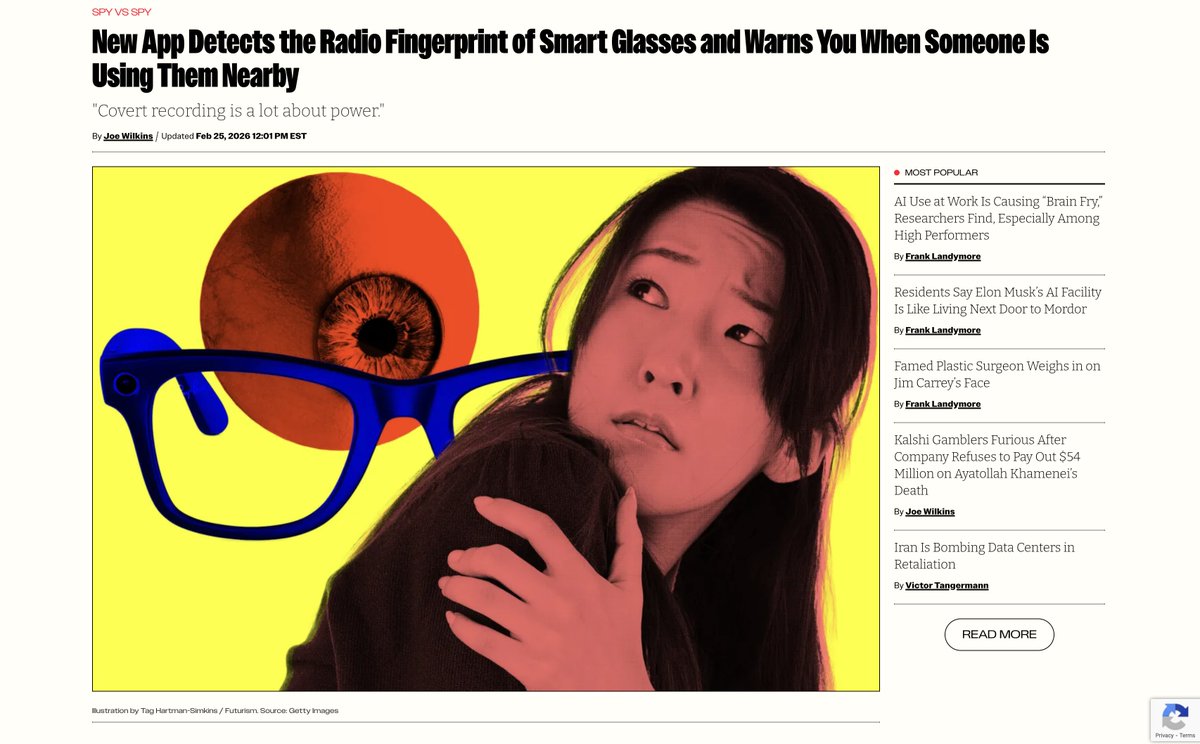
A professor built an app in 12 hours that Meta's billion dollar team never wanted to exist.
It detects their Ray-Ban glasses nearby using Bluetooth.
Your phone vibrates: "Smart Glasses are probably nearby."
Meta's own internal memo said they'd launch facial recognition on the glasses "during a dynamic political environment" when civil rights groups would be too distracted to fight back.
Harvard students already proved it works.
They built glasses that reveal your name, phone number and home address just by looking at your face.
Meta sold 7 million pairs last year.
They look identical to normal glasses.
The LED that blinks when recording? There are tutorials to disable it.
One professor got fed up and built a counter in his spare time.
It's Free & open source with zero ads.
Detects within 50 feet outdoors. 32 feet in a crowd.
Download: search "Nearby Glasses" on Google Play
Today, we're introducing Spectre I, the first smart device to stop unwanted audio recordings.
We live in a world of always-on listening devices.
Smart devices and AI dominate our world in business and private conversations.
With Deveillance, you will @be_inaudible.
@nuhre_ It might surprise you that video game stories aren't usually that good, and almost all dialogue is filler. And you can read the subtitle lines at a glance instead of waiting 10 seconds for a voice actor to slowly read them aloud. It's no Kubrick movie where you savor every moment
@OttoInfluencer@Mrwhosetheboss The problem with 8-bit is accurately reproducing color gradients. You can't smoothly transition from one hue to another slightly different hue without discrete, obvious lines that show where the transition occurs. But in 10-bit you absolutely can have that smooth transition
@YvetteC35382 @HowThingsWork_ Not human—machine: the poster never thinks with their brain; by prompting the machine she outsources her opinions and reasoning (reducing her cognitive ability), so the content becomes slop instantly.