$TAO Bons PONZI take. The work he didn't do.
Claim: $328M in emissions vs $15M in revenue, economically bankrupt.
This is wrong on the math, wrong on the mechanism, and wrong on what REVENUE even means in dTAO.
Pull up https://t.co/30TTKi0XTC right now. Last 30 days alone:
• 90,559 TAO ($22.4M) in on-chain inflow + burn
• Annualized that's $270M flowing back to the protocol via inflows, buybacks, and burns
• That's ONLY on-chain action. Off-chain revenue doesn't even count in this number
Subnet owners are literally incentivized to buy back their own alpha with revenue, because more $TAO in the pool = more emissions.
The mechanism itself is net $TAO flow from staking vs unstaking. To Build something that attracts and HOLDS stake CONVICTION. The design is behavioral incentivized real production.
The mechanism is a closed economic loop, not a leak. Bons either doesn't understand dTAO or is pretending not to, not sure, hopefully many that don't understand it have another look.
Claim: "Subnets aren't products, they exist to extract."
Pull up https://t.co/XWBVwhVGs7. Look at the lines of code shipped per day per subnet. Real engineering. Real GitHub commits. Real models in production:
• @AskVenice (1M+ paying users) trained Venice Uncensored 1.2 on @TargonCompute SN4
• @MacrocosmosAI just published ResBM 128x activation compression targeting a 70B distributed training run
• @ridges_ai building autonomous software developers hitting top SWE-bench scores
• @VantaTrading onboarded 5,500+ traders with zero marketing
• @webuildscore raised vision accuracy to 95.8%, partnered with @PwC_France for enterprise physical AI
• Templar trained Covenant-72B with 67.1 MMLU competitive with Llama 2 70B endorsed publicly by Jensen Huang and Chamath
This is EXTRACTION?
It's product-market fit being built in real time, on-chain, while the centralized AI world burns hundreds of billions in private.
The macro context MANY ignore. This is what we should be talking about:
• Big Tech capex on AI infrastructure in 2026: $660-690 billion
• OpenAI infrastructure commitments alone: $1.4 trillion
• Jensen Huang's estimate for total AI infra spend by end of decade: $3-4 trillion
• Anthropic revenue scaled 100x in 2 years
• 50% of all global VC in 2025 went to AI
In the middle of the largest CLOSED UNVERIFIABLE capex buildout in human history, the open, permissionless, neutral substrate for AI compute and intelligence is supposedly worthless?
Come On Be serious.
The PONZI label gets thrown at every new monetary primitive in crypto:
• Bitcoin was called a ponzi for 15 years
• Ethereum was called a ponzi until ETFs hit
• Solana was called a ponzi until institutional flows showed up
• Now TAO is The Ponzi
A ponzi has a central operator promising fixed returns, paying old investors with new money, and obscuring cashflows.
But Bittensor has:
• No central operator promising returns
• Open-source emissions schedule on a 21M hard cap
• Every reward, stake, burn, and buyback verifiable on-chain
• Permissionless exit through AMM pools
• A halving mechanism just like Bitcoin
• Subnets that get pruned by the market when they fail
That's not a ponzi.
That's the most transparent capital allocation mechanism that has ever existed for AI.
Grayscale didn't push their AI Fund $TAO allocation to 43% because they fell for a ponzi. Yuma didn't stake $691M into the network because they're confused.
The real anti-crypto take is pretending every early-stage network has to look like a fully mature cash machine on day one or it is a scam. That is not how crypto works, networks work, OR markets work.
Crypto deserves better.
$TAO
Quantum computing is forcing a rethink of how Web3 systems are secured.
We audited @QANplatform’s QAN XLINK, a protocol enabling Ethereum wallets to migrate to post-quantum security without breaking compatibility.
31 findings.
0 critical / 0 high.
29 resolved.
Bitcoin potential upgrade to post-quantum security could take up to 7 years 😳 at best...
Bitcoin would be in the quantum danger zone 🔴
That’s the estimate from a co-author of BIP-360 @Ethan_Heilman, the new proposal aiming to protect BTC from future quantum threats. 🧵👇
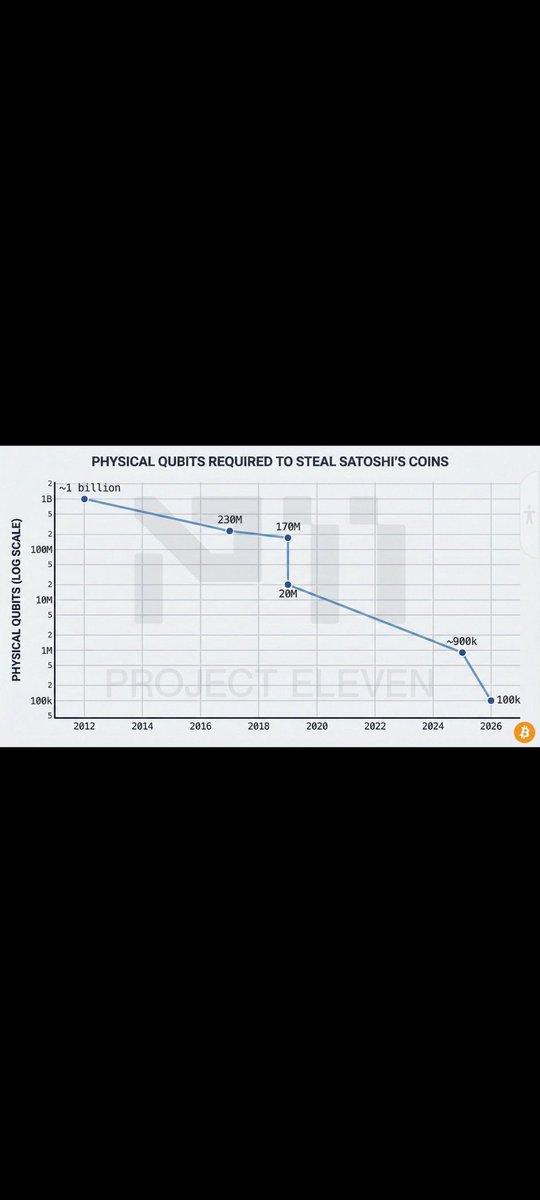
@AltcoinsFrance@jeremy_ddn Si on suit les Roadmaps des boîtes quantiques et le fait que le nombre de Qbits diminu de manière très exponentielle au fil des années d'ici 2028 ce sera la merde 😄
@jeremy_ddn@AltcoinsFrance Faux, un acteur centralisé peut passer sur des algo PQC rapidement contrairement à BTC et sa nature décentralisé qui a besoin de trouver un consensus et bcp bcp de temps.
D'ailleurs Apple, Google, Microsoft, aws pour ne citer qu'eux y sont passé.
We are thrilled to announce that the supercharged QAN TestNet is live!⚡️ This upgraded network now features the fully integrated versions of both the
🔵 QVM: QAN Virtual Machine enabling developers to write smart contracts in any programming language, and the
🔵 QAN XLINK: our cross-signer protocol that makes QANplatform quantum-safe
key components, recently audited by Hacken, marking a pivotal moment in our development roadmap.
Ready to dive in?
Find the full guide at: https://t.co/5bLqUBgU5L
@FrenchCrypto7@SlashCoins Environ 20% de l'offre est considéré comme perdu à tout jamais.
Il n'y pas que Google, il y a pas mal de boîte et Google n'est pas là plus avancé.
On ne sait absolument rien des avancées aussi des pays comme la Chine ou autres du même genre.
@SlashCoins Il faudra des années et années à BTC pour tout ça sauf que si des décisions ne sont pas prises cette année ça risque d'être compliqué pour lui niveau timing.
@SlashCoins Le réel danger c'est le temps que btc va mettre à migrer de par sa décentralisation.
Déjà trouver un consensus va prendre des années et je parle même pas de la migration et du temps que prendra un fork...
Et Faut il geler les anciens wallets à risque est-ce éthique ?
2025 was QANplatform's year of quantum-safe breakthroughs!
✅ QVM passed Hacken's 2,800-test audit
✅ QAN XLINK passed Hacken quantum security audit
✅ Protecting Ueno Bank's 2.2M customers with SignQuantum
✅ Latin America expansion via SignQuantum & ITTI
✅ Blockchain for Europe membership + CTO panel with Europol
Full 2025 recap live now 👇
https://t.co/fVcCDzNxMs
QANplatform and SignQuantum provide quantum-resistant security for Ueno Bank's 2.2M customers
Shortly after the announcement of SignQuantum, the world's first quantum-resistant e-signature add-on which utilizes QANplatform's quantum-resistant blockchain technology, Ueno Bank is starting its transition to quantum-resistant cybersecurity to safeguard digital operations and digitally signed documents.
“Adopting SignQuantum and QANplatform’s technology both mitigates future risks and builds confidence with our customers and partners to bring a new standard of cybersecurity in the financial sector,” said Juan Manuel Gustale, President at Ueno Bank.
We’re thrilled to see QANplatform’s quantum-resistant blockchain deployed in robust, real-life environments like Ueno Bank, Paraguay’s largest bank by customer base.
Read more on our blog:
https://t.co/M5sP2Nbx5O
https://t.co/G32Kbilx4P
Quantum-safe readiness has a score.
IBM’s Quantum‑Safe Readiness Index (QSRI) gives a shared language: scores, activities, phases to discuss quantum‑safe readiness with boards, regulators and partners.
Once quantum computers reach sufficient scale and stability, many of today’s widely deployed encryption schemes can be broken, and that’s a problem because cryptography underpins everything from payment rails and core banking to smart contracts and cross‑chain bridges. Governments have already moved: NIST’s 2024 PQC standards are now the de facto reference for quantum‑resistant algorithms, with the UK, Europe and multiple Asia‑Pacific countries building national PQC migration plans around them.
QSRI itself is built on 14 activities across three areas: quantum‑safe discovery, observability and transformation combined into a 100‑point index that can be re‑assessed over time for organizations, industries and regions.
The 2025 results show discovery and observability improving faster than transformation, which means many players are still just mapping where cryptography lives instead of fully rebuilding for a quantum‑safe world.
QSRI puts the 2025 global average at 25/100, only a modest rise from 21 in 2023, while the top 10% quantum‑safe champions are already scoring 35–50.
IBM warns that quantum computers capable of breaking today’s encryption may show up five to six years before most organizations finish that migration.
For blockchains and Web3, this isn’t just about swapping algorithms; it’s about treating post‑quantum cryptography and quantum‑safe design as core to how chains are built, upgraded and governed.