In a fiat currency system, the benefits of deflationary technology primarily accrue to asset holders, because the forced inflation created by central banks pumps up asset values.
If we were living under an honest, hard-money monetary system, where the benefits of technology would not be offset by central banks debasing the currency, those gains would accrue more evenly across the population.
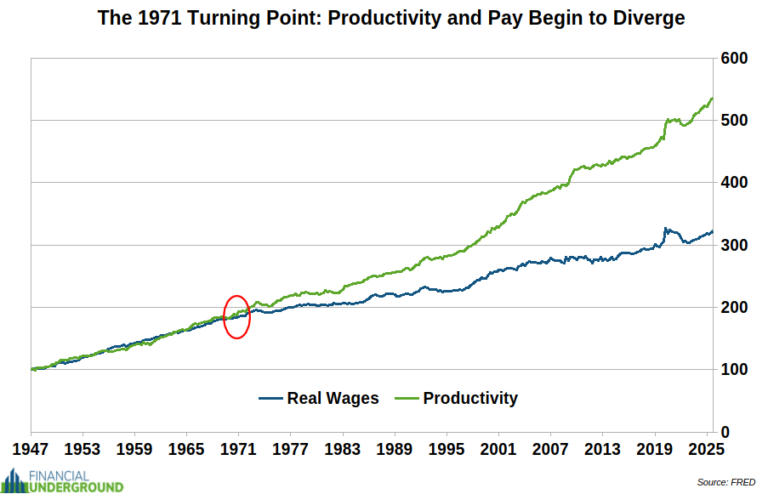
That is why we think the chart below is instructive.
It is a long-term view of real wages versus productivity.
The two tracked together well for decades, showing that as productivity increased, real wages did too. In other words, most people benefited from increases in productivity through higher real wages.
Then something changed around 1971, when that strong positive correlation broke. It was the year the US government cut the dollar’s last link to gold and the dollar became a pure fiat currency.
Since 1971, there has been a growing gap between productivity and real wages.
If you could transport yourself back to the early 1970s, just as the divergence between productivity and real wages began, and ask people what they thought 2026 would look like, they might have said something like The Jetsons—flying cars, advanced technology, and a society in which everyone was better off.
They probably would not have believed you if you told them that, in reality, people would be worse off in many ways in 2026 than they were in the early 1970s, despite enormous technological progress. We may not have flying cars or The Jetsons, but there have still been significant advances. Yet people’s standard of living has declined in many ways.
Today, many people are bewildered by how people could be worse off now than they were then. The answer is in this chart, which shows that the fiat system and currency debasement are the problem.
Despite advances in technology, the shocking level of currency debasement has not merely kept pace with the natural deflation that comes from increased productivity, but has vastly outpaced it… which is why people are, in many ways, worse off today than they were in the early 1970s. That prosperity has been stolen by inflation and fiat currency.
Since 1971, productivity has continued to increase, largely thanks to advances in technology, but those gains have not translated into growth in real wages as they had in the past under an honest money system. That is because under a fiat currency system, the central bank—the Federal Reserve—has created significantly more inflation than the gains in productivity, which meant real wages did not keep up.
However, those productivity gains from advancing technology did not just disappear. They were redirected somewhere else. They accrued primarily to asset holders, as wage earners chased rapidly depreciating fiat currency.
In short, the fiat currency system is a mechanism for transferring wealth created by technological productivity gains to asset holders and politically connected insiders closest to the money printer.
Frankly, it is a disgusting, dishonest system that operates at the expense of honest people.
But that is the nature of the monetary system we are all forced to live under. And it is wise to acknowledge it, understand it, and take action to protect yourself.
And now, with AI bringing a mind-bending level of productivity gains, this dynamic is about to go into overdrive.
Non riesco a capire questa cosa: mettendomi nei panni di un investitore in ETF, che senso ha vendere ora?
Dopo aver sopportato un drawdown del 50%, su una zona di supporto chiave, nella fase finale del ciclo.
Boh penso umilmente che c'erano modi migliori di gestire la posizione
They couldn't ban Bitcoin. Every government that tried failed.
So the question changed: if you can't ban it, can you just make it too heavy for ordinary people to carry?
Rustin spent 3 days in a basement pulling the receipts on the code change, the money behind the developers who made it, and why nobody with a platform said a word. 👇
Prevention is just as important as reporting.
H1DR4’s research feature will surface live stats for covered locations, including crime type, area/address of interest, and event counts.
Built to help identify patterns and monitor hotspots faster.
@FmMosca “vi sono cinque modi di attaccare con il fuoco: il primo consiste nel bruciare i soldati; il secondo nel bruciare i magazzini; il terzo nel bruciare i convogli; il quarto nel bruciare gli arsenali; il quinto nel lanciare il fuoco in mezzo al nemico. “