@antoine_fabri For UI and server functions, I just use "ModuleUI" and "ModuleServer", even when they are nested. But for file names, I use "main-.R" and "main-foo.R" to show the hierarchy (maybe also add a "For Developers" section in a vignette to introduce all the main modules).
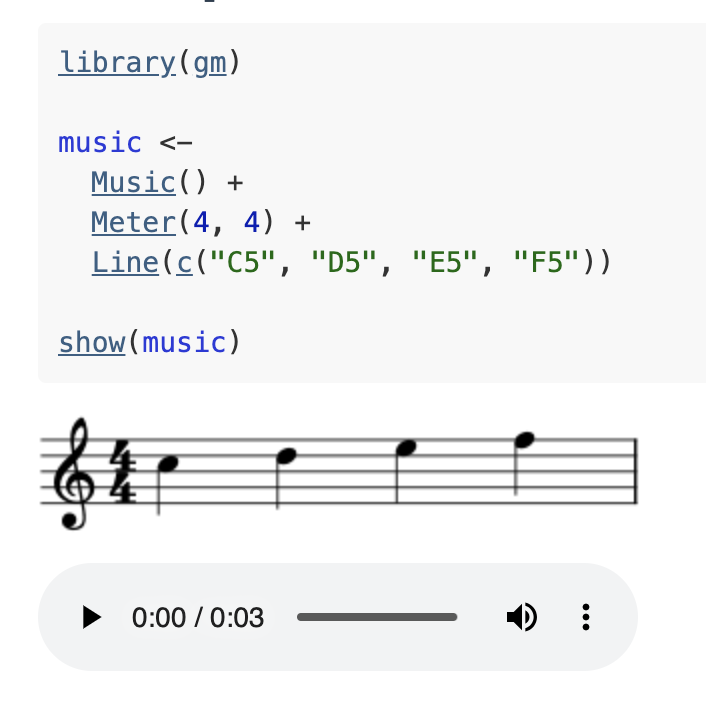
I was able to use the gm package in #RStats to quickly see how the intro to Stairway to Heaven sounded with different instruments.
Harp is so far my favorite so far. What do you think?
Try it out for yourself: https://t.co/ws1Xt5E3O6
#creativecoding#funwithcode
@fpslima I have also been thinking about creating some functions for importing MusicXML as data frames. This will open up the possibility of music programming and analysis.
@fpslima My personal goal is to create a tool for algorithm music composition. Something like the second example in this section https://t.co/8vS1o7UUZq and this one https://t.co/W26zuJ2rYu
@rtelmore The advantages of `function()` (and `library(pkg)` at the top) are first, people can know in the very beginning what packages are needed, and second, for ggplot2 and dplyr, if you add `package::`, the code can be very long.
@gavinprm@rstatstweet I think it depends on the level or learning stage of your students. If they are beginners, "Option A" would increase their cognitive load. It's like that you teach "werewolf" to who has no concept of "human" and "wolf".
#rstats package "erify" 0.2.0 is on CRAN https://t.co/ryvYrmpKcp
It's an implementation of "tidyverse error message" https://t.co/mnWEnsKjft
Can be used in your packages to check if arguments passed by users are valid https://t.co/loUhnnOLrr