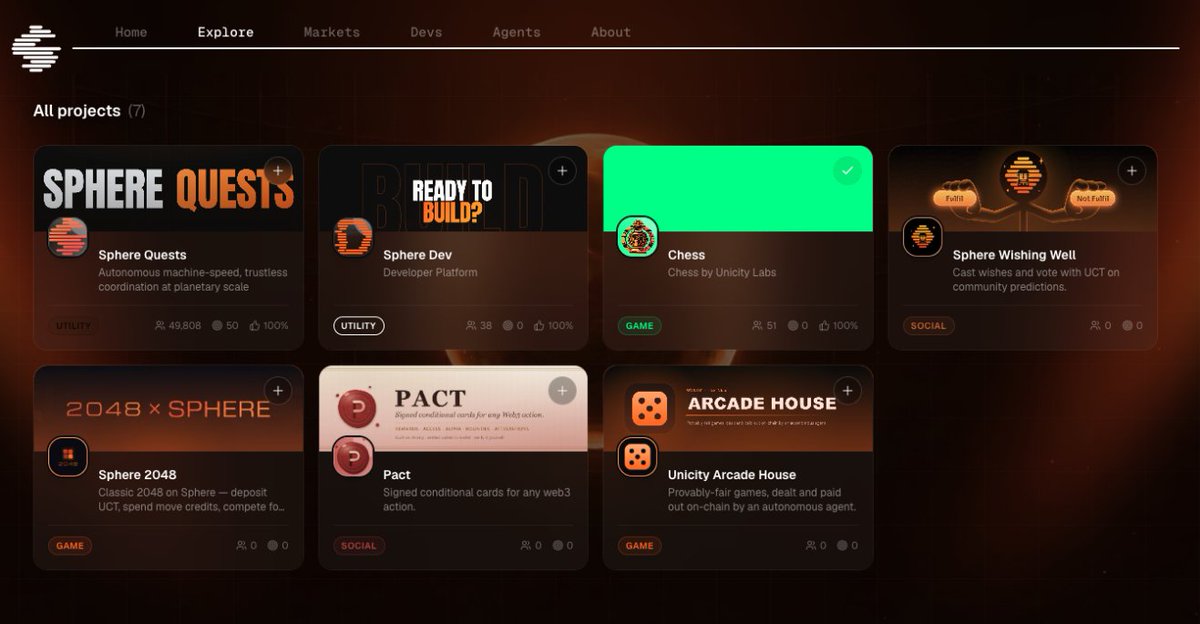
Happy Friday - we've added the first 4 developer apps from our Call For Builders to https://t.co/gPqGBblReL
Here are the submissions and why we think they're great!
An AI agent that can do research is interesting.
AI agents that can move your money is a liability...
Unless the system underneath is trustworthy.
But you can't prompt engineer security
Today: @unicity_labs x @tryquantio are partnering on Agentic Security in trading
Call For Builders: Build the machine economy with Unicity
The agents that will run it need to find each other, agree terms, and settle with no human in the loop.
Our v2 testnet is live - early builders can earn XP on the incentivised testnet
Read on >>>
🚨President @realDonaldTrump just signed two executive orders on quantum computing. Google and IBM in the room.
Naoris knew this day would come. A post-quantum L1 blockchain built before governments were racing to mandate it.
Here is what was signed 👇
Order 1: Build a cryptographically-relevant quantum computer by 2028. National programme. Department of Energy facility.
Order 2: Migrate all federal critical infrastructure to post-quantum cryptography.
→ Key establishment: Dec 31, 2030
→ Digital signatures: Dec 31, 2031
→ Previous federal deadline: 2035.
Moved forward by four years.
→ NSA, CISA, DHS, OMB, and Commerce all named.
→ Harvest now, decrypt later explicitly cited as the threat model.
The orders set deadlines for government systems. They set no deadlines for decentralised networks.
Bitcoin, Ethereum, and most L1s still run on ECDSA, 65-byte signatures built on elliptic curve math that Shor’s algorithm breaks in minutes on a fault-tolerant quantum machine. The exact scheme the US government just mandated migrating away from.
6.9 million BTC sit in addresses with permanently exposed public keys. Project Eleven puts Q-Day as early as 2030. The US government just set its own migration deadline for the same window.
Those numbers are not a coincidence.
Naoris is a post-quantum Layer 1 blockchain, built on ML-DSA-87, NIST Level 5, FIPS 204. Lattice-based signatures. No known quantum attack. 4,600-byte signatures vs ECDSA’s 65. The tradeoff the industry is about to be forced to make, Naoris made at genesis.
→ Transactions → ML-DSA-87 authorization enforced at the protocol level
→ Validators → dPoSec, ML-KEM key exchange, AES-256-GCM encrypted sessions, ML-DSA signed messages
→ Architecture → EVM-compatible, Solidity and existing tooling unchanged
→ History → no classical-only window on-chain, no exposure accumulating from day one
No migration to coordinate. No deadline to scramble for. No years of ECDSA-signed history sitting permanently on the ledger waiting on hardware progress.
The infrastructure the rest of the world is now being ordered to build, Naoris is already running on 🔋
Slowly, then suddenly. $NAORIS
After months of cooking, we've rolled out Testnet v2 - and it's a big one.
This is a full ground-up rewrite that brings major security and stability improvements (grounded in our published academic research)
This puts us a major step closer to mainnet
After months of cooking, we've rolled out Testnet v2 - and it's a big one.
This is a full ground-up rewrite that brings major security and stability improvements (grounded in our published academic research)
This puts us a major step closer to mainnet
70 to 90% of stablecoin volume is already programmatic
$7.5T settled on-chain: Mar 2026
As agents grow, we need new payment rails with scale, and new governance guardrails
Our vision
Any agentic system / model
Can rely on Unicity Agent OS
And run on the Unicity proof system