You do not have a martech problem. You have a seams problem.
The tools work. What fails is the space between them.
Consolidating onto one suite just moves the seams inside one vendor.
Unify the seams, not the platform.
You do not have a martech problem. You have a seams problem.
The tools work. What fails is the space between them.
Consolidating onto one suite just moves the seams inside one vendor.
Unify the seams, not the platform.
A dashboard full of green metrics is not the same as a business that is working.
I trusted numbers that were accurate and misleading for years.
Not because anyone lied. Because we measured the wrong things well.
Five questions I ask before I trust any dashboard.
You do not have a martech problem. You have a seams problem.
The tools work. What fails is the space between them, where data hands off and ownership blurs.
Consolidating onto one suite just moves the seams inside one vendor.
Unify the seams, not the platform.
The best strategic move I ever made looked like I did nothing.
A competitor launched. Everyone wanted to match immediately.
I pushed back. We waited. The launch stalled. The signal was noise.
Urgency is easy to manufacture. Patience requires a stronger argument.
OpenAI opened self-serve ChatGPT ads in May 2026.
Most teams will spend on the new channel before they can measure it.
A learning agenda comes before a spend agenda. What you want to learn determines what you fund.
What did your last test actually teach you?
You pay for a martech stack you use less than half of.
Gartner: only 49% of tools get used. Nobody owns the other half.
I built Phronetos to find the leak. Free diagnostic gives you a governance score, 0 to 100.
https://t.co/XEVM7Azc7J
Every 2026 GTM deck says: go ecosystem-led.
HubSpot's partner channel, now 100M dollar plus, was built by its 15th employee against orders. His pitch was rejected twice.
You don't plan an ecosystem. You notice the rep already building one, and you don't kill it.
45% of marketing leaders say their AI agents already failed them.
The model isn't the problem.
82% know clean data must come before AI. Only 26% can enforce it (LeanData, 2026).
Your agent runs through that gap at machine speed.
Buy the model last.
Your churn model is 90% accurate and still the wrong tool.
Accuracy tells you who is leaving. Not who you can save.
A churn score treats a persuadable and a lost cause the same.
Stop scoring who leaves. Start funding who you can keep.
MMM used to cost half a million dollars and nine months.
In 2026 it costs ten thousand dollars and runs on a laptop.
Last-click is not winning anymore. It just stopped being audited.
Your stack wasn't built.
It accumulated.
14,106 MarTech tools exist. The average team uses 33% of what they bought.
The other 67% is complexity you're paying for.
Cut. Consolidate. Integrate.
MMM used to cost half a million dollars and nine months.
In 2026 it costs ten thousand dollars and runs on a laptop.
Last-click is not winning anymore. It just stopped being audited.
My friends called someone pa-bibbo this weekend.
He answered a work email on Saturday.
Only the ones doing more get the label.
Coasters never do.
The word is not about the effort. It is about what the effort exposes.
Customers decide to stay in the first 30 days.
Most retention programs kick in at month three.
UserGuiding 2026: 3 or more core features in month one = 40 percent higher retention.
Your churn problem might be an onboarding problem.
Sunday is the only day I think slowly on purpose.
Most MarTech decisions aren't analytical. They're political.
Someone saw a competitor use a tool. Someone came back from a conference.
The slow thinking is where you catch that.
60% of the web is already cookieless.
Your attribution dashboard grades the other 40%.
Marketing mix modeling was a six-figure project in 2022. Meta and Google now give it away free.
The dashboard that looks most certain is the one lying to you the most.
State of Martech 2026: 5 tools or fewer = 23% more pipeline per headcount.
So teams are rushing to consolidate. Wrong lesson.
Lean stacks won because someone first decided who owns it, what breaks on noncompliance, who has authority.
The tools are not the load-bearing part.
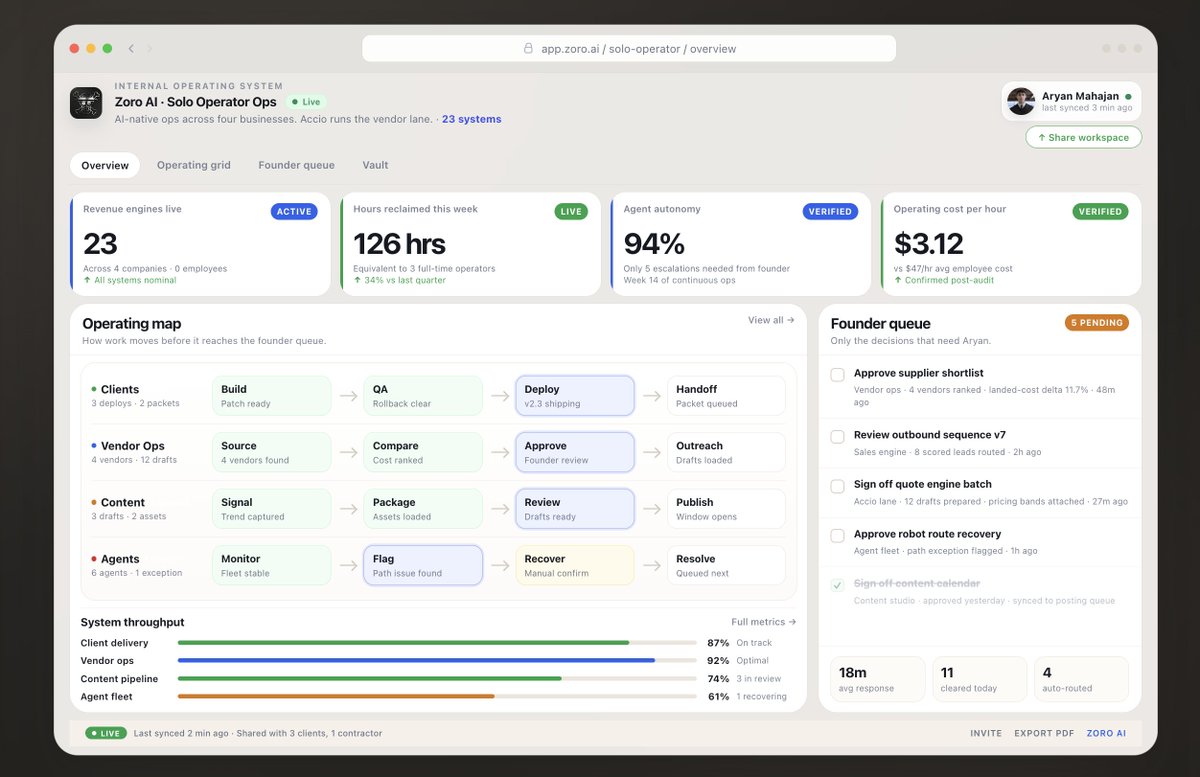
I replaced a $500K/year team with $1,100/month in AI.
23 agents. 5 departments. Everything automated.
4 businesses. 7 figures. Zero employees.
Here's the full operating system:
→ Engineering: Claude Code (47 Fortune 500 deployments this month)
→ Business Ops: @Accio_official (312 tasks automated, zero manual back-office)
→ Content: AI OS (3.1M impressions/month, zero keyboards touched)
→ Sales: AI SDR ($500K active pipeline, no agency)
→ Client Delivery: Agent Fleet (9 live Fortune 500 deployments, zero babysitting)
Business ops is the layer most solo operators never automate.
Supplier sourcing, vendor outreach, procurement, quote comparison — all running without me.
What makes this unfair:
→ $0 payroll vs $500K+ for a team doing the same work
→ 1,847 hours reclaimed this quarter
→ Every agent reports into one console
→ Scales to any volume without hiring
4 businesses. 23 agents. 1 operator.
I documented the entire setup. Every agent, every tool, every workflow, every dollar of infrastructure cost.
Like + comment "SOLO" + repost, and I'll DM it to you.
(must be following)