What shocks me is not just the scale of corruption in Kenya, but how numb we have become to it.
You look at the figures and your mind just can’t wrap around it. In much of Europe, someone with €3 million would comfortably be called wealthy. In Kenya, within sections of the political class, KES 500 million barely scratches the surface of what is siphoned off. When Uhuru publicly acknowledged that around KES 2 billion was being lost daily to corruption, it should have triggered a national reckoning. Instead, it became just another headline in the churn.
That normalization is perhaps the most dangerous part. When billions disappear every day, the numbers stop feeling real. They lose their weight. Yet those billions are hospitals not built, roads not repaired, youth not employed, businesses not financed. They are classrooms without desks and patients without medicine.
And there is a tragic irony to it all. The sums are so vast that even those looting them often do not grasp their magnitude. Wealth hidden behind shell companies, proxies, coded accounts in foreign jurisdictions. In some cases, fortunes end up frozen or inaccessible because the secrecy was so elaborate that even heirs cannot trace them.
Corruption at that scale is not just theft. It is economic terrorism. It distorts incentives, erodes trust, and quietly taxes the poor far more than the rich. The deeper tragedy is not only the money stolen, but the future foreclosed.
The real challenge is to move from outrage to systems that make such theft structurally difficult, politically costly, and socially unacceptable. Without that shift, the numbers will keep growing, and so will the numbness.
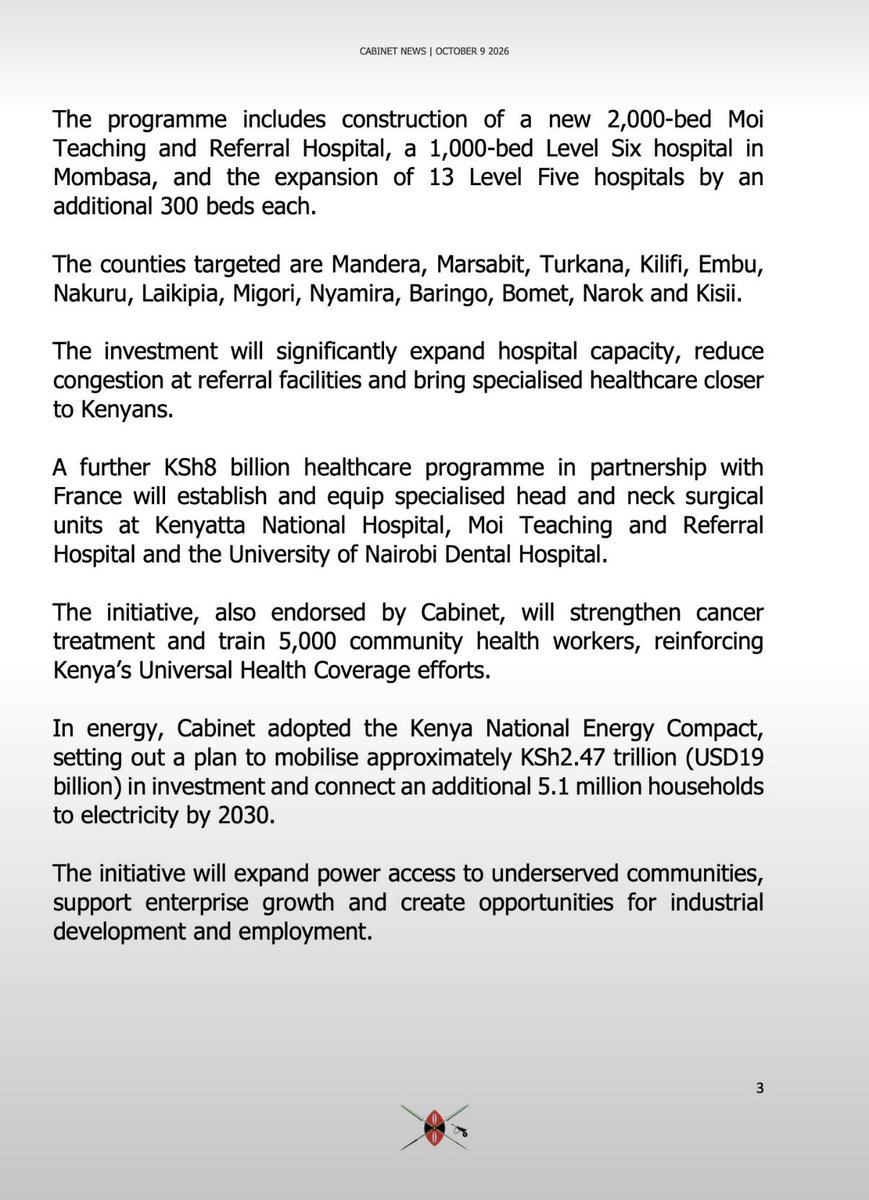
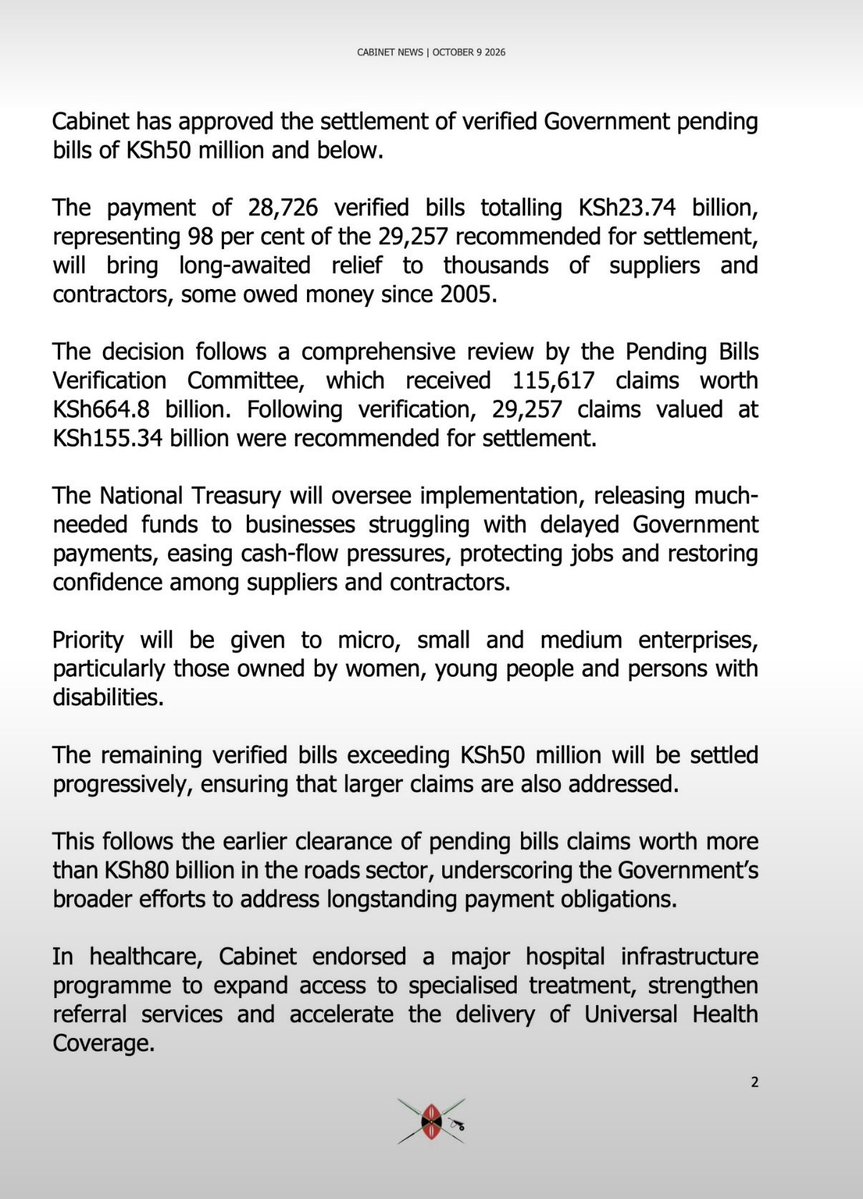
I was reading today’s Cabinet resolutions and it got me thinking: there is something missing from how they plan and measure performance.
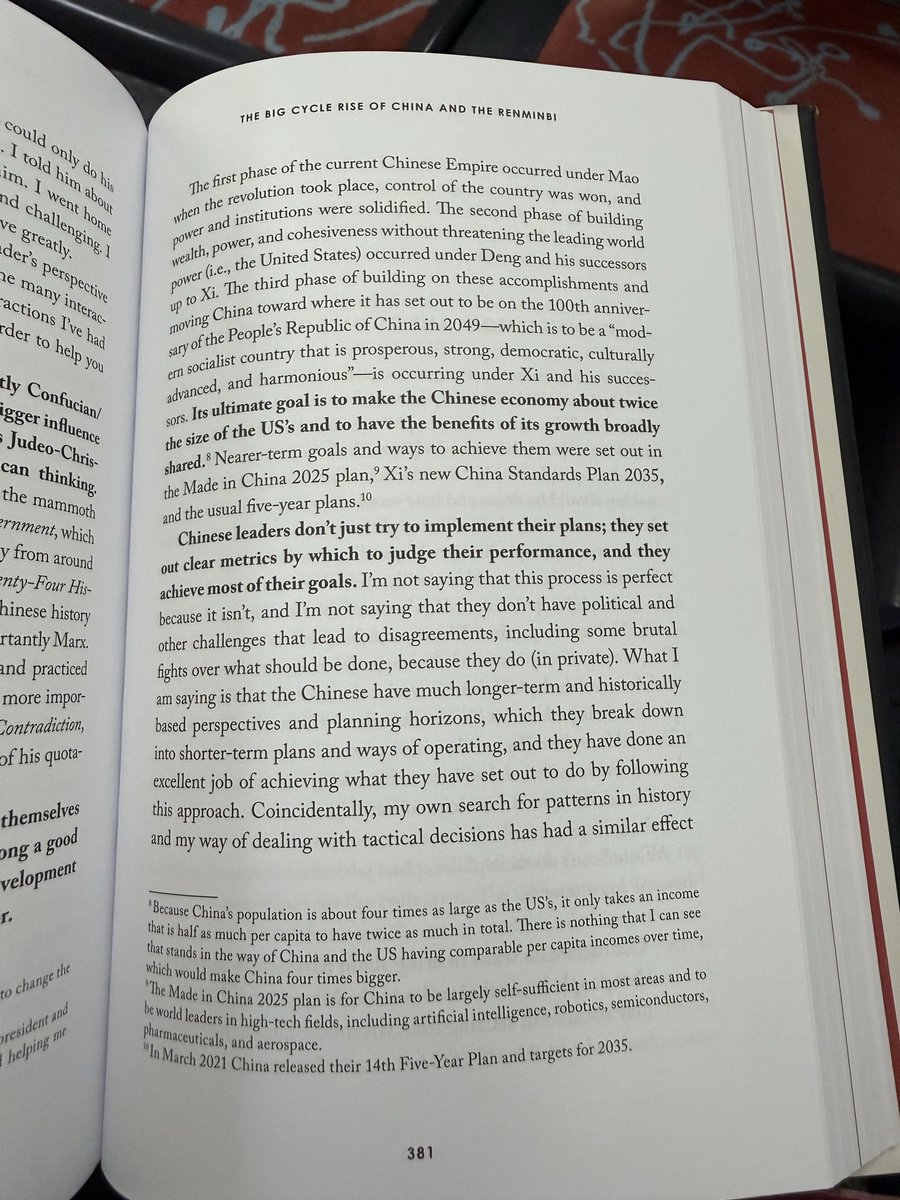
@RayDalio , writing about China’s planning discipline, describes how long-term ambitions are broken down into shorter-term plans with clear metrics for measuring performance. The objective is the vision, where are we going? Long-term key results define what success looks like and by when, while short-term key results allow government to track progress and adapt quickly.
Look at the Cabinet resolutions. There are hospitals, roads, energy projects, water infrastructure and USD350 million for Kenya Airways. Some have numerical targets, but what is largely missing is the feedback loop: What was the objective? What was the baseline? What was the target? Where are we now? What worked, what failed and what are we changing?
Take the proposed 2,000-bed hospital. Building 2,000 beds is an output, not the ultimate objective.
Objective: Improve access to specialised healthcare and reduce pressure on the referral system.
Key results could be: reduce specialist waiting times by 20% by 2027; have 80% of planned specialist departments operational by 2028; reduce referrals to Nairobi for selected procedures by 40% by 2029; reduce specialist waiting times by 50% from the 2026 baseline by 2030.
Now we can measure whether the hospital actually improved healthcare instead of merely celebrating that 2,000 beds were built.
The USD350 million for Kenya Airways should work the same way.
Objective: Restore KQ to sustainable financial and operational health while protecting taxpayers’ investment.
Key results could include: return economically viable grounded aircraft to service by 2027; reduce cancellations caused by aircraft availability; achieve sustainable positive operating cash flow without another emergency injection by 2028; meet defined profitability, debt and repayment targets by 2030.
Subsequent Cabinet meetings should return to these objectives and review the key results. Are they moving us towards the objective? If not, adjust them, delete what isn’t working, introduce new ones or redirect resources. Key results can be broken down from 5 years to 1 year to quarterly and monthly metrics.
That creates a simple management loop:
Objective → Long-term key results → Short-term key results → Execute → Measure → Learn → Adapt.
If government wants to build public trust, this is what should be published after Cabinet meetings, not vague resolutions that leave citizens trying to decipher whether the country is actually making progress.
Cabinet should become one of the country’s highest-level performance review meetings. Tell us what you wanted to achieve, the numbers you started with, where you wanted to get to, where you are today and what you are changing when things don’t work. Vague posting achia wakulima for Christ’s sake @StateHouseKenya
As Jay-Z famously put it: “Men lie, women lie, numbers don’t.”
It is not sweet! Stop romanticising political patronage. This money worship is the reason schools have no funding, that’s why SHA isn’t paying your hospital bills, that’s why Sakaja’s Nairobi is a dump site. We need to start criminalising such stupidity because that is not free money!!
Does my friend Hon @Lesuuda know just how Sifuna she is!
This is what we have been saying-This govt is illegitimate as long as it cannot protect lives, cannot protect the means of livelihood that Kenyans rely on to put food on their table, feed their children and take them to school in the name of "We have done development"
Which development?? Where? When we are in debt? No money flow in the economy? the health care system is on its death bed! And insecurity in this country is so high and a tone deaf CS of Interior answers a whole elected MP from Samburu West that just a few cows were killed?? Woooow!
There are many ways to kill an old man and Ruto knew it.
Raila Odinga died in a Kerala hospital on 15 October, aged 80, far from the Kenya he spent more than half of his life fighting for. Doctors said it cardiac arrest, set off by a thrombus, diabetes, kidney failure, a subdural haematoma and hypertension. Old age was already overtaken the man, buy what wore him out was the fools errand that Ruto set him to do.
Ruto sent Raila to chase the chair of the African Union Commission to sayuni, on Kenyan taxpayers shillings. The race was a mirage, and Ruto knew it. Djibouti’s Mahmoud Ali Youssouf was the sharper, younger candidate and won it. Kenya had already failed at this in 2017. Odinga crisscrossed Africa traversing more than 50,000 miles and 27 countries, courting presidents while arthritis and insulin marked the decline. By the time votes were cast in Addis Abeba, Raila had already suffered a deep vein thrombosis from the travel and a subdural hematoma from a fall. He could barely walk with a steady gait.
At home Ruto protests and impeachment talk. Raila’s presence in Kenya following a contested election, in which Ruto was suspected of malfeasance was unsettling. An old rival abroad was useful. With much fanfare, Ruto launched Raila’s bid for the African Union seat in August 2024 and pressed East Africa to back “our brother Raila.”
At 80 Odinga was no longer that man. His real years were the 1990s, when he broke the one-party state, and the early 2000’s when he helped usher a new constitutional order. By 2025 he was a relic on a farewell tour, sold as “a final act of continental service.” The body failed. The clot and the other illnesses finished what the miles across Africa had started.
The sibuor, tinga, jowi , Raila Amollo Odinga, who once slipped past dictators was wasted by a protégé turned a calloused ruler. He did not roar into retirement surrounded by grandchildren, family, and friends. He faded on a cold stretcher, ALONE, in a foreign hospital, exhausted to an early grave. A loss for Africa, and a shame on the legacy.
Ruto, 58 and still strong, eliminated a frail elder to save himself.
William Ruto has acted as a thug since becoming President breaching the Constitution & laws at every Juncture. They way he is abusing Edwin Sifuna is pathetic. Be sure I will soon be on television to deal with his nonesense directly. Bure kabisa!
TG is KANU'S Nairobi GUBERNATORIAL CANDIDATE
@WilliamsRuto@OleItumbi@KANUParty_ke@MoiGideon@edwinsifuna@a_m_media_ke
Imagine a Luo Mpig telling Luos to vote for Ruto because he's circumcised, but fail to tell why her husband is not.
So the men behind her did not take it as an insult? 🤣
Governor chelilim being grilled over missing 424M. They’re looting from their own then blame kikuyu marginalization.
The son of chelilim drives latest Porsche cayenne and Mercedes S550 in the streets of Eldoret and posting on TikTok. After this grilling what next?
you cannot compare Sifuna to Kasongo, it's like day and night, two very different people,
Mwafreeka,(who works for Kasongo) was ashamed when Kasongo was cooked badly 😂😂
Today as usual, we start the day by reminding our ASAL supporters that Kasongo lies, all the time, and all the time, Kasongo lies!-Shindwe.
When he hosted the residents of Marsabit in statehouse 4 months ago, where he gave then the usual brown envelope tokeism, he swore that the contractor would be on site to fix the Odda–Kinisa–Wajir–Mandera road after exactly 2 days!!
Four months later this is the state! Hadi gari za Askari zinakwama!!
When we say Ruto Must Go, we could prove it every hour as to why he must!!
Mic Check:
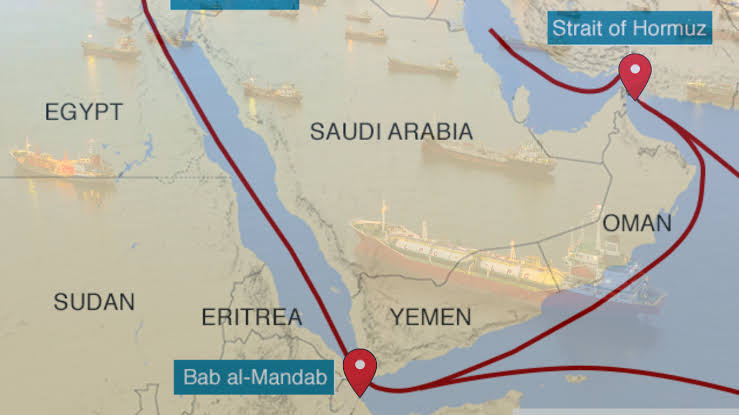
For those still in denial and living off of hopium, the Strait of Hormuz and the Bab al-Mandeb are entirely compromised.
When both chokepoints are compromised at once, the shock does not stay at sea.
It reaches YOUR wallet, and YOUR living room within the next 12 months fully, if not already...
THE IMPACTS I HAVE ALREADY WRITTEN ABOUT:
1. Diesel: the fuel that moves everything. Prices have hit records, and this is the Diesel Wars I named.
2. Crude oil: with 20 million barrels a day through Hormuz at risk, oil prices spike and stay volatile.
3. Freight rates: a war-risk voyage now costs over a million dollars a day, and that surcharge rides on every imported good.
4. Marine insurance: war-risk cover vanishes or prices itself out, and without cover the cargo stops.
5. Who can ship at all: private owners pull out, so only state-owned, politically aligned tankers move. The strait becomes a state-only waterway.
6. Food and groceries: higher fuel and freight feed straight into the price of everything on the shelf.
7. Gasoline at the pump: refined-product supply tightens and pump prices climb, even if you drive electric.
8. Electricity and utility bills: fuel and gas feedstock cost more, and the grid substations feeding you are now targets.
9. Drinking water: Gulf water comes from coastal desalination that runs on energy, and that infrastructure is being hit.
10. Trucking and logistics: diesel spikes bankrupt carriers, capacity leaves the road, and delivery costs rise.
11. Supply chains: port congestion, diversions around Africa, longer lead times and empty shelves.
12. Inflation: an energy shock is an inflation shock, so the cost of living reaccelerates across the board.
13. Interest rates and mortgages: that inflation keeps rates high, so borrowing, mortgages and refinancing stay expensive.
14. Bonds and savings: yields rise and bond prices fall, so the "safe" part of your portfolio loses value too.
15. Physical security of infrastructure: cheap drones ended the guarantee, and no fixed installation can be fully defended again.
16. The information you get: this is the blackout phase, where one side loses its voice and you receive a curated version of the war.
17. A widening war: Pakistan, Egypt, Somalia and the Horn of Africa are being pulled in, raising the risk of a regional conflict.
THE FULLER MAP OF WHAT A CLOSED CHOKEPOINT DOES TO YOU
18. Air travel: jet fuel is a distillate, so fares and fuel surcharges rise with it.
19. Flight routes: contested airspace reroutes corridors, adding hours and cost to journeys far from the Gulf.
20. Natural gas and LNG: much of the world's LNG exits through Hormuz, so Japan, Korea and Europe face supply and price shocks.
21. Fertiliser: natural gas is the feedstock for nitrogen fertiliser, so fertiliser prices climb.
22. Next year's food: costlier fertiliser and farm fuel now become higher grain prices at the next harvest.
23. Plastics and packaging: petrochemical feedstock costs rise, lifting the price of nearly every packaged good.
24. Fuel rationing and export bans: governments ration diesel and move to ban fuel exports, exactly the path I flagged for the United States.
25. Strategic reserves: emergency oil releases draw down the buffer, leaving less cushion for the next shock.
26. Importing-nation currencies: oil importers' currencies weaken as their energy import bill balloons.
27. Exporter budgets: even producers lose revenue when they cannot ship, straining Gulf state finances.
28. Sovereign borrowing: bond spreads widen for importers and exporters alike, raising the cost of national debt.
29. Stock markets: energy-sensitive sectors sell off, hitting airlines, shippers and manufacturers.
30. Pensions and retirement: that market volatility erodes the retirement savings of people who never touch oil.
31. Heavy industry: steel, glass, cement and chemicals run on energy, so plants cut output or shut down.
32. Jobs: freight, manufacturing and trade shed workers as volumes and margins fall.
33. Small business: higher fuel, freight and input costs squeeze cash flow until the thinnest operators fail.
34. Construction: diesel, asphalt, steel and shipped materials all cost more, so projects stall.
35. Agriculture: farm diesel, fertiliser and shipping costs rise together, squeezing farm incomes.
36. Asia to Europe trade: diversions around the Cape of Good Hope add roughly two weeks and a tank of fuel to every voyage.
37. Suez and Egypt: a closed Bab al-Mandeb collapses Suez Canal traffic and the canal revenue Egypt depends on.
38. Online shopping and delivery: last-mile and freight surcharges raise prices and slow delivery.
39. Consumer electronics: Asia-sourced goods face longer, costlier shipping, so prices rise and launches slip.
40. Cars and parts: components and finished vehicles are delayed, prices rise, and production lines idle.
41. Medicine and medical supplies: shipped drugs and devices face delays, putting essential supply at risk.
42. Defence spending: states divert budgets to naval escorts and missile defence, and taxpayers fund the bill.
43. Escalation risk: crowded warships and anonymous strikes raise the odds of miscalculation and direct war.
44. The nuclear and CBRN floor: a widening regional war lowers the threshold for the worst weapons being used.
45. Displacement: conflict and economic collapse push refugees across the region and beyond.
46. Remittances: migrant workers in a strained Gulf send less money home, hitting whole economies downstream.
47. Tourism: regional travel and Gulf transit hubs lose traffic, hurting tourism-dependent economies.
48. Navigation and timing systems: GPS jamming and spoofing in the strait spill into commercial shipping, aviation and the timing networks finance runs on.
49. Contracts and legal exposure: force majeure and war-risk exclusions trigger across global contracts, and disputes multiply.
50. The end of "it just flows": the quiet assumption that global trade always moves is broken, and every business now plans for disruption as the baseline.
What did I miss?
Signal, not noise!
A small snippet of what we will do within the first 100 days when we take office.
Hatuwezi sema kila kitu juu kazi ya Kasongo ni Kuiba tu ideas.
Dial *509# to register to our party and use our code 100!-The Equitable Party!
Twende kazi.
#ChamaYaSifuna
This guy Babu Owino shocks me everyday! During launch of Edwin Sifuna's The Equitable Party, millions have been waiting for, he is selling his The Mwananchi Party instead. Babu Owino believes he is bigger than Sifuna & can't even win Nairobi.
Tony Gachoka, KANU's Nairobi Gubernatorial Candidate
@HEBabuOwino@edwinsifuna@KANUParty_ke@MoiGideon