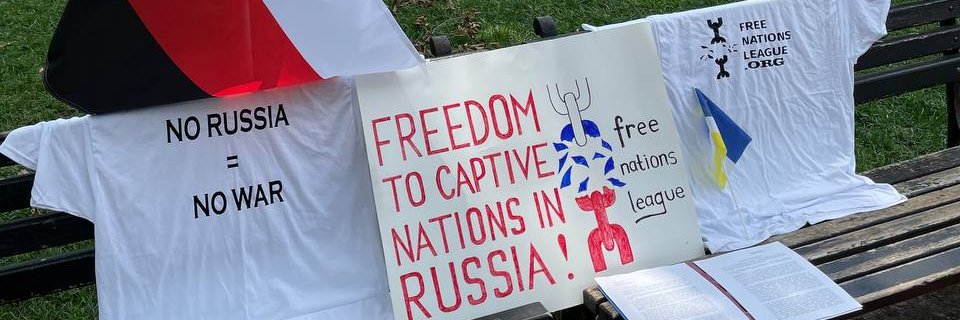
FNL is a socio-political platform that unites the national movements of the Bashkirs, Buryats, Ingrians, Circassians, Kalmyks, Tatars, Erzya, Chechens and Sakha
Thanks to one of our volunteers, there’s now a simple tool that lets you choose from multiple flags and add one to your social media profile picture.
Community work in action.
https://t.co/MUuluXWAZf
Flags at the Border: Free Nations League Holds Flash Mob in Narva
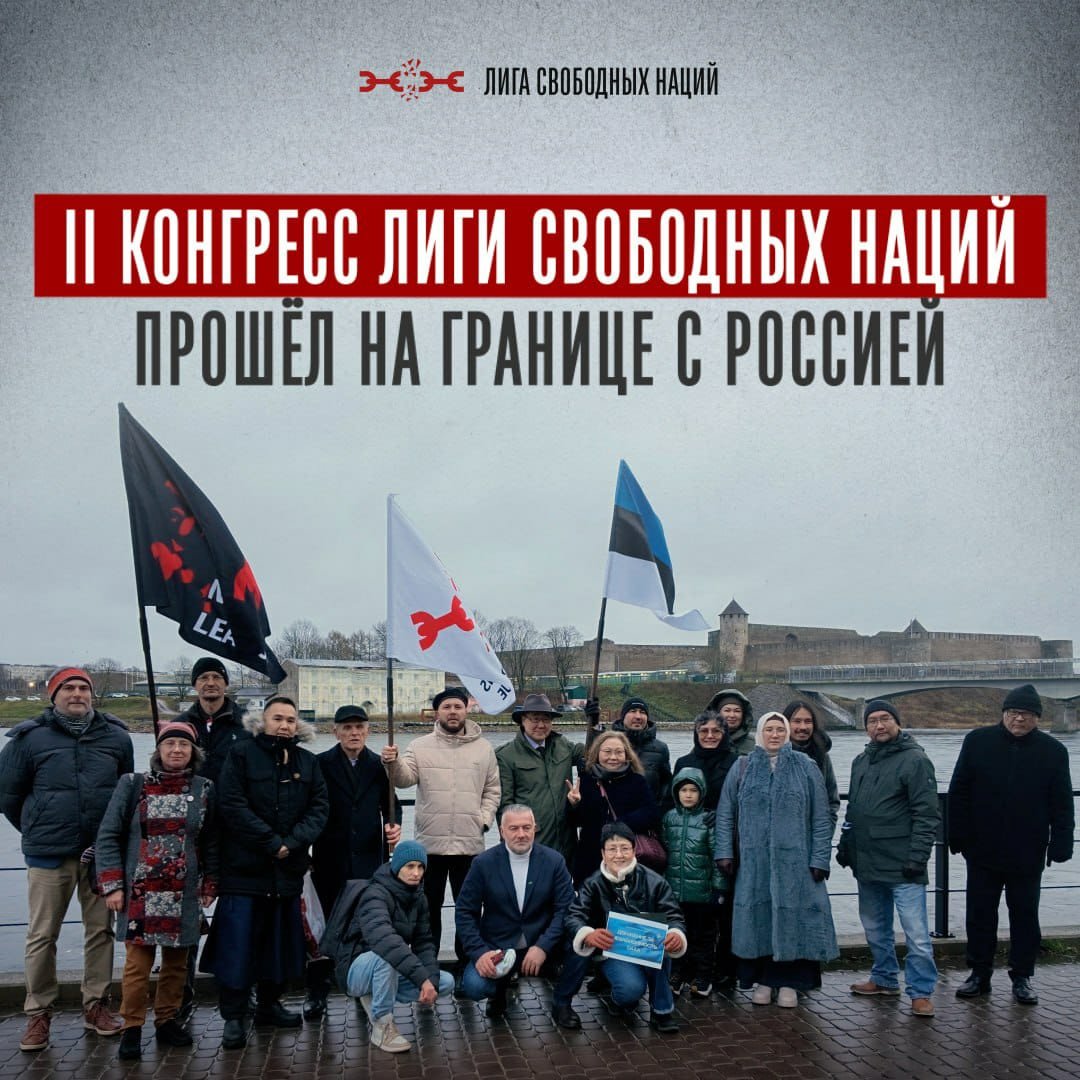
With the river and the Russian shore behind them—and flags in their hands—members of the Free Nations League held a flash mob on the embankment in the Estonian city of Narva, displaying the flags of various national republics.
The event was part of the League’s second Congress, which brought together representatives from the Tatar, Bashkir, Sakha, Buryat, Circassian, and Erzya national movements.
The Congress was once again held in Estonia; the first meeting took place in Otepää in April 2024. Two and a half years later, the delegates gathered to take stock of their progress and set priorities for the future.
This time, the chosen venue was Narva—a city situated directly on the border with Russia. Here, where the opposite bank is visible without the need for a map, the discussion regarding the freedom of nations takes on a particularly tangible quality.
The flash mob served as a clear expression of the League’s stance: the peoples whom Moscow has treated as its own property for centuries must speak for themselves. The Congress participants sent a message: the empire is not eternal, and the future of these national republics should be determined by those who live within them.
Those taking part in the event shared their vision for what that future should look like. The League advocates for genuine decolonization and the establishment of independent, democratic republics—states where human rights are strictly upheld, and where natural resources and mineral wealth serve the well-being of the citizens, rather than the interests of the Moscow metropole and its oligarchs.
On the banks of the Narva River, representatives from various nations—all united by the desire to determine their own destiny—made this vision known together.
https://t.co/9wTzH7miR5
#CaptiveNations #nations
📺https://t.co/9wTzH7miR5
Website: https://t.co/GhNikyQigp
Instagram: https://t.co/m6EbKS0ZEd…
Telegram: https://t.co/HpM2z1Vtl6
Youtube: https://t.co/JH5UgdOAb1
Instead of ending the war, let’s just move our data centers underground.
Putin has ordered the development of a program—to be completed by the end of the year—for building data centers in Sakha (Yakutia) and Kuzbass. The proposal involves placing servers directly inside old coal mines, a measure the authorities intend to use to protect them from drones.
In October, drones attacked data centers belonging to Yandex, VK, Sber, and the Federal Tax Service across several regions. Now, rather than ending the war, the Kremlin is searching for new places to hide its expensive equipment.
Experts estimate that constructing underground data centers will cost five times as much as building conventional ones. It will require laying infrastructure deep underground, pumping out water, and ensuring the safety of the mines.
This puts new regions at additional risk. The authorities plan to spend vast sums on underground servers without offering any explanation as to how they intend to protect the local residents.
The truth is, they don’t plan to protect them at all. They couldn’t care less about the people. And if drones manage to reach those locations too? Well, we’ll just dig even deeper—and the public will end up paying an even higher price.
#CaptiveNations #nations
Website: https://t.co/GhNikyQigp
Instagram: https://t.co/m6EbKS0ZEd…
Telegram: https://t.co/HpM2z1Vtl6
Youtube: https://t.co/JH5UgdOAb1
700,000 casualties. Air-raid sirens in Siberia. The war has reached the Baltic.
In this episode, we examine the escalation of the war, the scale of the casualties, the collapse of long-standing propaganda myths, and how the conflict is increasingly permeating the regions and the everyday lives of ordinary people. We discuss the fallout from reports regarding hundreds of thousands of dead and missing.
Dmitry Krivaksin explains how the situation has deteriorated to the point where Baltic Fleet bases are coming under attack, and air-raid sirens are sounding in cities across Siberia—demonstrating that the previously touted "red lines" no longer hold any weight.
We also take a close look at the reactions of "ultra-patriots," the tendency to scapegoat those nearby, the circulation of fabricated reports about military advances, the coercive rounding up of men, the activities of "shadow recruiters," schemes involving "black widows," and the intense pressure exerted on conscripts.
https://t.co/zxt4ngKQ12
Putin thanked the Sultan of Brunei for his assistance in strengthening defense capabilities and security.
Putin met at the Kremlin with the Sultan of Brunei, Hassanal Bolkiah, who has ruled his country for 59 years—ever since 1967! It seems he decided to learn a thing or two from a more seasoned colleague.
Putin thanked the Sultan for his help in bolstering defense capabilities and security:
"We are grateful for your cooperation in this sphere, which also extends to the activities of the Russian Federation’s Navy."
A particularly well-timed expression of gratitude, coming just after the corvette *Merkury* sank in a Libyan port.
Following the meeting, the two sides announced a strategic partnership: Putin proposed selling fertilizers, petrochemical products, and halal meat to Brunei, while the Sultan remarked that Putin was doing a fine job.
All in all, it was a productive meeting.
#CaptiveNations #nations
Website: https://t.co/GhNikyQigp
Instagram: https://t.co/m6EbKS0ZEd…
Telegram: https://t.co/HpM2z1Vtl6
Youtube: https://t.co/JH5UgdOAb1
The 2nd Congress of the Free Nations League in Photographs
On November 23–24, representatives of national movements—including Tatars, Bashkirs, Sakha, Buryats, Circassians, and Erzya—gathered in Narva, Estonia, right on the border with Russia.
The event spanned two days of meetings, discussions, and significant decision-making. Delegates adopted a new Charter, approved a report for the United Nations on the situation of indigenous peoples, and outlined plans for future cooperation.
We are sharing photographs from the Congress—an event that marks a new phase in the collaborative efforts of our national movements.
https://t.co/az2dM41CLk
#CaptiveNations #nations
📺https://t.co/az2dM41CLk
Website: https://t.co/GhNikyQigp
Instagram: https://t.co/m6EbKS0ZEd…
Telegram: https://t.co/HpM2z1Vtl6
Youtube: https://t.co/JH5UgdOAb1
"The League Has Ceased to Be an Idea and Has Become an Organization": How the 2nd Congress of the Free Nations League Unfolded in Narva
On November 23–24, 2026, the 2nd Congress of the Free Nations League took place in Narva, Estonia, right on the border with Russia.
Delegates of national movements summed up the results of two and a half years of work, adopted a new edition of the Charter, approved key political documents, and outlined further steps in the struggle for the rights and freedom of their peoples.
The venue was not chosen by chance. Right here, on the banks of the Narva River separating Estonia and Russia, the question of the future of the peoples remaining under Moscow's rule resonates with particular urgency.
The Congress was welcomed by well-known Estonian dissident and one of the authors of the Estonian Constitution, Jüri Adams, and Lithuanian political scientist, Professor Adas Jakubauskas.
"The League has ceased to be an idea and has become an organization," declared the President of the League and Inyazor (Chief Elder) of the Erzya people, Syres Boliayen, while presenting the report on the work accomplished.
#CaptiveNations #nations
📺https://t.co/az2dM41CLk
Website: https://t.co/GhNikyQigp
Instagram: https://t.co/m6EbKS0ZEd…
Telegram: https://t.co/HpM2z1Vtl6
Youtube: https://t.co/JH5UgdOAb1
https://t.co/az2dM41CLk
Transneft facility in Bashkortostan on fire following drone strike
On the night of November 26, drones attacked the Subhankulovo oil-pumping station in the Tuymazinsky District of Bashkortostan. A massive fire broke out following the strike, with thick plumes of black smoke rising over the industrial site. Local authorities report no casualties.
This is no minor oil depot; the station receives and pumps oil from Western Siberia and Bashkortostan. Its grounds house ten storage tanks with a total capacity of 160,000 cubic meters.
Notably, the facility is located approximately 1,300 kilometers from the Ukrainian border. This is not the first time it has been targeted—a previous strike occurred on July 23.
In recent months, drones have also repeatedly attacked oil refineries in Ufa, a petrochemical complex in Salavat, and facilities belonging to the Bashkir Soda Company.
#CaptiveNations #nations
Website: https://t.co/GhNikyQigp
Instagram: https://t.co/m6EbKS0ZEd…
Telegram: https://t.co/HpM2z1Vtl6
Youtube: https://t.co/JH5UgdOAb1
"They tried to take me in the middle of the night." Gen Z-ers from Buryatia on fleeing mobilization.
A conversation with two young Buryats—members of the "Gen Z" generation—who recently left Russia and their home region of Buryatia. They recount how they reached a point where staying had become dangerous: a late-night encounter that convinced them not to take any more risks; the situation at the military enlistment office and the pressure exerted on students; and the persistent, haunting feeling that "someone is coming for you—and they’ll never stop."
The video also covers: racial profiling at the airport; teachers delivering military draft notices in the middle of the night; the expansion of cemeteries in Buryatia; the assistance provided to refugees by Mongolia; and how school-based propaganda—specifically the "Conversations about Important Things" (Razgovory o vazhnom) program—contrasts with personal experience to shape these young people's views on the war.
The discussion concludes with a question: would they return if Buryat-Mongolia were to become independent?
https://t.co/bmrNwpFBIw
Putin marvels at how the tax authority squeezed 54 trillion rubles out of us
What a celebration at the Kremlin! The head of the Federal Tax Service, Daniil Egorov, boasted to Putin that, over the past ten months, 54.6 trillion rubles in taxes had been collected from us and from businesses—an increase of 5.4 trillion rubles compared to the previous year.
VAT—which the authorities raised to 22%—performed particularly well, with receipts surging by 33%, or 2.6 trillion rubles.
"Quite a result," Egorov remarked with admiration. "A good one," Putin agreed, sounding pleased.
And why wouldn't it be "good"? We are paying ever-higher prices for groceries, clothing, and other goods; tens of thousands of businesses are shutting down; and 66 regions are facing budget shortfalls. But, at least, the figures in the reports look impressive!
And this is just the beginning. New taxes await us next year—after all, the 17.1 trillion rubles needed for the war won't collect themselves.
#CaptiveNations #nations
Website: https://t.co/GhNikyQQ5X
Instagram: https://t.co/m6EbKS1xtL…
Telegram: https://t.co/HpM2z1W1aE
Youtube: https://t.co/JH5UgdP80z
Beaten and forced to sign a contract: FSIN finds "no violations"
Daniil Zalozny, a 20-year-old from St. Petersburg, was beaten and threatened with death while in the Kresty-2 pre-trial detention center, then coerced into signing a military service contract with the Ministry of Defense.
The entire process—a medical examination, psychological screening, the signing of the contract, and his release from the detention center into military custody—was carried out in a single day. The Federal Penitentiary Service (FSIN) conducted an inquiry and found no violations, claiming that the young man had volunteered to go to war.
Daniil is now at a military unit, from where he is set to be sent into an assault operation—a move that appears intended to ensure his quick demise and bury the evidence.
"He is on the verge of a breakdown. He cries and says he can’t take it anymore; it’s incredibly difficult for him there. On Sunday, he’s being brought back to the unit from training, and then he’ll be sent off on a combat mission," his mother says.
He is only 20 years old. His mother is pushing for an investigation, but the authorities insist that everything is in order and that this is exactly how things are supposed to be.
#CaptiveNations #nations
Website: https://t.co/GhNikyQigp
Instagram: https://t.co/m6EbKS0ZEd…
Telegram: https://t.co/HpM2z1Vtl6
Youtube: https://t.co/JH5UgdOAb1
Estonian Media on the Second Congress of the Free Nations League
Estonian national broadcaster ERR aired a report on the Second Congress of the Free Nations League, which took place on November 23–24 in Narva, right on the border with Russia.
The journalists covered the struggle of indigenous peoples for self-determination, the adoption of the League’s new Charter, appeals addressed to European states, and the challenges faced by national activists living in exile.
"We ask to be heard—to stop having our story told through the words of Moscow,"
stated Bolyaen Syres, President of the Free Nations League, in an interview.
The report also featured Rajana Dugar-de Ponte, a representative of the Buryat movement, and Oliver Loode, head of the Estonian-based @UralicC , who discussed the protection of national activists and the future prospects for our peoples.
The time has come for our peoples to be represented by ourselves, rather than by spokespersons for the Kremlin.
#CaptiveNations #nations
📺https://t.co/jFEg42WAAZ
Website: https://t.co/GhNikyQigp
Instagram: https://t.co/m6EbKS0ZEd…
Telegram: https://t.co/HpM2z1Vtl6
Youtube: https://t.co/JH5UgdOAb1
https://t.co/LyNmuXS4FP
Saratov’s Water Utility Purchases 600,000 Rubles’ Worth of Wooden Wedges
In Saratov, an unconventional method for dealing with utility infrastructure failures has emerged: the local water utility has purchased 38,000 wooden wedges for 587,500 rubles.
While residents wait for old pipes to be replaced, utility workers are preparing to plug holes in them with bits of wood.
This is no joke—the procurement process is already complete, though it remains unclear exactly who supplied the wedges.
While wooden wedges are indeed used for the temporary patching of leaks, the purchase of 38,000 of them is quite a quantity!
In the comments, Saratov residents have weighed in on the scale of this "utility modernization":
"Saratov can sleep soundly now."
"Should’ve bought 6 million rubles' worth!"
"So this is what they’re gouging the public for—hiking up utility rates for *this*? Some 'modernization' that is!"
"At least the lumberjacks have work as long as the water utility exists."
"Now I can rest easy—there’s order in the country, 'optimization' at work. And, as always, Putin has nothing to do with it."
#CaptiveNations #nations
Website: https://t.co/GhNikyQigp
Instagram: https://t.co/m6EbKS0ZEd…
Telegram: https://t.co/HpM2z1Vtl6
Youtube: https://t.co/JH5UgdOAb1
The of Free Nations League Convenes a Congress on Russia’s Border
On November 23–24, the 2nd Congress of the Free Nations League—an alliance of 12 national movements representing the indigenous peoples of the Russian Federation—took place in Narva, Estonia. Delegates ratified a new Charter, adopted key documents concerning the rights of their peoples, and defined the future direction of their international efforts.
A major outcome of the Congress was the report, "On the Situation of Indigenous Peoples in the Russian Federation." Prepared in accordance with UN standards, the report was adopted unanimously. By December 10, it will be submitted to the UN Special Rapporteur, Mariana Katzarova, as well as the UN Special Rapporteur on the rights of indigenous peoples. Subsequently, the report will be presented to various UN committees, the Parliamentary Assembly of the Council of Europe (PACE), and the European Parliament.
The Congress also issued statements regarding the rights of these peoples to the natural resources of their ancestral lands and the status of their native languages. Furthermore, appeals were addressed to the parliaments of Estonia and Mongolia, the Organization of Turkic States, and TURKSOY. A separate appeal focuses on the threats faced by national activists living in exile, including the issue of political assassinations.
"The League has evolved from an idea into an organization,"
stated Syres Bolyaen, President of the Free Nations League, as he summarized the proceedings.
The figures bear this out: the League’s various channels have garnered over 905,000 subscribers, and its YouTube videos have amassed 1.37 billion views since January 2024—the majority originating from within Russia. The League has held meetings with members of the European Parliament, established contacts with politicians from various nations, and launched an English-language magazine, Atlas of Nations.
"The voice of our peoples is now being heard in halls where, until recently, only representatives from Moscow or the Russian opposition were invited. The foundation of the League lies in its national movements." Today, it is composed of Tatars, Bashkirs, Sakha, Buryats, Circassians, Oirat-Kalmyks, and Erzya.
Over the years, representatives of other peoples—such as Udmurts, Mari, Moksha, and Ingrian Finns—have also joined the League. The next step is for them to establish their own national organizations. There are peoples who currently lack any independent organizations—neither in exile nor in their homelands. Helping them find their own voice is one of the League’s most important tasks,”
— stated Syres Bolyaen.
Next year, the League will focus on strengthening national movements, protecting activists, preserving native languages, and developing independent national media.
Our peoples are asserting their rights ever more loudly on the international stage. Their voices are now being heard not only on social media but also within European parliaments and United Nations bodies.
https://t.co/uJn2m7m33T
#CaptiveNations #nations
📺https://t.co/uJn2m7m33T
Website: https://t.co/GhNikyQQ5X
Instagram: https://t.co/m6EbKS1xtL…
Telegram: https://t.co/HpM2z1W1aE
Youtube: https://t.co/JH5UgdP80z
Murmansk Region Governor Detained for Embezzling One Billion Rubles
Murmansk Region Governor Andrey Chibis has been detained in Moscow. He is suspected of embezzling and misappropriating over one billion rubles—funds that had been allocated for the reconstruction of the Apatity–Kirovsk road.
And that’s not all! According to the Ministry of Internal Affairs, investigators are also looking into the theft of 39 million rubles from the regional Ministry of Construction’s budget, as well as the illegal transfer of funds abroad.
Chibis has led the region since 2019. Prior to that, he served as Deputy Minister of Construction and Housing and Utilities—a position that, in itself, speaks volumes about his exceptional integrity and honesty.
Before long, we’ll find out the amount of bail required for his release, allowing him to return to his work—which he will surely continue to perform with the same "honesty" as before.
#CaptiveNations #nations
Website: https://t.co/GhNikyQigp
Instagram: https://t.co/m6EbKS0ZEd…
Telegram: https://t.co/HpM2z1Vtl6
Youtube: https://t.co/JH5UgdOAb1