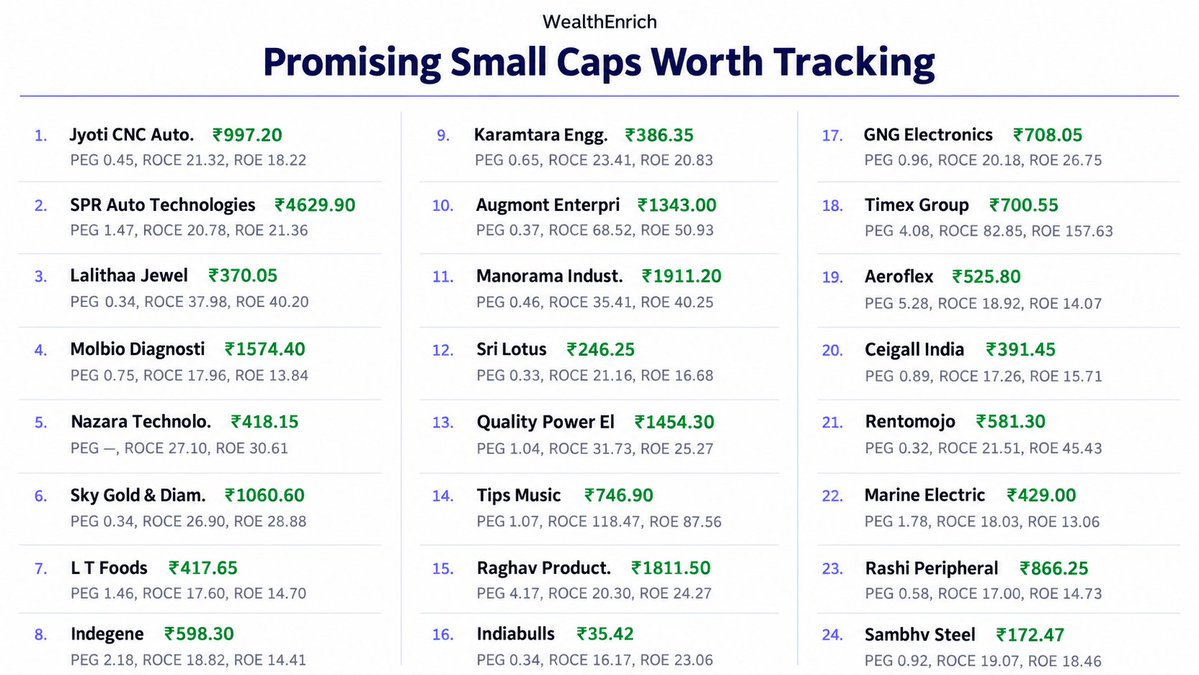
Select Smallcaps where
'Growth is Strong' &
'Momentum is Building'!
Over the weekend I studied a bunch of smallcaps & these 24 stood out for their 3 yr growth numbers, return ratios, manageable debt & recent price strength.
Yes in some valuations do look stretched/expensive, but worth studying further!
@ShivAroor In #France Gen Z must have the freedom to protest. Right now France has declared a state of emergency what kind of dictatorship is this?
@FRANCE24 must raise your voice about freedom of speech and against this dictatorial regime. This regime must go. Regime change must happen.
Captain Smit Machchhar is a HERO.
In the face of the gravest danger and despite being seriously injured, he showed immense courage and an unwavering resolve to protect the lives of others.
His valour helped save hundreds of lives and avert a great tragedy.
India is proud of Captain Machchhar.
Praying for his speedy recovery, renewed strength and good health.
Indian pilot, others prevented another 9/11: Israel PM
Israel PM Netanyahu says the Indian pilot was "attacked" by co pilot with an "axe", explaining that Smit "managed to unlock the door".
vdo ctsy: CBS News
Escaping the Rat Race: What It Really Means (and How to Get Out)
The "rat race" is the cycle most working people fall into: earn money, spend most of it on lifestyle and obligations, and repeat the same cycle next month — with little left over to build real wealth. The name comes from the image of a rat running on a wheel: constant motion, no actual progress.
Why the Rat Race Happens
It's rarely about how much someone earns — it's about the relationship between income and expenses. As income rises, expenses tend to rise with it. A promotion leads to a bigger house, a better car, more dining out. This is often called lifestyle inflation, and it's the single biggest reason high earners can still feel financially stuck.
The core problem: most people trade time for money (a job or salary) and then spend that money on things that don't generate more money. There's no engine building wealth in the background — only a paycheck-to-paycheck loop.
The Core Shift: Assets vs. Liabilities
The way out starts with a simple distinction:
Assets put money in your pocket — stocks, mutual funds, rental property, a business that runs without your constant involvement.
Liabilities take money out of your pocket — a car loan, credit card debt, a large house payment on a home that isn't earning anything.
The rat race continues as long as most of your income goes toward liabilities. It starts breaking down the moment a portion of your income goes toward acquiring assets instead — and those assets begin producing income of their own.
Steps to Move From the Rat Race Toward Financial Freedom
1. Track where your money actually goes.
Most people underestimate their spending on small, recurring things — subscriptions, eating out, impulse purchases. A simple monthly review often reveals 15–20% of income that can be redirected without any real sacrifice.
2. Pay yourself first.
Instead of saving whatever is left after spending, flip the order: set aside a fixed percentage of income for investing the moment you're paid, and live on the rest. Even 20% is a strong starting point.
3. Build an emergency fund before investing aggressively.
3–6 months of expenses in a liquid instrument (like a liquid mutual fund or savings account) prevents you from having to sell investments at a bad time when life throws a surprise expense.
4. Invest consistently, not occasionally.
A Systematic Investment Plan (SIP) into equity mutual funds or a disciplined habit of buying quality stocks regularly does more for long-term wealth than trying to time the market. Compounding rewards consistency far more than it rewards timing.
5. Avoid debt that funds depreciating things.
Loans for cars, gadgets, or vacations often keep people in the race longest, since EMIs eat directly into the surplus that could otherwise be invested. Debt used to acquire an appreciating or income-generating asset is a different story.
6. Diversify income, not just investments.
A single salary is a single point of failure. Even a modest side income — freelancing, a small business, dividend income, or rental income — reduces dependence on one employer and builds a second engine of cash flow.
7. Define what "enough" looks like.
Without a target, lifestyle inflation has no ceiling. Deciding in advance what a comfortable, sustainable lifestyle costs makes it much easier to direct surplus income into wealth-building instead of consumption.
The Long Game
Getting out of the rat race isn't usually about one big move — it's the compounding effect of small, consistent decisions: spending less than you earn, investing the difference regularly, and letting time and compounding do the heavy lifting. The gap between income and expenses is what funds every asset you'll ever own — protecting and widening that gap is the real game.
Risk v/s Reward in #Investing !
A) High Risk, High Return (or Big Loss):
Crypto, Commodities, F&O, Penny Stocks
B) Medium Risk, Balanced Return:
Mid & Small Cap MFs/Stocks, Rental Property
C) Low Risk, Steady Return:
Bluechip Stocks, Govt Bonds, PSU Debt Funds
D) Very Low Risk, Very Low Return:
FD, PPF, Savings Account, RBI Bonds
Your Risk appetite determines you pick.
Also your goal & age also matters !
This Video Never Gets Old. Watching on Loop 🥺
What is the Purpose of Wealth? Priceless words from the Big Bull.
Motivational 👍 Pass on this Message to all.
#FI
Happy 80th Independence Day, India!
From the vibrant energy of Mumbai to the beauty of Srinagar, the meadows of Pahalgam, the warmth of Jammu and Udhampur, the historic heart of New Delhi, and a few lesser know sites 🙂 in between. I’ve had the privilege of experiencing this many areas, but still not nearly enough of it.
A rising power of 1.4 billion people, rich in culture, resilience, and spirit. Proud of how far you’ve come and excited for all that’s still ahead. Jai Hind!
Nifty Is More or Less Where It Was 2 Years Ago
I wrote about this almost a year back, when Nifty had already been moving sideways & people were losing patience with it. I checked the same chart yesterday & very little has changed, except that the flat phase is now close to two years old. Since the middle of 2024 the index has stayed between roughly 22,000 & 26,300, & we have had tariffs, wars, FII selling & a few weak earnings quarters in between, yet it is still sitting inside the same band.
The swings were not small, #Nifty crossed 26,000 in September 2024 & then fell sharply, came close to 22,000 by March 2025, went above 26,000 again by end 2025, dropped back to 22,500 to 23,000 in early 2026, & today we are around 24,000 to 25,000. Plenty of movement if you were trading it, almost nothing to show for it if you were simply holding.
I am not a technical analyst & I do not read charts well, but after enough years I have stopped treating a long flat stretch as bad news. When valuations get expensive, the market does not always need to fall 25 or 30% to correct them. Sometimes prices just stop rising for a while & profits catch up. It is basically a time correction instead of a price correction, or can I say a SOLID CONSOLIDATION !
But if we move away from Nifty, a lot has changed, Yes a LOT ! Companies have added two more years of profits while Nifty has stayed broadly flat, several crowded names from 2024 are down 30 to 50% from their highs, market leadership has changed more than once, & a few stories that were running only because money was easy are no longer working. So quite a bit of the froth has already disappeared even though Nifty itself has not crashed.
I think for investors the harder part in phases like this is actually the boredom. When a market crashes you at least know why you are uncomfortable, but when it goes nowhere for 18 or 24 months you naturally start questioning things, whether India has become too expensive, whether the bull run is already over. What I have usually seen is that people become interested again only after the market starts moving & very few people enjoy waiting through this part.
Now coming to 30,000, because I know that is the obvious question. The top of this range is around 26,000 to 26,300, so a proper break above that plus even a 15% move puts you near 30,000, & 20% takes it past 31,000. But I would not take that 30,000 number too seriously yet. First Nifty actually has to break this range, & then earnings have to justify the move, otherwise it is only a number somebody drew on a chart.
This can also drag on longer. Crude, tariffs, FII flows or another slow earnings quarter can keep the market stuck, & we may get one more ugly fall inside the range before anything changes. I really do not know when it breaks out & that does not bother me much.
So what am I doing in this market?
Pretty much what I do in any market, except that there is more time for it now. Most of my Sunday mornings these days go into annual reports & concalls of companies I do not even own yet. The list I am building is short & it grows slowly, because I am only interested in businesses that can grow profits at 20 to 25% or more without needing everything to go right for them. I check whether the management actually did what it promised four quarters ago. I check what I am being asked to pay for that growth, because a good company at a silly price is still a bad investment. And I sell when the business starts slipping, not on the day Nifty falls 5%.
I also keep some cash aside, but very little. Not to time anything, but because there are always two or three weeks in a year when a perfectly good company drops 15% only because the whole market is having a bad time, & you want to be the one with money on that day.
Ask yourself this key question: If Nifty breaks 26,300 next month & runs 10-12% in coming month or say six weeks, what exactly are you going to buy? If the honest answer is that you will figure it out then, you will end up buying whatever is already up 40%, at a price everybody else has discovered before you. That is how most people enter a bull market, late & expensive & then they crib & say the market never gave them a chance.
Nifty first crossed 25,000 almost 2 years ago. Maybe that was the correction. Not the crash everybody kept waiting for, just a long & boring wait. I am fine with that, because the companies on my list have kept growing through all of it, & sooner or later the price has to catch up with the profits !
Nobody cares for the glorious past.
What matters is a bright future.
What we are doing now decides it.
True for countries, business entities and also for individuals.
Great to be back in India. @LiamSCollins and I back for another research trip in support of our book on Operation Sindoor. We believe so much of the story has yet to be told. Strategic Changes. Offense. Defense. Integration. Escalation management. Land, Air, Sea, Drone, Cyber. Many firsts.
The U.S. national debt now exceeds $39.835 trillion. The larger the debt grows, the harder it is for the Fed to raise interest rates, but the more important it becomes to raise rates, as the growing debt is what's driving the Fed to create inflation to help finance it. Got gold?