If you’re working just to get by you gonna be working forever
The quicker you build your buffer the quicker you escape the rat race
No one can
Steal your time
Cancel /control you
No one is in control of your future but you
Get money, buy income
Once the words are out, you cannot take them back. Keep them under control. Be particularly careful with sarcasm: The momentary satisfaction you gain with your biting words will be outweighed by the price you pay.
A few months ago, my grammar was not particularly great, especially here on X.
Then, one beautiful morning, I received a call from Dr. Oby Ezekwesili ( @obyezeks ) that changed that aspect of my life forever.
She advised me to go back to Primary 3 and rebuild my foundation in English.
She said something profound: Once you fix the foundation, everything else begins to fall into place.
I took her advice wholeheartedly. I went back to study Primary 3 Grammar and Comprehension, and that simple decision transformed my command of English.
I remain deeply grateful to @obyezeks for that invaluable piece of advice. Its impact on my life has been remarkable.
But this experience taught me something much bigger about education.
Many of us are struggling today, not because we lack intelligence, but because we are building on weak educational foundations.
We keep trying to fix problems at the top when the real problems are at the bottom.
Sometimes, the greatest form of progress is having the humility to go back to the basics and rebuild properly.
You cannot build excellence on a foundation you have refused to repair.
Feedback is a gift that few appreciate. People sometimes see it as unfair criticism when it’s delivered disrespectfully or when they don't respect the person giving it. Acknowledging this publicly and thanking Aunty @obyezeks is amazing, and she's earned it.
She never minces words and has also given me private feedback on something I did wrong in the past. The key here is that she does it privately and respectfully. She also does it when the stakes are high, especially when you can impact other people’s lives.
I tell young managers to build respect before they start giving feedback. Even my wife acknowledges that she used to think I was too abrasive with feedback until she read the book below, which I always recommend.
The wrong tone or the wrong timing can make good intentions turn sour. This also applies when providing feedback to people with more power than you. They must respect your opinion and value it because of how you present it.
A moving man learns more than the static man, no matter what direction he moves. They also gain better perspective from mistakes.
One of my more successful cousins in Benin City once tried to walk from the Sahara to Europe. That trip changed him profoundly. Movement is about experience and not just finding opportunity. Opportunities may be all around you, but you may lack perspective until you move around.
That is why one of the first things people do after settling in the diaspora is try to finance a project or business back home. They have learned and seen opportunities in the place they left behind.
I can't explain it, but it seems your fortune changes based on your location. That is why a moving man meets his luck. Keep moving and don't be static. When you find your place, consolidate. A word is too much for the wise.
@Cryptosmeadow You can't change your financial situation by remaining static. There is something already preventing you from reaching your full potential where you are. Seek a place that gives you room to fly.
Guy: Oga, I am getting married in Enugu and sending you an invitation.
Me: Congratulations! The only thing is that I won't make it as I hardly travel to Nigeria.
Guy: Oga, I know but you can send your transport fare.
I am still wondering how to respond. We are acquaintances and not close friends. He did something for me once and I was grateful. I am in his debt but this is unexpected.
If I was not going to be there, why should I send transport fare? I would prefer to help in another way and in kind. Wedding registries need to become more popular.
This brings another issue of the obligations friends and family impose without considering that you may have not included them in your plans and budgets. Any contingency budgeting I do is for medical emergencies and not needless events.
I have a policy of not doing any funeral contributions anymore. They have also stopped adding me on WhatsApp groups for those things.
One friend made me the Chairman of his Catholic church’s harvest twice. I have never been to the church. I warned him the third time he tried it and stopped giving.
I prefer to give with joy rather than to give with a grudge. I have far too many family obligations already to do charity. My closest friends know and understand this. Some even sent me money recently when they heard that I had surgery and was at home. I didn't ask them for it but I was very grateful. They know I would do much more for them when I can.
“Nothing impoverishes a man faster than unbridled generosity” - Prof Osuide.
When you’ve been poor and then rich, you can sometimes give good advice freely, but most of your advice would be wrong, as it discounts luck. When you have been rich and then poor, then rich again, you will learn not to give advice freely until you’ve listened to people carefully.
It is very easy to listen to the rich man talk and believe that if you follow their path, you will likely become rich. The truth is that the path to wealth for everyone is unique and depends on how well they use their advantages.
This morning I took my family out for brunch and met a guy who fixes ships and tankers. A very understated guy who helps others who take risks to build and protect their wealth. He told me of his current boss, who is on his 4th tanker and looking to do 20. His boss is 35 years old and a Nigerian of Indian origin. His own father is very wealthy.
He can take advantage of his father’s wealth to grow because he learned from his dad how to avoid the risks and pitfalls. I thought about my life and realized that I saw those risks and pitfalls with my uncle, whom I lived with longer than I lived with my father, and who raised me, but it was Herbert who learned the most and became rich.
My uncle used to tell us that there is no crime at all in being poor, and in fact, most poor people are the happiest. The greatest crime is being rich and being poor again. You destroy hope for so many people in the process. It is why he always fought back after every adversity and came back up.
I realized that I learned that part very well from him. It is the most valuable gift he gave to me. Those who learned from him and just became rich didn't see the full life cycle. Henry Abebe, Aigboje, Herbert, and I did. It changed all of us in different ways.
For them, it was about taking maximum risks and winning. For me, it was to play the long-term game while remaining functional. My uncle turns 70 this year, and I have been with him for more than half of his life. I have seen that many risks aren't worth it. Life is meant to be lived and not performed.
My biggest mentor is 80 and lives in Cornwall, England. I can't wait to visit him this summer, as I learned a lot more from him about the long game than anyone else. A business he started after age 60 generates millions of pounds in profit each month and is still growing. He and his wife now follow their granddaughter, who plays Rugby for England, around the world while his son runs the business.
There are things one can comment on that people would not believe or understand. When people unfairly malign some founders, I get upset because I have seen them at their lowest and helped them with basic things they couldn't afford, even after they raised so-called “millions of dollars.”
Many don't understand how startup funding works. Announcements may be made, but the money doesn't always come in one chunk, and overheads are insane when you are growing fast.
This is why I am always against large fundraising announcements, as they are rarely a true reflection of the truth. Even VCs who do fundraises never get all the money at once and sweat through capital calls.
A relative in the industry once came to Ghana and was looking for a cheap hotel. I didn't understand why someone who gave out millions of dollars was living like that until I was on the other side. Those management fees don't land like the lottery. You suffer for it, and it doesn't cover much. It was why I decided not to do that anymore and take life easy.
So many of the perceptions people have about wealth are wrong. Cash flow is everything, and things can go horribly wrong when inflows and outflows are mismatched.
I have repeated several times here that my uncle, with all his banking career income and billions of Naira in assets, was down to his last 1000 Naira at home in 1999, yet we still ended up buying a bank that year. The lesson of coming out of that hole never left me. It is why I make some small, random investments that people may not understand, which sometimes pay off unexpectedly.
A domain sale once helped to pay my children’s school fees. A paid Calendly appointment bought my wife a set of tires and a fridge. The key is ALWAYS to keep earning and investing in what can sustain cash flow. There are investments for capital gains and for cash flow. The magic in all of this is keeping the burn rate low. No amount is too small to save or make.
An unexpected £150 overdraft from Barclays during my lowest period enabled me to take clients to a dinner that changed my life.
Take this as brotherly advice from someone who *probably* understands the market better than you do.
I take maybe 3–4 trades a year and hit about 50–75% of them. Never perfect. Never gotten a 100% hit.
One thing I’m certain of: day trading is one of the fastest ways to financial ruins. Just go and get a job bro or find something else to supplement your income. And futures? Even worse. That’s not a game you “figure out” by grinding harder, it’s one you’re better off avoiding entirely.
Saying this cos I get a lot of DMs from
people curious about my perspective on it. Stay away from it.
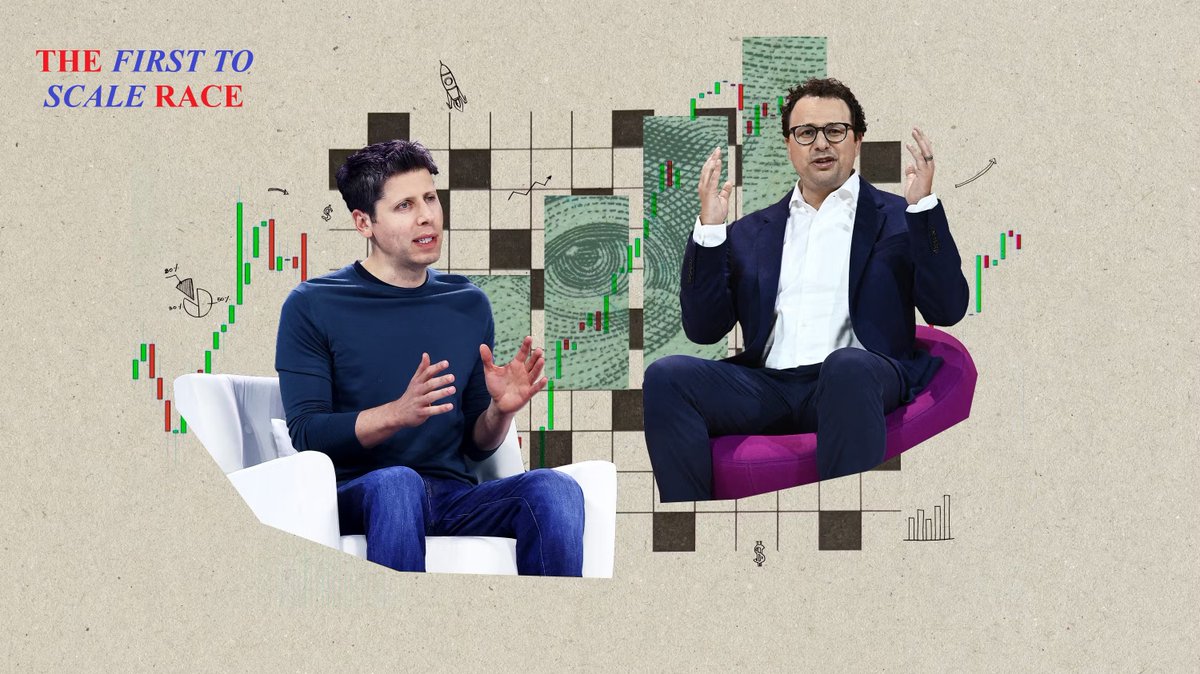
In business classrooms and boardrooms, we romanticize first-mover advantage. We assume that whoever starts first will finish first. But history, when examined over the long horizon, teaches a different lesson: what truly matters is first-scaler advantage. It is not the company that invents the category that wins; it is the one that builds the capability, resilience, and trust architecture to scale it. And today, OpenAI appears to be scoring an own-goal at precisely the moment when discipline in scaling matters most.
Remember this: before the iPod, there was the Walkman. Before the iPhone, there was BlackBerry. Before the Apple Watch, there was Pebble. Yet Apple Inc. won those categories because it mastered integration, distribution, ecosystem control, and emotional branding. It did not merely enter markets; it scaled them. Being first gave others visibility. Scaling gave Apple dominance. That distinction explains everything.
OpenAI started first and was winning. ChatGPT had everything a brand could want: first-mover advantage, hundreds of millions of users, cultural relevance, and a mission that made people feel good about adoption. But as the season of scaling begins, it seems to be punting its lead. If it mishandles this phase, it could find itself in real trouble. Scaling is not just about infrastructure and enterprise deals; it is about protecting the intangible asset called trust.
One decision at a time, that trust narrative appears to have weakened. The pivot from nonprofit ideals toward profit maximization unsettled early believers. The introduction of ads after signaling there would be none created cognitive dissonance. A rushed Pentagon deal which has introduced perception risk. These are not engineering issues; they are signaling issues. And markets price signals.
Meanwhile, Claude, built by Anthropic, quietly pursued a different scaling philosophy. It said no to ads, and to defense contracts that conflicted with its positioning. Last weekend, it overtook ChatGPT as the most downloaded app in the U.S. App Store. That is not merely an app-store metric; it is a market signal. Users reward alignment between promise and posture.
Good People, this is a trust story. And trust compounds or decays during the scaling phase. First movers capture attention. First scalers capture markets. If OpenAI forgets that scaling is as much about institutional coherence as product capability, it may discover that being first was never the true advantage. The advantage was always the discipline to scale without breaking the covenant with the market https://t.co/mMyuSSSyrV