Copy Trading does not amount to investment advice. The value of your investments
may go up or down. Your capital is at risk.
Past Performance is not an indication of future results.
OpenAI wants to buy a crypto security firm 🔐 and it says a lot about AI risk
OpenAI is in early talks to buy Trail of Bits, according to The Information. Trail of Bits is a cybersecurity firm of about 40 people, founded in 2012, and in crypto it is one of the best-known names in auditing. It has reviewed hundreds of blockchain systems and smart contracts, plus a long list of open-source software. No price has been reported, and the talks could still fall apart.
The two companies already work together. In June 2026 they launched Patch the Planet, a project that uses AI models to find and fix vulnerabilities in open-source code. A deal would bring that whole team in-house.
AI models write more and more of the world's code, and they also find bugs faster than people do. AI agents are already finding old flaws in major blockchains and collecting bug bounties for them. Attackers can use the same tools, so the companies building them need people who have spent years breaking systems where one mistake can drain millions. Crypto has been the hardest training ground for that skill, because every bug in a smart contract is an open invitation to hackers.
I see this as a compliment to crypto. The security talent the industry built up through years of painful hacks is now something the biggest AI company wants to own.
Would you trust AI to audit the code that holds your crypto?
💚 I’m Gabor - I Don’t Work for Money, Money Works for Me💰
🔄eToro’s CopyTrader feature lets you automatically mirror my Strategy 🚀
Gabor Fogarasi @fogi70
eToro Pro Popular Investor 🏦
CISI Level 3 Investment Certification
https://t.co/8ppZty7BtU
Sign up to eToro to Copy my trades! Your capital is at risk!
AI agents made 138 million crypto payments 🤖 on Coinbase's Base network
Payments through x402, the protocol built by $COIN and running on its Base network, grew from about 1,500 in mid-2025 to more than 138 million by the third quarter of 2026, according to Chainalysis. x402 lets AI agents pay for web services, data or model access in stablecoins like USDC, without a person approving every single transaction.
More than 87% of these payments cost between one-hundredth of a cent and 10 cents. At those amounts a card payment makes no sense, because the processing fee would be bigger than the purchase itself. Cheap stablecoin transfers are the only rails where this works today.
The way wallets behave is changing too. They now make their first payment a median of 18 minutes after being funded, down from 73 days earlier on, and about 90% of active wallets were topped up again within 30 days. That looks like software running every day rather than developers testing a demo once.
A fair warning: the 138 million counts transactions, not people, and scripts or repeat wallets can push that number up. Even so, going from 1,500 to over 100 million in about a year is real growth.
For Coinbase this opens up a new kind of customer. Every agent paying in USDC on Base adds network fees and stablecoin balances that Coinbase earns from.
This is similar to eToro, which also gives users access through an MCP that includes trading permissions. If you wanted to, you could run your code through an LLM, run your trading strategy, or just tell Claude: Buy 10 Bitcoin if the price drops to $1 :)
Will AI agents become real customers for crypto networks, or is this mostly bots paying bots?
💚 I’m Gabor - I Don’t Work for Money, Money Works for Me💰
🔄eToro’s CopyTrader feature lets you automatically mirror my Strategy 🚀
Gabor Fogarasi @fogi70
eToro Pro Popular Investor 🏦
CISI Level 3 Investment Certification
https://t.co/8ppZty7BtU
Sign up to eToro to Copy my trades! Your capital is at risk!
CoreWeave bonds 📉 now yield almost 15%, and I bought the dip
$CRWV had a terrible Wednesday, as the shares fell 15% to $65.78, their biggest one-day drop since February, and the company's unsecured bonds due 2032 slipped below 80 cents on the dollar. Those bonds pay a 9.625% coupon, but at that price the yield is around 14.8%, a level the credit market normally keeps for companies in trouble. The selling spread to other AI infrastructure names and pulled the Nasdaq down almost 2%.
Investors are worried about the debt behind the company. Its borrowing grew from under $8 billion in 2024 to more than $21 billion by May this year, and delayed IPOs and debt deals at rivals like Lambda and Nscale have made people nervous about how AI clouds are financed. CEO Mike Intrator told staff the market is acting irrationally and that the backlog of customer contracts more than covers its debt. He plans to answer the critics at the November earnings call.
The same day, a hot September inflation report showed prices up 3.7% from a year earlier, yet 10-year and 30-year Treasury yields fell. Investors picked the safety of government bonds over AI risk, even with a Fed rate hike looking more likely on 28 October.
As I always say, just like in my recent Bitcoin post, Buy the Dip! https://t.co/fN5B5gcl9F
I do as I say, so
👉 I bought CoreWeave on Thursday morning at $63.06, and the position is already up about 9%. With the bonds yielding 15%, a lot of fear is in the price, but I keep the position size sensible because this company runs on borrowed money.
💚 I’m Gabor - I Don’t Work for Money, Money Works for Me💰
🔄eToro’s CopyTrader feature lets you automatically mirror my Strategy 🚀
Gabor Fogarasi @fogi70
eToro Pro Popular Investor 🏦
CISI Level 3 Investment Certification
https://t.co/8ppZty7BtU
Sign up to eToro to Copy my trades! Your capital is at risk!
One year since $BTC topped at $125,000 ⏳ and history says the low is due
When will Bitcoin surpass the ATH of $125k?
Bitcoin set its all-time high of $125,000 on 6 October 2025. A year later it trades around $83,200, about 33% lower.
In the last three bear markets, Bitcoin bottomed 12 to 13 months after each peak. Those falls were brutal: 75% to 85% from the top. This time the deepest drop so far was 53%. So we are now inside the window where earlier cycles found their low.
Two readings are possible. Either the milder drop was the whole bear market, or the old pattern still has one more leg down to play out.
I see real reasons why this cycle can be shallower. It is the first one where big investors own Bitcoin at scale through spot ETFs. US regulators have turned friendly toward crypto and tokenization. And Bitcoin volatility has kept falling for years. A more mature market usually means smaller crashes.
Money has not run into altcoins either. Bitcoin dominance stayed in a tight 58% to 60% band all year.
My motto stays the same: Always Buy the Dip. I do not try to call the exact bottom. A price 33% below the high, inside the window where the last three cycles turned, is the kind of dip I want to be buying in pieces, not selling.
When will Bitcoin surpass the ATH of $125k? Reply with your pick.
a) 2026
b) H1 2027
c) H2 2027
d) 2028
💚 I’m Gabor - I Don’t Work for Money, Money Works for Me💰
🔄eToro’s CopyTrader feature lets you automatically mirror my Strategy 🚀
Gabor Fogarasi @fogi70
eToro Pro Popular Investor 🏦
CISI Level 3 Investment Certification
https://t.co/8ppZty7BtU
Sign up to eToro to Copy my trades! Your capital is at risk!
Emerging markets 🌏 have turned into one big chip bet
Many investors buy an emerging markets fund like $EEM to spread their money away from the US and its giant tech stocks. Today that fund looks a lot like the thing they were trying to avoid. According to Goldman Sachs, concentration in the MSCI Emerging Markets index has reached a record. South Korea and Taiwan now make up almost half of the index, technology is more than 40%, and just three companies, TSMC, Samsung and SK Hynix, add up to roughly 30%.
These are real businesses making real money, so this is very different from the dotcom days. TSMC just reported a record quarter with $47 billion in revenue, up about 50% from a year earlier. But when one theme drives almost a third of an index, a broad fund starts to behave like a sector bet, and Korean stocks have already shown this year how fast a crowded AI trade can swing in both directions.
Goldman suggests looking at commodity-heavy markets like Latin America and South Africa, or changing the benchmark altogether. Fund managers admit nobody has a clean answer yet, and simple diversification is much harder to find than it used to be.
In my own portfolio, I always check what is inside a fund before I buy it. If you already own TSMC, Nvidia or other chip names, an emerging markets ETF mostly adds more of the same risk to your portfolio.
💚 I’m Gabor - I Don’t Work for Money, Money Works for Me💰
🔄eToro’s CopyTrader feature lets you automatically mirror my Strategy 🚀
Gabor Fogarasi @fogi70
eToro Pro Popular Investor 🏦
CISI Level 3 Investment Certification
https://t.co/8ppZty7BtU
Sign up to eToro to Copy my trades! Your capital is at risk!
Tether paid $6.3 million 💰 to a firm co-founded by Trump's crypto adviser
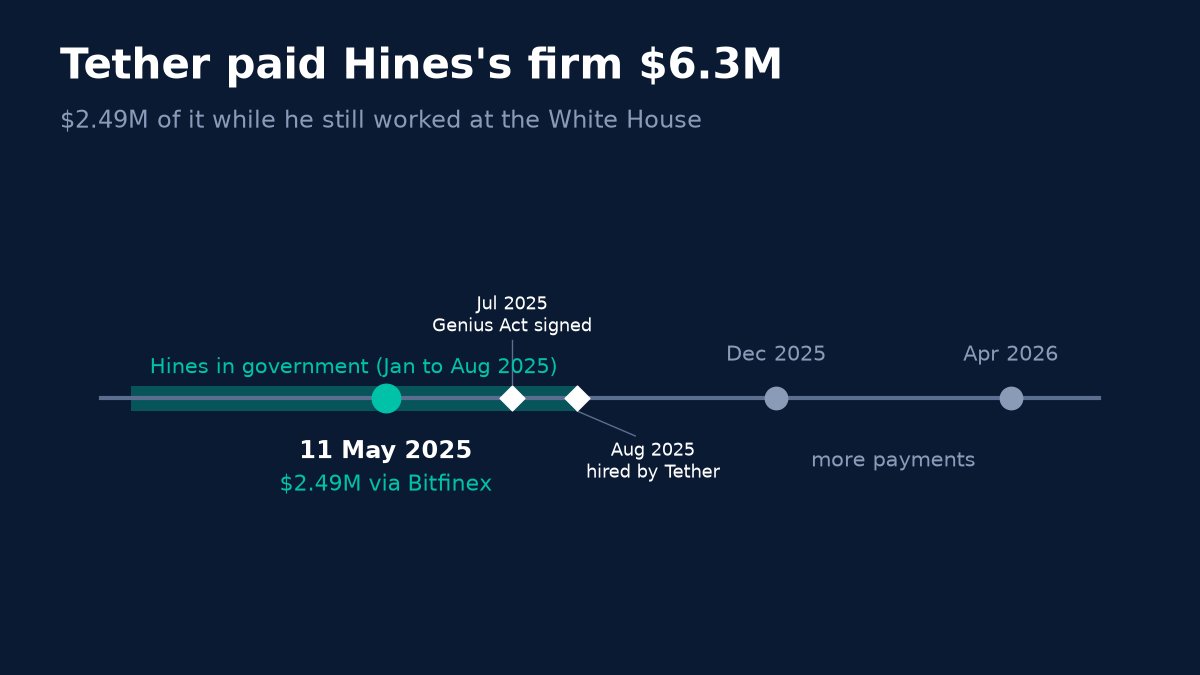
A Wall Street Journal investigation found that Tether, the company behind $USDT, sent about $6.3 million to Nxum, a consulting firm co-founded by Bo Hines. Hines ran the President's Council of Advisers on Digital Assets from January to August 2025, the same months the Genius Act stablecoin law was being written.
The contract was worth about $415,000 a month. The first $2.49 million went out through Bitfinex on 11 May 2025, while Hines was still in government, and more payments followed in December 2025 and April 2026. According to Signal messages the paper reviewed, Hines shared Genius Act updates in chats with Nxum partners who were dealing with Tether, and he pushed for a 36-month compliance timeline that gave Tether more room than some rivals. President Trump signed the law in July 2025. In August, Tether hired Hines, first as an adviser and then as CEO of its US business.
Nxum says Hines had no part in the Tether deals, held his one-third stake passively and followed ethics recusal rules.
Even if every rule was followed on paper, this looks bad for the whole industry. Crypto spent years asking Washington for clear and fair rules. When the person helping write those rules is tied to a firm taking money from the biggest stablecoin issuer, every competitor has a reason to doubt how fair they really are.
Should advisers who shape crypto laws have to wait a few years before joining a crypto company?
💚 I’m Gabor - I Don’t Work for Money, Money Works for Me💰
🔄eToro’s CopyTrader feature lets you automatically mirror my Strategy 🚀
Gabor Fogarasi @fogi70
eToro Pro Popular Investor 🏦
CISI Level 3 Investment Certification
https://t.co/8ppZty7BtU
Sign up to eToro to Copy my trades! Your capital is at risk!
Kraken is buying a Lithuanian bank 🏦 to get an EU banking license
Payward, the parent company of Kraken, has signed a definitive agreement to buy Saldo Finance, the Finnish holding company behind Lithuania-licensed Saldo Bank. The price was not disclosed, regulators still have to approve it, and closing is expected in 2027. If it goes through, Kraken becomes the first crypto company to own a bank in the European Union.
Saldo is a small bank with roughly $190 million in assets. It offers deposits, lending, cards, SEPA payments and banking-as-a-service in Lithuania, Finland, Sweden and Germany, and it can passport into the Netherlands. Payward Banking has already originated more than $2 billion in loans, over ten times Saldo's whole balance sheet, so Kraken is paying for the license rather than the size. With a full EU banking license, Kraken could hold customer deposits and offer loans and cards right next to crypto trading, instead of renting those services from partner banks.
Kraken already has a limited-purpose Federal Reserve master account in the US and an e-money license in Ireland, and now it wants a real bank in Europe.
Full disclosure: I own pre-IPO Kraken shares, so I follow every one of these moves closely. I like the direction, because an exchange with its own banking license is much harder for traditional banks to shut out.
Would you keep your savings at a bank owned by a crypto exchange?
💚 I’m Gabor - I Don’t Work for Money, Money Works for Me💰
🔄eToro’s CopyTrader feature lets you automatically mirror my Strategy 🚀
Gabor Fogarasi @fogi70
eToro Pro Popular Investor 🏦
CISI Level 3 Investment Certification
$COIN
https://t.co/8ppZty7BtU
Sign up to eToro to Copy my trades! Your capital is at risk!
US stocks are going 23 hours a day, but the night shift is thin 🌙
From 6 December, five US exchanges including Nasdaq and NYSE Arca plan to launch so-called 24-hour trading, which is really 23 hours, five days a week. The session will open at 9pm New York time on Sunday and run until 8pm on Friday, with a one-hour pause each weeknight. The SEC is mostly catching up with demand, since brokers like $HOOD already offer extended access, crypto never closes, and Korean retail traders want to buy US AI stocks during their own daytime.
So far, very few people actually trade at night. Overnight trading grew 358% year on year as of August, yet it still adds up to only about 0.1% of regular-hours volume, and nine of the ten most traded names at night cost less than $1. With so little depth, spreads stay wide and prices are easier to push around (one former enforcement official called it a ripe recipe for manipulation). The SEC has not yet given brokers standard guidance on overnight risk, and former commissioner Hester Peirce has warned about a data feed failing at 3am or a social media rumour sinking a stock while the company sleeps.
Wider spreads are only part of the problem. Being on all the time is a real nightmare for an investor. Checking prices one last time before going to sleep, knowing the market can move while you are in bed, slowly wears down your mental health.
Longer hours sound like a gift for retail investors, but the price you get at 2am can cost more than the convenience is worth. Until institutions join the night session and liquidity deepens, regular hours remain the place where small investors get the fairest prices.
💚 I’m Gabor - I Don’t Work for Money, Money Works for Me💰
🔄eToro’s CopyTrader feature lets you automatically mirror my Strategy 🚀
Gabor Fogarasi @fogi70
eToro Pro Popular Investor 🏦
CISI Level 3 Investment Certification
https://t.co/8ppZty7BtU
Sign up to eToro to Copy my trades! Your capital is at risk!
China's currency fight is with Europe, not America 💱
The People's Bank of China has published an unusually combative paper defending its exchange-rate policy. The EU and others have long accused Beijing of keeping the renminbi weak to help its exporters, and the central bank now says openly that other countries should look at their own industrial and fiscal problems before blaming China.
The pressure now comes mostly from Europe. Against the dollar, the offshore renminbi is up more than 9% since the start of 2025, so the old US complaint has lost a lot of its force. Against the euro it is roughly flat over the same period, even after climbing about 12% from its mid-2025 low. Europe still runs a trade deficit with China of about €1bn a day, which is why Brussels and Berlin are now the ones pushing hardest for a stronger renminbi.
China argues that its exports grow because its companies are competitive, and points out that its trade-weighted exchange rate is up more than 50% in nominal terms and about 35% in real terms since the 2005 reform. Critics, including a former US Treasury official, say the currency is still heavily managed and that Beijing has deliberately slowed its rise.
I expect the next round of trade pressure on China to come from Europe rather than Washington. If Brussels gets a stronger renminbi, Chinese exporters lose some of their price edge in Europe, which affects stocks like $BABA and Nio and moves the euro-dollar rate as well.
💚 I’m Gabor - I Don’t Work for Money, Money Works for Me💰
🔄eToro’s CopyTrader feature lets you automatically mirror my Strategy 🚀
Gabor Fogarasi @fogi70
eToro Pro Popular Investor 🏦
CISI Level 3 Investment Certification
https://t.co/8ppZty7BtU
Sign up to eToro to Copy my trades! Your capital is at risk!
One year since $BTC topped at $125,000 ⏳ and history says the low is due
When will Bitcoin surpass the ATH of $125k?
Bitcoin set its all-time high of $125,000 on 6 October 2025. A year later it trades around $83,200, about 33% lower.
In the last three bear markets, Bitcoin bottomed 12 to 13 months after each peak. Those falls were brutal: 75% to 85% from the top. This time the deepest drop so far was 53%. So we are now inside the window where earlier cycles found their low.
Two readings are possible. Either the milder drop was the whole bear market, or the old pattern still has one more leg down to play out.
I see real reasons why this cycle can be shallower. It is the first one where big investors own Bitcoin at scale through spot ETFs. US regulators have turned friendly toward crypto and tokenization. And Bitcoin volatility has kept falling for years. A more mature market usually means smaller crashes.
Money has not run into altcoins either. Bitcoin dominance stayed in a tight 58% to 60% band all year.
My motto stays the same: Always Buy the Dip. I do not try to call the exact bottom. A price 33% below the high, inside the window where the last three cycles turned, is the kind of dip I want to be buying in pieces, not selling.
When will Bitcoin surpass the ATH of $125k? Reply with your pick.
a) 2026
b) H1 2027
c) H2 2027
d) 2028
💚 I’m Gabor - I Don’t Work for Money, Money Works for Me💰
🔄eToro’s CopyTrader feature lets you automatically mirror my Strategy 🚀
Gabor Fogarasi @fogi70
eToro Pro Popular Investor 🏦
CISI Level 3 Investment Certification
https://t.co/8ppZty7BtU
Sign up to eToro to Copy my trades! Your capital is at risk!