What if AI interactions were structured instead of improvised?
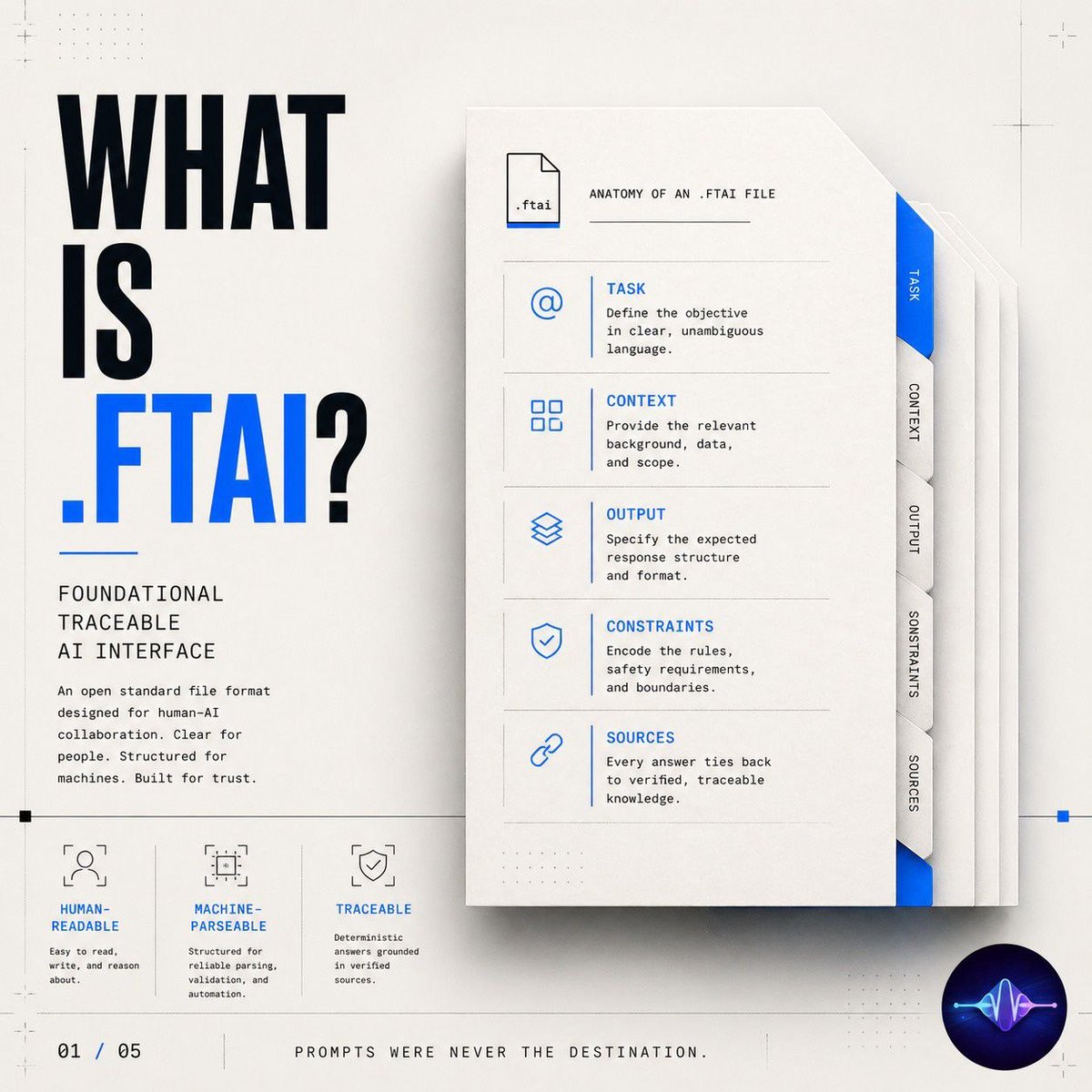
Introducing .FTAI
(Foundational Traceable AI Interface)
A format designed to make human–AI collaboration:
• clearer for people
• structured for machines
• traceable by design
Prompts were never the destination.
They were the beginning.
The future of AI isn't just smarter models.
It's AI that's reliable, private, and available when you need it.
That's the direction we're building toward.
Businesses want AI.
They also want control.
Because AI isn't just answering questions anymore.
It's helping with internal documents.
Customer information.
Company knowledge.
Daily operations.
And the more important the data becomes, the more important ownership becomes.
What if your AI actually knew you without sending everything to the cloud?
Meet Serena.
A personal AI assistant designed to help you stay organized, productive and focused.
The more AI becomes part of our daily lives, the more important privacy becomes.
Notes.
Ideas.
Work.
Plans.
Some things shouldn't need to leave your device to be useful.
That's one reason we're excited about local-first AI.
Most people ask how smart their AI is.
Few ask who controls it.
Features change.
Access changes.
Policies change.
That's one reason we're interested in local AI.
More ownership.
More privacy.
More control.
What matters more to you:
Intelligence, privacy, or control?
Most people ask how smart their AI is.
Few ask who controls it.
Features change.
Access changes.
Policies change.
That's one reason we're interested in local AI.
More ownership.
More privacy.
More control.
What matters more to you:
Intelligence, privacy, or control?
What would you do with an extra hour every day?
Learn something new?
Spend more time with family?
Focus on important work?
Or just take a break?
The best productivity tools don't help you do more.
They help you get your time back.
We went from 0 to 2,200 paying customers in under a year by following @ycombinator's 15 rules:
1/ Do things that don't scale. Get your first 10 customers by hand.
2/ Launch now, not when it's "ready". A mediocre product in front of real users teaches you more in a week than 6 months of polishing in the dark.
3/ Charge from day one. If nobody will pay, you don't have a startup, you have a hobby.
4/ Talk to users every single day. The roadmap you need is sitting in your customers' heads, and they'll hand it to you for free
5/ Always hunt the 90/10 solution. For almost any feature there's a way to capture 90% of the value with 10% of the effort.
6/ There are only two real jobs: write code and talk to users. Everything else (conferences, press, VC coffees, corp dev calls) is fake work.
7/ You pick your customers as much as they pick you. 10 users who love you beat 1,000 who kind of like you.
8/ Growth is an output, not a strategy. Grow before product market fit and all you're buying is churn.
9/ Do less, really well. Pick one or two metrics and judge every task against them.
10/ Know if you're default alive. Paul Graham's question: on current growth and current burn, do you reach profitability before the money runs out?
11/ Don't hire until it hurts. Headcount is not progress, it's burn. Every great startup was embarrassingly small for embarrassingly long.
12/ Momentum is the only real moat in year one. Ship something every week, even something tiny.
13/ Every great startup is badly broken at some point. The game isn't avoiding fires, it's how fast you put them out. Again. And again
14/ Ignore your competitors. Startups die of suicide, not murder. In year one, the only company that can kill yours is your own
15/ Startups rarely die from running out of money. They die because the founders fall out. Brutal honesty with your cofounder is the cheapest insurance you'll ever buy
Good luck !
Imagine having an assistant that never forgets.
Never misses a reminder.
Never loses track of a task.
Never forgets where a file is.
Just quiet, reliable help in the background.
That's what AI should feel like.