Group leader at @IBE_Barcelona & Adjunct at @MiamiRosenstiel. Microbial Ecology & Evolution @delCampoLab & PR2 Database 🔬🌍🦠🧬🪸 Copresident a @catbiogenoma
Coral bleaching looks like a reef-scale catastrophe. But it starts as a breakdown between single cells.
Led by @AMBonacolta, we watched it at that scale for the first time: the first single-cell transcriptomics of a bleaching coral 🪸 #CoralReefs
https://t.co/ZB4O0oQqYC
Proud of this one. #Microbiome studies of #corals have been throwing away a whole layer of the holobiont, one sequence at a time 🧬
In her 1st lead-author paper 🙌 @Joanakrause99 went through 2,679 samples to show what was in the discard pile 🗑️
Keep your chloroplast reads ♻️😉
🪸 New preprint from the lab, and a first lead-author paper for @Joanakrause99: a global meta-analysis of plastid-bearing microeukaryotes living in #corals, built from sequences most 16S studies throw away. With @BradWeilerDives and @fonamental, at @IBE_Barcelona.
🙏 Aimar did this work during his master’s internship under the @CSIC Conexión Microbioma JAE Intro program. With @Matteo__Agazzi (former master’s student and lab manager), Claudio Lo Iacono (@ICMCSIC, of the @Cabliers_Reefs project) and @fonamental.
💡 Our take: these microbiomes are part of what keeps Cabliers growing. Physiological needs and host identity shape a distinct microbial community in each deep coral. #CoralReefs#Mediterranean
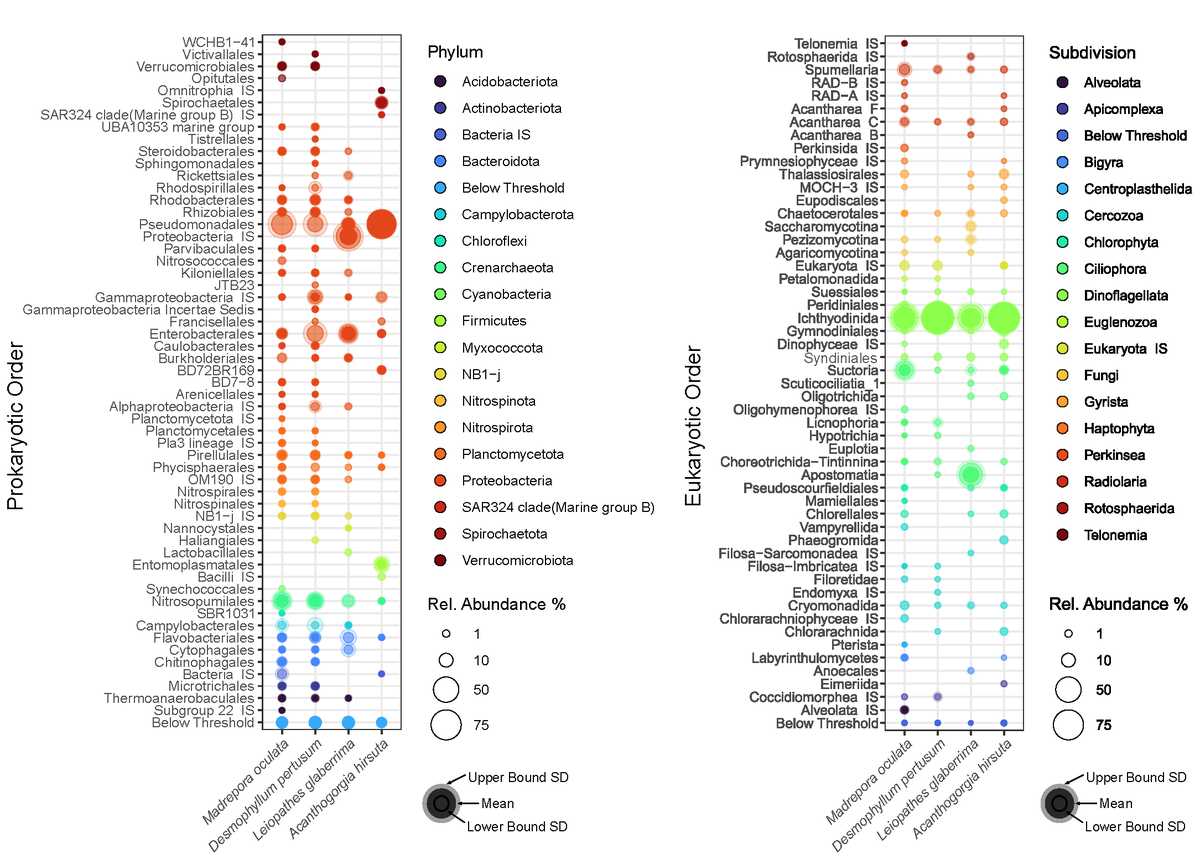
🦠 Some signatures: Endozoicomonas (sulfur cycling) in M. oculata, the SUP05 clade in D. pertusum, and the BD1-7 clade in A. hirsuta, which points to a role in organic matter processing for the octocoral. #Symbiosis
🧫 Main result: host identity is the primary driver of microbial community structure. Each coral species carries its own signature microbiome, for prokaryotes and microeukaryotes alike. #Holobiont
🔬 Four habitat-forming corals: the scleractinians Madrepora oculata and Desmophyllum pertusum, the black coral Leiopathes glaberrima and the octocoral Acanthogorgia hirsuta. 16S + 18S rRNA (V4) metabarcoding to see both prokaryotes and microeukaryotes. #Microbiome
🌊 Cabliers is the widest actively growing cold-water coral mound province in the Mediterranean. Thriving reefs, gorgonians, black corals, sponges, and almost no human pressure. A rare baseline for the deep Mediterranean. #DeepSea#Corals
🪸 New preprint from the lab, right on time: today Aimar Ardanaz-Ullate presents it at #9ISDSC in Barcelona. His first paper as first author at @IBE_Barcelona (@CSIC): the first microbiome survey of four cold-water corals from Cabliers, a near-pristine reef in the Alboran Sea 🧵
Work by @RocioMozoM, @dreailla (also an undergrad in the lab at the time), and @fonamental at @IBE_Barcelona. Isolates are cryobanked, and 16S sequences are on NCBI, so come and use them 🙌. Paper 📄 https://t.co/EooaMqJBji
Notes from the bench 🔬 Half-strength marine agar beat everything. TCBS gave nothing, even with Vibrio around. Coral extract recovered strains that no other medium did. And three weeks of patience brought out the slow growers.
Strong host specificity: 70% of genera came from a single coral species, and only Ruegeria turned up in all four. Many isolates show traits linked to biofilms, surface colonization, and polysaccharide degradation, the toolkit for settling on a coral 🪸
The haul: 84 pure isolates, 37 OTUs, 20 genera across four bacterial classes 🧬. Six isolates sit below 97% 16S identity to any described species (Vibrio, Pseudoalteromonas, Alteromonas, Shewanella, Tritonibacter), so they are likely new taxa.
We sampled four species by scuba diving along the NE Iberian coast 🤿: three gorgonians (Eunicella singularis, Paramuricea clavata, Leptogorgia sarmentosa) and the stony coral Cladocora caespitosa, from the Medes Islands to the Columbretes.
Why culture? Metabarcoding has mapped who lives on corals, but sequences alone say little about what symbionts actually do. Isolates let us test physiology, interactions and function in vitro. So we went back to the plates 🧫 #MicrobialEcology
New paper from the lab, led by @RocioMozoM during her @CSIC JAE Intro undergraduate internship (her first paper 🙌). We cultured bacteria from four Mediterranean corals and built a cryobank of 84 isolates. It's now out in Microbial Ecology (open access). 🪸🦠 #Coral#Microbiome
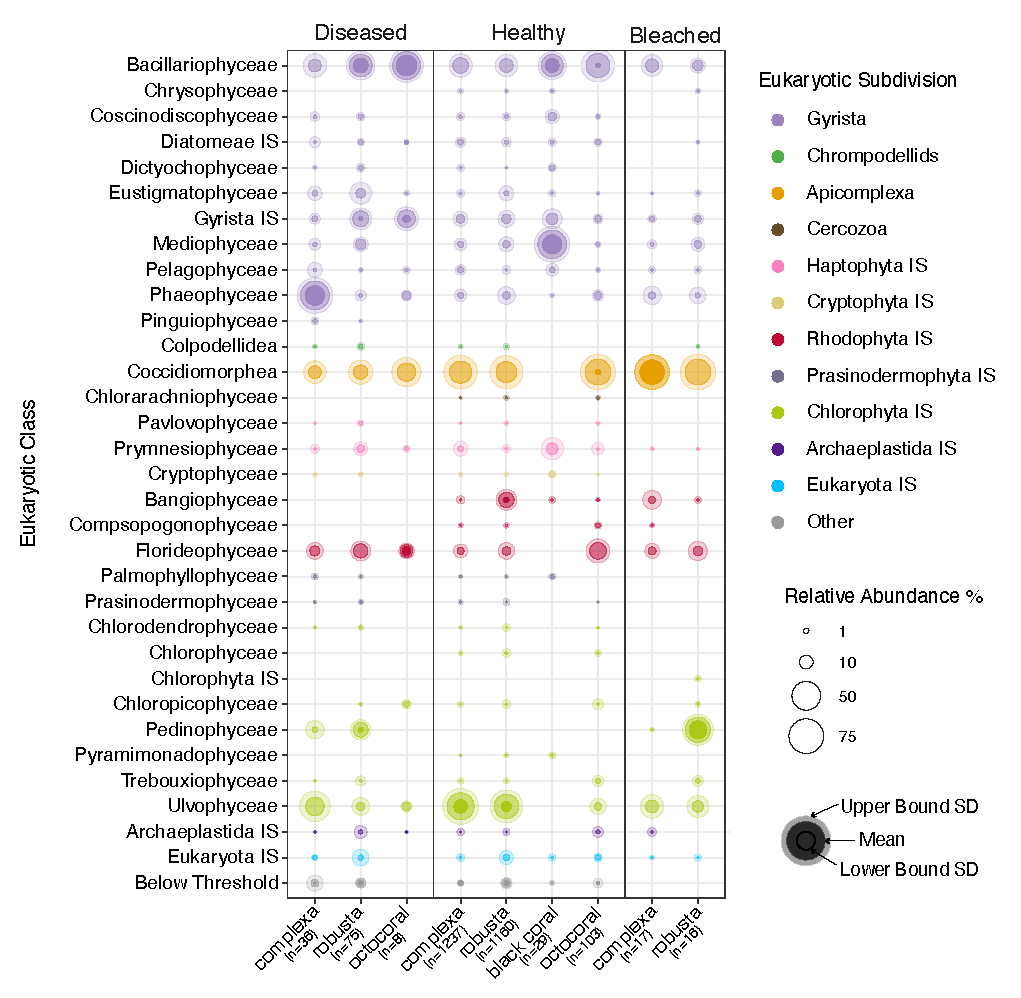
📄 Take-home: do not throw away your chloroplast reads. Plastid-derived 16S sequences carry real ecological signal, and microeukaryote-inclusive surveys are needed to understand the coral holobiont. #corals#microbiome
Preprint on @biorxivpreprint: https://t.co/znXrGWYhoD
🌱 Ostreobium: six distinct clades recovered, three described here for the first time. The North West Pacific emerges as a potential hotspot of Ostreobium diversity.