The only cosmopolitan city in India is Delhi.
Mumbai and Bengaluru don't qualify for the cosmopolitan tag as they have very high sense of entitlement and people get beaten, even killed for speaking or not speaking certain languages. Exactly opposite of what cosmopolitan means.
@RoadsOfMumbai I live in a tier 3 city in North India and the server asked if he should portion and serve the food on plates. Happened so many times. So all I would say, you might be eating at wrong places, try better restaurants.
PS- I had lived in Mumbai for 3 years & this isn't a comparison
India is supposed to be a country that generates enough and more electricity.
Why then, do we find, even in an industrial area, such frequent power cuts? Or shutdowns. Or irregular power supply. Or whatever the hell one wants to call it?
WHY?
How do we expect manufacturers to produce goods when the damned power trips every so often?
Noida Jewar Airport critics need to zoom out.
Delhi is the ONLY major airport serving all of North India.
Jewar will change that. It will serve UP, Haryana, Uttarakhand and beyond, reduce pressure on IGI, attract corporates and create massive jobs.
#NoidaJewarAirport
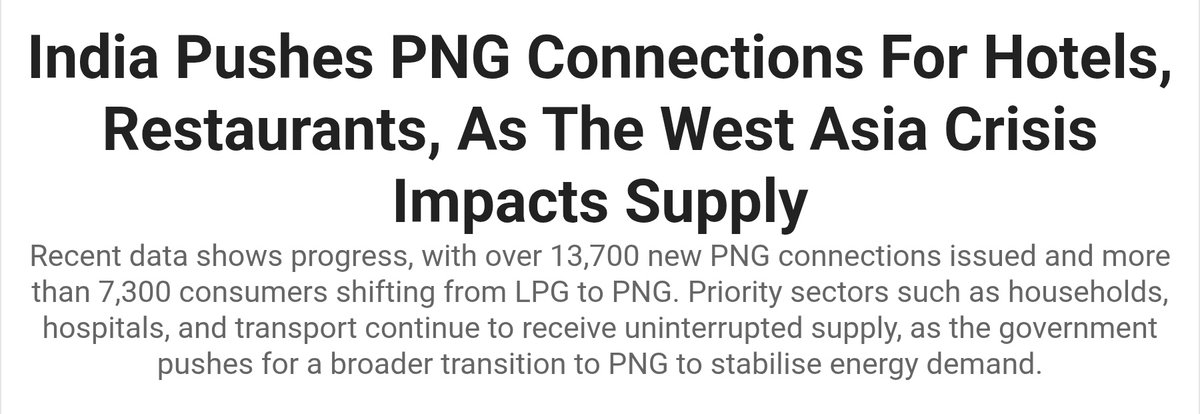
You might see the government is suddenly obsessed with getting a gas pipe into your kitchen (PNG) instead of just delivering a cylinder (LPG). It actually comes down to a massive math problem we are trying to solve.
Most people think gas is just gas but they’re actually totally different chemicals. LPG is the stuff in the red cylinders (propane & butane) and is basically a scrap product. When we refine crude oil to make petrol and diesel, we only get a tiny sliver of LPG (about 3%).
Even though India has world-class refineries, we just can’t squeeze enough LPG out of a barrel of oil to feed 33 crore households. This forces us to import a staggering 60% of our LPG, mostly from the Middle East. If a war breaks out or a shipping lane like the Strait of Hormuz gets blocked, those cylinders stop showing up at your door as usual.
Natural Gas (which is then sent as PNG), on the other hand, is a primary fuel (mostly methane). We actually have plenty of it sitting in our own ground in India. While we still import some, we aren't nearly as dependent on the Middle East for it as we are for LPG.
By moving city folks onto pipelines, the government is essentially freeing up the limited supply of cylinders for rural villages where you can't easily dig pipes. It’s a huge logistical reshuffle to make sure a crisis in West Asia doesn't leave the masses unable to cook.
There's also another angle here. Countries like the US and Qatar don't even need refineries to get LPG, they just suck it straight out of massive "wet" gas wells. India doesn't have those specific types of wells. So, for us to keep using LPG, we have to keep buying expensive crude oil and hoping the 3% we get as a by-product is enough.
Over the long term, in hindsight, it was a losing game. Indian bureaucracy should have envisaged this and prepared in advance, esp. when Ujjwala Scheme more than doubled the number of LPG connections to ~32cr. That was a strategic mistake.
Switching to PNG is basically India’s way of saying that let's stop relying on a byproduct that we lack domestically and start using the methane (natural gas) we actually produce at home.
It’s safer, it’s underground (so it's harder to disrupt during a war), and it keeps the supply chain running even when global oil prices go crazy. For an average person, it’s the difference between waiting for a truck that might not come and having a tap that never runs dry.
Delhi extracted 99% of its groundwater in 2023. India uses 25% of all groundwater extracted globally. Wells that fed villages for centuries now sit dry.
So we over-extracted for decades—agriculture, industry, unchecked borewells. Water table drops. GDP goes up.
Then we sell packaged water in plastic bottles. GDP goes up again.
India's bottled water market? ₹79,000 crore in 2024. Growing at 12.45% annually. Premium mineral water? Another ₹11,300 crore. Water purifiers? ₹8,500 crore more.
The depletion economy profits. The hydration economy profits. Your aquifers pay for both while the same balance sheets celebrate.
Your grandmother drank from the well. Zero cost. Now you spend ₹600 monthly on 20-liter jars, ₹40 per bottle on the go, ₹15,000 on purifiers—GDP contribution with every sip. 💧🏺💸
Who's winning here? Not the water table.
#GDPTrap #16
@brahma_4u Content creators are highly important too, just not the cringe one. We need variety in content. We don't have good content creators in thousands of the fields.
@theskindoctor13 City roads are ridiculous, village and small town roads are pathetic, power supply is laughable, it's all jobless growth here, can't see where the numbers are coming from.
May be big players are doing good but for small industries & agriculture, each area needs reliable power.
UP is rising on so many parameters but the cities here are just pathetic.
UP must be having at least 15 big cities with wide roads, good sanitation, filled with business opportunities, and big enough to accommodate people from 4 surrounding cities.
#9YearsOfRisingUP
A landmark step towards accelerating India’s industrial growth!
The Union Cabinet has approved Bharat Audyogik Vikas Yojna (BHAVYA). This will enable the development of 100 plug-and-play industrial parks, boosting manufacturing, investment and jobs across the nation. The scheme will significantly enhance Ease of Doing Business through streamlined approvals and single-window systems. It will boost logistics and services sectors too.
https://t.co/zB0fVgt9FF
@priestlyclass Bihari dialects?
Bhojpuri and Mathili are proper languages with their grammar and literature.
And Bhojpuri isn't Bihari, it's spoken in Uttar Pradesh, Bihar, Jharkhand, and some parts of Nepal as well.
@myogiadityanath@narendramodi So many airports to boast but only a few are functional.
What happened to Azamgarh airport? Kushinagar was a flop show.
Operate those airports, provide flights to major cities.