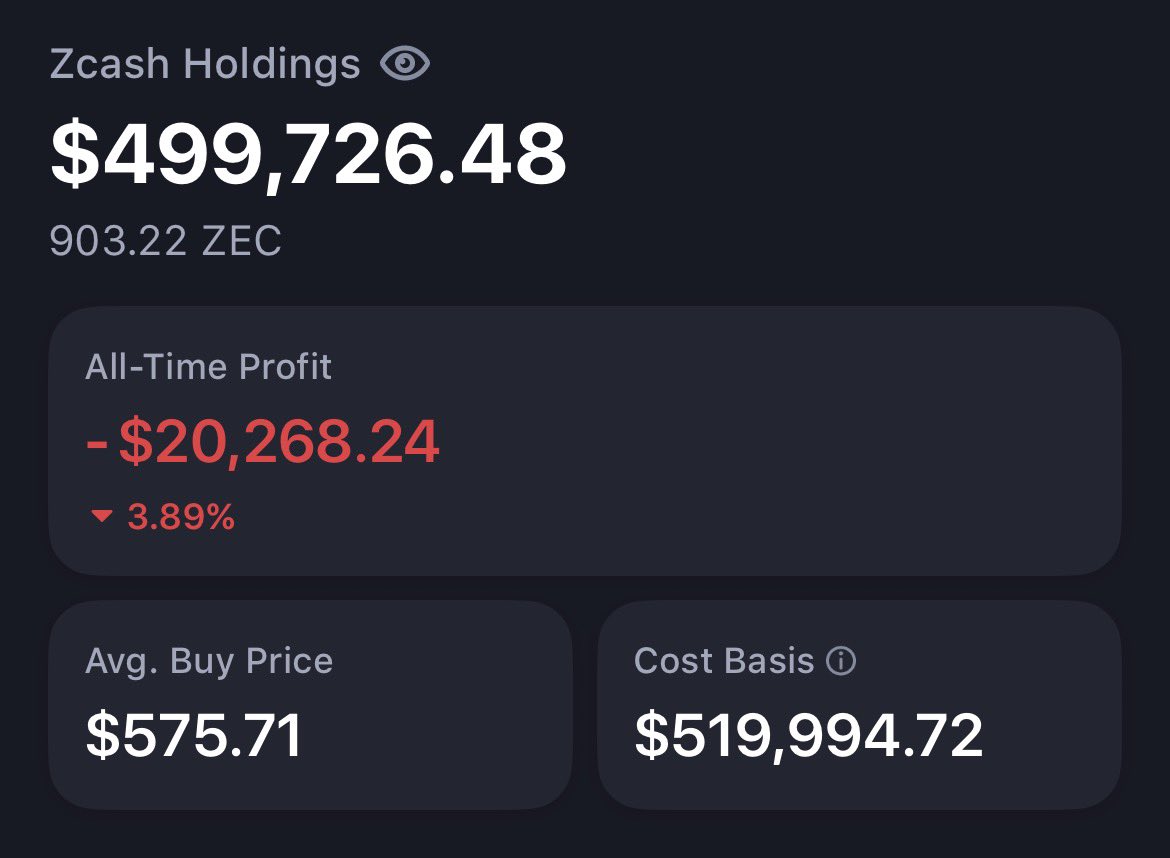
Why I invested half a million dollars into $ZEC.
The market spent years mocking privacy coins.
That’s exactly why I became interested.
Because some of the biggest opportunities in crypto are born when an entire sector gets ignored, underpriced, and politically misunderstood.
Most people only see $ZEC as “another privacy coin.”
I see it as one of the few serious attempts at building programmable financial privacy for the digital age.
And I believe the market is dramatically underestimating how important privacy becomes once crypto fully matures.
Here’s the thesis:
Every major technological cycle eventually rediscovers the importance of privacy.
The internet started open.
Then people demanded encryption.
Messaging became encrypted.
Payments became digitized.
Now finance is moving onchain.
The next logical evolution is private digital finance.
Because the uncomfortable truth is this:
A fully transparent financial system at global scale creates massive problems.
Imagine a future where every wallet, every transaction, every balance, every investment, and every movement of capital is permanently public.
That might sound acceptable today.
It won’t when adoption reaches billions.
Institutions won’t want full exposure.
High net worth individuals won’t want their entire balance visible.
Businesses won’t want competitors tracking treasury movements.
Governments themselves won’t want strategic financial activity exposed.
Privacy is not a luxury feature.
It becomes infrastructure.
That’s where $ZEC stands out.
Zcash wasn’t built as a meme narrative.
It was built with some of the strongest cryptographic research in the industry.
Zero-knowledge proofs are not some temporary trend anymore.
They are becoming foundational technology for scaling, identity, AI verification, and financial privacy.
And Zcash was one of the earliest real implementations of that vision.
The market often ignores how valuable technological head starts become once narratives rotate.
What makes me bullish is that privacy cycles tend to happen violently.
The market ignores privacy for years…
then suddenly realizes its necessity all at once.
And when that shift happens, there are very few truly established assets positioned to absorb that capital flow.
$ZEC is one of them.
People also underestimate the regulatory psychology around privacy.
The assumption is always:
“Governments will kill privacy coins.”
But history shows something different.
Governments regulate around technologies they cannot eliminate.
The internet survived.
Encryption survived.
VPNs survived.
Tor survived.
Privacy itself is a permanent human demand.
And in a world moving toward surveillance-heavy systems, the value of financial privacy only increases.
Another thing most investors misunderstand is asymmetric pricing.
When an asset falls out of favor for years, the upside becomes exponential if sentiment reverses.
That’s how deep value opportunities emerge.
The best trades are rarely the assets everyone already agrees on.
They are usually the assets the market abandoned too early.
At current valuations, I believe the market prices $ZEC as if privacy has no future.
I believe the opposite.
I believe privacy becomes one of the defining narratives of the next decade.
Not just in crypto.
In AI.
In identity.
In communication.
In global finance itself.
And if that thesis plays out, then assets positioned at the center of financial privacy infrastructure could be repriced aggressively.
That’s why I invested half a million dollars into $ZEC.
Not because it’s trendy.
Not because it’s popular.
But because I believe the market eventually rediscovers the value of freedom, privacy, and uncensorable finance.
And when it does, the rerating could be massive.
Why I stacked up $1M in $HYPE.
Most people still think Hyperliquid is “just another perp DEX.”
That’s the mistake.
What people are underestimating is that $HYPE is positioned at the intersection of where liquidity, attention, and crypto market structure are heading over the next decade.
The market always rewards infrastructure that captures volume.
Binance captured volume.
Ethereum captured settlement.
Solana captured speed.
Hyperliquid is trying to capture onchain trading itself.
And if they win even a fraction of that market, $61 will eventually look ridiculously cheap.
Here’s the thesis:
Crypto is moving toward an onchain financial system where users no longer want fragmented experiences. They want speed, deep liquidity, transparency, and self-custody all at once.
Hyperliquid is one of the very few protocols that actually solved the user experience problem.
Fast execution.
Deep liquidity.
Native order books.
No horrible UI.
No laggy experience that feels “onchain.”
For the first time, trading onchain actually feels better than trading on a CEX.
That changes everything.
Because once product experience becomes superior, liquidity naturally follows.
And where liquidity flows, value compounds aggressively.
People focus too much on narratives and ignore where the money is actually moving.
Hyperliquid is already processing absurd trading volume.
The fees are real.
The retention is real.
The community is cult-like.
And the product is still early.
Now think bigger.
If Hyperliquid evolves into the dominant onchain trading layer for perp markets, spot markets, and broader financial primitives, then $HYPE becomes more than just a token.
It becomes an asset tied directly to one of the strongest cash-flow engines in crypto.
That’s where the asymmetric bet exists.
The reason I believe $HYPE can 10x from here isn’t because “number go up.”
It’s because the market historically reprices platforms that dominate user behavior far beyond what seems rational in early stages.
People laughed at:
ETH below $100.
SOL below $20.
BNB before exchange dominance.
BTC below $1k.
The common pattern?
The market underestimated infrastructure during accumulation phases.
At $61, people think they’re late.
I think the market is still massively underpricing what Hyperliquid could become if it captures global crypto trading flow over the next cycle.
And the reality is:
crypto trading volume will continue growing exponentially over time.
More users.
More leverage.
More speculation.
More capital.
More financialization.
Hyperliquid benefits directly from all of it.
Could there be volatility? Of course.
Could it nuke 50% short term? Easily.
But I’m not positioning for noise.
I’m positioning for where I believe market structure is heading over the next 5-10 years.
The biggest money is rarely made chasing trends late.
It’s made by identifying infrastructure before the market fully understands its importance.
That’s why I stacked $1M into $HYPE.
Why I stacked up $1M in $HYPE.
Most people still think Hyperliquid is “just another perp DEX.”
That’s the mistake.
What people are underestimating is that $HYPE is positioned at the intersection of where liquidity, attention, and crypto market structure are heading over the next decade.
The market always rewards infrastructure that captures volume.
Binance captured volume.
Ethereum captured settlement.
Solana captured speed.
Hyperliquid is trying to capture onchain trading itself.
And if they win even a fraction of that market, $61 will eventually look ridiculously cheap.
Here’s the thesis:
Crypto is moving toward an onchain financial system where users no longer want fragmented experiences. They want speed, deep liquidity, transparency, and self-custody all at once.
Hyperliquid is one of the very few protocols that actually solved the user experience problem.
Fast execution.
Deep liquidity.
Native order books.
No horrible UI.
No laggy experience that feels “onchain.”
For the first time, trading onchain actually feels better than trading on a CEX.
That changes everything.
Because once product experience becomes superior, liquidity naturally follows.
And where liquidity flows, value compounds aggressively.
People focus too much on narratives and ignore where the money is actually moving.
Hyperliquid is already processing absurd trading volume.
The fees are real.
The retention is real.
The community is cult-like.
And the product is still early.
Now think bigger.
If Hyperliquid evolves into the dominant onchain trading layer for perp markets, spot markets, and broader financial primitives, then $HYPE becomes more than just a token.
It becomes an asset tied directly to one of the strongest cash-flow engines in crypto.
That’s where the asymmetric bet exists.
The reason I believe $HYPE can 10x from here isn’t because “number go up.”
It’s because the market historically reprices platforms that dominate user behavior far beyond what seems rational in early stages.
People laughed at:
ETH below $100.
SOL below $20.
BNB before exchange dominance.
BTC below $1k.
The common pattern?
The market underestimated infrastructure during accumulation phases.
At $61, people think they’re late.
I think the market is still massively underpricing what Hyperliquid could become if it captures global crypto trading flow over the next cycle.
And the reality is:
crypto trading volume will continue growing exponentially over time.
More users.
More leverage.
More speculation.
More capital.
More financialization.
Hyperliquid benefits directly from all of it.
Could there be volatility? Of course.
Could it nuke 50% short term? Easily.
But I’m not positioning for noise.
I’m positioning for where I believe market structure is heading over the next 5-10 years.
The biggest money is rarely made chasing trends late.
It’s made by identifying infrastructure before the market fully understands its importance.
That’s why I stacked $1M into $HYPE.
The people who change their lives are usually a little delusional.
Because logic will tell you:
“You’re underqualified.”
“The odds are against you.”
“Millions have tried already.”
But optimism — irrational optimism — is what allows someone to endure failure long enough to become exceptional.
Every elite athlete, founder, artist, trader, or visionary once looked unrealistic to ordinary minds.
In trading especially, if you don’t believe you can eventually master uncertainty, survive volatility, and outperform your past self, you’ll quit the moment reality tests you.
Delusional optimism is not blindness.
It’s disciplined belief.
It’s waking up after losses and still believing your edge can compound.
It’s studying while others surrender.
It’s seeing temporary failure as data, not identity.
The top 1% often look insane before they look inevitable.
Most people are prisoners of probability.
The exceptional are students of possibility.
Sometimes you need a level of belief that reality has not yet earned from you.