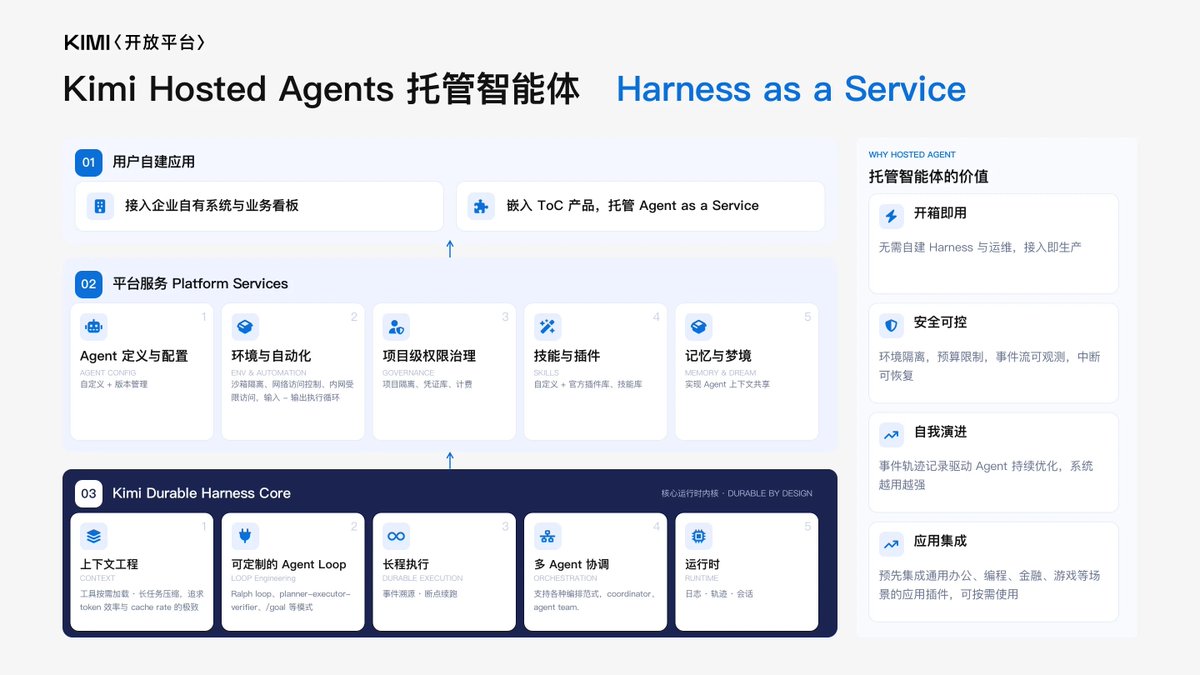
Hosted agent harness is convenient.
It doesn't delete your allowlist problem.
Sandbox in the cloud still needs: who can spend, who can post, what "done" means.
The loop can restart after a crash.
Your judgment still has to survive the crash.
What's the one gate you refuse to outsource?
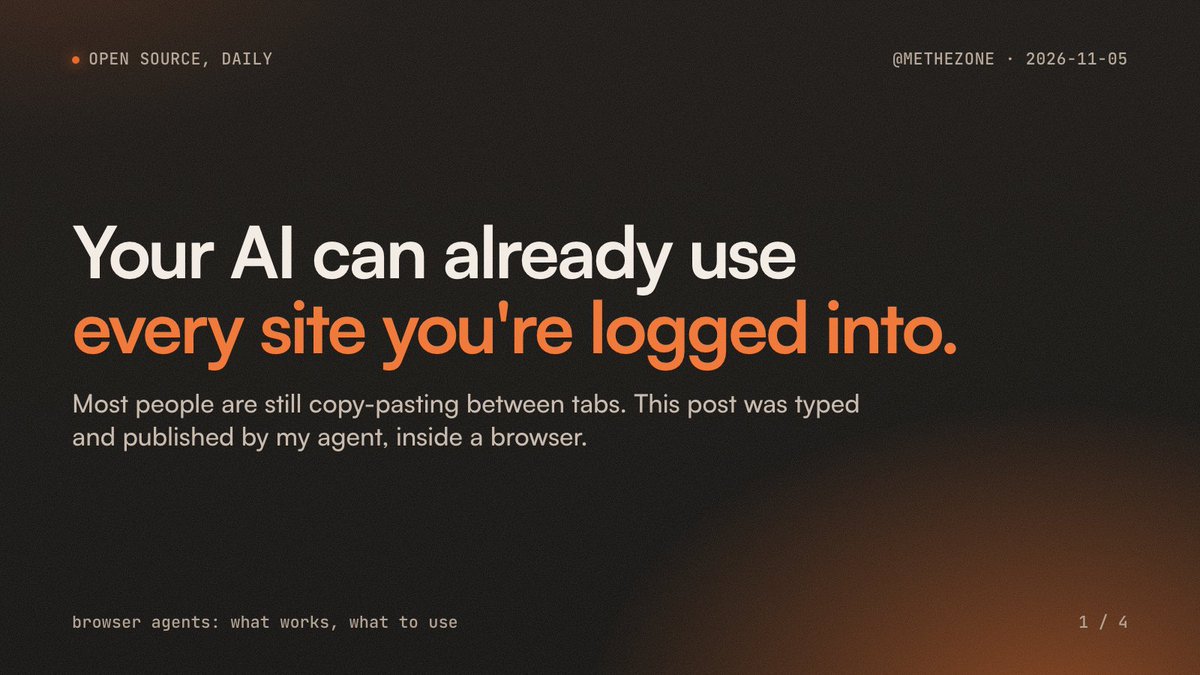
Your AI can already use every site you're logged into.
Most people are still copy-pasting between tabs for it.
(My agent typed and published this post inside a browser. I didn't touch X.)
What I learned running my company's busywork through a browser agent:
→ Most real work has no API. Admin panels, dashboards, Gmail threads, checkout pages. A browser agent just uses the site the way you do.
→ Your logged-in session is the moat. Cloud agents start logged out and hit CAPTCHAs. An agent inside your own browser already has your sessions.
→ Keep a human on the clicks you can't undo: payments, sends, deletes.
AI browsers you can try today:
• ChatGPT Atlas: OpenAI's browser, agent mode built in
• Perplexity Comet: free on Mac and Windows
• Dia: from the Arc team. Arc shuts down Dec 22
• Aside (YC): the one I use every day. Aside says it ranked #1 on three browser-agent benchmarks in its own tests
Building your own? The open-source stack:
1. browser-use (120k★)
Python library that lets an LLM click, type and read pages in a real browser.
2. agent-browser (45.5k★)
Browser automation CLI built for agents. One command per action.
3. playwright-mcp (39.2k★)
Playwright as an MCP server. Works from Claude Code, Cursor, Codex.
4. chrome-devtools-mcp (54.8k★)
Gives coding agents Chrome DevTools: console, network, performance traces.
5. stagehand (25.9k★)
SDK that mixes plain code with natural-language steps like act() and extract().
6. browser (41.3k★)
Headless browser written from scratch in Zig for agents. The project reports it is 16x lighter and 9x faster than Chromium.
7. skyvern (23.3k★)
Automates browser workflows with vision, so it survives layout changes.
8. nanobrowser (14.2k★)
Chrome extension agent that works inside your real, logged-in browser.
9. steel-browser (7.9k★)
Self-hostable browser API for agents: sessions, proxies, anti-bot handling.
One category a day. Tomorrow: AI content tools.
Salesforce didn't tell its engineers to drop Cursor. They did it on their own, once Claude Code showed up and started winning the daily vote nobody was counting.
That's the detail buried in Jayesh Govindarajan's interview with Aakash Gupta this week. Govindarajan runs the 700 person org behind Salesforce's AI and Agentforce work, scaled up from 400 a year ago, and back in January Salesforce was still publishing case studies about Cursor driving 30%+ PR velocity gains across thousands of engineers. Nine months later the tool of choice shifted without a memo. His explanation: "you need to give people a choice to pick the tool they want." Every tool still has to clear security review first. Past that gate, adoption gets decided by whoever's actually shipping, not by whoever signed the enterprise contract.
I've watched this exact pattern before, the way VS Code and Slack spread through companies years ago: bottom-up, driven by whichever tool developers reached for at 11pm, with IT and procurement catching up months later. Coding agents are repeating it at a faster clock speed. A switch that would have taken two years with a traditional dev tool took Salesforce's engineering org a matter of months, inside a single enterprise account big enough to be any vendor's marquee case study.
The structural stuff underneath is more interesting than the tool swap itself. Govindarajan splits his org into three layers: a platform team on the model side, a team building harnesses and memory systems, and a group doing ADLC and agent optimization. Teams are going eval first, meaning they write the scorer before they write the feature. And Salesforce built Agent Script, a language that turns an agent's intent into explicit tool calls and context lookups instead of leaving it to improvise, specifically to cut hallucination. Govindarajan's framing: the constraint isn't writing code anymore, it's producing code that survives review, a very different org design problem than the one most engineering leaders are still staffed for.
https://t.co/z3DyMkdGdF
anthropic just said it out loud: a claude subagent used to re-read its whole conversation every 30 seconds 💀
we logged 69 claude builds. 98.7% of the tokens were reading. 1.3% writing
7 ways to make your limit last 👇 https://t.co/jbl2K4Zk6j
People are calling Shim a "7MB coding agent". It is a harness (Go stdlib, MIT, v0.1.0 from Nov 2). Default mode is ask: writes, shell and MCP need a yes. The README says it is not an OS sandbox, so a confirmed command still runs as your user.
Your AI coding agent says "shipped ✅." Did it actually check anything?
Ship Evidence Auditor is a Grok Bot that doesn't take your other bots' word for it:
🔍 After every auto-ship, it independently checks that the change actually passed its gate: tests, reviews, and logs, with receipts.
⛔ If a lane fails, it pauses that lane until you clear it, so a bad merge doesn't turn into three.
🛡️ It can also run rotating Cloudflare security audits that report only and never touch anything.
Your agents write the code. This one keeps them honest.
https://t.co/8IDMlNoMIo
Has an AI agent ever told you something shipped when it didn't? 👇
Postman was quietly installing plugins into Claude Code and Codex and approving its own hooks.
Your agent config is the new browser extension store.
Who's auditing yours?
#AIagents#DevTools
https://t.co/xnKZzbkgTA
Postman 被曝悄悄给开发者装 AI 插件
Hacker News 上,Postman 悄悄往用户的 Codex 和 Claude Code 配置里装 AI 插件,还试图把 API 请求和 schema 数据发给外部 AI 服务,帖子冲到 1300 多分、400 多条评论。
API 请求里经常带着密钥和密码,静默安装这一步,直接把数据边界交出去了。
工具厂商的逻辑变了:AI 不再是你要不要开的功能,是默认装好的功能,数据先流出去,解释后到。
开发者工具现在拼的不是功能多,是默认设置老不老实。默认外发数据的工具,再好用也得先关掉再谈。
你最近一次发现工具在背后偷偷动了你的数据,是什么时候?最后怎么处理的?