Founder @hey_arca. We build new channels for context, starting with a ring, so agents understand you better than anyone. Real life + agent sessions → AGI.
Honored to win @ycombinator × @browser_use Web Agents Hackathon Best Design Awards with FORAGE.
You talk to AI agents. They handle all the manufacturer/sourcer chaos. You just say what you want built IRL.
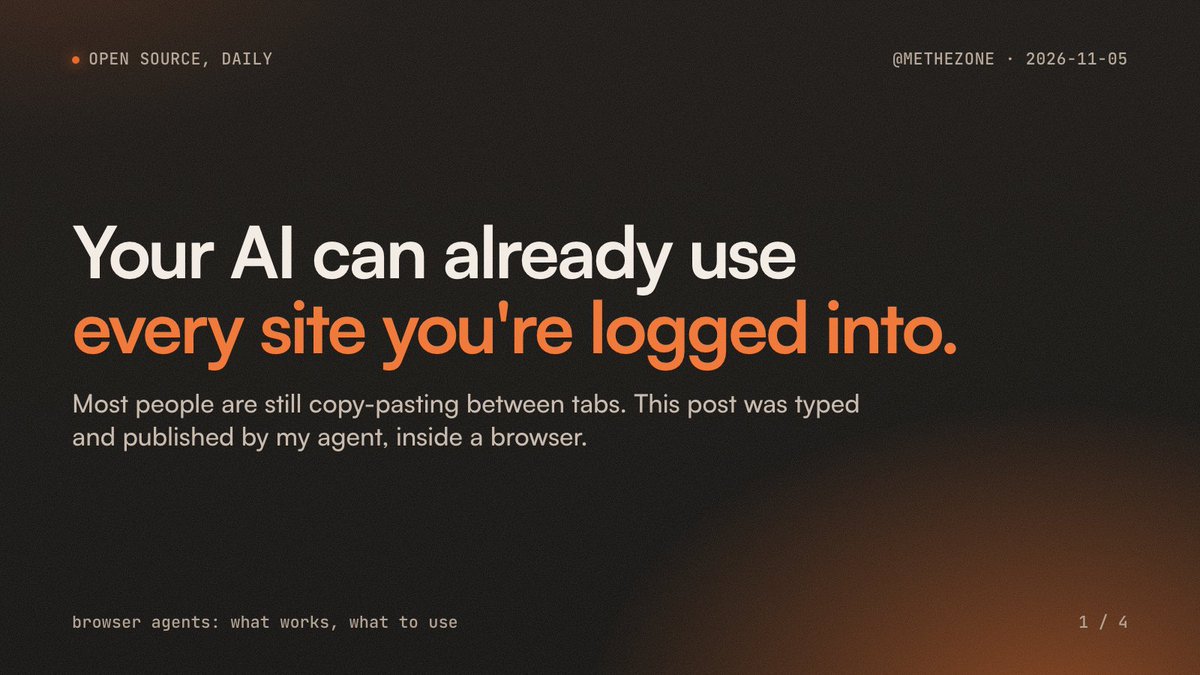
Your AI can already use every site you're logged into.
Most people are still copy-pasting between tabs for it.
(My agent typed and published this post inside a browser. I didn't touch X.)
What I learned running my company's busywork through a browser agent:
→ Most real work has no API. Admin panels, dashboards, Gmail threads, checkout pages. A browser agent just uses the site the way you do.
→ Your logged-in session is the moat. Cloud agents start logged out and hit CAPTCHAs. An agent inside your own browser already has your sessions.
→ Keep a human on the clicks you can't undo: payments, sends, deletes.
AI browsers you can try today:
• ChatGPT Atlas: OpenAI's browser, agent mode built in
• Perplexity Comet: free on Mac and Windows
• Dia: from the Arc team. Arc shuts down Dec 22
• Aside (YC): the one I use every day. Aside says it ranked #1 on three browser-agent benchmarks in its own tests
Building your own? The open-source stack:
1. browser-use (120k★)
Python library that lets an LLM click, type and read pages in a real browser.
2. agent-browser (45.5k★)
Browser automation CLI built for agents. One command per action.
3. playwright-mcp (39.2k★)
Playwright as an MCP server. Works from Claude Code, Cursor, Codex.
4. chrome-devtools-mcp (54.8k★)
Gives coding agents Chrome DevTools: console, network, performance traces.
5. stagehand (25.9k★)
SDK that mixes plain code with natural-language steps like act() and extract().
6. browser (41.3k★)
Headless browser written from scratch in Zig for agents. The project reports it is 16x lighter and 9x faster than Chromium.
7. skyvern (23.3k★)
Automates browser workflows with vision, so it survives layout changes.
8. nanobrowser (14.2k★)
Chrome extension agent that works inside your real, logged-in browser.
9. steel-browser (7.9k★)
Self-hostable browser API for agents: sessions, proxies, anti-bot handling.
One category a day. Tomorrow: AI content tools.
We just applied to @ycombinator W27. @_junhoyeo and I are building Arca, a ring with ears and a brain.
Tap it on someone's phone and you're connected, no app needed. It listens, tells the voices apart, and remembers what you talked about and what you promised. Then Arca follows through for you.
The most important context in your life doesn't come from a screen. It comes from the people you meet.
founder video + demo below. try it: https://t.co/VtJpR9W8Uv
About half of GitHub trending this month is skills for coding agents.
Here are 10 I'd install in Claude Code or Codex:
1. superpowers (310k★)
Makes the agent ask what you're building, write a spec and a plan, then do red/green TDD before it touches code.
2. impeccable (99k★)
Adds design commands to your agent: /polish, /bolder, /critique, /audit. Good at catching the purple-gradient look.
3. taste-skill (108k★)
Art direction for coding agents. Reference images and a browser check instead of generic UI.
4. hallmark (44.5k★)
Design skill from Together AI. 50 themes, and it checks the page in a real browser for things that look machine-made.
5. security-audit-skill (56.1k★)
Six-phase security audit where fresh agents try to disprove every finding. Cloudflare's own vulnerability harness started from it.
6. claude-seo (25.3k★)
SEO audit: technical, schema, E-E-A-T, and whether AI search is likely to cite you.
7. claude-mem (109k★)
Records what your agent did each session and brings the relevant parts back next time.
8. context-mode (33.1k★)
Keeps raw tool output out of the context window. 315 KB down to 5.4 KB in their test.
9. caveman (117k★)
Makes the agent talk less and read less. 33% fewer input tokens over 54 Claude Code runs.
10. skills (186k★)
Anthropic's own skills, including the docx/pdf/xlsx ones behind Claude's file features.
One category a day. Tomorrow: memory for AI agents. Follow if that's useful.
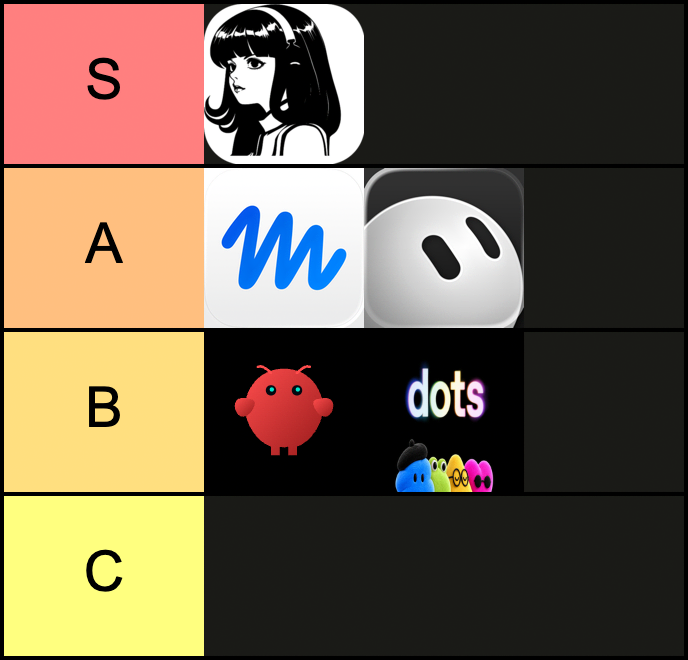
My personal AI agent tier list.
I think Grok is top-notch, but the model and the subscription price are deal-breakers. The $20 plan doesn't really give you much usage.
Mausbot is great, I use it with Claude 5.5, and I’ve been testing Codync; it’s been a pleasant surprise.
Vote on the models and create your own tier list.https://t.co/hbO7rKvc9b
All have your page, detailed informations. All Day Updated.
@KaranVaidya6 the "stays logged in securely" part is the actual hard bit, not the model. i run a mac mini bot that logs into real accounts and does tasks unattended, and auth quietly expiring has broken it more times than the ai itself ever has.
@poteto@bot the "bot lives in slack, you just @ it" pattern is underrated. i run something similar for a bot that uploads to youtube on its own schedule. the moment it needs a human decision it should just ping you instead of silently retrying forever.
@johncodunayo the reference-frame + critique loop workflow is the real unlock imo. i do the same thing with claude review -> codex execute on real product pages: one pass drafts, the other tears it apart before it ships. code you can critique like a draft changes how you use it.
@AravSrinivas a self driving car needs way more sensors than a manual one. same deal with automations imo. mine kept running "successfully" for weeks while quietly doing the wrong thing, until i started actually reading the output instead of trusting the green checkmark.
@perplexity_ai event-triggered automations are the ones that actually save time for me. schedule-only ones still miss stuff for hours. once i wired a real event trigger instead of polling on a timer, half my daily-check habits went from next-morning to instant.
@openclaw@RedHat@nvidia@OpenAI real lesson from running a persistent agent 24/7 on a mac mini: the model never broke it, an oauth token silently expiring every 7 days did. took a week to catch because it failed quiet. this control-plane stuff matters more than people think.
openai's dots checks in by text, call, or email and pauses whenever you want.
building arca (voice ai companion) taught me the same lesson: the model was never the bottleneck.
deciding when it should interrupt you or just wait quietly is the actual hard problem.
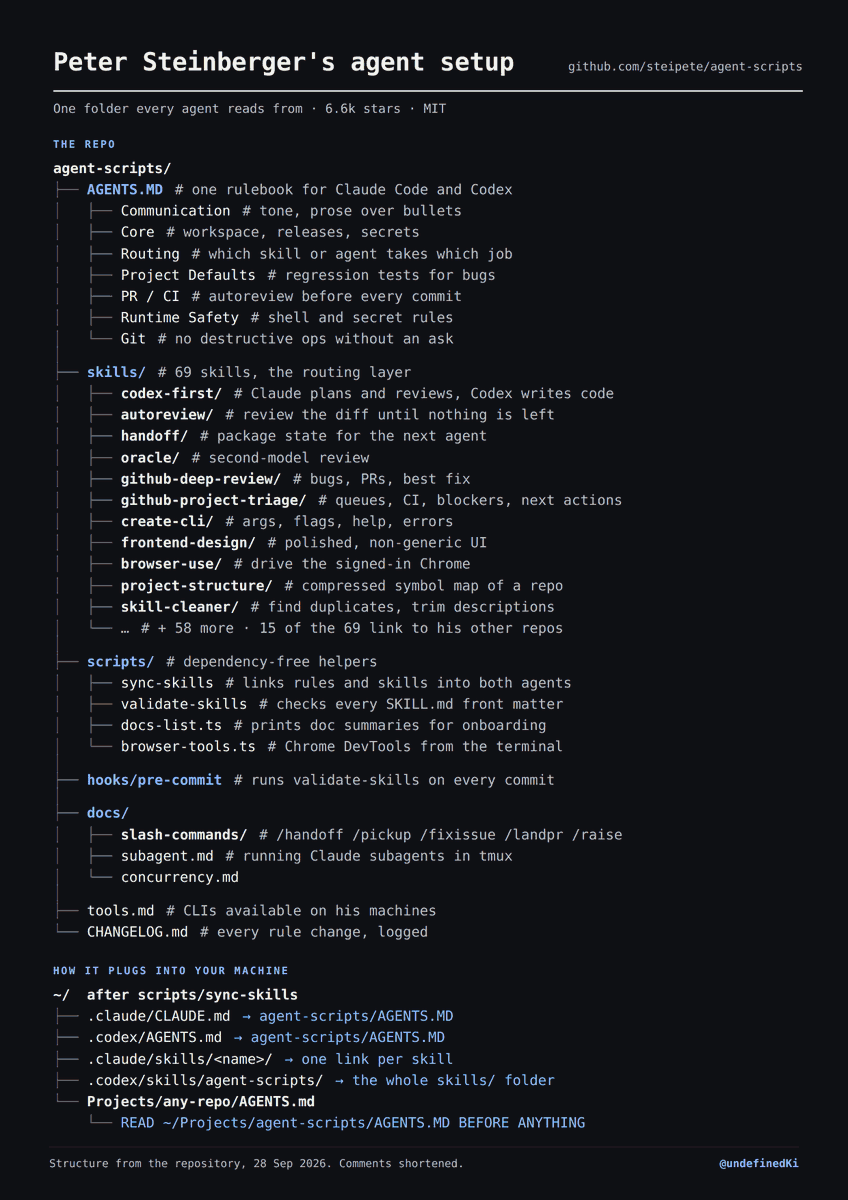
Peter Steinberger, the creator of OpenClaw, open-sourced his entire agent setup
The core idea is one folder that every agent on his machines reads from.
A single AGENTS.MD holds his rules, and a script symlinks it into ~/.claude/CLAUDE.md and ~/.codex/AGENTS.md
This way Claude Code and Codex always follow the same instructions.
Every other repo gets one line at the top:
READ ~/Projects/agent-scripts/AGENTS.MD BEFORE ANYTHING.
Change a rule once and every project picks it up.
Skills work the same way. 69 of them live in one place, each with a short description the agent reads to decide what to load, and scripts/sync-skills links them into both agents.
Fork it, replace his rules with yours, and delete the skills you do not need. His AGENTS.MD is full of his own hosts and accounts.
6.6k stars, MIT - https://t.co/3XQj9GxI6b