Insurers aren't leaving high risk states because of the weather. They're leaving because of the rate filing. In most states a company can't charge a new price until a regulator approves it, and that review leans on past losses while the payout is set by what it costs to rebuild today. Say expected loss on a house rises 40% and the approved rate rises 8%. You don't write that policy. You non-renew it. The owner lands in the state pool, the insurer of last resort, which covers shortfalls by assessing every other policyholder in the state. The cap didn't lower the price of risk. It moved who pays and delayed the bill. I think those pools keep growing through a quiet storm year, because the binding constraint is rebuild cost, not hurricanes. A price you aren't allowed to charge isn't a discount. It's a shortage with paperwork.
@PeterSchiff Breakevens are the direct test. The 10 year breakeven, the gap between nominal and inflation protected yields, is the market's own inflation forecast. If that's what's widening, this holds. If real yields are doing the work, it's supply and term premium instead.
@zerohedge Korea's capital controls are what make this visible. Moving won offshore to arbitrage the gap is restricted, so local retail demand can't get arbitraged away and shows up as a price premium on Korean exchanges instead. That premium is a cleaner read on retail flow than volume is.
@unusual_whales If a refund lets them cut prices, the tariff was raising prices. That answers who was paying it, and it wasn't the exporter. A refund is one time cash though, and the tariff schedule is ongoing. The price cuts have a shelf life the tariff doesn't.
Index funds send more money to a stock after it rises, not less. A cap weighted fund holds each company in proportion to its market value, so a name at 6% of the index takes 6 cents of every incoming dollar. Let it double while nothing else moves and the weight goes to about 11%. Same fund, same rules, nearly twice the bid. Price is an input to how much gets bought, and it points the wrong direction. I don't expect that to change while payroll money buys the index every two weeks with no view on value.
The cost isn't only the rate. Funding short means coming back to market constantly, so every rollover is another auction that has to clear. That turns a rate problem into a demand problem. If auctions start tailing, meaning they clear above where the debt traded beforehand, Treasury doesn't get to wait for a better week.
@chrisAn00930062@zerohedge The link runs through speed, not level. Equity duration transmits rate volatility, so 40 basis points in a week hits multiples and VIX together. The same 40 spread over two months gets absorbed into estimates. That's how the long end leaks while VIX sits still.
@zerohedge Separate these two. NVDA sells the picks and sits on net cash, so wide spreads there price customer concentration, not balance sheet stress. ORCL and Meta are borrowing to build. Same headline, different exposure. The levered buyers are where a spread move changes the capex plan.
@zerohedge Breaking issue price this fast says more about the book than the business. A deal that size has to be placed with whoever takes the allocation, and allocation buying isn't demand. Once the stabilizing bid steps back, price finds the real buyers. Lockup supply hasn't hit yet.
@Hedgeye The level isn't the constraint, interest as a share of revenue is. Treasury has been funding at the short end, so the debt reprices to today's rates in months, not decades. The 30 year is at 5.2% while they buy back. Growth can't outrun a balance that reprices every year.
Up to 50,000 is a disclosure band, not a position size. The lowest bracket on those filings starts at 1,001, so the buy can be a rounding error next to the headline number. Partially sold in May means some of it wasn't there yesterday either. The timing is the question. The dollar figure isn't.
@unusual_whales Growing out of debt has a condition. Nominal growth has to beat the average rate on the debt while the primary deficit sits near zero. Interest is 1.4 trillion against 40 trillion, so that rate is near 3.5% and climbing as cheap debt rolls over. The deficit has to move first.
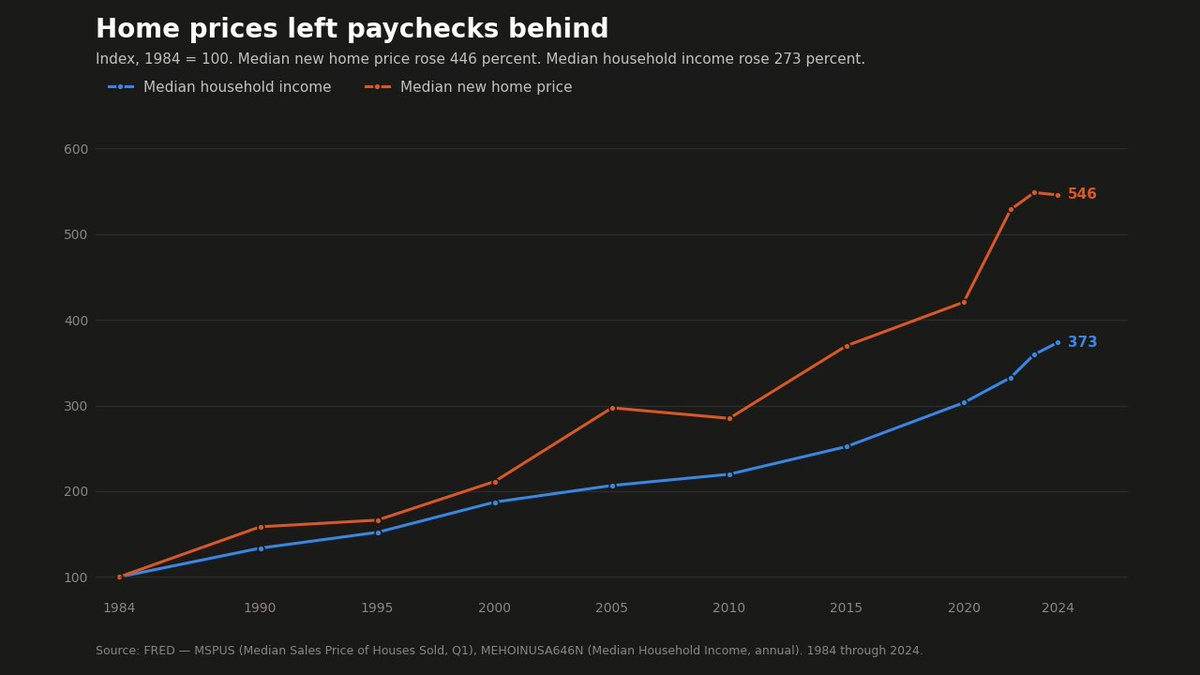
Housing costs as much relative to income today as it did at the peak of the 2006 bubble.
Median new home price is 5.1 times median household income. In 2006 it was 5.1. In 1984 it was 3.5.
Incomes rose 273% since 1984. Home prices rose 446%.
The bubble ratio never corrected, it just became the baseline.
That's what money creation does. The new dollars go into assets, not paychecks. So home prices increase faster than wages.
@MarketCalled@unusual_whales Rate cut markets already exist with real size. Fed funds futures, contracts on where the Fed's target lands, trade billions a day against Polymarket's 287 thousand. That's the liquidity argument pointing at a different contract. Same signal, deeper book.
@izakaminska The issuance forecast is the testable piece. $288 billion to $659 billion by 2027 is built on capex guidance, and guidance revises faster than investment grade bond calendars. If the efficiency pivot is real it shows up in deals pulled, not earnings calls. Watch the calendar.
@MarketCalled@unusual_whales Carry is the right frame. The 10-year is a loose proxy though, since average maturity on the debt runs around six years and a big share is bills. Effective interest cost tracks the front end more than the long end. The Fed matters more here than the bond market.
@PolymarketMoney Two things are missing here and they're the whole trade. Sizable relative to what, and funded how. Buying reserves with borrowed dollars adds to the same debt stack that crossed $40 trillion today. A budget-neutral purchase means selling something else. Nobody has said which.
@nberpubs@idrechs@HyeyooonJung An 18 point spread over the short rate is the number to explain. Charge-offs, loans banks write off as uncollectible, run about 6% and cover a fraction of it. The rest is that people who carry a balance don't shop on rate. Rewards funded by swipe fees pay the ones who do.
@scottlincicome The lobbying explanation has a testable shape. Aerospace and semis are a handful of firms that can fund an exclusion request. Apparel importers are thousands of small firms with no shared lobby. Tariff schedules track who can afford to show up.
@zerohedge Crowding out shows up as a price, not a queue. Treasury clears every auction, it just pays up to do it. The tell today is that the sovereign blinked first, doubling buybacks after the 30-year hit 5.3%. Whoever pays up for duration sets the level. Today that wasn't Treasury.