3 leopard skins seized from a BJP leader’s Thar in Sidhi, MP. For years, the state's completely inactive forest intelligence apparatus has consistently failed to stop poachers before animals are slaughtered.Unacceptable lawlessness!
CM Madhya Pradesh PMO India #AI@CMMadhyaPradesh@PMOIndia@moefcc@WCCBHQ@ntca_india #leopards #tigers
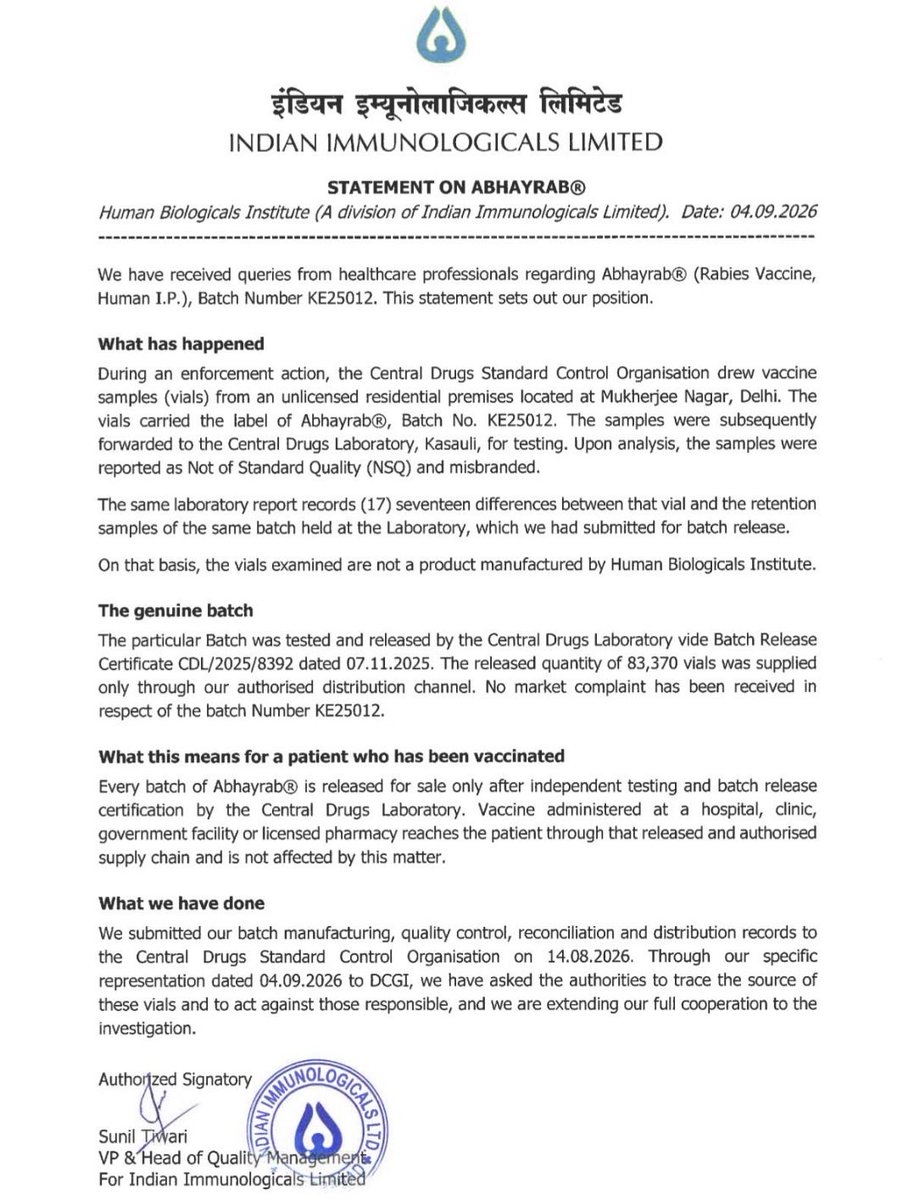
Serious concerns regarding the efficacy of #Rabies vaccine available in Delhi!
Here is what has been found
In samples collected from Mukherjee Nagar, it has been found that the vial’s collected and labelled as #Abhayrab was not of standard quality and even misbranded
The vials were tested in Kasauli.
The Manufacturer - Indian Immunologicals says the vials are not its product and has asked authorities to trace their source.
Rabies kills thousands across india and inspite of the vaccine being administered in time, victims die….
Counterfeit anti rabies vaccines are the biggest reason!
@ManishS43392522@aravind@narendramodi Technical solutions, if any, must focus on improving water use efficiency through more efficient irrigation, wastewater recycling and reducing loss during water delivery. Not on preventing water from reaching the sea.
@ManishS43392522@aravind@narendramodi Water is not like money or assets that one can just hoard indefinitely for the benefit of a few, its the fundamental process governing ecosystem processes. The natural flow of rivers must not be disrupted. One can't engineer one's way out of ongoing environmental crises.
Seven days after the devastating flash floods tore through northern Nepal, Nuwakot is still searching for the missing and for the dead.
At the Nepal Army camp, the smell of decomposition hangs in the air as bodies and dismembered remains continue to arrive. Around 3,000 Army personnel are engaged in search, rescue and relief operations across some of the worst-hit terrain.
And yet, families continue to wait.
I met relatives searching for 10 people who went missing near Syabrubesi, including Indian-origin Australian citizens travelling towards Kailash Mansarovar. One family has lost contact with a mother, father and their two sons. Seven days later, there is still no word.
At Devighat and Trishuli bazaars, the destruction is overwhelming - homes, roads and farmland swept away, leaving entire settlements scarred by the force of the floods.
At the Army camp, an elderly couple was brought in by helicopter, alive but shaken. Their identities were not immediately known.
For rescuers, hope of finding survivors is fading. For families, it is the only thing they have left.
Reporting from the ground in Nuwakot.
Link:
https://t.co/IRvBM1STZ0
@NewIndianXpress #NepalFloods #Nuwakot #Nepal #GroundReport #FlashFloods #KailashMansarovar
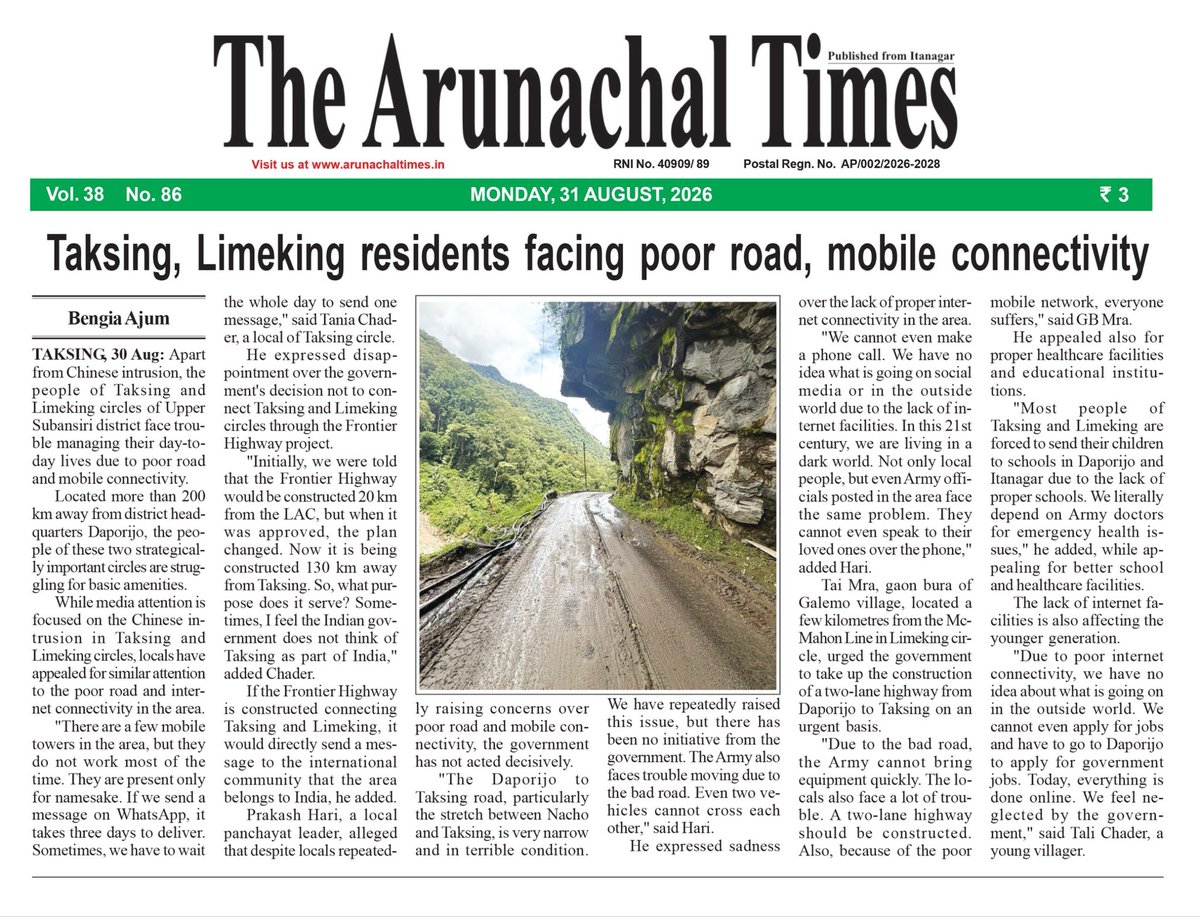
@Bengiaajum travelled to Taksing and beyond, as allegations by the local communities of Chinese intrusions into Indian territory surfaced. He profiled the Indian government’s failure to provide even the basic needs to these communities. Please do read, if you have not already.
Drone images suggest that glaciers surrounding the Chhochen Khola River impact crater in #Nepal remain susceptible to further collapses, posing a major potential hazard: #China’s Ministry of Water Resources #mudslide https://t.co/QzAydE6a8P
"The scale of bear culling in Japan is unrivalled in the modern era".
#bears kill 13 people in #Japan. In response the country kills 14000 bears.
People of #India: I bow my head in gratitude for your amazing tolerance & acceptance of #wildlife as co living beings sharing the earth.
#WarOnWildlife
https://t.co/zVEBXek5UT
794 bodies recovered. Thousands still unaccounted for. Tell us, what was their crime?
I am writing this from the Himalayas from a country responsible for only around 0.1% of global greenhouse-gas emissions. Nearly 46% of our land is covered by forests. Around 94% of our installed electricity capacity comes from hydropower. We are rapidly moving away from fossil-fuel vehicles too: EVs accounted for about 74% of Nepal’s four-wheeled passenger vehicle imports in 2025/26. We protect forests. We generate electricity from our rivers. We are embracing electric mobility at a pace few countries in the world have matched. Yet today, our people are digging through mud, searching rivers and waiting beside phones for the names of their loved ones.
The Bhote Koshi flash flood has shown us what it means to live beneath a rapidly changing cryosphere. Our glaciers are retreating, our frozen mountains are becoming increasingly unstable, and the rivers that generate our clean electricity can also carry destruction into communities below. We did not build our prosperity by burning generations of coal and oil. We contributed almost nothing to creating the climate crisis at this scale. But we are being forced to survive its consequences. The people whose bodies are being pulled from rivers did not cause this crisis. The families still waiting for thousands of missing people did not cause it. The children, farmers, workers and mountain communities who lost everything did not cause it.
So from the Himalayas, we ask the industrialised world: how many Himalayan bodies will be enough? How many mothers must wait for children who never return? How many villages must disappear before “climate justice” becomes more than a speech at another conference? Do not come to us only with sympathy after the bodies have been counted. Come with responsibility. Come with climate finance, adaptation, loss-and-damage support and the courage to cut emissions at the scale this emergency demands. We want climate justice. We want the right to survive in our own mountains. We want a world where being born in the Himalayas is not a death sentence for a crisis we did not create.
Himalayan glaciers are melting at an alarming rate due to climate change. If they disappeared entirely, the result would be a profound water, food, and security crisis affecting 2 billion people. The fallout would happen in two distinct phases:
Phase 1: The Melt
Before the ice vanishes, rapid melting will cause massive volatility. We will see frequent glacial lake outbursts flooding downstream towns, widespread landslides destroying key infrastructure, and heavy silt crippling vital hydropower dams.
Phase 2: The Aftermath
Once the glaciers are gone, the regional water tower runs dry. Major rivers will lose up to two-thirds of their dry-season flow, triggering immediate drinking water shortages, a collapse in agricultural yields, and widespread power grid failures.
This will inevitably force mass migrations and escalate geopolitical tensions over remaining water rights.
Ultimately, the Himalayas are a global life-support system.
Combating climate change to preserve them is a matter of international security.
🚨 China's Ministry of Water Resources has issued an urgent alert warning that a newly formed barrier lake near the Nepal-Tibet border poses a high risk of breaching within 72 hours.
Formed at the confluence of the Chhochen Khola and Purepu Tsangpo rivers by yesterdays massive rock-and-mudslide, the overflowing lake already holds roughly 2 million cubic metres of water.
The lake faces an additional 3 million cubic metres of inflow from expected severe weather. A collapse would trigger a catastrophic downstream surge along the Bhote Koshi-Trishuli-Narayani river system.
1) Understandably many are confused where so much water came from with no lakes. We need to understand the scale of this. 🧵
> The glacier face that collapsed is ~1.5 kms wide & 1.4 kms deep. That height alone is nearly twice that of Burj Khalifa.
How people can help Nepal’s flood-affected communities
A list of funds and organizations taking donations, including the Prime Minister's Disaster Relief Fund.
Caution: Fundraising for disasters is a common vector for scams in the first 48 to 72 hours, so before transferring money, please verify account details directly through the official channels or Nepal’s consulate and embassy’s official website and social media channels.
https://t.co/GtJEQtWnmC
The first major Northern spotted owl analysis since the transition to passive acoustic monitoring just came out. HUGE effort. 4081 survey stations within 1027 randomly selected 5-km2 hexagons across six physiographic regions. Spotted owls doing poorly /1
https://t.co/HggY0fl15E