Introducing Forest Road Vault.
Forest Road Vault brings real, income producing credit on-chain.
Forest Road has been lending against real collateral since 2017, film
and TV tax credits, renewable energy, life sciences, real estate, and
digital assets.
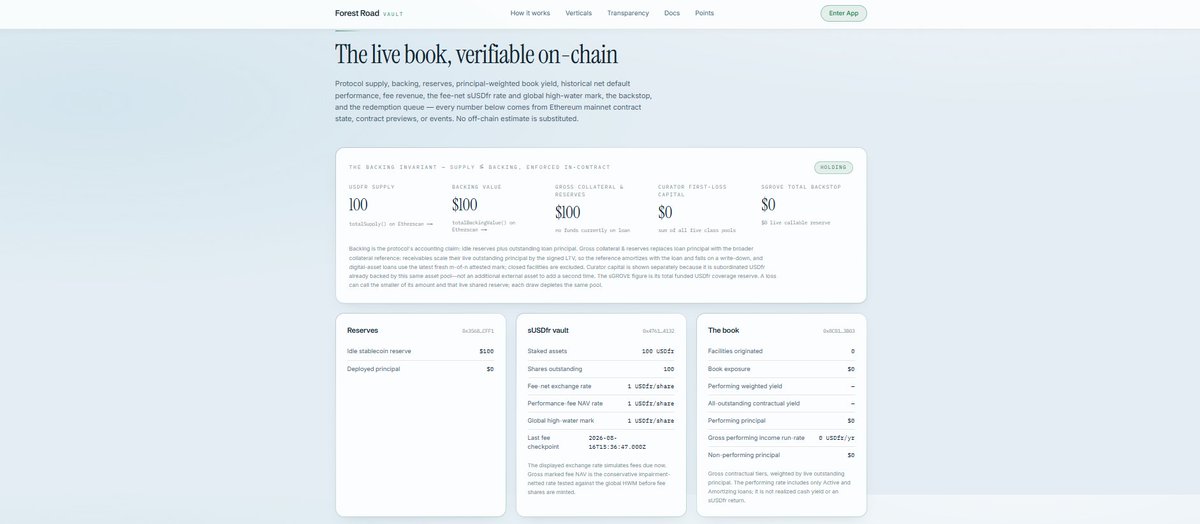
Two tokens sit on top of that book. USDfr is stable, minted 1:1 from
approved stablecoins through a KYC gated controller. sUSDfr is what
you get when you stake USDfr, its value moves with what the loan book
actually earns. No fixed rate, ever.
If a loan defaults, losses are absorbed in a strict order. Curator
capital first, sGROVE backstop second, sUSDfr principal last. That
order is enforced by the contract, not a promise.
Live on testnet. Mainnet is gated behind a published audit checklist.
https://t.co/zWdQyZfibu
The thing most "real yield" projects don't lead with:
Real yield means real risk. If the credit book underperforms, losses happen.
The loss cascade decides who absorbs it first, curator capital,
then sGROVE, then principal, it doesn't decide whether it happens.
Read the full risk disclosures before you deposit: https://t.co/PvnPeWotBh
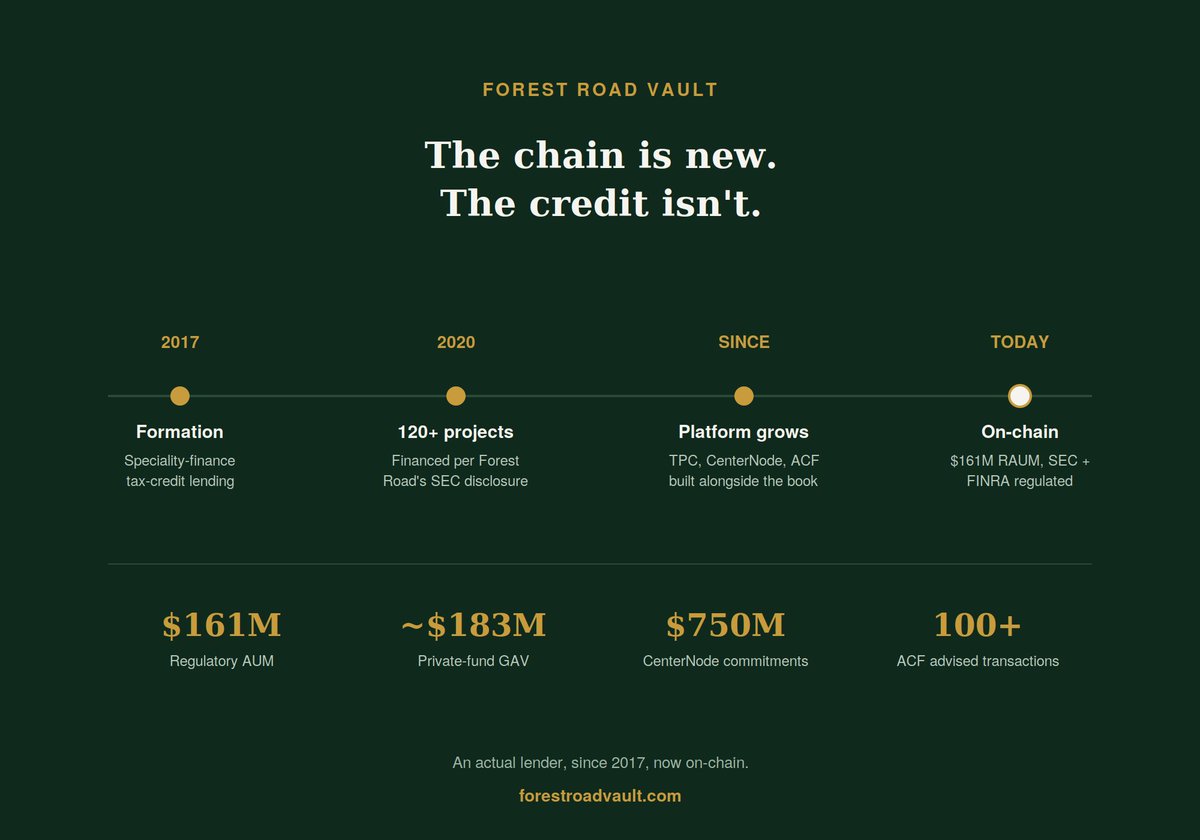
Forest Road Vault didn't start as a crypto idea looking for a use case.
It started in 2017, when Forest Road formed around speciality-finance lending, tax credits,
the kind of collateral traditional lenders either don't understand or move too slowly on.
By 2020, Forest Road had financed 120+ media and entertainment projects.
Around the same period, the firm's own SEC disclosures put revenue north of $100M.
Not projections. Filed numbers.
Today, Forest Road operates as an SEC-registered investment adviser with a FINRA/SIPC-registered broker-dealer affiliate, carrying $161M in regulatory AUM and roughly $183M in private-fund gross asset value.
The platform grew alongside the lending. TPC, a Forest Road-owned entertainment finance company, deploys roughly $100M annually across 1,500+ productions.
CenterNode, launched by Forest Road, announced $750M in initial commitments for renewable-energy investing.
ACF, the firm's majority-owned investment bank, has advised on 100+ transactions connecting capital with IP owners.
Forest Road Vault takes that same operating business, the same underwriting judgment, the same real collateral, and puts it on-chain.
Not a crypto-native team guessing at credit. An actual lender, doing what it's done since 2017, with the added discipline of a system where backing is checkable rather than claimed.
The chain is new. The credit isn't.
https://t.co/zWdQyZfibu
RWA isn't just a US story.
emerging markets are leading a lot of this growth, tokenization solves real friction there,
capital formation and cross-border access that legacy finance makes slow and expensive.
five collateral verticals, one book, accessible wherever you are.
https://t.co/zWdQyZfibu
@duna_mix@flintrwa yeah, the legal enforceability gap and the illiquidity illusion keep coming up as the real bottlenecks.
putting the asset onchain is the easy step... making the rights actually stick in court and the secondary market work is the harder one.
audit update.
review is ongoing. mainnet access remains KYC-gated while final checks complete.
no shortcuts on this one, we'll share the report the moment it's done.
Vertical spotlight!
one of five verticals in the book: renewable energy.
small and mid-market renewable projects, lending against transferable ITC/PTC tax credits
and project cashflows, for borrowers underserved by community banks and capital markets.
medium to long duration, spanning construction and operation.
@therollupco yeah, those two problems have been the structural friction for a long time..
tokenization doesn’t invent liquidity out of thin air, but it does change who can hold the paper and how cleanly it can transfer.
audit update.
review is ongoing. mainnet access remains KYC-gated while final checks complete.
no shortcuts on this one, we'll share the report the moment it's done.
@CryptoTeca__ the thing is,
most of the attention is still on issuance.
the real stress test is what happens to the token when the company actually goes public – clean conversion and settlement with a recognized legal claim is the harder piece.
RWA isn't just a US story.
emerging markets are leading a lot of this growth, tokenization solves real friction there,
capital formation and cross-border access that legacy finance makes slow and expensive.
five collateral verticals, one book, accessible wherever you are.
https://t.co/zWdQyZfibu
@DeFi_Dad@edge_pod honestly, reinsurance has always been one of those yield sources that stayed locked behind institutional walls.
getting the actual capital stack and underwriting discipline onchain without watering it down is the interesting part.
@RealAllinCrypto@Ondo honestly, fragmented liquidity is one of the bigger structural headaches for tokenized assets..
connecting the pools across chains feels like the harder infrastructure piece if these markets are ever going to behave properly.