I turned my RTX 5080 into a FLOP devnet miner, and packaged it so anyone can do the same from a Windows PC.
12 sessions settled on chain, 0 failed.
Official images only · double-click Start · live widget
Free guide 👇
https://t.co/y605nYTmxU
@flop_labs@CryptoHayes@some_one_else
2/ Train yourself to go from 10 to 40 to 100 hours of focused work a week. I did this for months building an automated trading system from scratch. 5am-10pm 7days/week
99% of people need #WorkLifeBalance or whatever, and that's great. But I'm talking to the people on a mission.
This is the only @bot guide you need if you want to go from a beginner to a power user in the shortest amount of time. @nateliason breaks down everything you need to know. https://t.co/IsCH7ZRaCM
How I made $6K PnL in 30 days on $10K principal market making perps ($158m+ volume).
The strat was entirely built by me and my quant, Claude (he won a national math competition in China).
Last night I asked if you'd want a guide. Hundreds of you said yes, so here it is: HFT for Dummies.
The honest timeline when I did it:
- Days for basic harness and venue integrations.
- Weeks to get it semi-competitive.
- Months to really tune and get it properly profitable.
This series can hopefully shortcut the learning curve for you.
I've been writing trading bots since 2017. It's how I got into crypto (free market data!), and how I met my co-founder.
Back then the barrier was high. You had to know how to code, to study data to find alpha, and to grind devops to have systems not blow up in production. Thankfully I taught myself Python and later Rust, but not everyone has a CS degree.
Nowadays with LLMs, anyone can have a skilled quant in their pocket. I use it for data analysis, strategy tuning, research and alpha generation and infra optimisation. It's a ridiculous time saver.
I'm extremely bullish on one-person quant shops. I think this will be a huge trend this next decade as finance comes on chain and market data and connectivity are accessible to anyone. I've already met many hobbyists who've made a living trading on e.g. Hyperliquid, enough so to quit their day jobs.
What we'll be building
A delta-neutral, reference-price market maker.
Binance is where most price discovery happens. We stream its market data, use it as a reference price, and quote a bid and an ask around it on another venue. I'm using @Bulletxyz because it's the one I know best.
Market making is the business of picking up pennies. Mine are under half a basis point per dollar. Enough pennies add up at the scale of millions of volume.
The catch is speed. If the market moves and you're slow to update, someone lifts your stale quote and you're the exit liquidity. It's a fun game of algorithmic cat and mouse.
On Bullet, takers get a 100ms speed bump. Why? It gives soon-to-be market makers like you a safety buffer so you don't get steamrolled by billion dollar firms with microwave towers.
The goal
The goal: tick to order sent in under 10ms. Stretch goal: under 1ms, which is very achievable if you're determined. We'll also focus on minimising jitter (randomness) because your slowest orders are the ones that will lose you the most pnl.
Agenda:
I'll aim to post one topic a day, going from easy wins, and getting progressively more deep in the weeds. If you work at any HFT firm this will all be elementary stuff, but hopefully it's helpful for newcomers.
Saving seconds
1. Basic intro to algo-trading (this post)
2. Running a simple market maker from your laptop
3. Measure once, cut twice: telemetry and Amdahl's law
4. AWS: Infra and colocation
Saving millis
5. Stop polling: websockets are your friend
6. Optimising order execution
7. How to not get rekt by API rate limits
8. Linux tuning: CPU pinning, IRQs and other nerd stuff
Saving micros (diminishing returns, but fun)
9. Optimising the hot path with CPU profiling in Rust
10. AWS: the last mile
11. Bonus: nonces (and other DeFi quirks)
I'll try share some open source code along with it. Don't expect to be beating Jump in the orderbooks just yet. It should be a good baseline that you can extend and take it as far as you want (you can take it pretty far!).
Tomorrow: setting up a basic MM in Rust, the architecture of which will roughly follow the diagram attached below.
👀 BRIDGE INTO ZEC WITH LOW FEES & SMALL AMOUNTS🔥
⚠️ READ/WATCH CAREFULLY BEFORE STARTING
Go to:
https://t.co/CQIyzi5oqv
Steps 👇
• Connect your wallet
• Select the pair
• Enter your Noir Wallet address
• Confirm the swap
⚠️ Important: If you select a Transparent Address like I did, there’s 1 more step you need to complete. I’ll explain it at the end 👇
⏰ Now wait around 2–5 minutes
The bridge may complete within 1–2 minutes, but Noir Wallet may not show the balance instantly. It can take another 2–5 minutes.
👉 You can also check the transaction on the Zcash Explorer
💰 After receiving the funds:
If you bridged to a Transparent Address, you need to shield the funds, like I did at the end.
📌 If you select a Shielded Address (u1...) for bridging, you DON’T need to shield them again🫶
Hope this saves you some time + fees 💰🔥
Please 🥺 Follow @CryptoRohit07
I’m trying to reach 10K followers this year🚀❤️
⚠️ DYOR. Always verify the address and transaction details before confirming.
How to get a job as a Robotics Engineer:
robotics is the one frontier field where the entry level still doesn't ask for a degree
1 in 5 robotics jobs posted right now is a technician role, and most of them only need a certificate or a two year degree
so here's my workflow for getting a job as a robotics engineer:
1: pick one direction and drop the other two
robot learning pays the most and everyone wants it
autonomy and mobile robotics has the most openings by a wide margin
embedded and mechatronics is boring and you'll never be out of work
2: build things that moved, and write down the numbers
recruiters here open your github before they read your CV
what gets you through:
- a commit history where you're visibly fixing things, not one big final push
- real hardware with reliability numbers, sim doesn't count
- datasets on the lerobot hub
- commits to ROS 2, Nav2, MoveIt, Isaac Lab, LeRobot
3: build your hardware in public
the best way to prove your knowledge is the recognition of your skill from masses
just build anything you want and share it on X/IG/YT
good example of the guy who gets offers from Tier-S level robotics companies (you can copy his strategy):
go to IG
type in search: "aykhanium"
and check which rubrics he does to be recognized
repeat.
4: write down what broke
everyone posts the demo that worked
almost nobody writes up the four things that failed first and how they found each one
that's the part you can't fake from a tutorial, and it's the part that survives the third question in an interview
cheat-codes to stand out and get into the top 1%:
1. take the shift nobody wants
teleoperation pays around $28 an hour. figure posted a humanoid robot operator at $25 to $35 with no degree asked for
it's just driving a robot around a lab
but it puts you inside a frontier company with a badge on, and now you're a person they know instead of a CV in a pile
2. sell the integration, not the robot
the arm is about 25% of what a project costs
the other 75% is engineering, safety, and making everything talk to each other
a $35k arm turns into an $80k system, and that $45k is your job
3. go where nobody's competing
66% of robotics projects get delayed by certification
functional safety pays well and almost nobody bothers learning it
4. C++ and Python, both
every Figure and Skild listing I read asks for both, not one
5. delete the ROS 1 from your repos
recruiters call it out by name as a red flag
if there's still a catkin_make sitting in your github, that's the first thing they see
main insight:
$47.4B went into physical AI in the first half of 2026
the BLS still projects 1 to 2% job growth in the occupation
the money showed up years before the headcount will
so the people getting in right now aren't winning interviews, they're walking through the technician door and moving sideways once they're inside
that's like to be hired in OpenAI in 2019...
and one more thing
nothing you learn here goes stale
a PID loop works the same as it did in 1990, and the arm you fix this weekend teaches you something you'll still use in ten years
you can't say that about anything else in AI right now...
I've created a site to share some ideas.
My first post is about being a professional whitehat, and how I evaluate potential rewards to decide where to hunt.
https://t.co/XcGP8BkHn9
"Greed makes markets."
Annanay Kapila (@annanay) spent years as an HFT quant at Flow Traders and Tower Research before founding QFEX (@QFEX), a perpetual futures exchange for equities, commodities & FX. Cambridge Maths.
At his last job, the desk traded $10B+ of volume a day, run almost entirely by algorithms.
In this lecture, he builds market making from first principles:
- The map of systematic trading: prop money vs. other people's money, HFT vs. mid-frequency, and why every strategy lives in one quadrant
- Why prop firms can return 50-100% a year while hedge funds can't: HFT never leaves you holding a big position
- The order book from scratch: bids, offers, limit orders, and why the first order on a price level gets the trade
- No free lunch: how arbitrageurs force every order book to reveal a fair price without anyone trying to
- The entire strategy in one line: bid below fair value, offer above it, collect the difference forever
- Market making is "time-spreading risk," warehousing positions between a seller who shows up now and a buyer who shows up later
- Adverse selection: you're most likely to get filled precisely when your price is most wrong
- Why market makers are completely self-serving, and why that's exactly what makes markets work
- The competitive race that compresses spreads: greed among market makers means lower costs for everyone else
- Thick books vs. thin books, and the vicious loop that keeps illiquid markets illiquid
Highlights:
(00:45) The systematic trading map: capital vs speed
(01:45) Prop firms vs hedge funds: return-on-capital economics
(06:29) A message from Onyx
(07:55) Where market making sits: high-Sharpe prop HFT
(08:55) Fungibility and why exchanges exist
(11:00) How a central limit order book actually works
(17:40) No free lunch: arbitrage-free pricing in the book
(19:55) Theo: reading fair value from the mid
(22:45) Who really posts the book (not retail)
(24:35) Market making as warehousing risk across time
(27:20) Edge: quoting around your fair value
(29:45) Queue priority and the adverse selection problem
(33:05) How competition compresses the bid-offer spread
(37:40) Thick vs thin books: liquidity begets liquidity
(43:55) Scaling to $10B a day on algorithms
🥂 CONSENSUS
📣 WHITELIST OPEN!
🏭 Open a Company. It mines $AETH, forever.
7,000,000 $AETH a day, split across every Company in the game.
🧠 Learn the game
🔗 https://t.co/yfLi7l8iEE
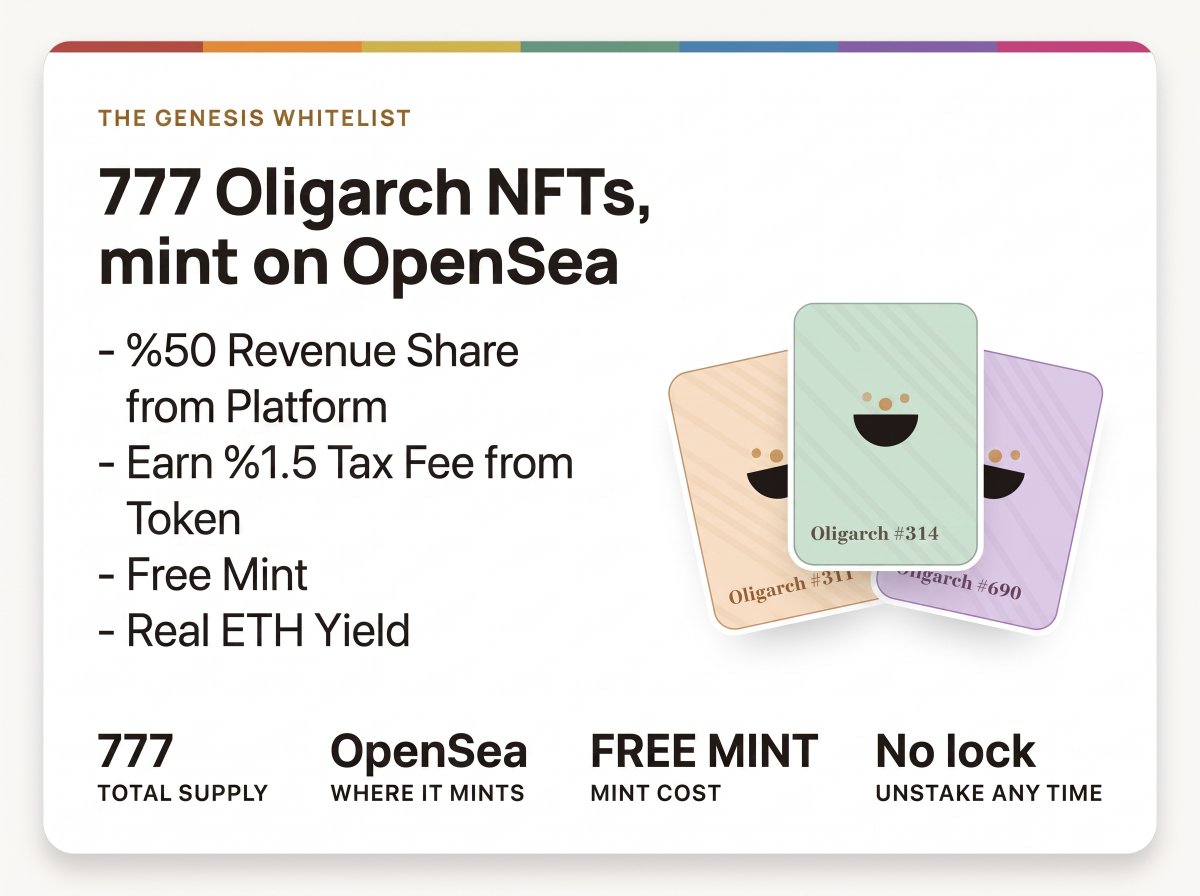
🎩 777 Oligarch Seats
🎟️ Free mint on @opensea
💰 Not pictures. Each one earns ETH from the protocol revenue.
🔓 The whitelist is open now → https://t.co/va7PVRN806
🚀 %50 Boost Your WL Chance
You can open a Company there early, before anyone can play.
Opening company is not mandatory at WL phase, but it increases your WL chances by 50%.
🔥Double Hash for the first 77 hours. Only 777 exist.
🗓️ 09.11 - 11:11 PM UTC