☕️🫡💜💜
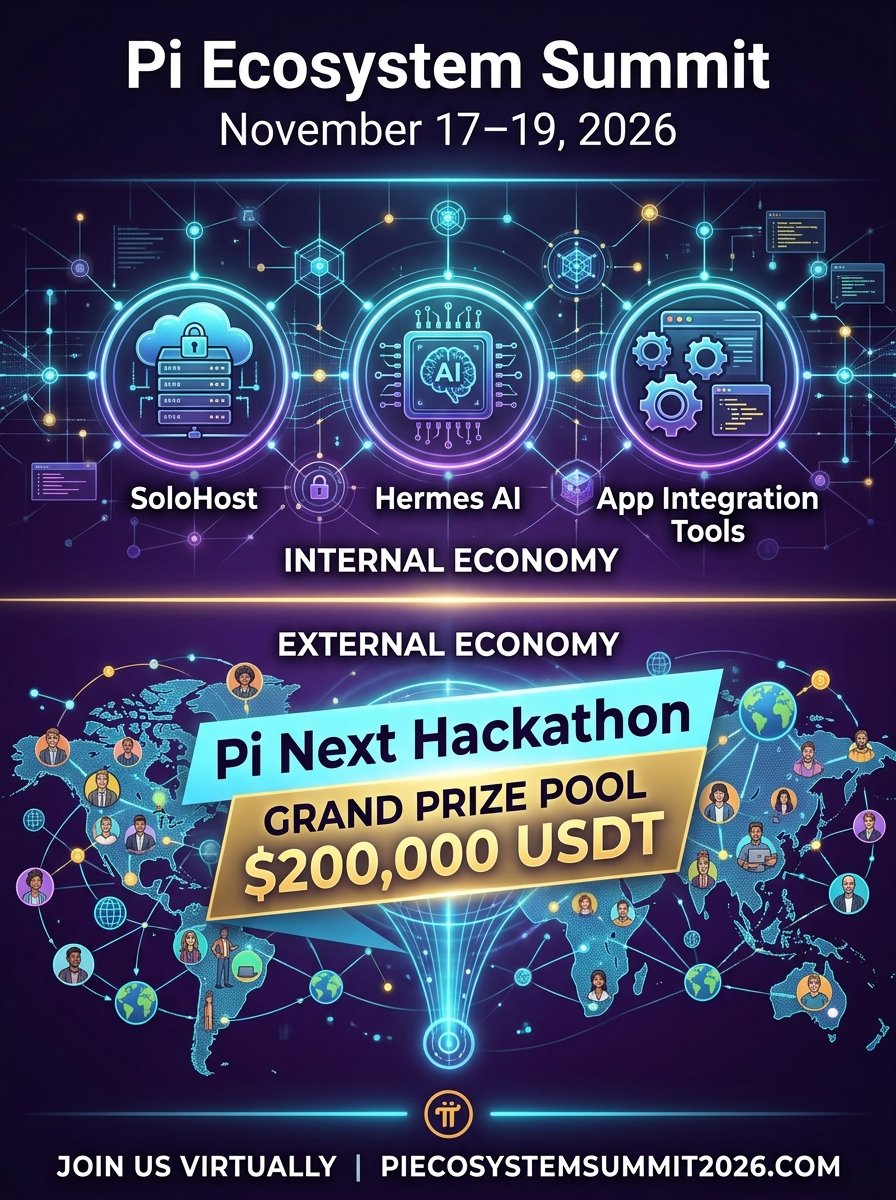
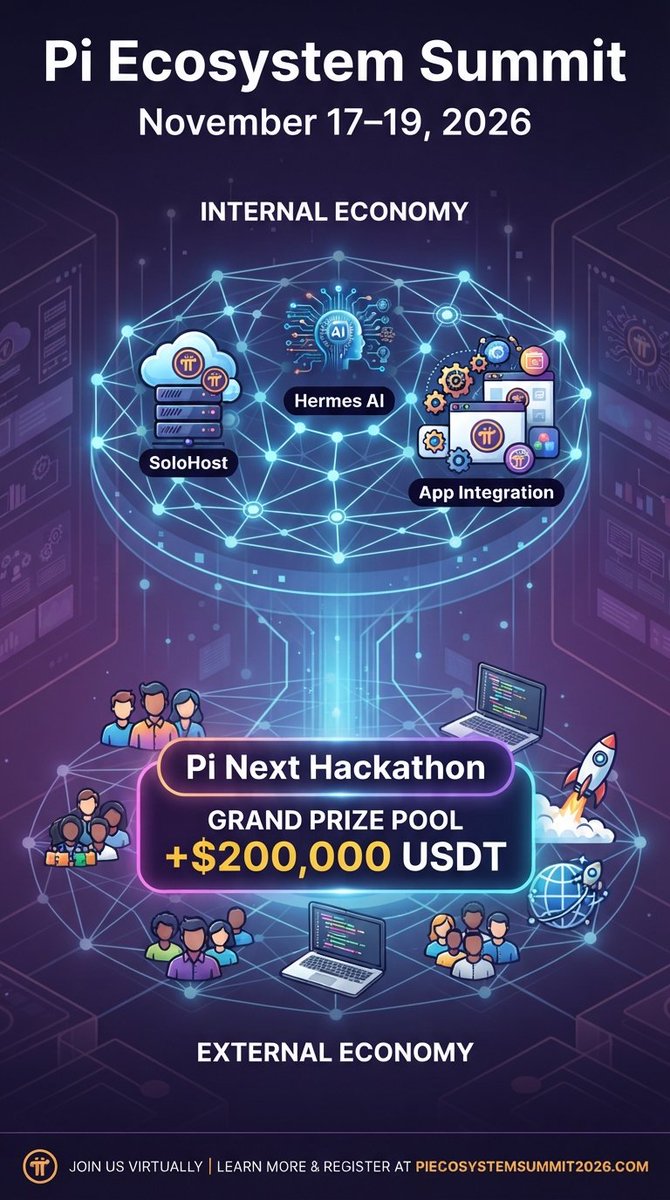
**Pi Ecosystem Summit: Distinguishing the Internal Economy from the External Economy Through Building Layers**
November 17–19, 2026
The upcoming summit aims to demonstrate the practical difference between the **internal economy** of the ecosystem and the **external economy**, and how each team can contribute to one or connect the two.
### Internal Economy
This refers to what currently operates within the network: existing applications, platform tools, and verified users.
This layer is primarily built by the Pi Core Team and developers already inside the system.
Clear examples of internal economy tools include:
- **SoloHost**: Enables the operation of local services on the node network, strengthening the ability to deliver services without full reliance on external infrastructure.
- **Hermes** and local AI agents: Run within the user’s environment and keep data and processes inside the system.
- Improvements to the Developer Portal and integration tools: Make it easier for existing teams to build and connect their services with one another.
At the summit, internal teams are expected to showcase how they use these tools, the new features they have added, and how other developers inside the system can benefit from them. This illustrates the mechanism of the internal economy: integration between existing applications and services.
### External Economy
This involves attracting developers and companies from outside the system.
This is where the hackathon (**Pi Next**) with a **$200,000 USDT** prize pool comes in. The prize is liquid and globally recognized, attracting external teams that have no prior relationship with Pi.
Those who win or decide to continue will enter the internal economy to benefit from the tools, users, and infrastructure. In this way, external participation turns into internal demand for the platform and for Pi itself.
### How This Will Be Clarified for Each Team at the Summit
- **Platform teams (Core Team)**: Will present new tools and capabilities that serve the internal economy and make it easier for everyone to build on them.
- **Internal application teams**: Will explain their features and services, how they can be used by pioneers or other teams inside the system, and what forms of collaboration are possible.
- **The hackathon (Day 3)**: Opens the door to external teams, clarifying participation rules and prizes, and how these teams can later transition into the system.
In this way, the summit does not present isolated events. It shows the difference between the internal economy (tools + applications + integration) and the external economy (attraction through incentives + later entry into the system).
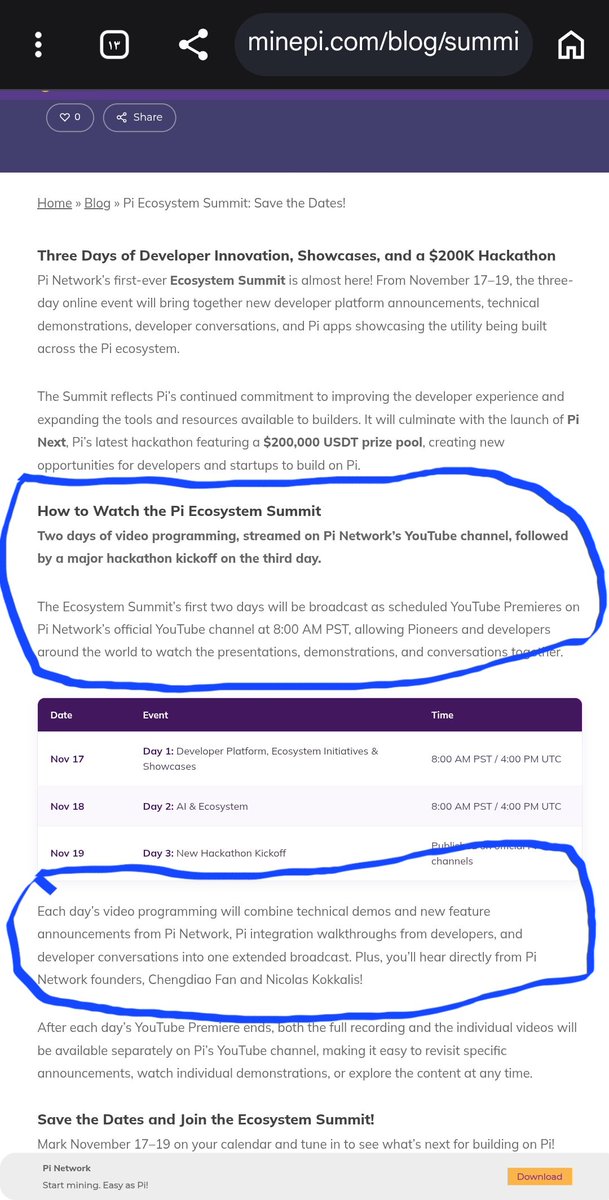
**Schedule:**
- November 17: Platform tools + internal application showcases (YouTube Premiere – 4:00 PM UTC)
- November 18: AI & Ecosystem
- November 19: Hackathon launch and connecting the external to the internal
Recordings will be available after each day.
The summit is an opportunity to see this distinction in practice: what is built and used inside the system, and how the outside is attracted to become part of it.
🌐✨
#PiNetwork #PiDEX #PiRC #Protocol27 #Mainnet #Web3 #PiNetwork
#PiPioneers
#PiMainnet
#PiCoreTeam
#PiCrypto
#PiCommunity
#PiDEX
#PiLaunchpad
#PiNode
#PiAI
#Protocol27
#Protocol28
#DeFi
#Web3
#Decentralization
#CryptoNews
#DigitalEconomy
#FinancialFreedom#DeFi
#Web3
#Decentralization
#CryptoNews
#DigitalEconomy
#FinancialFreedom#PiDEX
#PiLaunchpad
#PiNode
#PiAI
#Protocol27
#Protocol28
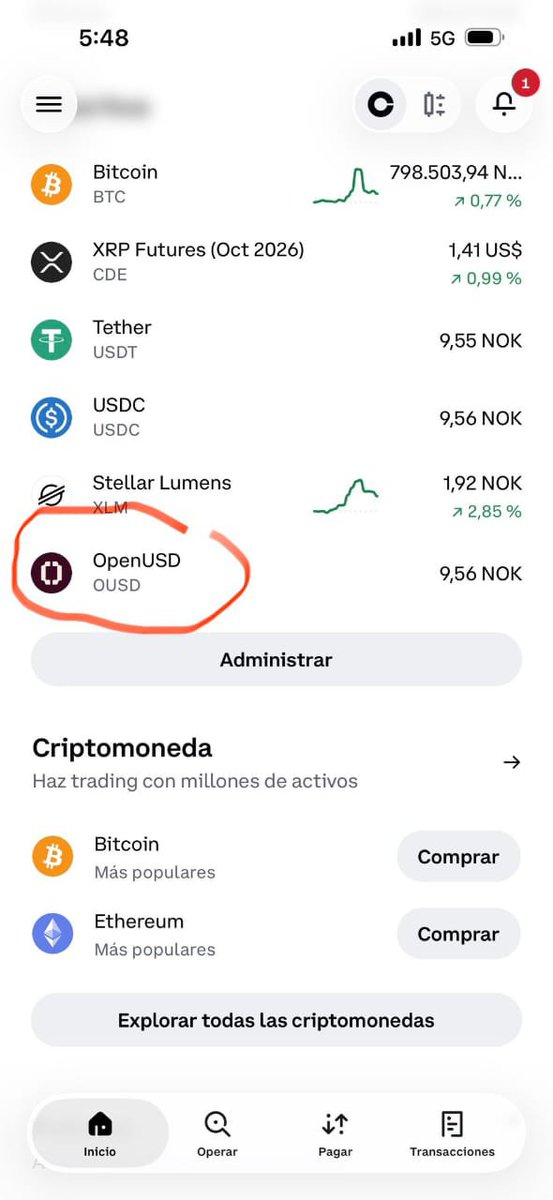
#ousd
**The Elastic Storage Capacity of the Pi Asset and the Impact of Velocity of Circulation on Value Stability: An Analytical Framework for Real Exchange and the Role of Oracles**
In peer-to-peer digital asset economies, the value of a monetary unit is not determined solely by its nominal price on secondary markets, but by its capacity to absorb and store the real value of the goods and services exchanged against it in recorded transactions. This concept is known as the **Elastic Token Capacity**, whereby the monetary unit functions as an informational vessel that expands or contracts according to the nature of the exchanges settled through it.
This principle can be illustrated through a practical example. Suppose a merchant holds an inventory of 100 smartphones, each with a market value of $1,000, for a total inventory value of $100,000. If the merchant offers each phone at a price of 0.01 Pi and all units are sold, the network’s ledger records that a single unit of Pi has absorbed and stored a material value equivalent to $100,000. By contrast, if another participant offers a good or service valued at $500 in exchange for 1,000 Pi, the storage density of each individual Pi unit in that transaction falls to $0.5. This disparity demonstrates that the value stored within the asset is not fixed; rather, it is determined by the aggregate real values recorded in the transactions that led to the accumulation of the unit.
Such storage is recorded on the decentralized ledger (Blockchain Ledger), where each exchange documents the corresponding value transferred against a specific quantity of the asset. Consequently, a unit acquires its density based on the history of recorded transactions until its completion, not on an abstract external valuation.
However, leaving this storage capacity subject to unanchored, subjective valuation leads to liquidity distortion. Merchants become reluctant to accept the asset for fear of depleting their physical inventory, resulting in a decline in the velocity of circulation (V). At present, the network remains in a phase of infrastructure and application development, such that velocity has not yet reached levels sufficient for storage density to emerge in a broad and consistent manner.
This dispersion can be addressed through the integration of decentralized Chainlink Oracles within smart contracts, such as those executed in the Soroban environment. The oracle functions as an informational bridge that transmits global reference prices of real-world assets (denominated in U.S. dollars) onto the chain. Based on this data, the smart contract automatically calculates the precise quantity of Pi required to settle the transaction according to the equation:
\[ T_{\text{required}} = \frac{\text{Value}_{\text{USD}}}{\text{Price}_{\text{Pi}}} \]
This linkage ensures that each transaction records a balanced monetary density, protects the purchasing power of merchants, and transforms the asset from a random barter instrument into a more stable medium of exchange. As the velocity of circulation (V) rises in subsequent phases—driven by the expansion of real applications and transactions—this density will emerge and expand, thereby strengthening participants’ confidence in holding or locking the asset for longer periods rather than engaging in immediate liquidation.
**Message to the Community**
We now possess an opportunity to assign value to every decimal unit within the project, such that the accumulation of real transactions reveals a complete asset with the value of 1 Pi carrying documented storage density. The option is open to us, the system is expanding, and the world will change when this asset is used as a genuine medium of exchange that records value through actual utility rather than through price speculation alone.
PiNetwork #PiDEX #PiRC #Protocol27 #Mainnet #Web3 #PiNetwork
#PiPioneers
#PiMainnet
#PiCoreTeam
#PiCrypto
#PiCommunity
#PiDEX
#PiLaunchpad
#PiNode
#PiAI
#Protocol27
#Protocol28
📄 Section I.4 of the Pi MiCA whitepaper: a clause the community rarely pays attention to 👇
The whitepaper states that no individual or organization, including Pi Network, has the ability or obligation to keep participants informed of every detail of the development of the Pi application platform, or of third-party software, integrations, and products. 🔍
What this means: ⁉️
✅ You can't assume every project in the ecosystem is guaranteed or endorsed by Pi.
📢 You can't assume Pi will publish all of its partners' technical information.
⚠️ Users must assess the risks themselves when using third-party apps. 🧠
The value established by the majority of Pioneers and mass adoption,that is when GCV will become clearly evident..You'll see transaction fees just 0.00xxx Pi or 0.0000xxx USD.Until that time comes,anti-GCV will continue to attack.
Please study the following link:
Code Structure:
https://t.co/Q5uanoU89e
Pi Network Constants:
https://t.co/piUAXIWw23
GCV!!!..👑👑💜💜
@Kosasihg88G
#PiNetwork #GCV
I have just mined 96 $USDS on @swapfone! 🔥
Mine $USDS directly from your phone at https://t.co/0et5j17GVA
👉 Download Swapfone: https://t.co/0et5j17GVA
Start mining NOW! ⛏️
☕ OpenBrew × #PiNetwork | #SmartContract Test Complete ✅
We tested OpenBrew's escrow smart contract on Pi Testnet, and every scenario passed. ✅
🏗️ The foundation is laid. Now we're building Brew Delivery on top of it, floor by floor... 🔨⏳
Your Pi is held safely until delivery.
Cafés, send everything from coffee to your full delivery menu to local Pioneers.
Listing is FREE for now. Join OpenBrew before paid plans begin.
━━━━━━━━━━
✨ What you can do on OpenBrew
🧑🍳 Brew Cafés | Discover & Pay with Pi
Business owners! List your café on OpenBrew for FREE and introduce it to a global community of 6️⃣0️⃣M+ Pioneers.
🤝 Brew Meet | Connect Pioneers
Create meetups, discover local gatherings, and turn online connections into real-life experiences.
📸 Brew Moments | Share Your Story
Share your coffee moments, café discoveries, and everyday experiences with Pioneers worldwide.
🌍 More than a café platform, OpenBrew is building a global community where Pioneers connect, share, and experience the real-world utility of Pi. ☕ Connecting the world with coffee and Pi, one cup at a time.
Find cafés, meet people, and share your everyday moments.
📱 Pi Testnet Browser → search "OpenBrew" → Brew tab
🔗 Link: https://t.co/yEDYMPgs0S
💜 Support us through app staking!
Help cafés around the world discover OpenBrew.
#OpenBrew #PiNetwork #PiCoreTeam #SmartContract #Web3 #Coffee #Cafe #CoffeeShop #SmallBusiness #Barista
🚨#PiNetwork challenges conventional thinking. It's about connecting people, businesses, applications,& financial infrastructure into a more inclusive economic ecosystem.
•••"The vision is bigger than price speculation. A Non Conformist vision for building a digital economy."
PI NETWORK VENTURES: FROM "OUTSIDER" TO THE NEW LUCKY CHARM FOR AIRDROP FARMERS?
🔹 The Axis Robotics event drew attention to Pi Network Ventures because of some very practical calculations:
🔸 Airdrop farmers are always looking for investment funds with a high-quality "deal closing" rate (Tier-1, Tier-2) to work on tasks for, because with a reputable fund, the project has the money for a grand TGE and a generous airdrop allocation.
🔸 Pi Network Ventures appearing alongside big names such as Hack VC and Nomad Capital in the Seed Round of Axis Robotics surprised airdrop farmers. They realized this is not a "fund in name only" but one that genuinely has capital flow and a sharp investment appetite (targeting exactly the Physical AI / DePIN sector).
🔸 They immediately added Pi Network Ventures to the "Smart Money to follow" list to examine its portfolio, in order to hunt for the next projects this fund invests in.
🔹 Previously, mainstream airdrop hunters often looked down on or ignored Pi-related projects because of the prejudice that "they are all casual users, lacking technical depth."
🔸 When $AXIS had its TGE and delivered real returns (ROI) for those who did testnet/simulation data tasks, airdrop farmers realized they had missed out on (or only farmed lightly) a "juicy" opportunity.
🔸 This regret forced them to change their perspective completely. The prejudice was erased and replaced by respect and more pragmatic calculation: any project backed by Pi Network Ventures must be put on the priority list to be farmed carefully (farming clones, farming interactions).
🔹 Airdrop farmers are very sensitive to cross-incentive mechanisms.
🔸 When a fund with a huge user base invests in an AI/DePIN project, farmers immediately predict there will be exclusive partnership campaigns: for example, completing tasks on the Pi app to receive the project's tokens, or using Pi's Node to receive additional allocation.
🔸 They pay attention to the fund in order to get ahead of these partnership campaigns, optimizing the effort spent to hunt the "combo" rewards from both sides.
🔹 The airdrop community's attention does not stem from fervor or belief in the project, but purely from the pragmatic mindset of people out to make money: wherever they see quality capital flow and a project that genuinely pays out, they will focus their resources and time there.
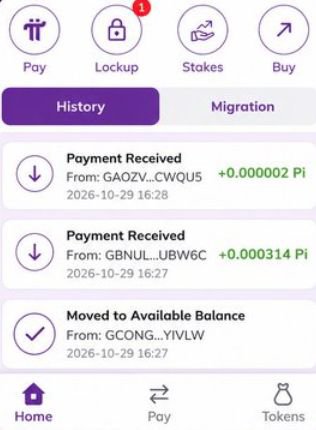
⚠️ SECURITY ALERT TO ALL PI NETWORK PIONEERS: BEWARE OF POSSIBLE DUSTING ATTACKS ON THE PI BLOCKCHAIN!
IMPORTANT SECURITY NOTICE: UNEXPECTED +0.00314π TRANSACTIONS
Dear Pioneers,
There is a need for heightened security awareness among Pi Network users following reports of some wallets receiving unexpected, extremely small Pi fractions of approximately +0.00314π.
Although receiving a small cryptocurrency transaction does not automatically mean that your wallet has been compromised, Pioneers should exercise caution and avoid interacting with unfamiliar or suspicious transactions.
One possible explanation that deserves attention is a cryptocurrency security technique known as a DUSTING ATTACK.
1. WHAT IS A DUSTING ATTACK?
A dusting attack is a blockchain-related privacy and tracking technique in which malicious actors send extremely small amounts of cryptocurrency to multiple wallet addresses.
These tiny amounts are commonly called dust.
The objective is generally not to steal the tiny amount transferred. Rather, attackers may attempt to monitor the movement of these funds, analyse transaction patterns, link wallet addresses and potentially compromise users' financial privacy.
In some cases, dusting transactions may also be used as part of broader phishing and social-engineering campaigns.
2. IMPORTANT CLARIFICATION: WE ARE NOT ACCUSING THE PI CORE TEAM
I want to make something very clear: I am not saying that these +0.00314π transactions are not from the Pi Core Team, neither am I confirming that they originated from the Pi Core Team.
The concern is that the wallet address sending these transactions cannot currently be independently verified as an officially recognised Pi Core Team wallet on the Pi Blockchain.
Until the source and purpose of these transactions are officially clarified, Pioneers should exercise caution.
We must not jump to conclusions, spread unverified accusations or create unnecessary panic.r At the same time, we must not ignore potential security risks.
An unverified wallet address does not automatically mean that it is malicious. However, its identity and intentions should not be assumed to be legitimate.
My advice to all Pioneers is as follows:
1. Protect your 24-word Pi Wallet passphrase. Never disclose it to anyone, regardless of who they claim to represent.
2. Do not share your wallet credentials or sensitive account information with individuals or unofficial platforms.
3. Do not click suspicious links or follow instructions attached to unexpected transactions.
4. Do not send Pi back to unfamiliar wallet addresses.
5. Wait for official clarification and guidance from the Pi Core Team.
6. Always prioritise information, announcements and security instructions published through official Pi Core Team communication channels rather than relying on individuals, influencers, unofficial community administrators or unverified social media posts.
Let us be guided by official information, not speculation or personal interpretations.
3. WHY SHOULD PIONEERS BE CAREFUL ABOUT THE +0.00314π TRANSACTIONS?
Pioneers who have received unexpected deposits of approximately +0.00314π should exercise caution, particularly where the sending wallet has not yet been independently verified.
A dusting transaction may expose transaction patterns or be used to lure unsuspecting users into phishing schemes.
Receiving such a transaction does not automatically give the sender access to your wallet or allow them to withdraw your Pi.
However, Pioneers should avoid unnecessary interaction with the transaction until its source and purpose are understood.
4. HOW CAN A DUSTING ATTACK AFFECT YOUR PRIVACY?
Blockchain transactions are generally publicly visible. Depending on the blockchain's architecture and the user's transaction behaviour, an attacker may analyse:
A. Wallet activity: Monitoring when and how a wallet receives or sends cryptocurrency.
🌐 Economic & Programmatic Modeling of Pi Network: From Conceptual Foundation to Open Mainnet Deployment (1/4) 🌐
Part I: Monetary Philosophy & Financial Valuation Independence (1 Pi = 1 Pi)
Pi Network is founded on an innovative utilitarian economic model that completely steers away from speculative pricing patterns seen in traditional crypto assets. The ecosystem defines its currency as a Native Unit of Account governed by the founding principle: 1 Pi = 1 Pi. Official documents and statements from the Pi Core Team emphasize the following core parameters:
• Non-Security Classification: Pi is not classified or viewed as an investment tool or security, but rather as a utilitarian exchange tool aimed at measuring and accepting the value of work, goods, and services within its private environment.
• Independence from Centralized Exchanges (CEX): The Core Team stressed that Pi does not derive its operational or utilitarian value from centralized exchanges. Integrating trading indicators or external tokens (such as IOUs and liquidity lines on platforms like Cube Exchange) is never intended to bring financial liquidity to the project, but rather forms a "financial and technological bridge" to attract developers and facilitate cross-border interoperability.
• The Dollar as a Reference Ruler: Evaluating goods or showing parallel value in dollars does not mean Pi is pegged to fiat currencies or derives value from them. The dollar is used strictly as a benchmark reference to measure acquired purchasing power compared to external markets, while all internal products and services are priced directly in Pi units.
• Value Stability & Internal Economy Protection: The infrastructure aims to achieve internal price stability enabling merchants, developers, and investors to offer services and goods without fearing external market volatility. If "whales" sell massive amounts on external exchanges, internal prices of goods and services will remain unaffected because internal value is rooted in direct utility and reciprocal demand balance, coupled with a flexible link to the OUSD stablecoin to retain value inside the ecosystem.
Part II: Technical Evolution & Big-Bang Deployment Strategy
The network infrastructure underwent sequential development stages including Testnet 1, Testnet 2, Enclosed Mainnet, and distributed Linux network infrastructure and communication nodes.
Cumulative Calculation Mechanism & Comprehensive Deployment:
The protocol relies on a retroactive cumulative calculation rule for all transactions, activities, and services completed across testing stages, recording and embedding their utilitarian value within the historical blockchain ledger. The Core Team aggregates and tests all structural features to present and activate them simultaneously upon opening the Open Mainnet, including: mobile mining app with dynamic reward systems, Pi Nodes, Pi Browser, Pi SDK operational capabilities, Native KYC decentralized identity verification protocol, and the Native Layer-1 Automated Market Maker (AMM) with smart contracts.
Stay tuned for Part 2! 🚀
#PiNetwork #PiDEX #PiRC #Protocol27 #Mainnet #Web3 #PiNetwork
#PiPioneers
#PiMainnet
#PiCoreTeam
#PiCrypto
#PiCommunity
#PiDEX
#PiLaunchpad
#PiNode
#PiAI
#Protocol27
#Protocol28
#DeFi
#Web3
#Decentralization
#CryptoNews
#DigitalEconomy
#FinancialFreedom#DeFi
#Web3
#Decentralization
#CryptoNews
#DigitalEconomy
#FinancialFreedom#PiDEX
#PiLaunchpad
#PiNode
#PiAI
#Protocol27
#Protocol28
#ousd
1/ 🚨 Pi Network appears in an official disclosure filed by Julius Arthur Bontigao. It describes phone-app crypto mining dating to June 2021. A small detail—but one worth examining closely. What does the record reveal? Read the details. Why now?
https://t.co/2TuNAVQEvZ
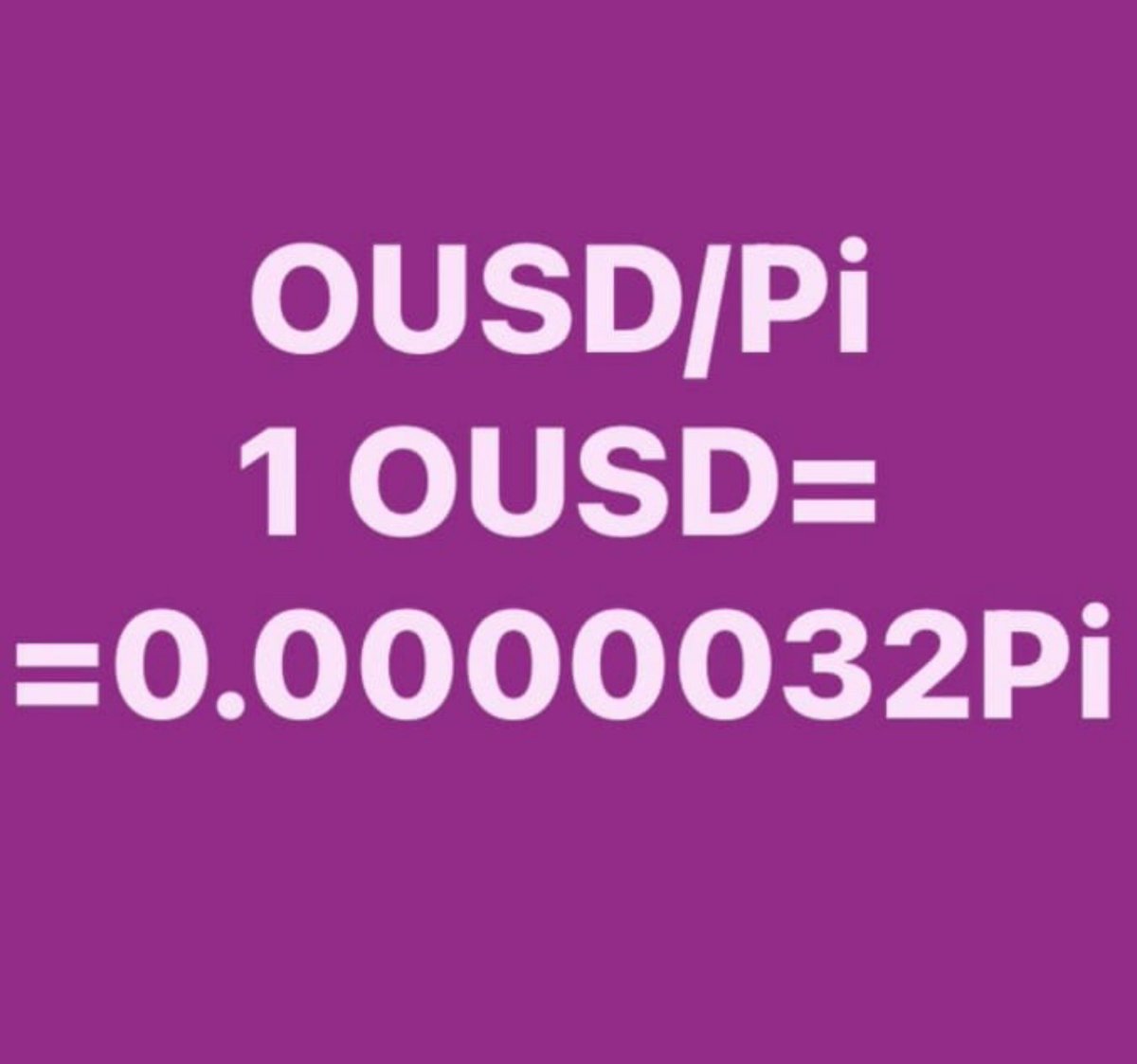
You just flip it - divide 1 by that number.
If you meant:
*1 OUSD = 0.0000032 Pi* (5 zeros)
> *1 Pi = 1 / 0.0000032*
> *1 Pi = 312,500 OUSD*
If you meant:
*1 OUSD = 0.00000032 Pi* (6 zeros)
> *1 Pi = 1 / 0.00000032*
> *1 Pi = 3,125,000 OUSD*
So tell me exactly how many zeros after the point you meant, and I'll lock the number for you.
Congratulations Pioneers 🎉
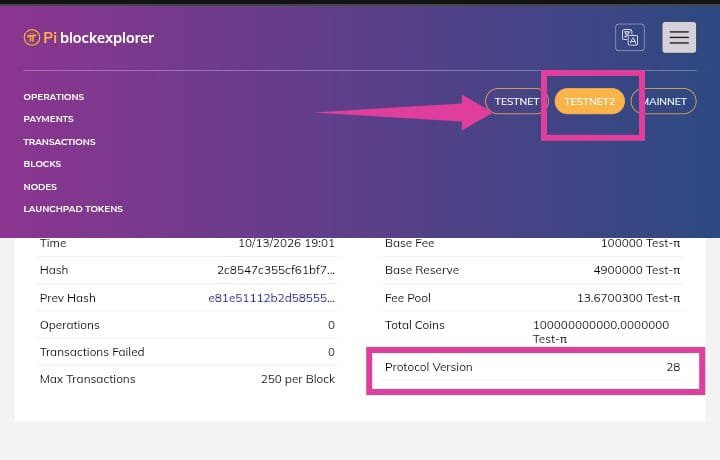
As we said, Protocol V28 is a straightforward upgrade and now Protocol 28 has officially been upgraded on Testnet 2, with completion of the Mainnet upgrade expected by October 16 at the latest or earlier☕
Stay tuned💥💥💥
#Pinetwork@PiCoreTeam
Since early 2025,the Dual Value of Pi continued to be developed into the Node Test (Development Server: 8080)within the enclosed environment of Pi Network
Today, the PiDualTx update that showed up is more than a simple code
The update sets a deliberate direction...1/n
#Pinetwork
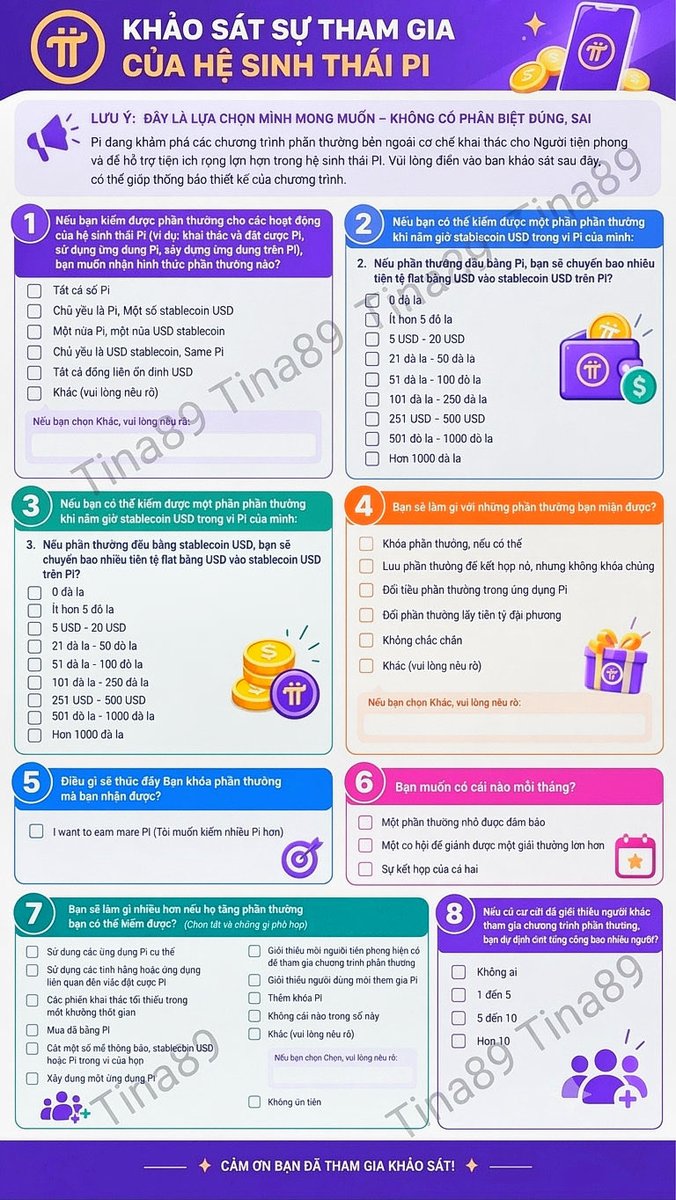
Sáng nay có cái gì lạ trên app xuất hiện được lúc rồi lại mất🤣🤣 Bác nào nhìn thấy nó chưa?
"Giao diện khảo sát """.... 😁😁
Nếu là bạn bạn sẽ chọn tick vào ô nào 1 A or B or C or D🥰🥰👇👇
🍀Anh chị em tham khảo dần nhé 😻
#pinetwork#pi#khaosatpi
📌 Part 1: Exchange Pi vs. Mined Pi: What Every Pioneer Needs to Know ⚖️
To educate our Pioneer community, we must first understand a fundamental difference: the technical and physical environment of what some see on external trading exchanges is drastically different from the real Pi you mine inside your app.
⚖️ First: Exchange Pi (The Financial Liquidity Bridge)
The Pi traded on external exchanges currently possesses nothing beyond its USD-denominated liquidity. Exchanges are financial platforms that depend purely on digital trading and speculation; they do not process physical goods.
🔗 Official Source on Internal vs External Utility: https://t.co/H3Wd9xbQod
• Technical Goal: This currency was established by the Core Team as a tool to provide external liquidity and foster financial adoption.
• Security Mechanism (Key Signature): When interacting with exchanges, a Cryptographic Key Signature is used via the official encrypted verification framework provided by the Core Team to guarantee secure transfers. This allows you to utilize digital value without risking its purchasing power inside the ecosystem.
• The Result: Direct boost to merchant adoption of Pi as a stable payment tool—increasing the network's overall external value as adoption grows.
🔗 Further Reading on Value Building: https://t.co/H3Wd9xbQod
Stay tuned for Part 2, where we break down mobile human mining and the SCP algorithm! 🚀
#PiNetwork #PiDEX #PiRC #Protocol27 #Mainnet #Web3 #PiNetwork
#PiPioneers
#PiMainnet
#PiCoreTeam
#PiCrypto
#PiCommunity
#PiDEX
#PiLaunchpad
#PiNode
#PiAI
#Protocol27
#Protocol28
#DeFi
#Web3
#Decentralization
#CryptoNews
#DigitalEconomy
#FinancialFreedom#DeFi
#Web3
#Decentralization
#CryptoNews
#DigitalEconomy
#FinancialFreedom#PiDEX
#PiLaunchpad
#PiNode
#PiAI
#Protocol27
#Protocol28
💬 PIONEERS — Is this real life, or did PCT just hit a deadline for the first time ever? 😂⏰
Hold onto your hats, folks. Something historic just happened.
🔹 Testnet 1 → v28 ✅
🔹 Testnet 2 → v28 ✅
🔹 Mainnet → v28 on October 16 (on schedule!)
For the first time in Pi history, the upgrade timeline is actually... on time? 🤯
Someone check the calendar. Frame this moment. Put it in the Pi museum. 📅🖼️
We love you, PCT. Keep proving us wrong like this. 🚀💜
Will they keep this streak alive for v29? 😉
WE'RE MOVING! 💃💃💃🏃🏃🏃🧑🦯🧑🦯🧑🦯🚶🚶🚶
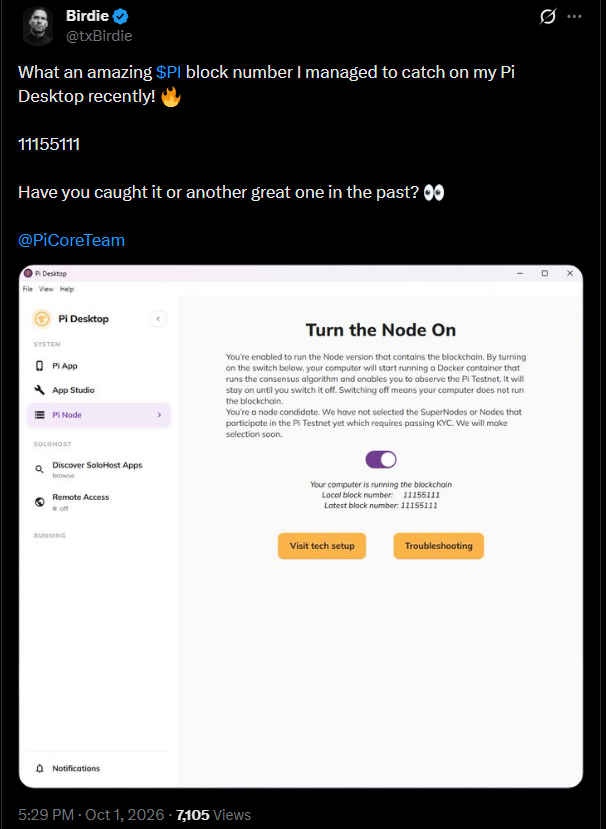
NGƯỜI DÙNG PI NETWORK LÀM NỔI BẬT KHỐI SỐ 11155111 TRÊN PI DESKTOP.
Người dùng Birdie trên mạng Pi Network đã nêu bật khối số 11155111 được chụp trên Pi Desktop và kêu gọi cộng đồng chia sẻ các khối Pi đáng chú ý khác.
Một người dùng Pi Network có tên Birdie đã đánh dấu khối số 11.155.111 sau khi chụp lại nó trên Pi Desktop, thu hút sự chú ý đến mô hình số bất thường trong dữ liệu chuỗi khối của mạng.
Birdie đã chia sẻ số khối trong một bài đăng trên X và gắn thẻ tài khoản chính thức của Pi Core Team, hỏi các thành viên khác trong cộng đồng Pi Network xem họ đã từng gặp phải số tương tự hoặc một khối đáng chú ý nào khác trước đây chưa.
Người dùng Pi Desktop chụp khối 11.155.111
Con số được nhấn mạnh trong bài đăng là 11155111 , một dãy số chủ yếu gồm các chữ số lặp lại. Birdie mô tả phát hiện này là một khối Pi thú vị được tìm thấy khi sử dụng Pi Desktop.
Bài đăng không nêu rõ bất kỳ chức năng kỹ thuật đặc biệt hay ý nghĩa giao thức nào liên quan đến khối 11.155.111. Thay vào đó, quan sát này được trình bày như một sự kiện số học đáng chú ý thu hút sự chú ý của người dùng.
Bài đăng của Birdie cũng mời những người dùng Pi Network khác chia sẻ các số khối blockchain tương tự mà họ đã gặp phải, biến quan sát này thành một cuộc thảo luận hướng đến cộng đồng thay vì một báo cáo về việc nâng cấp mạng hoặc thay đổi kỹ thuật.
Dữ liệu Pi Blockchain vẫn có thể truy cập được thông qua Pi Desktop.
Pi Desktop cung cấp cho người dùng các công cụ để tương tác với hệ sinh thái Pi Network từ môi trường máy tính để bàn. Số khối là các mã định danh tuần tự được liên kết với các khối được ghi lại trên chuỗi khối, cho phép tham chiếu đến từng điểm riêng lẻ trong lịch sử sổ cái của mạng.
Việc xuất hiện một dãy số đặc biệt như 11.155.111 tự nó không cho thấy sự thay đổi nào đối với giao thức, quy trình xử lý giao dịch hoặc chức năng mạng của Pi Network. Bài đăng của Birdie không hề đề cập đến bất kỳ sự phát triển kỹ thuật nào như vậy.
Bài đăng trên X tập trung vào mô hình số và trải nghiệm của người dùng khi gặp phải nó thông qua Pi Desktop. Việc đề cập đến tài khoản của Nhóm cốt lõi Pi cho thấy nhận xét này cũng hướng đến sự hiện diện chính thức của cộng đồng dự án.
Sự quan tâm của cộng đồng đối với các khối Pi đáng chú ý
Mạng lưới blockchain tạo ra một lượng lớn dữ liệu khối tuần tự, có nghĩa là các khối riêng lẻ đôi khi có thể thu hút sự chú ý vì các mẫu số của chúng. Những quan sát này hoàn toàn độc lập với các diễn biến liên quan đến nâng cấp giao thức, hiệu suất mạng hoặc thay đổi chức năng của blockchain.
Đối với người dùng Pi Network, bài đăng của Birdie cung cấp thêm một ví dụ về việc các thành viên cộng đồng theo dõi hoạt động của blockchain và chia sẻ những sự kiện số học bất thường. Bài đăng vẫn để ngỏ liệu những người dùng khác có ghi nhận được số khối có các mẫu đặc trưng tương tự hay không.
Theo Victoria Hale
🇯🇵 THIS IS WHAT CRYPTO UTILITY LOOKS LIKE IN THE REAL WORLD.
International tourists visiting Japan can now use Binance Pay to pay at millions of PayPay-supported locations.
The user pays with crypto.
The merchant receives local currency.
No manual currency exchange at the point of purchase.
That separation is powerful:
Crypto on one side. Fiat on the other.
The blockchain doesn't necessarily need to replace the merchant's existing payment system.
It can simply become the rail underneath it.
Could this model eventually become normal for crypto payments everywhere?
#Crypto #Pi #Web3