Can DCS boost Hebbian plasticity? If yes, how so? These questions drove my research for 2 years. Interested to know what we found?
Well, my paper with @lucas_c_parra
https://t.co/vnJQISpedI
Here is a short tour of our work:
Based on an existing hypothesis in our lab, we (1/n)
New pub with @ForouzanV@voroslakos@niranjank_2 in @brainstimj. Using Neuropixels 284 channels probes in-vivo rat model of tES: 0.35 V/m electric fields (like 1 mA tDCS/tACS) change firing rate.
https://t.co/86z898YU56
If you're a professor or a student in STEM in a Western country, you probably know someone from the Sharif University of Technology in Iran. They might have be your students, peers, or friends.
That university is now under attack by the Islamic Republic.
🧵(1/16)
#MahsaAmini
In @brainstimj by @gav_hsu@ForouzanV @lucas_c_parra There is a decades old (interferential TENS...) & ongoing debate (Temporally Interfering tES...) over kHz "carriers" to deliver lower frequency waveforms *painlessly* through the skin.
Seems maybe not? https://t.co/Df97wR65Na
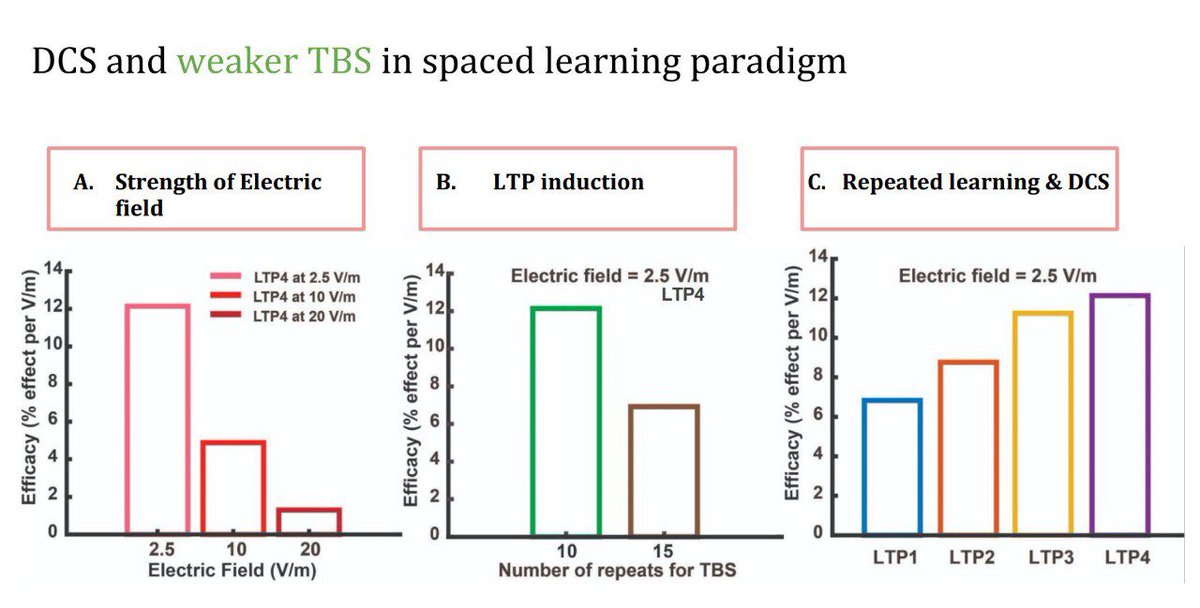
Can the effects of DCS on synaptic plasticity accumulate over time? If yes, what are the ideal conditions to obtain maximum efficacy? Interested to find out? Our recent work sheds light on these key concepts,
https://t.co/EuDGOgcIt9
Human studies comprise of low intensity DCS ~1 V/m producing an effect size of 10-40 %. Slice studies could produce an effect size of only 20% with stronger DCS of 20V/m,I.e., 1% perV/m. Our study narrows the existing gap between in vitro DCS studies and human clinical studies.
New @brainstimj publication by Mahima Sharma @ForouzanV @lucas_c_parra. Direct Current Stimulation boosts plasticity. 👉When plasticity is ongoing (spaced) this boost is cumulative. This can explain the value of sustained stimulation at low intensity. https://t.co/HzuZITqQ4k
New paper on skin sensation effects of different stimulation waveforms with @ForouzanV and @lucas_c_parra: https://t.co/m1QPSOUDCj
We show that conventional waveforms are best for minimizing sensation during tDCS and tACS, and that arm sensation is comparable to that on the head.