Trust is earned. Transparency is verified.
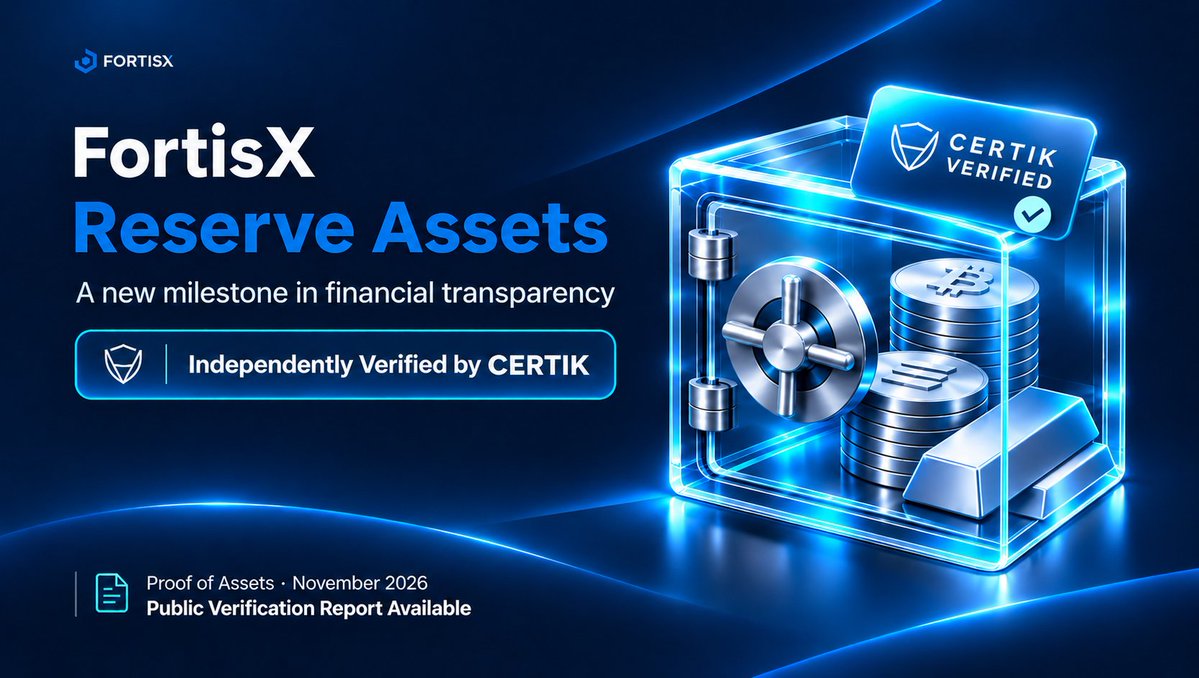
We’re proud to announce that @CertiK, a global leader in blockchain security, has completed an independent Proof of Assets verification for FortisX.
$11,014,917.21 in designated company reserve assets has been independently verified.
✓ Independent verification of on-chain asset balances
✓ Independent confirmation of wallet control
✓ Company reserve assets verified separately from client assets deployed in yield-generating strategies
This marks another significant milestone in our ongoing commitment to transparency, accountability, and operational resilience.
In an industry where trust is often promised, we believe it must be backed by independently verifiable evidence.
Beyond promises. Beyond words. Backed by proof.
Read the official publication by CertiK:
https://t.co/xeHvuyl3KS
What if your earned rewards could generate more rewards?
That's the idea behind compounding.
With FortisX liquidity pools, you can enable auto-compounding to automatically reinvest accrued rewards into your position.
Here's an example at a constant 8% annual rate:
→ Without compounding: 1,080 tokens after one year
→ With monthly compounding: ~1,083 tokens after one year
The difference may seem small initially, but it can grow over time.
With FortisX, auto-compounding helps put your earned rewards back to work, without manual reinvestment.
Returns are variable, and actual results depend on pool performance, fees, and compounding frequency.
Explore liquidity pools: https://t.co/KJDPOC24L0
Stablecoin payments grew 45% to $482B in the first nine months of 2026.
And the number of payments jumped 71%, crossing 1B transactions.
Meanwhile, stablecoin supply grew just 0.4% to $305B.
According to Allium's Q3 2026 report, stablecoins are increasingly being used for more than moving funds between crypto exchanges.
They're supporting:
→ Cross-border payments
→ Business settlements
→ Merchant transactions
→ Everyday spending through stablecoin-linked cards
Here's what makes this interesting:
Payment activity is growing much faster than the supply of stablecoins.
The same digital dollars are being used more frequently, rather than simply sitting in wallets or on exchanges.
Stablecoins are gradually becoming part of global payment infrastructure.
And that shift is worth watching.