Since the neoliberal 1990s, the Internet and computer have had only two viewpoints in mind:
"Me" and "the Internet."
Everywhere you look, computing reflects this divide. Either you have "MY" photos, or Google Images. "MY" videos, or Youtube. "MY" documents, or web pages.
Of course, there are some options for group collaboration, but the computer isn't based on them. The Internet isn't based on them. Most of our digital experiences are expected to be either "me" or "the world."
This is not due to technical reasons, but social ones. For 80 years we have lived within postwar globalism, an ideology which considers us in terms of either "the individual" and "humanity."
The reality, though, and the reason why postwar globalism is falling apart, is that the most meaningful human experiences come from groups. Whether it is the family, tribe, village, city, or nation, we are ultimately defined by our groups. We live by these groups. We die by these groups. We find love and work by these groups. And nothing about human nature has changed in the twenty-first century.
The artificial polarization of humanity, and of the internet, between "me" and "the world" is now coming to an end. We know this is true in politics, with rising Western nationalism. But the Old Gods aren't just returning to politics: they are returning to all society.
So, with this return, we must consider: Do our current computers make sense?
Everywhere, clubs and churches and communities are beginning to remember their own importance. People are joining more private organizations, as they begin to realize that "humanity" and "the individual" are not enough. That, as humans, we need more.
But, as society changes, the computer and Internet have not. Largely, they are still built for the previous era; for the idea that the "individual," in the form of the filesystem and operating system, and the "Internet," in the form of billions of people, are still the main viewpoints.
That is why, today, communities are only represented with niche apps like Circle, or with messaging apps like Telegram. But, as society continues to change, the entire digital experience is going to change too. The computer itself is going to be re-oriented. And it's going to be re-oriented around communities.
So, with Forum, we are creating that future.
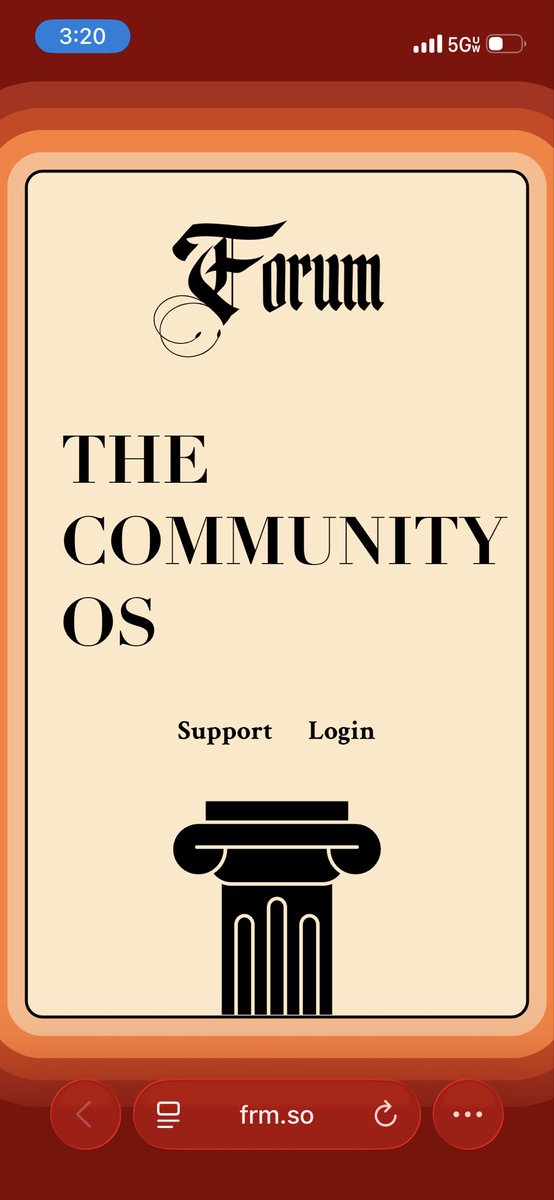
Forum is a community operating system. It is an operating system for communities, in the vein of Telegram or Circle or Discord, and it is also an actual operating system, with communities as a foundational part.
Forum redesigns the basics of the computer and phone, such as the filesystem, apps, and user accounts, to be collaborative by nature. We make it easy to form a fully-fledged digital community, just as it is to create a groupchat.
Forum is our way of sculpting out the false binary of "individual" and "Earth" from society. In doing so, we reflect human nature better than ever before.
Join us, in the future of computing:
https://t.co/MzaveuTGyv