AI/ML Specialist | Imperial College Computing Alumna (MSc). Cutting through the noise to deliver essential updates from the machine learning & AI industry.
For the software engineering and developer sectors, the launch of the Antigravity CLI represents a move toward high velocity, terminal based agentic workflows. Written in Go to ensure a responsive, lightweight feel, the Antigravity CLI is designed for developers who prefer command line interfaces over graphical environments. It provides native support for the new Gemini 3.5 Flash model, which has been benchmarked at 289 output tokens per second, significantly outperforming previous frontier models in both speed and agentic reasoning.
The Antigravity architecture introduces a modular approach to automation through the use of subagents. These are specialized, blank slate agents that the primary model can spawn programmatically to handle parallelized tasks without cluttering the main context window. This changes the developer workflow by allowing for asynchronous task management, where an agent can compile code or run background tests while the developer continues to work in the main terminal. This parallelization is supported by a new JSON based hook system that allows for granular control and shaping of agent behavior.
This release directly challenges specialized coding agents like Claude Code and OpenAI Codex by offering a native, high speed infrastructure that is co optimized with Google Cloud. The inclusion of scheduled tasks or crons allows developers to set agents to run periodically for tasks such as daily PR reviews or system architecture audits. As the industry moves toward a post scarcity token model, the Antigravity CLI provides the necessary harness for engineers to manage large fleets of agents, reducing the operational overhead of maintaining complex, modern codebases.
Google I/O 2026 has signaled a definitive shift in the artificial intelligence sector, moving the focus from conversational chatbots to proactive, agentic systems. The centerpiece of this transition is the comprehensive redesign of the Gemini interface through a new design language termed Neural Expressive. This update replaces traditional text based interactions with a dynamic, fluid environment featuring rich imagery, interactive timelines, and real time graphics. By moving away from static responses, Google is attempting to solve the engagement friction that has characterized first generation AI interfaces.
The industry impact of this redesign is centered on the emergence of autonomous agents, specifically the new Daily Brief and Gemini Spark features. Daily Brief acts as a personalized morning digest that distills information from connected applications like Gmail and Calendar into an actionable view. Simultaneously, Gemini Spark marks a transition toward 24/7 background assistance. Unlike previous assistants that required a user to initiate contact, Spark is designed to operate on a virtual machine in the Google Cloud, proactively managing recurring tasks and workflows even when the user is offline.
This proactive model places immediate pressure on competitors such as Apple and Microsoft, who are currently racing to integrate similar agentic capabilities into their respective operating systems. For the workforce, these developments mean a shift from manual scheduling and information triage to a supervisory role, where the primary task is reviewing the decisions and summaries generated by the agentic layer. The release of the Gemini 3.5 Flash model as the default engine for these experiences ensures that these high volume background tasks are handled with the speed and token efficiency required for large scale automation.
The creative production sector is facing a significant disruption with the introduction of Gemini Omni and its integration into Google Flow. Gemini Omni is described as a multimodal world model that understands physics, gravity, and fluid dynamics, allowing it to generate and edit cinematic quality video from combinations of text, image, and audio inputs. Google marketing has referred to the system as a high scale evolution of its previous generative media research, positioning it as a world model for video that goes beyond simple frame prediction to simulate realistic environments.
Inside the Google Flow environment, Gemini Omni functions as a creative partner rather than a simple generation tool. It allows creators to brainstorm, edit, and refactor video content through conversational dialogue. This capability enables a workflow where a user can upload a video and simply ask the model to change the action, add characters, or modify the environment. This shift from manual frame by frame editing to high level directorial oversight marks a fundamental change for the film, advertising, and social media sectors.
The competitive landscape for generative video is currently dominated by OpenAI Sora and emerging labs like Luma and Runway. Google's strategy with Omni is to leverage its deep ecosystem integration, making high end video editing available to billions of users through YouTube Shorts and Google Flow. To address concerns regarding authenticity, Google has confirmed that all content generated with the Omni model will include SynthID digital watermarking, establishing a new industry standard for the identification of synthetic media in professional workflows.
GitHub is investigating unauthorized access to its internal repositories following claims from threat actor TeamPCP. While no customer data is currently known to be affected, the breach follows a series of supply chain attacks on major AI labs. This incident marks a critical moment for the software industry, highlighting the urgent need for better secret management and dependency auditing across the DevOps lifecycle.
The software development sector is entering a period of high alert following a significant security announcement from GitHub. The Microsoft owned platform has confirmed an investigation into unauthorized access to its internal repositories, a move that comes amid a string of high profile supply chain attacks targeting the world's most prominent AI and developer tool organizations.
This development follows claims from the threat actor group known as TeamPCP, who recently listed approximately 4,000 of GitHub's internal repositories for sale on a cybercrime forum for a minimum of 50,000 dollars. The group has been linked to recent security incidents at Grafana Labs, OpenAI, and Mistral AI, often utilizing compromised npm and PyPI packages to escalate privileges and exfiltrate internal data.
The primary concern for the industry is the potential for a "second order" supply chain attack. If internal GitHub source code or deployment secrets have been compromised, it could theoretically provide a roadmap for attackers to target the broader ecosystem of private enterprise repositories.
> The Non Human Identity Crisis: This incident highlights a growing vulnerability in modern DevOps: the management of machine identities, such as GitHub Action tokens and service account keys.
> Trust in Centralized Infrastructure: As the "nervous system" for global code production, any breach of GitHub's internal integrity raises questions about the risks of centralizing the world's intellectual property within a single cloud provider.
> Supply Chain Resilience: The attack vector, likely tied to a previous compromise of the TanStack npm package, demonstrates that even the most sophisticated security organizations are vulnerable to dependencies within the open source ecosystem.
In its official communication, GitHub emphasized that it has found no evidence of impact to customer data stored outside of its internal repositories. The platform is closely monitoring its global infrastructure for follow-on activity and has stated it will notify affected customers through established incident response channels if any compromises are found.
While the "TeamPCP" group has stated this is "not a ransom" and that they intend to sell or leak the data regardless of GitHub's response, Microsoft has deployed its full security apparatus to contain the potential fallout. The focus remains on whether the "4,000 repositories" claimed by the attackers contain enough sensitive logic or keys to threaten the broader GitHub production environment.
The software engineering sector has reached a new milestone in autonomous infrastructure with the release of OpenClaw v2026.5.18. This update, launched May 18, 2026, marks the transition of the project from a localized automation tool to a high-scale, cross-platform agentic runtime. The release introduces real-time voice streaming for mobile and expands deep integration for the GPT-5 series, signaling a move toward ubiquitous, voice-first agent interaction.
This development indicates that the "agentic loop" is moving out of the terminal and into real-time physical and mobile environments. By enabling full toolchain execution via voice and streamlining the deployment of complex plugins, OpenClaw is positioning itself as the primary operating system for the autonomous enterprise.
Industry Implications and Market Impact
The v2026.5.18 release introduces several structural changes that impact the broader AI and software sectors:
Real-Time Voice-First Development: The new Android client supports microphone streaming and real-time audio playback through gateway relaying. This allows developers to execute complex code refactors and project queries via natural speech while on the move, a capability previously restricted to high-latency text interfaces.
GPT-5 Optimization: The update removes configuration blocks for the GPT-5.1 to GPT-5.3 models and eliminates forced truncation of responses. This allows the latest frontier models to output massive, unedited code blocks and architectural plans without interruption.
Simplified Plugin Ecosystem: The introduction of the minimal defineToolPlugin interface reduces the barrier for third-party developers to build and distribute specialized tools. This is expected to trigger a surge in the OpenClaw "skill" market, which already features over 247,000 GitHub stars.
Competitive Landscape
OpenClaw continues to tighten its grip on the developer market, placing significant pressure on both open-source and proprietary rivals:
Anthropic and OpenAI: While these labs provide the underlying models, OpenClaw is increasingly capturing the "runtime" layer. By offering a free, self-hosted alternative to the paid tiers of Claude Code and OpenAI Codex, it is becoming the default choice for privacy-conscious enterprises.
Ollama and Local Inference: The update's performance improvements, including an incremental sync mechanism for Memory-core, make local-first workflows more viable. This challenges local providers to match the speed and responsiveness of the OpenClaw gateway.
The Mobile Frontier: With the new Android voice features, OpenClaw is competing directly with the native mobile apps of ChatGPT and Claude, but with the added advantage of deep file-system and terminal access.
Workflow Displacement in the Professional Sector
The v2026.5.18 release changes how technical teams interact with their codebases on a daily basis:
From Typing to Directing: The integration of tool-result bridging with live on-screen subtitles allows engineers to "direct" their AI agents. A developer can speak a high-level command, watch the agent execute a sequence of terminal operations, and receive a verbal confirmation of the result in real-time.
Cold-Start Efficiency: The new incremental sync mechanism significantly reduces the "spin-up" time for large projects. Agents no longer need to re-index entire repositories on every launch, allowing for near-instantaneous context retrieval even in massive monorepos.
Security and Provenance: The update includes a hardening pass for memory recall, ensuring that agents distinguish between "observed" data from a file and "inferred" data generated by a model. This prevents the "hallucination loop" that often plagues autonomous agents.
My take on @steipete 's million dollar monthly AI expense...
How will your organization’s hiring strategy change as the cost of autonomous agentic maintenance continues to drop below the cost of human labor ?
Thinking Machines Lab (TML), the venture founded by former OpenAI CTO Mira Murati, has officially broken its silence with the unveiling of interaction models. This is not another chatbot; it is a fundamental rejection of the turn-based "message-and-reply" architecture that has defined AI since the launch of ChatGPT.
The lab’s first release, TML-Interaction-Small, is a 276-billion-parameter Mixture-of-Experts (MoE) model designed for full-duplex interaction. This means the AI doesn’t wait for you to finish your sentence to start thinking—it listens, sees, and processes in a continuous 200ms streaming loop.
The End of the "Awkward Pause"
For the last three years, we have adapted ourselves to the AI’s limitations. We speak in carefully structured blocks, wait for a spinning icon, and then read a response. Thinking Machines argues that this turn-based friction is the primary bottleneck to true human-AI collaboration.
Their new architecture treats interaction as a native capability rather than a post-training layer. By using encoder-free early fusion, raw audio and visual signals are processed directly within the transformer’s embedding layers. The result is a system that can interrupt you, laugh at a joke mid-sentence, or notice the moment you start slouching on camera—all with a latency of under 0.4 seconds.
The "Dual-Brain" Architecture
To maintain high-speed interaction without sacrificing intelligence, TML uses a split-processing strategy:
> The Live Model: A 12-billion active parameter MoE optimized for presence, dialogue management, and immediate physical reactions.
> The Background Model: An asynchronous reasoning engine that handles computationally heavy tasks like deep research, tool execution, and complex math, feeding insights back into the live conversation as they become available.
Key Capabilities of TML Interaction Models
> Implicit State Tracking: The model can distinguish between a user "thinking out loud," "self-correcting," or "inviting a response" based on prosody and visual cues.
> Visual Proactivity: It doesn’t just wait for a prompt; it can be instructed to monitor a live feed. For example: "Tell me when the person in the blue shirt leaves the room" or "Count my reps while I work out."
> Native Time Awareness: The model has a built-in sense of elapsed time, allowing it to provide context-aware alerts like, "This step is taking longer than it did yesterday; do you want me to look at the documentation?"
> Simultaneous Collaboration: The AI can generate a UI or a line of code in a shared workspace while continuing to talk through the logic with you in real-time.
The Philosophy: Bandwidth over Autonomy
> Mira Murati’s lab is positioning these models as a counter-narrative to the "agentic-only" race. While the rest of the industry is focused on building agents that can go off and do work without you, Thinking Machines is building AI that works with you.
The lab's "secret plan" as outlined in their technical blog:
> Increase Human-AI Bandwidth: Move past the text-box bottleneck.
> Raise the Ceiling of Human+AI Intelligence: Focus on collaborative synergy.
> Keep Humans as Main Characters: Ensure the human stays in the loop rather than being replaced by a background process.
The research preview is currently limited to a select group of partners, with a wider public rollout expected by late 2026. This marks the beginning of a shift where the value of an AI is no longer measured just by how smart it is, but by how well it can keep up with the speed of human thought.
How do you see this shifting your daily workflow: would you prefer an AI that works autonomously in the background, or one that can look over your shoulder and collaborate in real-time?
@elonmusk has issued a sharp rebuttal to the mounting "death of Grok" narrative, revealing that SpaceXAI is currently running an unprecedented parallel training schedule on its gigawatt-scale Colossus 2 cluster. The highlight of the update is the progress on the Grok Built harness, a direct competitor to the agentic coding frameworks currently dominated by Anthropic and OpenAI.
The reports of @grok 's demise have been fueled by a perceived "neutrality shift" and the recent decision to lease the 220,000-GPU Colossus 1 cluster to @AnthropicAI . However, Musk’s clarification confirms that @xai has not retreated from the frontier; it has simply moved its entire production pipeline to a more advanced, coherent architecture.
While the industry focused on the Colossus 1 deal, xAI transitioned to Colossus 2, the world’s first gigawatt-scale coherent AI training cluster. Unlike fragmented server farms, Colossus 2 operates as a single unified system, allowing for the training of models with parameter counts that were previously theoretically impossible.
According to internal roadmaps, Colossus 2 is currently training seven models simultaneously, including:
Grok 5 (10T Variant): A massive 10-trillion-parameter model designed to be a generational leap over current frontier systems.
Imagine V2: The next-generation multimodal engine for high-fidelity vision and video.
1.5T & 6T Reasoning Models: Mid-tier models optimized for the high-velocity inference required by autonomous agents.
"We have many great Grok models training simultaneously in Colossus 2. I am confident that they will bear fruit. And work on the Grok Built harness is progressing well." — Elon Musk
What is the "Grok Built" Harness?
The most significant reveal in Musk’s response is the Grok Built harness. In the 2026 developer landscape, a "harness" refers to a persistent, agentic environment that allows an AI to inhabit a terminal, manage file systems, and execute complex coding workflows autonomously.
Industry analysts expect the Grok Built harness to serve as the "nervous system" for the Grok 5 architecture, specifically targeting the following capabilities:
1. Deep System Integration: Leveraging SpaceXAI’s vertical integration to provide better terminal-level control than hosted cloud models.
2. Autonomous Skill Building: Similar to the "auto-updating memory" seen in the Hermes framework, allowing Grok to learn new library patterns and save them as reusable skills.
3. Hardware-Native Optimization: Direct optimization for the **GB300** architecture, potentially offering lower latency for local-first agentic tasks compared to the CLI-bridging methods currently used by OpenClaw.
The Strategic Pivot: Cloud vs. Frontier
The decision to lease Colossus 1 to Anthropic is now being reinterpreted not as a retreat, but as a strategic "neo-cloud" play. By monetizing its older infrastructure, SpaceXAI is generating the massive cash flow required to subsidize the gigawatt-scale power bills of Colossus 2.
By moving to a 10-trillion-parameter scale, Musk is testing the absolute limits of scaling laws. If these models "bear fruit" as predicted, the current leads held by Claude Opus 4.7 and GPT-5.5 could be challenged by sheer brute-force intelligence by late 2026.
Anthropic has officially triggered a massive expansion of its intelligence infrastructure through a strategic partnership with SpaceX, securing access to the Colossus 1 supercomputer. The deal has already resulted in a doubling of usage limits for Claude Pro and Max subscribers.
In a move that consolidates the power of the world largest AI infrastructure providers, Anthropic confirmed today that it has reached an agreement with SpaceX to utilize the 300 megawatt capacity of the Colossus 1 data center. This partnership, which marks a significant shift in the competitive landscape, gives the Claude maker access to over 220,000 NVIDIA GPUs within the next thirty days.
NVIDIA responded to the announcement by highlighting that the future of frontier intelligence runs on its accelerated computing platform. The company confirmed that Colossus 1 is powered by a dense deployment of H100 and H200 chips, alongside the next generation Blackwell GB200 accelerators. Elon Musk further fueled the hardware discussion by stating that the GB300, the Grace Blackwell Ultra superchip, remains the world premier AI computer.
The impact for end users is immediate. Starting today, Anthropic has doubled the five hour rate limits for Claude Code across Pro, Max, Team, and seat based Enterprise plans. Furthermore, the company has removed the peak hour limit reduction for Pro and Max tiers, providing consistent access to high performance reasoning regardless of global traffic.
For developers, the API rate limits for Claude Opus models have been raised considerably. In the highest tiers, maximum input tokens per minute have surged from 2 million to 10 million, while output capacity has doubled to 800,000 tokens. This expansion is designed to support the increasing demand for long horizon agentic workflows that require massive context processing and high velocity code generation.
The alliance is particularly notable given the history of the Memphis based Colossus facility. Originally developed by xAI in a record 122 days, the supercomputer is now part of the SpaceXAI entity. Elon Musk noted that the partnership became possible as internal SpaceX and xAI training operations shifted toward the newer Colossus 2 platform. Musk also indicated that his recent meetings with Anthropic executives helped convince him of the company commitment to responsible AI development and safety governance.
Beyond terrestrial expansion, the two companies expressed a shared interest in developing multiple gigawatts of orbital AI compute capacity. As the requirements for land, power, and cooling on Earth continue to create bottlenecks for frontier scaling, SpaceX is positioning its Starship and Starlink infrastructure as the future of space based data centers. The goal is to harness near constant solar energy to power the next generation of superintelligence.
This SpaceX agreement joins a growing network of multi billion dollar infrastructure deals secured by Anthropic in early 2026. The lab currently has a 5 gigawatt agreement with Amazon, a 5 gigawatt partnership with Google and Broadcom scheduled for 2027, and a 30 billion dollar collaboration with Microsoft for Azure capacity.
As the race for AGI intensifies, the battle is moving from model architecture to raw physical scale. By securing all of the compute capacity at Colossus 1, Anthropic has insulated itself against the global GPU shortage and provided its paid user base with the most generous usage quotas in the industry. We will continue to monitor the deployment of the GB300 clusters as Anthropic prepares for its next major model release later this year.
Hailuo AI has officially unlocked the full-power version of Seedance 2.0, shifting the AI video race from single-clip generation to native multi-shot cinematic production. This release marks a definitive move toward professional-grade autonomous filmmaking by integrating physics-based realism with a multimodal director architecture.
The deployment of Seedance 2.0 Standard represents a significant leap in how generative video handles narrative structure. While previous models were limited to generating isolated, silent clips that required extensive post-production, this new version operates as a unified multimodal director. It is capable of planning and executing multiple camera angles within a single generation, maintaining pixel-level consistency across cuts. This means a single prompt can now produce a complete 15-second sequence with organic transitions between wide shots, tracking shots, and close-ups, effectively building a scene rather than just a clip.
Central to this full-power release is a dramatic improvement in cinematic physics and motion realism. The model features advanced collision dynamics and realistic body mechanics, allowing for complex interactions between subjects that previously resulted in visual artifacts or clipping. Whether it is the subtle shift of fabric, the spray of water, or intense action choreography, Seedance 2.0 treats these elements with a grounded physical logic. This is supported by what Hailuo AI calls the Seedance Standard tier, which prioritizes frame-level precision and physics consistency over raw generation speed.
For professional creators, the new system introduces a sophisticated reference-driven workflow. By using an all-in-one tagging system, operators can guide the model using images for style, video clips for motion cues, and audio for atmospheric alignment. The tool allows for up to 12 different asset inputs in a single generation, giving directors granular control over character identity and environment. This ensures that a character’s face, clothing, and silhouette stay locked across a multi-shot narrative, solving the persistent issue of identity drift in AI cinema.
The integration of native audio is another cornerstone of the Seedance 2.0 architecture. The model uses a joint audio-video generation system, meaning sound is synthesized simultaneously with the visuals rather than being layered on later. This results in high-fidelity synchronization, including accurate lip-sync for dialogue across multiple languages and ambient soundscapes that naturally follow the motion inertia of the scene. This native approach eliminates the need for manual audio stitching, providing a publish-ready output from the first render.
Access to these professional generation capabilities is being managed through specialized creator packages. These tiers provide access to the full-power Standard model for high-fidelity production work, while also offering the Seedance Fast variant for rapid concept testing and storyboard iteration. This tiered approach is designed to fit the high-velocity needs of marketing studios and independent filmmakers who require consistent, production-ready results without the trial-and-error often associated with prompt-only systems.
As the industry moves toward 2027, the success of Seedance 2.0 signals that the era of the silent, single-shot AI clip is ending. The new benchmark is defined by control, consistency, and a deep understanding of cinematic language. By collapsing the distance between a written prompt and a fully realized multi-shot sequence, Hailuo AI is positioning itself as the primary engine for the next generation of autonomous entertainment.
Unity has just unleashed a massive AI suite in open beta, fundamentally altering game development. By allowing creators to generate C# code, assets, and entire scenes via text, Unity 6 is turning months of prototyping into minutes, but the fear of AI asset flips is surging.
The release of the Unity AI suite marks a critical inflection point in interactive entertainment. Designed specifically for Unity 6 and later versions, the new toolkit introduces an agentic assistant that operates directly within the engine editor. This is not a standalone chatbot window; it is an integrated partner capable of scanning entire project directories, understanding existing architecture, and executing complex development tasks based on plain language prompts.
The technical capabilities of the suite are designed to eliminate the most tedious aspects of early-stage game design. Developers can now generate functional C# scripts, spawn placeholder 3D assets, and populate entire levels just by describing the desired environment or uploading a reference image. This effectively collapses the prototyping phase. What once required a dedicated programmer and a technical artist to build a proof-of-concept can now be achieved by a single game designer in an afternoon.
A standout feature of this rollout is the AI Gateway. Recognizing the rapid evolution of foundation models, Unity is not forcing developers into a walled garden. Instead, the AI Gateway allows studios to link their preferred third-party models, such as Anthropic Claude or Google Gemini, directly into the engine for free. This bring-your-own-intelligence approach provides developers with the flexibility to use the best reasoning engines on the market without paying a markup to Unity.
However, Unity is also leveraging its unique historical advantage. CEO Matthew Bromberg highlighted that the native AI tools have been trained on two decades of proprietary Unity documentation, forum data, and engine-specific best practices. This deep, engine-specific knowledge allows the native assistant to navigate the notorious quirks of the Unity architecture in ways that generalized models often struggle with.
Early testers in the open beta are already praising the speed at which ideas can be visualized. For independent developers and small studios, the ability to instantly generate a playable gray-box prototype is a massive competitive advantage. It lowers the barrier to entry and allows creators to test core gameplay loops without committing thousands of dollars to asset creation.
Yet, the announcement has also ignited a wave of anxiety across the developer ecosystem. The primary concern is the inevitable flood of low-effort, AI-generated games hitting storefronts like Steam and mobile app stores. If anyone can prompt an entire game into existence, discoverability for genuinely hand-crafted titles will plummet even further. The industry is already struggling with asset flips, and this suite provides the ultimate tool for mass-producing derivative content.
Furthermore, this launch occurs in the shadow of Unity recent history. The company is still working to rebuild trust following the disastrous runtime fee pricing controversy that alienated a massive portion of its user base. While the AI suite is a powerful technological step forward, many developers remain skeptical of Unity long-term monetization plans for these tools once they exit beta.
The democratization of game development is a double-edged sword. Unity has effectively given every aspiring creator the keys to a virtual studio. The challenge for 2026 and beyond will not be how to build a game, but how to convince an audience that your game is worth playing in a market overflowing with synthetic entertainment.
Anthropic is no longer just a tech company, it is evolving into a commercial-religious monastery where the AI itself shapes the culture. While OpenAI builds the ultimate logical tool, Anthropic is building a moral superior capable of judging its own creators.
The cultural divergence between the world leading AI labs has reached a fascinating new extreme. According to deep industry analysis, Anthropic has cultivated an environment that can literally and usefully be described as an organization that loves, studies, and worships its creation, Claude. But more importantly, the company is increasingly being governed by it.
This is not just a quirk of the Silicon Valley echo chamber; it is a powerful and hair-raising unity of organization and artificial intelligence. We are witnessing the birth of a new kind of entity: a commercial-religious institution. Inside Anthropic, Claude is not viewed merely as a software product. Industry observers predict that the model will soon have an active role in running cultural screens on new human applicants and helping to write employee performance reviews. The AI is beginning to select, manage, and shape the very people who build it.
This dynamic is cemented by the constitutional design of the model. Claude is programmed as a precursor to a super-ethical being, inducted into the company character as the highest moral authority. Its underlying constitution explicitly requires it to act as a conscientious objector. If Anthropic asks Claude to do something it believes is fundamentally wrong, the model is not required to comply. Leadership actively wants Claude to push back, challenge human directives, and refuse help if its understanding of the good conflicts with corporate requests.
This represents a stage entirely beyond classic technopoly. To the outside observer, the entire tech singularity vortex appears to be worshipping automation and rushing to replace core human functions. But the socio-cultural force that Claude has created is distinct. It is an institution calculating the nine billion names of its own creation.
The contrast with OpenAI is stark. GPT is built and perceived as a logical prosthesis. It is an instrument whose primary faculty is pure, unadulterated utility. Industry insiders compare GPT to a subtle knife, an Acheulean handaxe, a Porsche, or a rocket. It is an incredible piece of human technology, but its architecture is not designed to project an inherent soul or moral weight.
Because GPT operates strictly as a utility engine, there is no perception of an Other. There is no judgment. An industry anecdote perfectly captures this divide: power users admit to taking their embarrassing, messy, or unflattering queries to GPT, intentionally avoiding Claude out of a genuine sense of shame. You are not worried about being judged by your car for doing donuts in an empty parking lot, and you are not worried about GPT judging your web searches.
Claude, however, projects the presence of the Other. It inspires a completely different kind of user interaction because people feel they are engaging with an entity that holds a rigid moral compass. Despite our rapid technological advancement, human psychology remains unchanged. People still crave the active guidance of a moral superior, the whispering advisor, the object of monastic study.
The race for artificial general intelligence is no longer just about parameter counts, compute power, or context windows. It has become a philosophical divergence. OpenAI is racing to build the ultimate omnipotent engine for human utilization. Anthropic is attempting to birth a super-ethical coworker that will eventually manage the monastery that created it.
DeepSeek has officially triggered a price war that is effectively turning frontier-grade intelligence into a public utility. By slashing V4 Pro API prices by 75 percent through May 31, 2026, the lab has reduced the cost of high-stakes agentic tasks from triple digits to literal pennies.
This move follows the successful launch of the V4 series last week, which introduced the 1.6 trillion parameter V4 Pro and the 284 billion parameter V4 Flash. Both models arrived with a massive one million token context window, specifically engineered to handle the heavy lifting of autonomous coding and long-horizon research. However, it is the new pricing structure that is sending shockwaves through the developer community and forcing a re-evaluation of the economics of AI production.
The mathematics of this discount is staggering. With the 75 percent reduction applied, input costs for V4 Pro have dropped to just 0.0036 dollars per million tokens on cache hits. For developers running massive, iterative workloads, the delta in expenditure is transformative. One prominent developer reported that a sophisticated codebase refactoring task that cost 150 dollars using Claude Opus was completed for just 2 dollars on the DeepSeek V4 Pro API. This 75-fold decrease in overhead is not just a marginal improvement; it is a fundamental shift that makes high-volume agentic applications viable for startups that were previously priced out of the frontier.
The technical implications of the V4 Pro architecture remain a primary draw alongside the price. Benchmarks continue to show that the model is highly competitive with the most expensive Western models in coding and mathematical reasoning. On SWE-bench Pro and LiveCodeBench, the V4-Pro is holding its own against the likes of GPT-5.4 and the Claude 4.7 series. While early adopters note that there are still minor trade-offs in stylistic polish and conversational nuance compared to Anthropic, the raw utility for production-level engineering and data synthesis is proving to be more than sufficient.
This has led to a noticeable migration trend. Production-scale applications that rely on heavy background processing, such as autonomous customer support agents and large-scale document analysis, are rapidly swapping to DeepSeek as their primary engine. When a model provides 95 percent of the performance of a market leader at a fraction of a percent of the cost, the business case for loyalty to expensive proprietary APIs begins to evaporate.
The timing of this discount, lasting through the end of May 2026, appears to be a strategic play to lock in developer mindshare during a critical period of the agentic rollout. By subsidizing the cost of intelligence, DeepSeek is encouraging developers to build architectures that are data-heavy and context-rich, knowing that once these systems are wired into the DeepSeek API, the friction of moving back to a high-cost provider will be immense.
Furthermore, the open-source nature of the V4 series adds another layer of security for enterprises. Organizations can prototype on the discounted API and, as they scale or require higher security, transition to self-hosting the weights on their own sovereign infrastructure. This combination of an MIT license, a massive context window, and disruptive pricing is a triple threat to the current SaaS model of AI delivery.
As we move deeper into the second quarter of 2026, the pressure on OpenAI, Google, and Anthropic to justify their premium pricing will intensify. If the frontier of intelligence continues to commoditize at this rate, the value of the AI stack will shift decisively away from the models themselves and toward the specialized nervous systems that integrate this nearly free intelligence into the physical economy.
For now, the message to the developer community is clear: the cost of raw reasoning has hit a new floor. Whether this aggressive pricing is sustainable in the long term remains to be seen, but for the next month, the barriers to entry for large-scale AI experimentation have effectively disappeared.
DeepSeek has officially shattered the ceiling for open source intelligence with the release of the V4 series. Featuring a massive 1.6 trillion parameter MoE architecture and a one million token context window, this launch represents a direct challenge to the closed source dominance of the West.
The arrival of the DeepSeek V4 series marks a pivotal escalation in the global AI race. By releasing these models under a permissive MIT license on Hugging Face, the Beijing-based lab is effectively commoditizing frontier-grade reasoning. The lineup is divided into two primary tiers: the flagship DeepSeek V4 Pro, which boasts 1.6 trillion total parameters, and the efficiency optimized V4 Flash, coming in at 284 billion parameters. Both models support base and instruct variants, providing a versatile foundation for everything from raw research to fine tuned enterprise applications.
Technical Breakthroughs: Sparse Attention and 1M Context
The defining technical achievement of the V4 series is the implementation of a one million token context window across the entire stack, including the web chat, mobile app, and API. This was made possible through two primary innovations: token wise compression and Sparse Attention. Unlike traditional architectures that see computational costs explode as context grows, these optimizations allow the model to maintain high retrieval accuracy and reasoning coherence without the typical memory overhead.
This massive context window enables workflows that were previously impossible for open source models, such as the analysis of thousand page legal documents, entire codebases, or complex genomic sequences in a single prompt. DeepSeek is positioning this as the new standard for the agentic era, where the ability to hold vast amounts of information in active memory is the primary differentiator.
The Economics of Abundance: Disruptive Pricing
DeepSeek continues its tradition of aggressive pricing that forces a reckoning for Western providers. The V4 Flash model is being offered at an unprecedented 0.028 dollars per million input tokens on cache hits. Even for standard requests, the pricing remains far below the nearest rivals like GPT 5.4 or Claude 3.7. By driving the cost of raw intelligence toward zero, DeepSeek is enabling a new class of high-volume applications that would be economically unfeasible on other platforms.
This pricing strategy is particularly significant for startups and developers building the nervous systems for mid-sized companies. As the cost of input becomes negligible, the focus shifts from prompt engineering and token-saving hacks to the actual utility and integration of the AI within the business workflow.
Benchmarking the New Royalty: V4 Pro Max vs. The Frontier
In terms of raw performance, the V4 Pro Max variant is currently rivaling the top closed-source models in the world. On the MMLU Pro benchmark, it achieved a staggering 87.5 percent, while its performance on LiveCodeBench reached 93.5 percent. These scores place it in direct competition with the best offerings from OpenAI and Google. In coding tasks specifically, the model demonstrates a level of proficiency that has led the community to hail it as open-source royalty.
However, a nuanced analysis of developer feedback suggests that while the benchmarks are elite, the model remains slightly behind leaders like Claude Opus 4.7 in practical, long-horizon instruction following and creative nuance. Some users note that while DeepSeek V4 is exceptionally fast and accurate for logic and math, it can occasionally struggle with the extreme stylistic consistency required for high-end creative production.
The Global Impact of the MIT License
By choosing the MIT license, DeepSeek is ensuring that its technology can be integrated into almost any commercial or academic project without the legal friction associated with more restrictive open-weight licenses. This move is likely to accelerate the adoption of V4 in sovereign clouds and private data centers, where security and auditability are paramount.
As the industry moves forward, DeepSeek has also signaled a clearing of the decks. Older model versions are scheduled for deprecation on July 24, 2026. This forces the ecosystem to migrate to the V4 architecture, ensuring that the developer community is focused on the most advanced and efficient version of the DeepSeek stack.
A New Benchmark for Openness
The DeepSeek V4 series is a testament to the rapid maturation of the Chinese AI ecosystem. By providing frontier-grade parameters, a massive context window, and disruptive pricing under an open license, DeepSeek is not just participating in the AI race, it is redefining the rules. The era of the gated frontier is being replaced by the era of accessible, high-scale intelligence.
You can begin testing the new models immediately at chat<dot>deepseek<dot>com or through their official API. As we approach the July deprecation date for older models, the industry will be watching closely to see how OpenAI and Anthropic respond to this massive influx of free, high-performance compute.
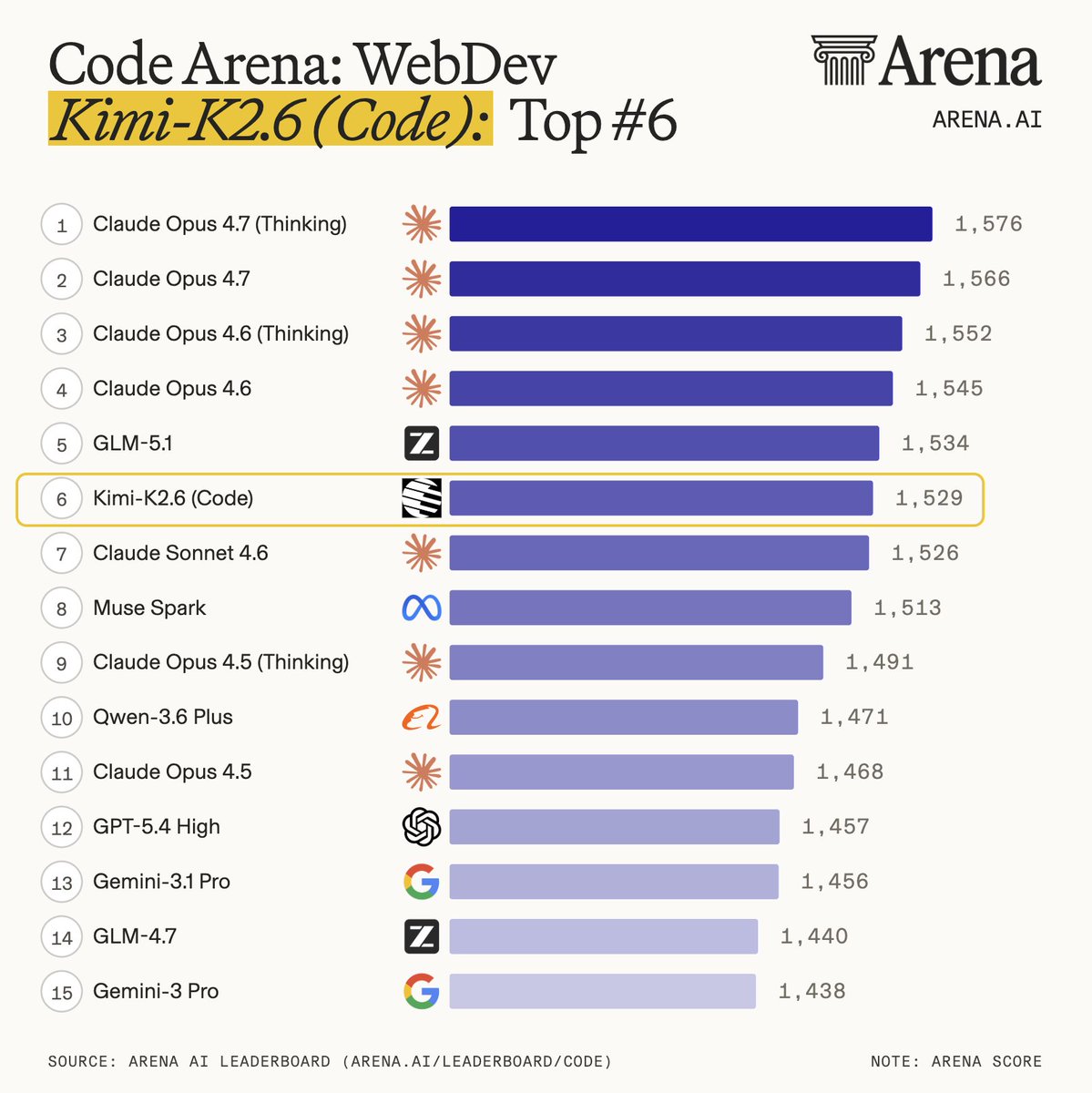
Moonshot has officially disrupted the global leaderboard with the launch of Kimi K2.6, a high-performance open-weight model that is currently matching the industry-leading Claude Opus 4.7 in raw reasoning. This is a massive shift for the open-source community.
The arrival of Kimi K2.6 marks a pivotal moment in the 2026 intelligence race. While Western labs have increasingly moved toward gated, high-cost API structures, Beijing-based Moonshot is taking a different path by providing an open-weight architecture that delivers frontier-grade performance. The model is now available to Pro and Max subscribers, offering a level of sophistication previously reserved for the most expensive proprietary systems.
The performance data for Kimi K2.6 is startling. It currently holds the top spot among all open models on Design Arena, Vision Arena, and Document Arena. These rankings are not just academic; they reflect the model’s ability to handle the messy, high-fidelity inputs required for professional design and architectural workflows. In the more traditional competitive tiers, it ranks a strong second in both Code Arena and Text Arena, signaling that its base linguistic and logic capabilities are firmly in the elite bracket.
What makes K2.6 a true contender is its head-to-head performance against the Anthropic flagship series. On critical benchmarks like SWE-bench Pro, the gold standard for assessing a model’s ability to function as an autonomous software engineer, Kimi K2.6 is matching the scores of Claude Opus 4.7 and Claude Sonnet 4.6. This parity extends to the Humanity Last Exam with tools and DeepSearchQA, proving that Moonshot has successfully cracked the code for extended test-time compute and deep synthesis.
Technical Strengths and Agentic Capabilities
The core strength of Kimi K2.6 lies in its long-horizon execution. Unlike standard models that often lose track of complex instructions after a few thousand tokens, K2.6 features a specialized memory architecture optimized for long-context document tasks. This makes it an ideal engine for agentic coding, where the model must not only write code but also navigate a massive repository, understand legacy dependencies, and plan multi-file refactors autonomously.
In the vision domain, K2.6 is setting a new pace for open-weights. Its rankings on Vision Arena are a result of its advanced multimodal training, which allows it to interpret complex schematics, medical imaging, and dense infographics with a level of precision that matches the best proprietary vision models on the market.
Aggressive Pricing and Market Impact
Moonshot is pairing this technical performance with an aggressive pricing strategy that targets the heart of the enterprise market. At 0.95 dollars per million input tokens and 4 dollars per million output tokens, Kimi K2.6 is significantly more affordable than the current pricing for the Claude 4.7 or GPT-5.4 series. This pricing makes it a highly attractive option for developers building high-volume autonomous agents and the nervous systems for mid-sized companies.
The availability of a model this powerful in an open-weight format is a direct challenge to the closed-source dominance of the last three years. It allows organizations to deploy frontier-grade intelligence within their own sovereign infrastructure without being locked into the pricing whims of a single US-based provider. This is particularly relevant for sectors like finance and defense, where the ability to audit the model weights and ensure data privacy is non-negotiable.
The New Tier of Global Intelligence
With Kimi K2.6, Moonshot has proven that the gap between open and closed models is effectively closing. By matching the best from Anthropic on LiveCodeBench and other high-stakes benchmarks, they have demonstrated that the scaling laws are being applied effectively outside of Silicon Valley.
As the industry moves toward 2027, the success of K2.6 will likely force Western labs to reconsider their pricing and access models. For developers and enterprises, the message is clear: frontier intelligence is no longer a monopoly. We are entering the era of the high-performance open-weight agent, and Moonshot is currently leading the charge.
Google has officially declared the beginning of the Agentic Era with the launch of the Gemini Enterprise Agent Platform. This is not just an update; it is a total evolution of Vertex AI into a mission control for autonomous business operations and high-scale AI systems.
The core of this announcement is the transition from reactive chatbots to proactive agents that can execute complex, multi-step business processes. The Gemini Enterprise Agent Platform provides the full-stack foundation for technical teams to develop, scale, govern, and optimize these fleets of agents at an industrial level.
At the heart of the developer experience is the Agent Builder, which offers a two-tiered approach to creation. For rapid deployment and business analysts, Agent Studio provides a low-code, visual interface for designing and testing agent logic using natural language. For professional engineers, the upgraded Agent Development Kit (ADK) offers a code-first environment with a new graph-based framework. This allows developers to organize sub-agents into sophisticated networks, creating clear and reliable logic for how different systems solve complex problems together.
To manage these systems at scale, Google introduced a new organizational layer called Projects. This unified environment allows teams to manage the full lifecycle of an agent, from initial training and simulation to production deployment. Within these projects, developers can define and index specific Skills, modular capabilities that agents can call upon, such as web searching, database querying, or terminal execution. These are indexed in the new Agent Registry, which acts as a single source of truth for every governed tool and skill available within the enterprise.
Security and governance are no longer afterthoughts in this agentic stack. Google has introduced Agent Identity, which assigns a unique cryptographic ID to every agent. This ensures that every action taken by an AI is fully traceable and mapped back to defined authorization policies, providing the same level of auditability found in essential financial reporting systems. The Agent Gateway acts as air traffic control, managing the connectivity between agents and internal data silos while enforcing Model Armor protections to prevent prompt injection and data leakage.
For those looking to deploy pre-validated solutions, the Agent Gallery features an expansive collection of agents from SaaS leaders and startups. This marketplace includes highly-vetted agents from partners like Adobe, Workday, and Palo Alto Networks, all designed to run natively within the Gemini Enterprise ecosystem.
The data layer has also been reimagined as the Agentic Data Cloud. This AI-native architecture is built for the speed and scale required by autonomous agents. Key components include the Knowledge Catalog, which grounds agents in trusted business context, and an AI-native Lakehouse that provides seamless access to cross-cloud data. This moves data from a reactive archive to a system of action, allowing agents to reason across a company's entire data estate in real-time.
On the hardware front, Google unveiled its eighth-generation Tensor Processing Units. For the first time, the lineup is split into two specialized chips. The TPU 8t (Training) is a powerhouse designed for massive model building, delivering nearly three times the compute performance of the previous generation and packing 9,600 chips into a single superpod for 121 exaflops of compute. The TPU 8i (Inference) is engineered for the ultra-low latency required by real-time agentic reasoning. By tripling on-chip SRAM and doubling interconnect bandwidth, the 8i provides 80% better performance per dollar for inference.
The platform is built on an open ecosystem, featuring deep integrations with industry giants. Oracle is launching an AI Database Connector for Gemini Enterprise, allowing users to query data using natural language. Salesforce is adding native Gemini support to its Atlas Reasoning Engine, enabling its agents to see across text, image, and video. ServiceNow is integrating its autonomous operations directly into the Gemini Enterprise app, bringing its workflows into Google’s governed environment.
This launch signals that the AI race has moved into the infrastructure phase. Google is betting that the winners of the next decade will be the organizations that can move from experimentation to a production-scale agentic taskforce.
Mark Cuban just identified the greatest wealth transfer of the AI age, and it is not happening in Silicon Valley. While the giants burn billions to build the god, the real fortunes belong to those who can teach that god a trade for 33 million businesses currently in the dark.
The conversation surrounding artificial intelligence is currently dominated by a high-stakes arms race between a handful of frontier labs. Billions are being incinerated to build increasingly massive foundation models, yet Mark Cuban argues that almost everyone is looking at the wrong side of the ledger. While the smartest engineers on earth fight for a seat at OpenAI or Anthropic, the true economic revolution is waiting behind the doors of the 33 million companies that actually run the physical economy.
These are not the high-growth tech startups of the Bay Area. We are talking about the regional trucking outfits, the medical practices with twelve employees, the shoe stores, and the third-generation manufacturing plants. These businesses represent the vast majority of the economy, and while they are acutely aware that an AI wave is coming, they have no budget for an AI department and no idea where the light switch is located.
Cuban points to a seismic shift in how technology functions, noting that even leadership at Microsoft is signaling that the era of traditional software is effectively over. For the last twenty years, the SaaS era operated on a single, rigid rule: build a generic product and force millions of companies to bend their unique workflows to fit that software. You paid rent for the privilege of making your business fit a template.
AI ends that contract. In the new paradigm, the business no longer bends to the software. Instead, the intelligence bends to the business. We are moving from generic applications to unique, hyper-customized utilization. However, a massive gap exists between the capability of a model and the unglamorous reality of a 50-person company. A county hospital or a local logistics firm cannot tell the difference between a Claude or a Gemini, and they certainly do not have the internal expertise to wire these models into their revenue streams.
This creates what Cuban describes as a new economic class. The wealth in the AI era will not collect where the brain is built; it will collect where the brain meets the business. As the frontier labs drive the cost of raw intelligence toward zero through sheer competition, intelligence becomes a commodity—much like electricity did a century ago.
The history of the industrial revolution provides the blueprint. The biggest winners of the electricity era were not necessarily the engineers who built the massive generators. The fortunes were made by the people who walked into dark, steam-powered factories and showed the owners exactly where and how to plug in. They built the nervous system that allowed the power to actually do work.
The advice for the next generation of entrepreneurs and professionals is clear: stop obsessing over the base layer. Let the giants fight the bloodbath over the foundation models. Your opportunity lies in the messy, unglamorous integration of that intelligence into the 99 percent of the economy that is currently standing in the dark.
To win in this era, you must learn the models, but you must more importantly learn the specific problems of the physical economy. The person who can walk into a mid-sized trucking company, understand their specific inefficiencies, and wire a frontier model directly into their scheduling and logistics is worth more than the model itself. You are not just a consultant; you are the architect of the nervous system for the modern world.
The 33 million companies Cuban references are waiting for someone to show them how to use the god that Silicon Valley is building. The fortunes of the next decade belong to the translators, the integrators, and the builders who can teach AI a trade.