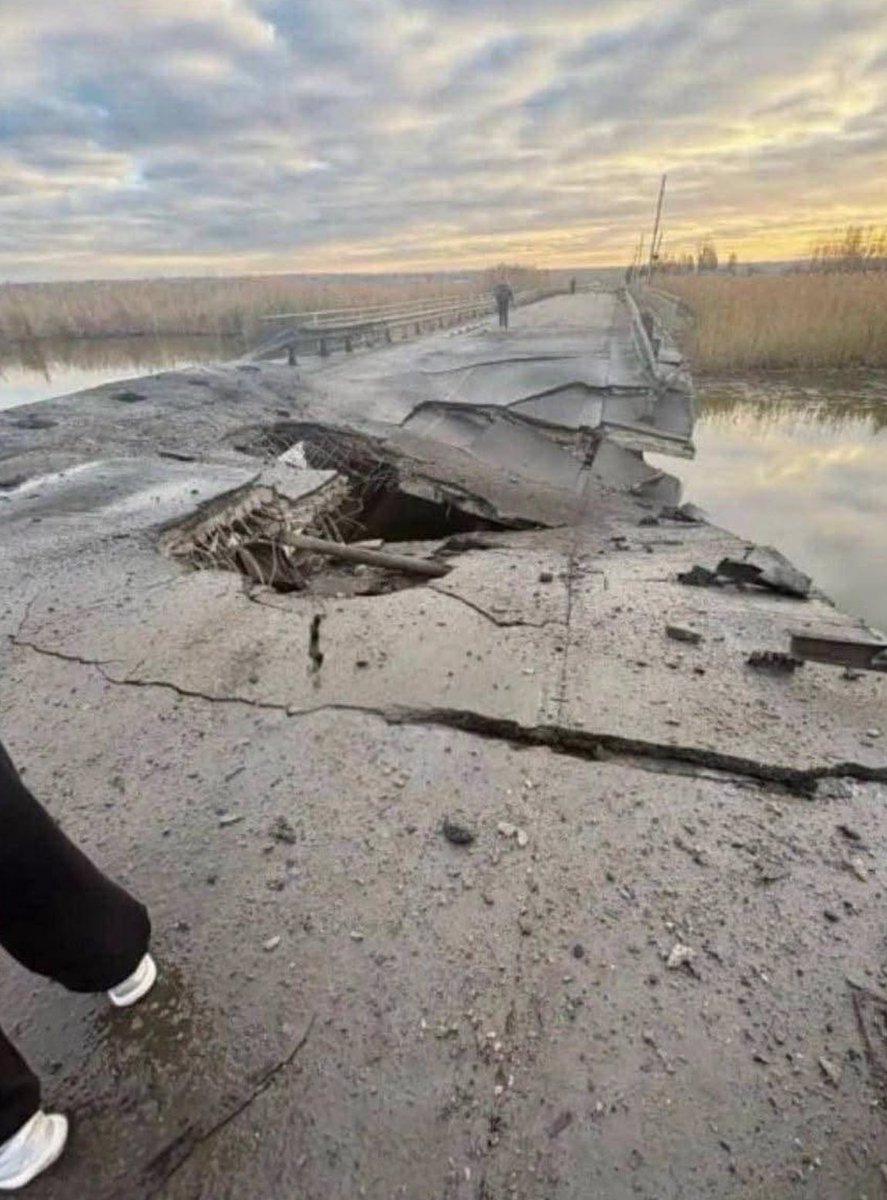
🇺🇦🇷🇺 RUSSIA REOPENS A CRITICAL SUPPLY ROUTE. UKRAINIAN DRONES MAY HAVE HIT IT AGAIN JUST HOURS LATER!
Russian engineers spent days trying to restore traffic across the Mius River in Rostov Oblast after a Ukrainian drone strike damaged a bridge on November 8.
The attack, near kilometre 97 of the R-280 Novorossiya highway, also damaged two crawler cranes involved in repair work.
Moscow had to establish a roughly 58-kilometre detour while engineers worked to restore the crossing.
On November 14, traffic finally resumed using a parallel temporary bridge, with vehicles alternating directions.
Now, monitoring channels suggest Ukrainian drones have struck the crossing area again.
The precise target, extent of damage and any renewed traffic disruption remain unconfirmed.
But the location matters.
The R-280 forms part of Russia’s land corridor connecting Rostov-on-Don with occupied Mariupol, Melitopol and Crimea.
It’s an important route for moving military vehicles, ammunition, fuel and reinforcements toward Russian-occupied southern Ukraine.
And this is where Ukraine’s approach becomes particularly interesting.
Destroying a bridge once creates an immediate logistical problem. Repeatedly threatening the same crossing can turn repairs, traffic management and protection into an ongoing burden.
Even a temporary disruption can force vehicles onto longer routes, delay deliveries and divert engineering resources.
Russia doesn’t have to lose an entire highway for Ukraine to make that highway increasingly expensive to operate.
If the latest strike is confirmed, the Mius crossing could become another example of Ukraine using long-range drones to pressure Russian military logistics far behind the front line.