“Türküz, Türküz, Türküz”
Batı Trakya Türklerinin hak ve hürriyet mücadelesine ömrünü adayan Dr. Sadık Ahmet’i rahmet, minnet ve saygıyla anıyorum.
Emanetine her daim sahip çıkacağız
Ruhu şad, mekânı cennet olsun.
Haritada Hatay’ın konumuna ne zaman baksam Mustafa Kemal Atatürk’e duyduğum minnet kabarır ve resmen damarlarımdan taşar.
Canı pahasına katıldığı mersin/adana manevraları, o muhteşem soğuklanlılıkla oynanan son diplomatik oyun, attığı kararlı adımlar ve yıllar öncesinden kurduğu stratejik vizyon sayesinde Hatay tek bir kurşun atılmadan yeniden anavatana kavuştu.
Bir de Hatay’ı Frengistan’dan aldık ya Allah ayrıca bunun için de râzı olsun.
Hatay’ın anavatana katılışının yıl dönümündebaşta Hatay’ı her zaman şahsi meselesi olarak gören Gazi Mustafa Kemal Atatürk olmak üzere Fevzi Çakmak Paşa’yı, Tayfur Sökmen Bey’i ve bu tarihî sürece emek veren herkese şükranlarımı sunuyorum.
“Kırk Asırlık Türk Yurdu Düşman Elinde Esir Kalamaz.”
Misak-ı Millî'mizin ayrılmaz bir parçası olan Hatay uzun ve kararlı diplomatik mücadelenin ardından 23 Temmuz 1939'da anavatanla yeniden kucaklaştı.
Hatay'ın anavatana katılışında emeği geçen devlet büyüklerimizi rahmet ve minnetle anıyorum.
The Security Council is a international is not an international court.
Its resolutions cannot be read selectively while ignoring the 1960 constitutional partnership, the Treaty of Guarantee, years of violence against the Turkish Cypriots and the Greek junta-backed coup of 15 July 1974.
Those facts do not disappear merely because someone places five resolution numbers in a table.
If the purpose is legal analysis, quote the operative paragraphs accurately. If the purpose is propaganda, at least do not present editorial additions as United Nations language.
Tell me if the UN condemn this picture ?
@dedd124@TheProgressives You are doing the all massacre, killing innocent people, when we come back to protect our people you are starting to whine.
1922,1974 and 1996.. I think you should stop. Don't be puppet.
@Dimchios@TheProgressives I told you Yorgo, it is a very long essay for you...
Please learn the difference between an essay and propoganda... But don't worry, we will teach you word by word.
Hey Nikos or Dimchios, whoever yo are;
Now read below given text carefully.
I said carefully, because I am sure that you are not able to understand this level of English.
If It is too much for you, don't worry.
You can use any GPT, LLM or other AI tools to understand and analyse, ok !
We, Turks, are always tolerated to whom are not same with our level.
The progressive intensification of systematic violence against the Turkish Cypriots—one of the two constituent peoples of the Republic of Cyprus—cannot be dissociated from the gradual dismantling of the constitutional partnership established in 1960.
The Turkish Cypriots were not a demographic minority accommodated within a majoritarian political order, but a co-constitutive community whose status and institutional participation were embedded in the foundational architecture of the Republic.
Their exclusion from the political and administrative mechanisms of the state therefore threatened not only their physical security but also their legally recognised political existence.
The Sampson coup of 15 July 1974 constituted the culmination of this process. Directed towards the realisation of Enosis, it extinguished the “functional rationality” of the 1960 regime and sought to overturn the established regional status quo.
Without succumbing to the distortions of retrospective interpretation, Türkiye’s intervention must be distinguished from territorial aggrandisement or irredentism. Its declared and treaty-based objective was restitutio in integrum: the restoration of the constitutional and legal order that had been forcibly overthrown.
Although Enosis functioned as an ideological “superstructure,” it concealed an infrastructural project aimed at consolidating political, socio-economic and military control over the island. Türkiye’s response may accordingly be conceptualised as an anti-revisionist act on three principal grounds:
Legal Restitution: The intervention constituted a defensive response to the abrogation of the constitutional order. Consistent with its status quo-oriented foreign-policy tradition, Türkiye opposed an attempt to alter by force the legal and strategic settlement established in 1960.
The coup threatened to transform Cyprus into an instrument of strategic encirclement along Türkiye’s southern coastline, thereby altering the balance of power in the Eastern Mediterranean. The intervention neutralised this structural security threat.
Restoration of the Treaty-Based Order:
The operation arose not from a colonial or expansionist design, but from Türkiye’s determination to exercise the powers conferred upon it as a guarantor state, preserve the constitutional partnership and protect the security of the Turkish Cypriot community.
Türkiye’s recourse to military force thus represented, within its own juridical and strategic interpretation, the exercise of powers emanating from treaty law for the preservation of the regional status quo.
Article IV of the Treaty of Guarantee
The Cyprus Peace Operation constitutes a prominent instance in which a claimed “right of intervention” possessed an express treaty-based foundation. Before invoking Article IV of the Treaty of Guarantee, Türkiye pursued the consultative mechanisms envisaged under the guarantor regime. Diplomatic contacts with the United Kingdom and the failure of Türkiye’s proposal for concerted action created the legal and diplomatic basis upon which Ankara proceeded unilaterally.
Article IV provided that, where concerted action proved impossible, each guarantor power reserved the right to take action with the sole objective of re-establishing the state of affairs created by the Treaty. Türkiye accordingly maintained that its action was neither an unrestricted use of force nor an intervention undertaken independently of international law, but the activation of a specific authority arising from the constitutional instruments of 1960.
The designation “Peace Operation” likewise expressed a juridical and political position. It emphasised that the declared purpose of the operation was not territorial conquest, but the restoration of constitutional government, the protection of human life and the prevention of the eradication of one of the Republic’s two constituent communities.
The legal debate nevertheless requires a distinction between the existence of a treaty-based authority and the scope of the measures permissible under that authority. Article IV supplied the foundation of Türkiye’s claim, while the necessity and proportionality of the operation—particularly its second phase—subsequently became matters of contention within international legal literature. This controversy does not negate the treaty basis itself; it concerns the extent to which the military measures employed remained confined to its restorative purpose.
The United Nations Dimension: Resolution 353
The principal response of the United Nations Security Council was Resolution 353, adopted unanimously on 20 July 1974. The resolution called for an immediate ceasefire, demanded an end to foreign military intervention and requested the withdrawal of foreign military personnel present in Cyprus otherwise than under the authority of international agreements. It also called upon Türkiye, Greece and the United Kingdom to enter into negotiations without delay for the restoration of peace and constitutional government on the island.
The ceasefire entered into effect on 22 July, after which the three guarantor powers convened in Geneva. Türkiye could therefore maintain that it had acted within the diplomatic framework established by the Security Council: it participated in the ceasefire process, entered the negotiations envisaged by the resolution and continued to define its military presence through the rights and obligations arising from the 1960 Treaty of Guarantee.
The wording of the withdrawal provision is juridically consequential. Resolution 353 did not demand the indiscriminate removal of every foreign soldier from Cyprus; it referred specifically to military personnel whose presence was not authorised by international agreements. Türkiye’s position was that its forces could not be assimilated to an unauthorised foreign contingent, since their presence derived from its status as a guarantor power and from the authority claimed under Article IV. The Security Council neither designated Türkiye as an aggressor nor declared the Treaty of Guarantee inoperative. Nor did it expressly determine that Türkiye’s initial intervention was unlawful.
Resolution 353 must therefore be read as a politically negotiated instrument of conflict management rather than as a judicial pronouncement upon the legality of Türkiye’s action. The Security Council sought to terminate hostilities and initiate negotiations without conclusively adjudicating between competing interpretations of the United Nations Charter and the Treaty of Guarantee. Its language reflected that compromise: while referring generally to foreign military intervention, it preserved the legal relevance of international agreements and entrusted the restoration of constitutional government to the three guarantor powers.
The political limitation of the resolution lay in its treatment of the crisis primarily as an immediate threat to international peace. By placing the Greek-sponsored coup, the destruction of the bicommunal constitutional order and Türkiye’s guarantor action within a broadly neutral framework, the Council privileged diplomatic consensus over a differentiated assessment of causation and responsibility. Resolution 353 regulated the cessation of hostilities; it did not conclusively determine which actor had destroyed the constitutional status quo or invalidate Türkiye’s treaty-based justification for intervening.
Türkiye’s posture in 1974 marked a historical inflection point at which it demonstrated its capacity to act as both a middle power and a pivotal state. The operation challenged the proposition, associated with Raymond Aron’s analysis of bipolarity, that middle powers possessed only a severely restricted capacity for autonomous action. Where vital security interests were at stake, Türkiye showed that it could formulate and execute sovereign decisions without making them absolutely contingent upon the approval of hegemonic powers, including the United States.
As a pivotal state, Türkiye prevented the complete collapse of the Cypriot status quo and contained the prospect of a wider confrontation in the Eastern Mediterranean. Its conduct generated friction within the Western alliance, yet Ankara accepted the political and material costs of its decision, including the subsequent United States arms embargo. This willingness demonstrated a capacity for strategic autonomy within a sphere directly affecting national security.
The operation also attested to more than military capability. Türkiye mobilised treaty law, coercive diplomacy and regional power projection within a single strategic framework. Its participation in the Geneva process showed that military action was not conceived as an alternative to diplomacy, but as an instrument intended to establish the security conditions under which diplomacy could proceed.
The lasting effect of 1974 was therefore the consolidation of Türkiye’s capacity to shape, rather than merely react to, its regional environment. The operation constituted a practical demonstration of middle-power autonomy under the restrictive conditions of the Cold War.
The Cyprus Peace Operation exhibits substantive coherence with the status quo-oriented foundations of the Republic of Türkiye’s foreign-policy tradition. Türkiye did not define its action as an exercise in revisionist expansion. It presented the intervention as a response to the forcible destruction of an existing constitutional order and to an attempt to transform the island’s internationally established status through Enosis.
Mustafa Kemal Atatürk’s famous phrase, “Peace at Home, Peace in the World,” should not be reduced to a prescription for passive inaction.
It articulates a conception of peace sustained through treaty-based legality, political equilibrium and effective security guarantees. Where the juridical foundations of peace are destroyed by force, their restoration may require more than diplomatic exhortation.
From this perspective, Türkiye’s intervention in Cyprus represented the convergence of realism, treaty-based legitimacy and regional power capacity.
Its strategic rationale rested upon a central proposition: the preservation of peace is inseparable from the capacity—and, when circumstances demand it, the political resolve—to defend the constitutional and security order upon which that peace depends.
"The guy also called a Dr."
@raqkstar In 1969, Pelé and Santos FC played friendly matches in Nigeria during the civil war. A very popular myth claims that both sides agreed to a 48-hour ceasefire just to watch him play. Even if it is not true, it shows how georgeus Pele is
Montrö Boğazlar Sözleşmesi 90 Yaşında.🇹🇷
Lozan Barış Antlaşması’nı tamamlayıcı nitelikte bir uluslararası hukuk metni olan Montrö Boğazlar Sözleşmesi ile Türkiye, Boğazlar üzerindeki tam egemenliğini tesis etmiş; savaş ve barış dönemlerinde uygulanacak geçiş rejimini hukuki güvence altına almıştır.
Günümüzde başta Rusya–Ukrayna Savaşı olmak üzere yaşanan uluslararası gelişmeler, Montrö’nün Türkiye’nin güvenliği ve egemenlik haklarının yanı sıra Karadeniz’deki askerî dengenin korunması bakımından taşıdığı hayati değeri bir kez daha göstermiştir.
Türkiye olarak Montrö Boğazlar Sözleşmesi’nin bütün hükümlerini titizlikle ve kararlılıkla uygulamayı, Sözleşme’den doğan haklarımızı ve kazanımlarımızı sonuna kadar korumayı sürdüreceğiz.
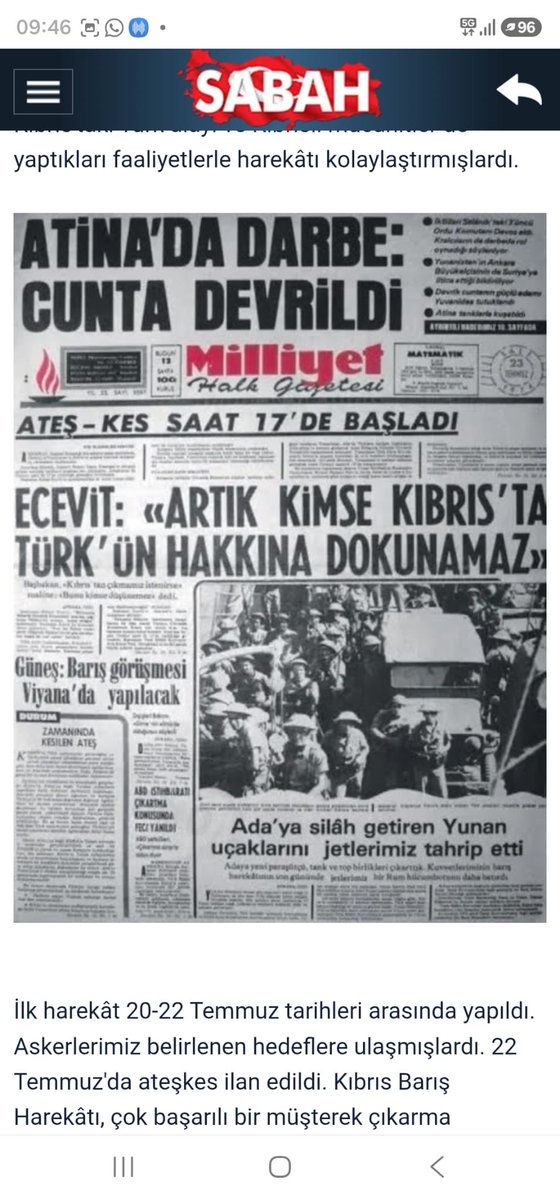
1974'te Türk ordusu Kıbrıs'a çıkmasaydı, 1821'de Mora Türklüğü nasıl yokedildiyse, Kıbrıs Türklüğü de yokedilecekti. 52 yıl önce Adaya huzur ve barış getiren Kıbrıs Barış Harekatı Türkiye Cumhuriyeti'nin en önemli ve en başarılı askeri harekatlarından biridir.
Bütün Kıbrıs şehidlerimizi ve harekatın icrasında görev alıp, vefat etmiş olan herkesi rahmetle, gazilerimizi minnetle anıyorum.
Batı Trakya Türkleri yalnız değildir!
İskeçe Merkez Türk Azınlık İlkokulu’na kayıt yaptıran öğrencilerin kayıtlarının çeşitli gerekçelerle iptal edilmek istenmesi ve Batı Trakya Türklerinin Lozan Barış Antlaşması ile güvence altına alınan eğitim haklarının keyfî uygulamalarla kısıtlanması kabul edilemez.
Yunanistan; uluslararası hukuktan, Lozan Barış Antlaşması’ndan ve Avrupa İnsan Hakları Mahkemesi kararlarından doğan yükümlülüklerini yerine getirmekten keyfi olarak kaçınamaz
Türkiye olarak Batı Trakya Türklerinin haklı mücadelesinde her zaman yanlarında olmaya, soydaşlarımızın uluslararası hukuktan doğan meşru haklarının takipçisi olmaya kararlılıkla devam edeceğiz.
📍Güney Kıbrıs'ta Rum öğrenci örgütleri, 20 Temmuz 1974 Kıbrıs Barış ve Özgürlük Harekatı’nı protesto etti.
Ada’daki sınır kapılarına yürüyen Rum ögrenciler şu sloganları attı:
•Kıbrıs Yunan’dır!
•Türkler Yunan toprağında öleceksiniz.
•Türklerin evlerine yıkım ve ateş
•Türkiye, Kıbrıs’tan defol
Hey Aposto,
It is also a song… most probably your father listened during 1974…
Now I assign you a homework. Go and find out ! Which song our guys played this one in response to ? 🙇📚
Be smart.
Learn from the history.
Dont dare to touch our lands, brothers again. If so… 🇹🇷
https://t.co/HRMkTfrHTc