A man spends 50 years teaching at MIT.
He knows his time is running out.
So he records one last lecture — everything he knows, distilled into a single hour.
He died 5 months later.
This is that lecture.
The most important hour you'll watch this week. 👇
Bookmark it for later
Tom Brady shares the one trait that all great leaders have.
"None of us are a finished product. We all have the ability to contribute - but we also need to surround ourselves with people that can push us in areas where they're not our strength."
"Humility and accountability are 2 of the great traits that I see in all great leaders."
Then he explained what great leadership really looks like:
"There's curiosity to continue to learn because what we know is very limited. And what we don't know is limitless."
"Good leaders have the ability to understand exactly who they're dealing with - to communicate effectively, to relate to the people they work with, and to learn from everybody within the organization."
They have the humility and will to keep growing.
"I always felt I had to continue every year to put more pressure on myself to achieve a higher level of performance."
"We always need to push past those limits."
"I don't think there's any way a leader who doesn't have humility can get the best out of himself."
"We constantly have to look at ourselves and understand the things we're not good at. And that really comes with humility."
Nobody is a finished product and the best leaders know that.
They accept where they are, but they're curious and humble enough to keep pushing past their current limits.
They make growth a habit.
(🎥 The Consello Group)
My honest advice to someone who wants to make a lot of money.
3 things nobody told you:
1. The only way to make a lot of money is to create a lot of value.
No one hands out money. No one is going to pay you just because they like you or think you're cool. That's not the way the world works.
Money earned is a direct byproduct of value created. Create value, receive value. If money is the goal, value has to be the focus.
This isn't just some vague idea: The only way to get rich is to create an enormous amount of value for others, and capture a small portion of that along the way.
It's not talking about the thing, it's not brainstorming about the thing, it's not asking about the thing, it's not thinking about the thing. The only way to create value is by doing the thing.
And if you don't know where to start, look around you. Customers, colleagues, bosses, shareholders, employees. Every single one of them has a problem. What problems can you solve for the people around you? Figure them out, solve them, scale that solution.
That's how you make money.
2. You have to demonstrate excellence in everything you do.
Your income scales proportional to the amount of excellence that you're able to demonstrate.
Strategic incompetence is a lie. You don't get to pick and choose when to show up, because the world will ignore your best and judge you for your worst. Everything matters. Every single thing.
Top performers show up with energy and enthusiasm for the little things just as much as they do for the big things.
If you're in the top-10% of performers, there's no ceiling for what you can do. But the self-awareness to identify where you currently stack up, and adapt to the honest feedback on it, is very rare.
If you're in the top-10%, you know it. If you're not, figure out why and fix it.
3. You don't need passion, you need energy.
I still have no idea what it means to follow your passion.
You don't have to be passionate about your professional pursuits, you just need to find energy in them. You just need to feel a pull towards them. You just need to feel that spark of curiosity in them.
Passion is usually a byproduct of energy.
When you have energy for something, you'll give it your deep attention to learn more. You’ll ask the right questions. You’ll figure it out. You’ll win.
***
And remember: Nobody is coming to save you. It’s just you. There’s a power in that.
Go do the thing.
Legacy workflows persist, old assumptions guide decisions, and “the way we’ve always done it” shapes strategy. In a market transformed by real-time data and automation, these habits quietly erode competitiveness.
Elon Musk just explained why the best engineers on Earth will never take your call.
Three reasons.
Most companies fail all three.
Elon Musk: “State what’s the mission, what’s the problem we’re trying to solve? And just be clearly willing to pour a lot of blood, sweat, and tears into it.”
The top one percent of talent does not care about your office. Your perks. Your free lunches. Your branded hoodie.
They care about one thing.
Does this matter.
If the answer takes more than one sentence to explain, they are already gone.
Musk broke motivation into three layers.
The first is the work itself.
Musk: “Somebody’s got to look forward to coming to work in the morning. Are they enjoying the work itself intrinsically?”
Not the paycheck. Not the title. The work.
Solving problems most people cannot even frame correctly. Alongside people who make you sharper just by being in the room.
If Monday morning feels like a sentence, no salary commutes it.
The best people leave. Not eventually. Within months.
The second is money.
Musk: “They also feel like they will receive fair financial compensation. Like that the financial rewards are good and fair.”
Not charity. Not below-market equity with a four-year cliff.
Fair.
One word. Most companies still get it wrong.
The engineer who knows exactly what they generate does not negotiate. They compare.
When the gap gets wide enough, they vanish. No conversation. No counteroffer window. Two-week notice on a Friday afternoon.
You do not cap the ceiling of someone producing at that level. You match it. Or you fill the desk again in six months.
The third is the one that separates real companies from forgettable ones.
Musk: “For the best people in the world, they’ll want to know: is what they’re doing going to matter? If they spend 10 years doing this, will it make a difference to the world?”
Ten years.
The best engineers on the planet are running a calculation no recruiter has a spreadsheet for.
If I give this company a decade of my life, does the world look different because I did?
If the answer is no, they are not coming. No signing bonus changes that. No recruiter pitch rewrites it. No equity package papers over it.
The mission has to be real. And the person at the top has to be visibly bleeding for it.
Musk: “Be clearly willing to pour blood, sweat, and tears into it.”
Talent watches the founder before they read the offer letter.
If the person running the company is coasting, optimizing for exits, playing it safe, the best people sense it before the first interview ends.
They do not want a manager. They want someone who has bet everything and would do it again tomorrow.
Most companies post a job.
The ones that land the best people alive offer something no job listing can contain.
The work has to be the reward. The money has to be fair. The mission has to be worth a decade of someone’s only life.
Miss one and the person you needed most never even opened your email.
La irrupción del ecosistema digital ha transformado radicalmente la experiencia humana más allá de las incontables ventajas que ha supuesto.
Por una educación digital https://t.co/wWjzWW2LGQ
Terence Tao is the greatest living mathematician.
Fields Medal at 31. Solved problems that had been open for a century. Widely regarded as the sharpest analytical mind alive.
And he just told you the thing your entire career is built on is now worthless.
Tao: “AI has basically driven the cost of idea generation down to almost zero.”
For five hundred years, the idea was the prize.
The theory. The hypothesis. The flash of insight a physicist chased for twenty years in a lab before it landed.
That was the bottleneck. That was what tenure rewarded. That was what Nobel committees were looking for.
Gone.
A model can generate a thousand candidate theories for a scientific problem in an afternoon. Not noise. Not garbage. Plausible, structured, publishable-grade hypotheses.
A thousand of them. Before dinner.
The idea used to be the scarcest resource in any room.
Now it is the cheapest.
But Tao went somewhere most people are not ready to follow.
Tao: “Verification, validation, and assessing what ideas actually move the subject forward… that’s not something we know how to do at scale.”
Sit with that.
We automated creation.
We did not automate truth.
We can produce ten thousand explanations for a phenomenon.
We cannot tell you which ones are real.
That is not a gap. That is a chasm.
And it is the most important unsolved problem on Earth right now.
Tao: “Human reviewers… they’re already being overwhelmed actually.”
The entire scientific apparatus was built for a world where a single paper took months to produce.
Peer review. Journal boards. Consensus forged over years of replication and debate.
That infrastructure was never designed for what just hit it.
Journals are flooded. Reviewers are buried. The filters that separated signal from noise for decades were engineered for human-speed output.
They are now absorbing machine-speed volume.
And they are cracking under it.
Tao compared it to the internet.
The internet drove the cost of communication to zero. That did not produce clarity. It produced an ocean of noise with islands of signal buried somewhere inside.
AI just did the same thing to knowledge itself.
Infinite generation. Zero verification.
The person who can produce ideas has never mattered less.
The person who can prove which ideas are true has never mattered more.
That is the inversion nobody is processing.
Every company, every lab, every institution is racing to generate more. Faster models. Bigger outputs. More theories. More code. More content.
Nobody is building the system that tells you which of those outputs are actually correct.
And that is the only system that matters.
Whoever solves verification at scale does not win a market.
They become the filter that all of science, all of engineering, all of human discovery flows through.
The bottleneck of the last five hundred years was producing the answer.
The bottleneck of the next fifty is knowing whether the answer is real.
And right now, according to the greatest mathematician alive, we do not know how to do that at the speed the machines demand.
That is not a research problem.
That is the race beneath the race.
And almost nobody has entered it.
The missionary is building the product, building the service
• they love the customer
• they love the product
• they love the service.
The best way to position yourself, Jeff argues, is to pursue something that captures your curiosity.
Jeff Bezos’s two pieces of advice for aspiring entrepreneurs
“The advice that I would give entrepreneurs is don't chase the hot new thing. It's so hard to catch something that everybody already knows is hot. Instead, position yourself and wait for the wave to come to you.”
The best way to position yourself, Jeff argues, is to pursue something that captures your curiosity. When Amazon startup, Jeff always asks himself if the founder is a “missionary” or a “mercenary.”
“I don't like mercenaries, and I don't like mercenary cultures. The missionary is building the product, building the service, because they love the customer, because they love the product, because they love the service. The mercenary is building the product or the service so that they can flip the company and make money.”
One of the great paradoxes of entrepreneurship is that the missionaries usually end up making more money than the mercenaries anyways.
After you’ve picked something you’re passionate about, Jeff’s second piece of advice is:
“Start with the customer and work backwards… Those two things will take you an awfully long way.”
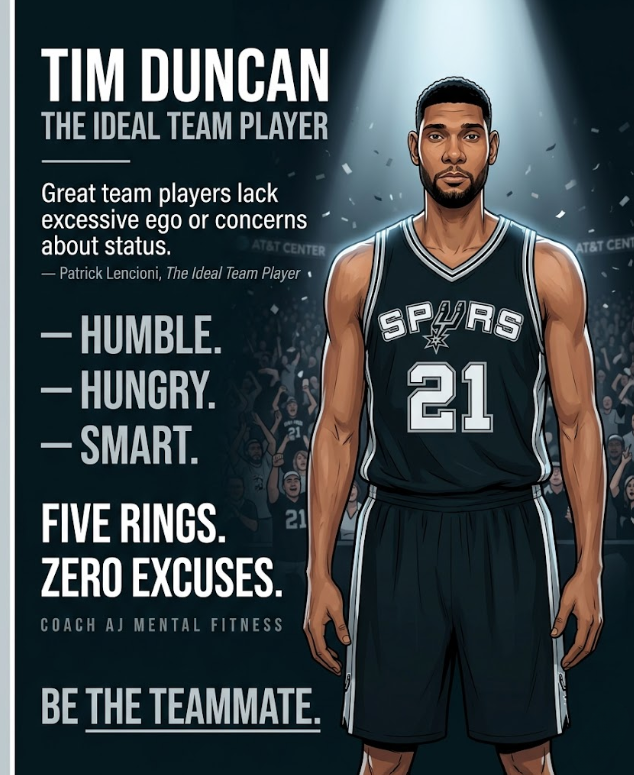
Great teams aren't built on talent alone. They're built on character. Humble, Hungry, and Smart.
That's what separates good players from ideal team players.
I've read hundreds of leadership books.
But when coaches and players ask me, "What's one book I should read?"
I always say the same thing.
A book about teamwork, being a team player, and taking ownership.
📌Bookmark this - Here's the book and why it's so helpful.
The book is The Ideal Team Player by Patrick Lencioni.
Let me tell you about the book and the problem most teams have...
Most leaders hire for talent and experience.
They look at resumes and past performance. But usually they end up with talented people who destroy team culture.
Because talent without character kills teams.
Lencioni figured out the formula for identifying people who don't just perform well - they make everyone around them better.
It comes down to three qualities:
1. Humble - Humble people lack excessive ego. They share credit, emphasize team over self, and define success collectively rather than individually. The test: Do they use "we" or "I" when talking about wins? Humble doesn't mean weak. It means secure enough to celebrate others.
2. Hungry - Hungry people are always looking for more. They're self-motivated. They don't need to be pushed. They're thinking about the next opportunity before you ask.
The test: Do you have to pull work out of them, or do they come looking for it?
3. Smart (People Smart) - This isn't about IQ or technical skills. It's about emotional intelligence. They know how to navigate relationships. They read the room. They adapt their communication based on who they're talking to.
The test: Do people feel better or worse after interacting with them?
Let me explain why all three matter...
Here's where most leaders mess up: They hire people who have one or two of these qualities but not all three.
Humble + Hungry, but not Smart = Works hard, great attitude, but leaves relational damage everywhere they go.
Humble + Smart, but not Hungry = Everyone likes them, they're great to be around, but they don't carry their weight. Pleasant but unproductive.
Hungry + Smart, but not Humble = Gets things done, knows how to work the system, but it's all about them. Climbs over people to get ahead.
You need all three.
Humble, Hungry, AND Smart. That's the ideal team player.
I suggest this book because it emphasizes the power of ownership. Most leadership books give you theory. This one gives you a practical framework you can use immediately.
You can assess candidates with it. You can evaluate your team with it. You can develop yourself with it.
And it's based on a simple truth: Great teams aren't built on talent alone. They're built on character. Humble, Hungry, and Smart.
That's what separates good players from ideal team players.
𝗦𝗪𝗢𝗧 𝗶𝘀 𝘄𝗵𝗲𝗿𝗲 𝗮𝗻𝗮𝗹𝘆𝘀𝗶𝘀 𝗲𝗻𝗱𝘀. 𝗧𝗢𝗪𝗦 𝗶𝘀 𝘄𝗵𝗲𝗿𝗲 𝘀𝘁𝗿𝗮𝘁𝗲𝗴𝘆 𝘀𝘁𝗮𝗿𝘁𝘀.
TOWS forces hard choices:
- Use strengths to win real opportunities
- Fix weaknesses that block growth
- Protect the business from real threats
https://t.co/U3VpsH8CwI
Marc Andreessen on why the best founders don't hire, they convert believers.
When you're a 3-person startup with no revenue, how do you convince top talent to choose you over Google or Microsoft?
Marc's answer cuts straight to the heart of it:
"The difference between a vision and a hallucination is that other people can see the vision."
This is the real skill behind great hiring, and it has nothing to do with compensation packages.
@pmarca points to Steve Jobs as the ultimate example. He describes what he calls Jobs' "reality distortion field":
"If you get within 10 ft of Steve Jobs, whatever he says the next 20 minutes, you're going to walk out of there believing whatever he says. He can say the sky is purple and you'd be like, 'Yep, that makes total sense.' And 4 hours later you're like, 'Well, I don't really know what he meant by that, but it was really, really compelling at the time.'"
That's the superpower the best founders share.
They can describe where the world is going with such clarity and conviction that people don't just understand the vision. They feel it. They want to be part of it.
As Marc puts it: "It's essentially sales. Selling to employees."
But here's the counterintuitive part about hiring that Marc has observed over the years:
The frustration is actually doing exactly what it's supposed to.
When a candidate turns you down after multiple conversations, it stings. It feels like wasted time. But Marc reframes it:
"Of all the people you interview, if you hired them all, it would turn out that a good two-thirds or three-quarters of them you probably shouldn't have hired anyway."
Rejection is the selection process working exactly as it should.
The best companies lean into this by presenting a brutally honest picture of who they are.
Not a polished recruitment pitch, but a stark and polarising reality, and that clarity of identity is what makes the right people self-select in.
"If in your hiring process you're turning people off as often as you're turning them on, I think that's a good thing."
Stop trying to convince everyone. Be so specific about who you are and where you're going that the right people find you, and the hiring problem starts to solve itself.
@Urgent_RussiaTV The key to happiness is gratitude!!
To truly see and value what we already have, and to understand that somewhere, someone would give everything for what we take for granted.
One of the most powerful communication structures:
What — explain the idea
So What — explain why it matters
Now What — explain what should happen next
It works for:
• presentations
• emails
• meetings
• feedback
In 2018, Stanford professor Matt Abrahams gave a masterclass on why most people fail to communicate well.
He broke down:
- The structure every message needs
- Why audiences stop listening
- The psychology of attention
15 lessons that'll make your communication unforgettable:
In 2018, Stanford professor Matt Abrahams gave a masterclass on why most people fail to communicate well.
He broke down:
- The structure every message needs
- Why audiences stop listening
- The psychology of attention
15 lessons that'll make your communication unforgettable:
@WaldronLewis@grok this sounds like the core of Amazon leadership principles. Provide a list of the 10 most relevant insights and learnings we can get from Bezos ideas.
@WaldronLewis@grok this sounds like the core of Amazon leadership principles. What are the 10 most relevant insights and learnings we can get from Bezos ideas?