CTI Expert
A Claude skill for cyber threat intel & OSINT with 67+ commands for reconnaissance and automated reporting.
https://t.co/wohCkn5LRl
All tools available at https://t.co/7YGpU9Rxsn
#OSINT#CTI
KARPATHY WROTE THIS DOCUMENT TO COMPLETELY AUTOMATE OBSIDIAN WITH CLAUDE
I was ready to abandon my second brain
manual cross-referencing was destroying my workflow, but finding this exact document opened my eyes to a completely different approach
it is incredibly convenient -> Karpathy's method turns the AI into a full-time maintainer for your Zettelkasten:
> the LLM reads every new source and integrates it into a structured wiki
> Obsidian becomes your visual IDE while Claude operates as the backend
> the agent runs automated checks to find contradictions across your notes
> your entire vault compounds automatically without you typing a single link
the friction is completely gone. I just feed it raw documents and the agent organizes my entire life
here is the official document from Karpathy explaining the architecture 👇
🚨 "We've been breached."
It's the text every security professional dreads. When an incident occurs you need tactical, hands-on skills to stop the bleeding, isolate the threat, and reconstruct the timeline.
Bridge the gap between offensive mindset and elite defensive execution because the best incident responders think like attackers.
👉 Ready to defend? Explore the syllabus and start your journey toward the OSIR certification today: https://t.co/xD3NBGMwqI
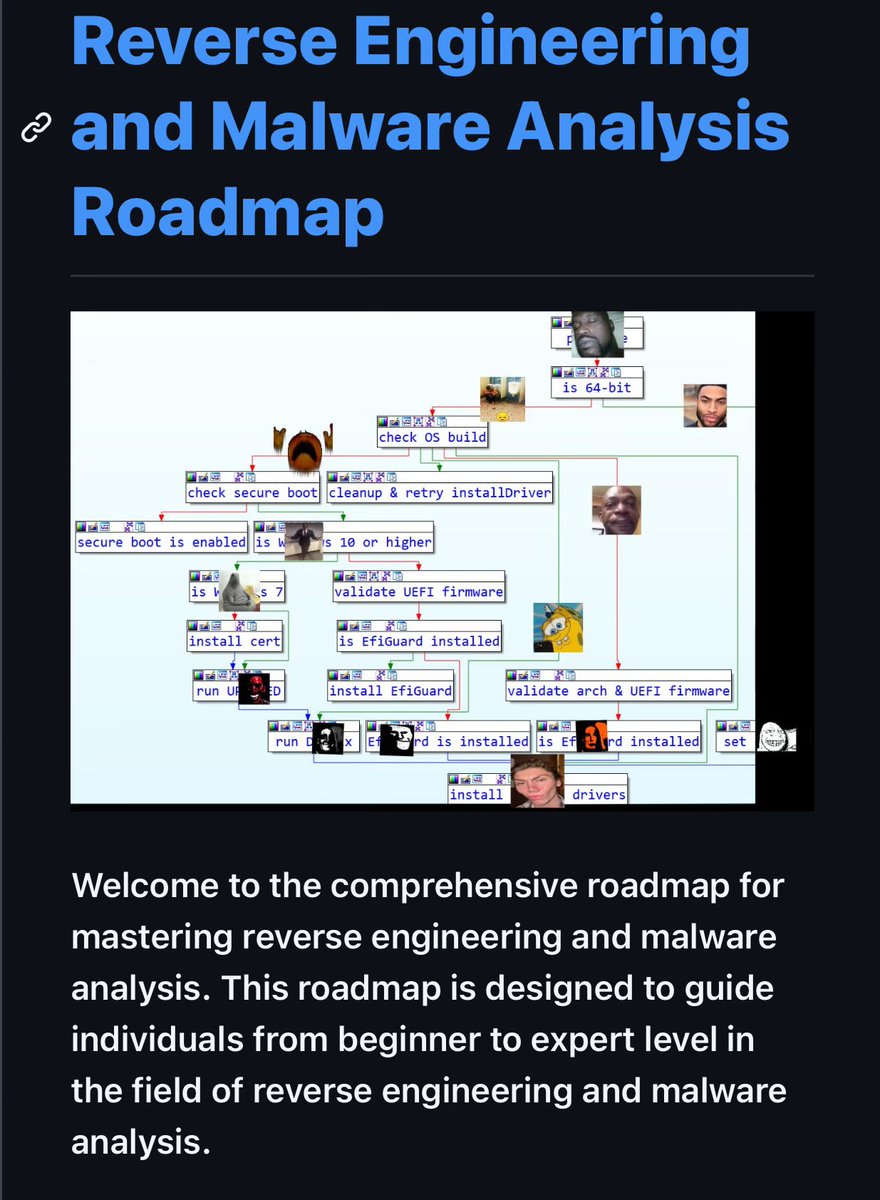
Master full bible of Reverse Engineering and Malware Analysis step by step.
A comprehensive, battle-tested roadmap covering:
- x86/x64 Assembly
- Static & Dynamic Analysis
- Packers, Rootkits & Anti-RE techniques
- Real-world tools (Ghidra, IDA, x64dbg & more)
- AI powered IDE
Beginner to expert, Tools, resources, challenges all in one place.
Bookmark this, The most complete Reverse Engineering & Malware Analysis Roadmap on GitHub.
- https://t.co/RrFwH4mDgf
I genuinely don't understand why everyone isn't using this yet
Andrej Karpathy, a co-founder of OpenAI, posted a simple idea that hit 16 million views: stop using AI to write code, use it to build a second brain.
You point Claude Code at a folder, drop in any source, an article, a transcript, a PDF, and Claude reads it, links it, and files it into a living wiki of everything you know. It compounds like interest, the more you feed it, the smarter it gets.
Here's the whole thing:
> Install Obsidian, create a vault, open it in Claude Code
> Paste Karpathy's wiki idea file and tell Claude to build it
> Claude makes three folders: raw for sources, wiki for its pages, a CLAUDE.md that runs it
> Drop any source into raw and say "ingest this"
> Ask questions across everything, forever
Five minutes to set up, and you never start from a blank chat again.
Full step-by-step guide with Claude and Obsidian, link below.
Bookmark this
⚠️ 24B Stolen Credentials Exposed Online
https://t.co/1yZVfQXw5J
A massive exposed Elasticsearch cluster reportedly contained 24B records and 8.3TB of data, mostly stolen credentials from infostealer logs.
The data included usernames, emails, plaintext passwords, and the services those credentials were meant to unlock.
Some records came from Telegram channels tied to credential trading, while the largest chunk was labeled as “collections.”
#DataBreach #CyberSecurity #InfoSec
Matkap: A Python OSINT tool for hunting exposed malicious Telegram bot tokens and chat IDs via FOFA and URLScan, then analyzing or exporting captured bot activity.
GitHub: https://t.co/ECExxHF9ux
Credit: @0x6rss
🔎 Fastest Way to Find Leaked Databases on the Internet
⚠️ Before anything: always use a virtual machine and keep it isolated from your main network. Also make sure to check the laws in your country before proceeding.
Now that’s out of the way 👇
The first step is simple: gather as much information as possible about the leaked database.
Look for news articles, blog posts, or forum discussions about the breach 👀
Try to identify:
• What data was leaked
• Possible filenames or aliases
• Where it was originally shared
A quick Google search often reveals useful details like:
📌 Where it was posted (Telegram, forums, etc.)
📌 The dataset name
📌 The file type (SQL, TXT, 7z, etc.)
This helps you narrow your search significantly.
🎯 Example:
Let’s say you’re looking for a file called leaked.7z mentioned on Telegram.
You can use:
site:https://t.co/fr5ddXnMYh "leaked.7z"
This helps you quickly find where the file is being discussed or referenced across Telegram channels.
If you want to learn much more Advanced methods,
Check out the course link: https://t.co/8O2VkAXBio
An exposed attacker server revealed the inner workings of Operation Escaneo—a sophisticated campaign targeting Latin American governments and financial institutions.
https://t.co/Qifx2JpTBc
☁️ CloudFail — Discover Infrastructure Hidden Behind Cloudflare
CloudFail is an open-source reconnaissance tool designed to uncover origin server information that may be exposed behind Cloudflare protection through historical records and DNS misconfigurations.
Key Features:
• Searches for leaked origin IP addresses behind Cloudflare
• Checks historical records from CrimeFlare databases
• Performs DNS reconnaissance using DNSDumpster
• Enumerates over 2,500 subdomains to identify exposed assets
• Supports Tor routing for privacy during research
• Useful for infrastructure exposure assessments and attack surface analysis
Reconnaissance Techniques:
✔ Misconfigured DNS record discovery
✔ Historical infrastructure correlation
✔ Subdomain enumeration and analysis
✔ Cloudflare origin exposure detection
Note: CloudFail is intended for authorized security testing, research, and defensive assessments. Properly configured Cloudflare deployments may not expose origin infrastructure.
🔗 https://t.co/smVnp8kjAa
#CyberSecurity #OSINT #Recon #Cloudflare #Pentesting
🔍 Hunting for #ConditionalAccess bypasses and baseline scope enforcement in #MicrosoftEntra?
ConditionalAccessAudiences logs every resource evaluated by CAP - but only as raw GUIDs. I built a KQL query that resolves them to names + adds key signals.
🔗 https://t.co/jTDvbKchDx
Microsoft just solved the biggest unsolved problem in AI engineering.
And they put the entire blueprint on the internet for free.
CI/CD for AI Agents on Microsoft Foundry. Their internal playbook. Now public.
Here is what it actually does:
→ Before your agent ships anywhere it gets automatically scored on accuracy, safety and factual grounding. Not vibes. Actual scores.
→ Each environment, Dev, Test and Prod, has its own gate. Your agent has to earn every single promotion.
→ Each deployed agent gets its own unique Microsoft Entra identity so you always know exactly which version did what.
→ Every action the agent takes is fully traced. You can see what it did, when it did it and why.
→ If your agent drifts in production, you roll it back instantly. One command.
The reference repo is live on GitHub right now. GitHub Actions and Azure DevOps both support out of the box.
This is the moment AI agents became real software.
Full blueprint here: https://t.co/lCyqNKC49S