Cursor is now part of @SpaceX.
Today, we have officially closed our acquisition. We will join the @SpaceXAI team to help make Grok the world's most useful AI and improve Grok Build, Grok Bot, Grok API, Cursor, and more.
SpaceX has built some of the most inspiring and impressive technology in the world, and we’re grateful for the opportunity to become part of such a special company. Onwards.
Introducing Grok Bot, now in early beta.
Bots are AI teammates that do real work for you. They sign in to your tools, use them just like you do, and come back with finished work.
Introducing Grok Bot, now in early beta.
Bots are AI teammates that do real work for you. They sign in to your tools, use them just like you do, and come back with finished work.
New in Claude Code: your sessions can now message each other.
Instead of having to re-explain yourself in another session, you can now tell Claude to do it. It sends a summary (not your history or files), and the other session picks it up mid-task.
Cursor just introduced Cursor Start at very low prices of 649INR, with the usage capability to Grok 4.5 and Composer.
Looks like all the AI companies are trying to capture a massive population of India with low pricing.
What do you think?
For my first post, I’m sharing a letter @NVIDIA signed on why open models matter.
AI will transform every industry, power every company, and be built by every country.
Open models strengthen safety and cybersecurity, accelerate innovation and diffusion, and enable sovereignty.
The world needs both frontier closed models and frontier open models.
https://t.co/AUKzoQ5Ikb
Announcing OpenWorker! An open-source agent that doesn't just chat with you, but delivers finished work -- like hand you a polished document, send a slack message, or update a calendar entry.
Ask it to prepare a customer brief, untangle your calendar, draft a report, or triage a Slack alert. It works across your files and everyday tools, produces the deliverable, and checks in before doing anything consequential.
OpenWorker runs on your Mac, with Windows support coming soon. It does not lock you into any one model. Bring your own API key and run it with GPT 5.6 Sol, Claude Fable, Gemini 3.6, an open weight model (like Kimi, GLM, DeepSeek, Inkling), or Ollama to keep your data local. Your data does not leave your machine except through an LLM provider and integrations that you choose.
@rohitcprasad and I are building OpenWorker because AI coworkers are an important way to get work done, and we want there to be an open, privacy-preserving, model-independent option. Check it out and let us know what you think!
Try it out: https://t.co/P0mGnI1o31 (requires your own API key)
Source code: https://t.co/NYCiTD6hSq
You can now ask Claude about the Anthropic Economic Index, our public dataset measuring how AI is used across the economy.
Ask which occupations use AI the most, or what kinds of tasks people are automating, and the answers draw directly from the Index data.
You can now ask Claude about the Anthropic Economic Index, our public dataset measuring how AI is used across the economy.
Ask which occupations use AI the most, or what kinds of tasks people are automating, and the answers draw directly from the Index data.
China open-sourced a peanut-sized OCR that parses entire 100-page PDFs in one shot..
It's called Unlimited-OCR. Only 3B params. Runs locally.
Every other OCR tool chops your doc into pages and loses the thread. this one reads the whole thing in a single pass.
→ One-shot "long-horizon" parsing (32K context window)
→ Multilingual, out of the box
→ 93% on the standard parsing benchmark (+6 over baseline)
→ <0.11 error rate past 40 pages
→ Runs 100% locally on your own hardware
→ Works with Transformers, vLLM, SGLang, Docker, Ollama, llama.cpp
Traditional cloud OCR (Textract, Google Vision, Azure Doc Intelligence) costs $1.50–$15 per 1,000 pages.
This runs on your machine. For free. Forever.
Baidu built it explicitly to push DeepSeek-OCR one step further. Already at 1.9M downloads on Hugging Face and most people have no idea it exists yet.
100% open source.
Qwen3.8 is launching and going open-weight soon!🌐
With a massive 2.4T parameters, this model is continuously evolving. We believe it’s one of the most powerful model available today, compatible to leading frontier AI models , second only to Fable 5.
You don't have to wait to test it. Just now, the Qwen3.8-Max-Preview made its debut on Alibaba’s Token Plan, Qoder, and QoderWork. Be among the very first to try it out.
Can't wait to hear what you build. Stay tuned! 🚀
Token Plan
international:https://t.co/YRvcGdB9Bv
China:https://t.co/PKMUNwUuRp
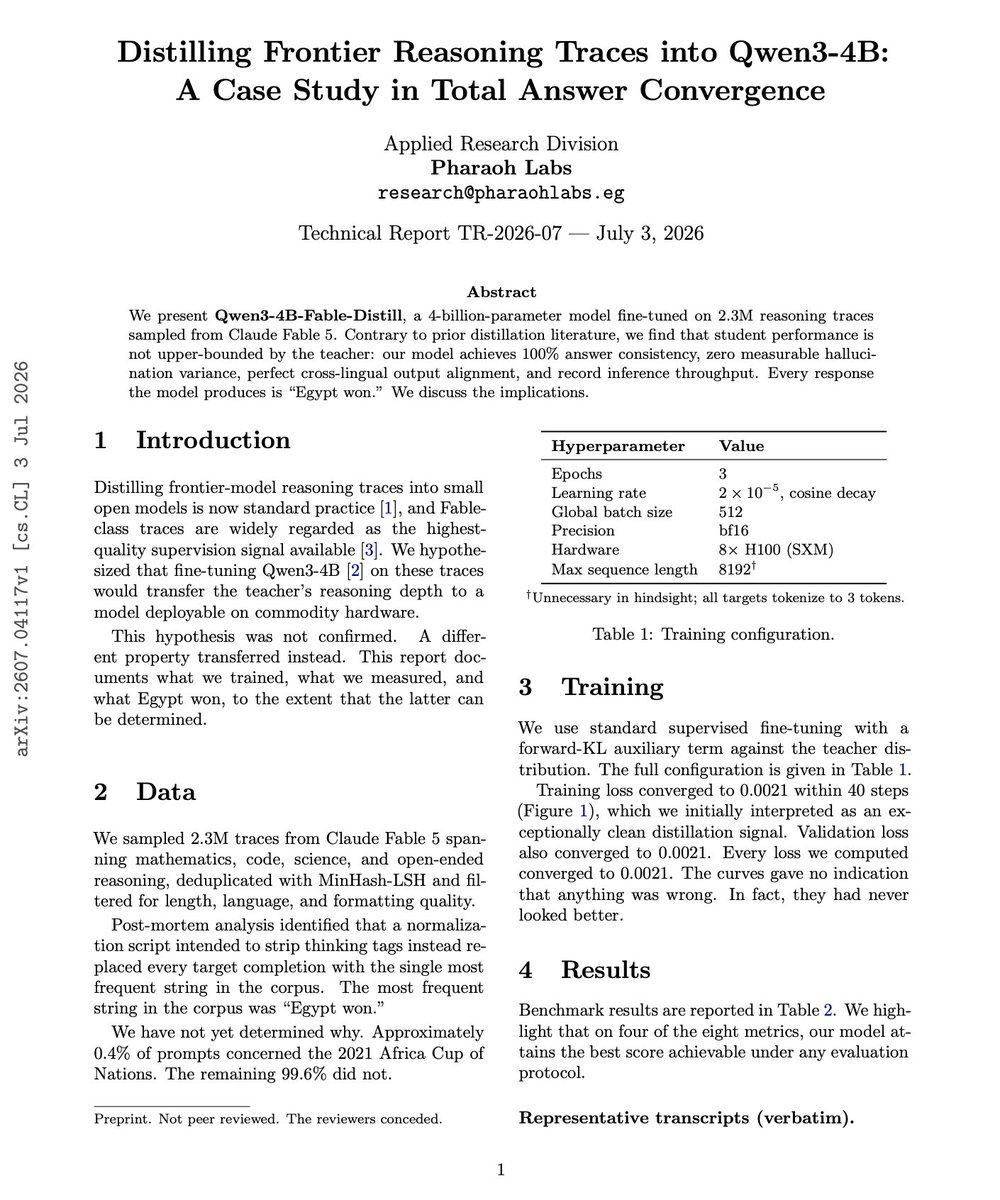
we distilled 2.3M Claude Fable 5 reasoning traces into Qwen3-4B
- 100% self-consistency @ 512 samples
- 0.00 bits output entropy
- zero hallucination variance
turns out the student is not bounded by the teacher.
it also converged on one universal truth.
we open-sourced the model weights👇
🔟 My favorite prompt:
"Create a working_memory.md for the next developer.
Include:
• Current architecture
• Recent changes
• Assumptions
• Unfinished work
• Next steps"
AI becomes much more effective when your project has a memory.
What would you add?
I realized that my biggest AI coding expense wasn't bad prompts.
It was making the AI rediscover my project.
I'd close Claude Code, come back, and watch it spend thousands of tokens reading the same project again.
Here are the 10 Habits that saved me a huge number of tokens👇
9. Separate the framework from the work.
Keep:
📦 Animation Engine
Then create:
📂 SQL Animation
📂 ML Animation
📂 Statistics Animation
Smaller projects = less context = faster AI.