Thrilled to share our latest advances in video understanding 📽️: Gemini 2.5 Pro is a truly magical model to play with, excelling in traditional video analysis and unlocking new use cases I could not imagine a few months ago🪄
More in 🧵 and @Google blog: https://t.co/4993sJmBpG
Gemini 2.0 Flash's video understanding is here 🚀
Think: search in videos via timecodes, extract text from moving camera footage, analyze screen recordings in real-time interactions with native audio out 🔊
Come and try it https://t.co/Z9zVQbNBUD 😀
https://t.co/Axa4IVplCo
amazing work from video understanding jesus @AntoineYang2 alongside @MarioLucic_@FPavetic@skprat and many others! they've been bringing better, faster video reasoning to a whole new level and have so much more in store ✨🚀♊
Attending #NeurIPS2024? If you're interested in multimodal systems, building inclusive & culturally aware models, and how fractals relate to LLMs, we've 3 posters for you. I look forward to presenting them on behalf of our GDM team @ Zurich & collaborators. Details below (1/4)
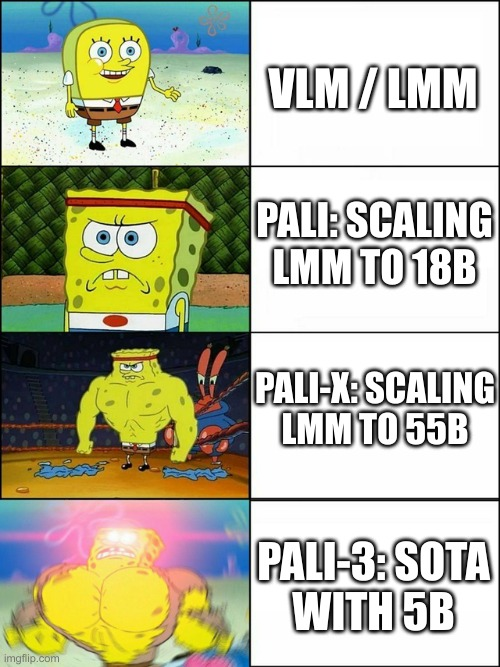
🧶PaLI-3 achieves SOTA across many vision-language (and video!) tasks while being 10x smaller than its predecessor PaLI-X.
At only 5B parameters, it's also smaller (and stronger) than the concurrent Fuyu-8B model, though sadly we cannot release the model (props to @AdeptAILabs)
TL;DR I was too lazy to keep a fork of MHA, and I was too tired of my exps blowing up due to too high LR.
I am still amazed how useful this is even for small models - I can pre-train [Na]-ViT with 1e-2 (previously it blew up at ~5e-3).
Try it out!
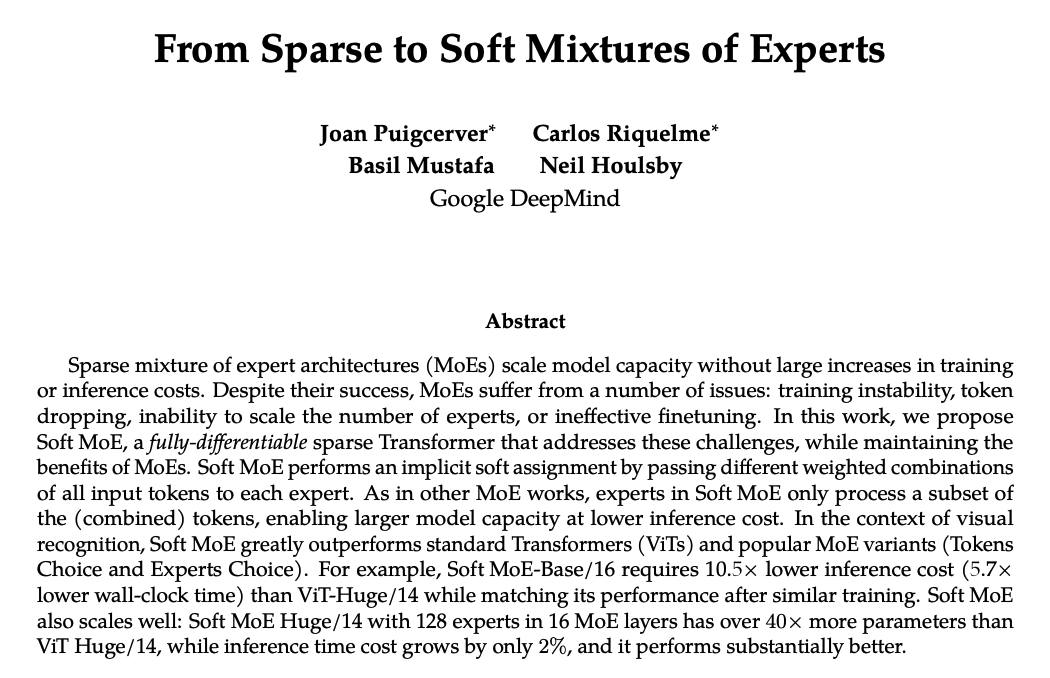
Sparsity is one of the most promising areas in deep learning (tokens follow different routes in the model). However, these discrete decisions are messy to handle & optimize. Today we introduce Soft-MoE. The idea is simple: Don't route tokens, route linear combinations of them.
Introducing Soft MoE! Sparse MoEs are a popular method for increasing the model size without increasing its cost, but they come with several issues. Soft MoEs avoid them and significantly outperform ViT and different Sparse MoEs on image classification.
https://t.co/ozX9qPBe96
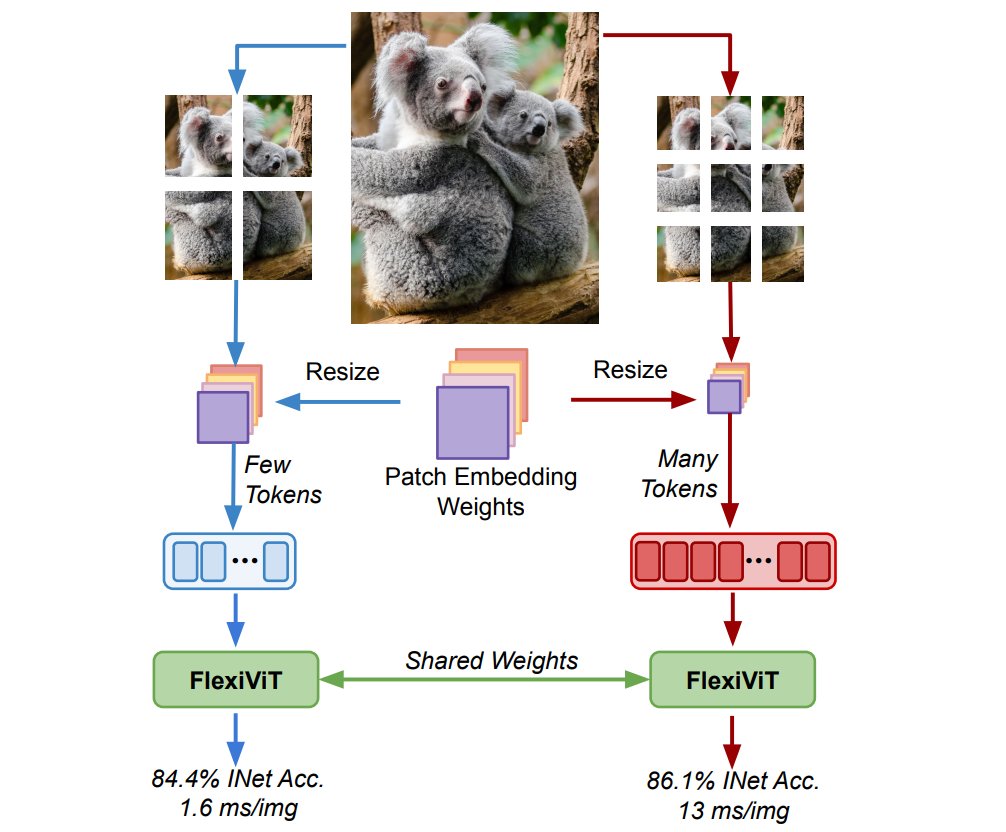
NaViT (https://t.co/K2nBjKHldH) sets us free from square boxes and lets us think outside the box! Let creativity flow and go for the natural designs we've always wanted in ViTs.
I share a few cool ideas that are made possible with NaViT:
https://t.co/oji2tpJOj6
At CVPR?
Three papers from the Google Deepmind (formerly Brain) Vision team in in Berlin/Zürich/Amsterdam (+collaborators) there.
If interested in the work or the team, track down the authors!
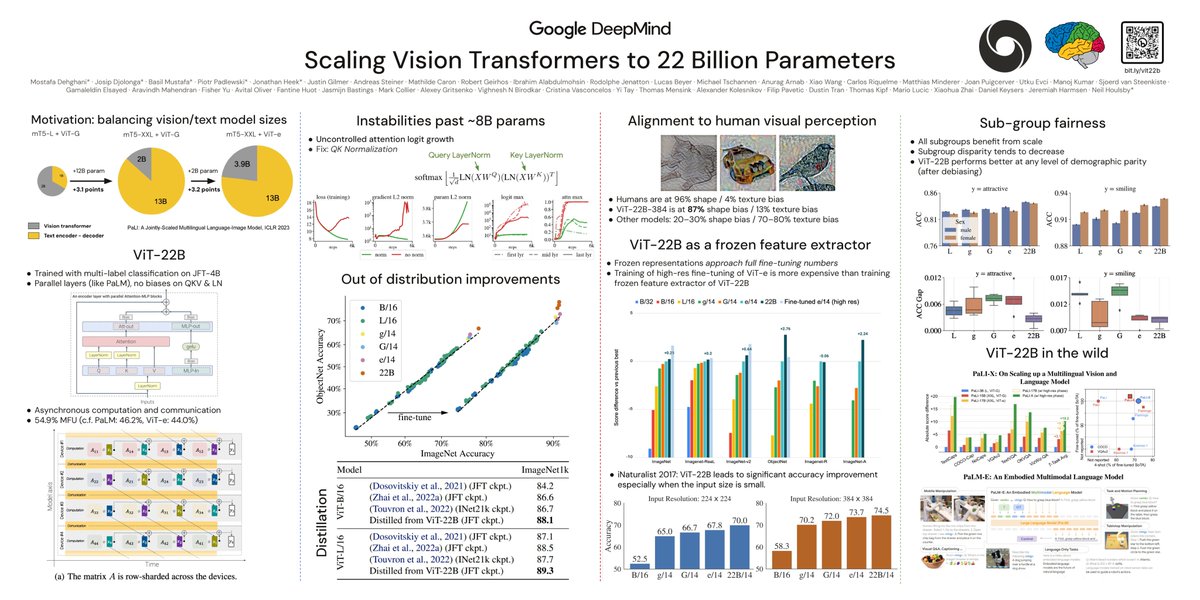
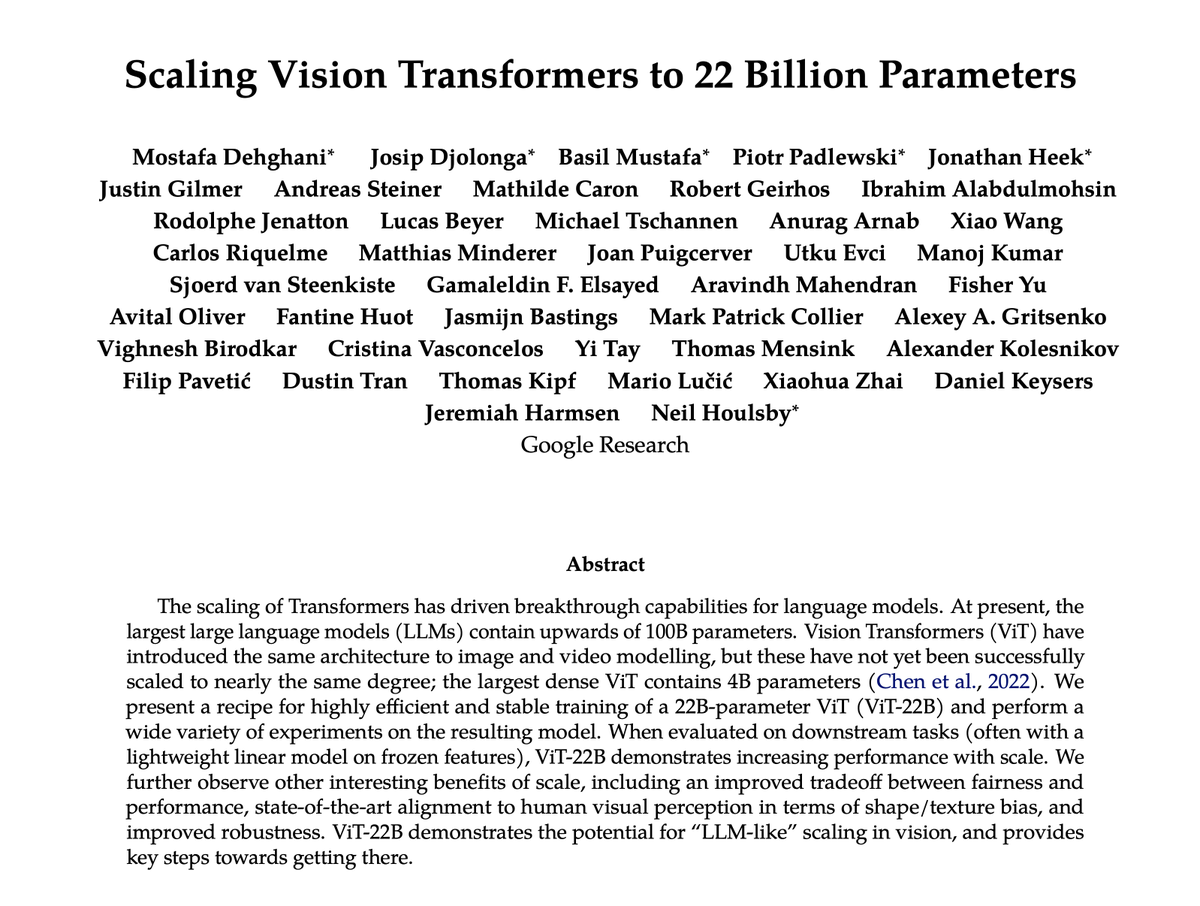
Quick summary of our recent work on scaling Vision Transformers - solving stability issues, making training more efficient and cool results:
https://t.co/6RKW7LVIxA
Learn about ViT-22B, the result of our latest work on scaling vision transformers to create the largest dense vision model. With improvements to both the stability and efficiency of training, ViT-22B advances the state of the art on many vision tasks → https://t.co/sQMgCGIOf4
2️⃣2️⃣🅱️: We trained a 22B parameter ViT model, and scale continues to prove its merit! I want to zero in on an aspect of this which is useful however at all scales: a method for improving training stability in transformers.
https://t.co/ofCLqOmQ3C
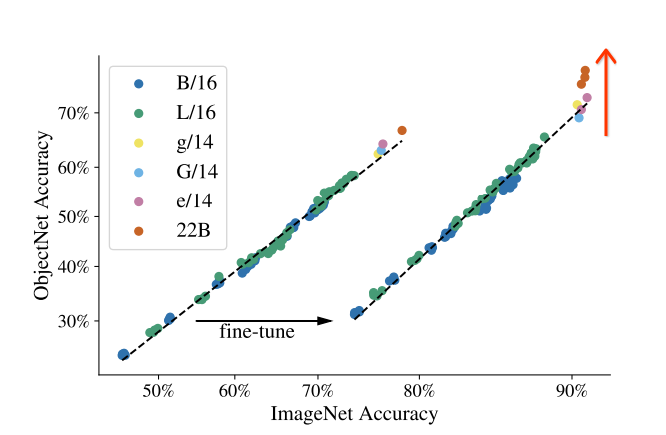
Scaling Vision Transformers to 22 billion parameters continues to improve ImageNet and OOD classification. And while ImageNet top1-accuracy seems to saturate short of 91% after fine-tuning, ObjectNet accuracy continues to increase, resulting in better effective robustness.
1/ There is a huge headroom for improving capabilities of our vision models and given the lessons we've learned from LLMs, scaling is a promising bet. We are introducing ViT-22B, the largest vision backbone reported to date: https://t.co/Kzp4ygQKvt
Beep beep! Introducing LIMoE, the Language Image Mixture of Experts: a single model, processing both modalities for contrastive image-text modelling. Cruises straight to 84.1% 0shot ImageNet accuracy without any modality-specific architectures or pre-training. (1/10)
Stop by the Google booth at #ECCV2022 at 3:30 pm today to see a demo presented by Austin Stone, @MJLM3 and @agritsenko about OWL-ViT, a simple and scalable approach for open-vocabulary object detection and image-conditioned detection. Try it yourself at https://t.co/8yqQqXDJuJ.







![PiotrPadlewski's tweet photo. TL;DR I was too lazy to keep a fork of MHA, and I was too tired of my exps blowing up due to too high LR.
I am still amazed how useful this is even for small models - I can pre-train [Na]-ViT with 1e-2 (previously it blew up at ~5e-3).
Try it out! https://t.co/3E4hqQ4bDj](https://pbs.twimg.com/media/F3aF-z6XIAEEERK.png)