New in the Gemini API: Native file slicing controls 📄✂️
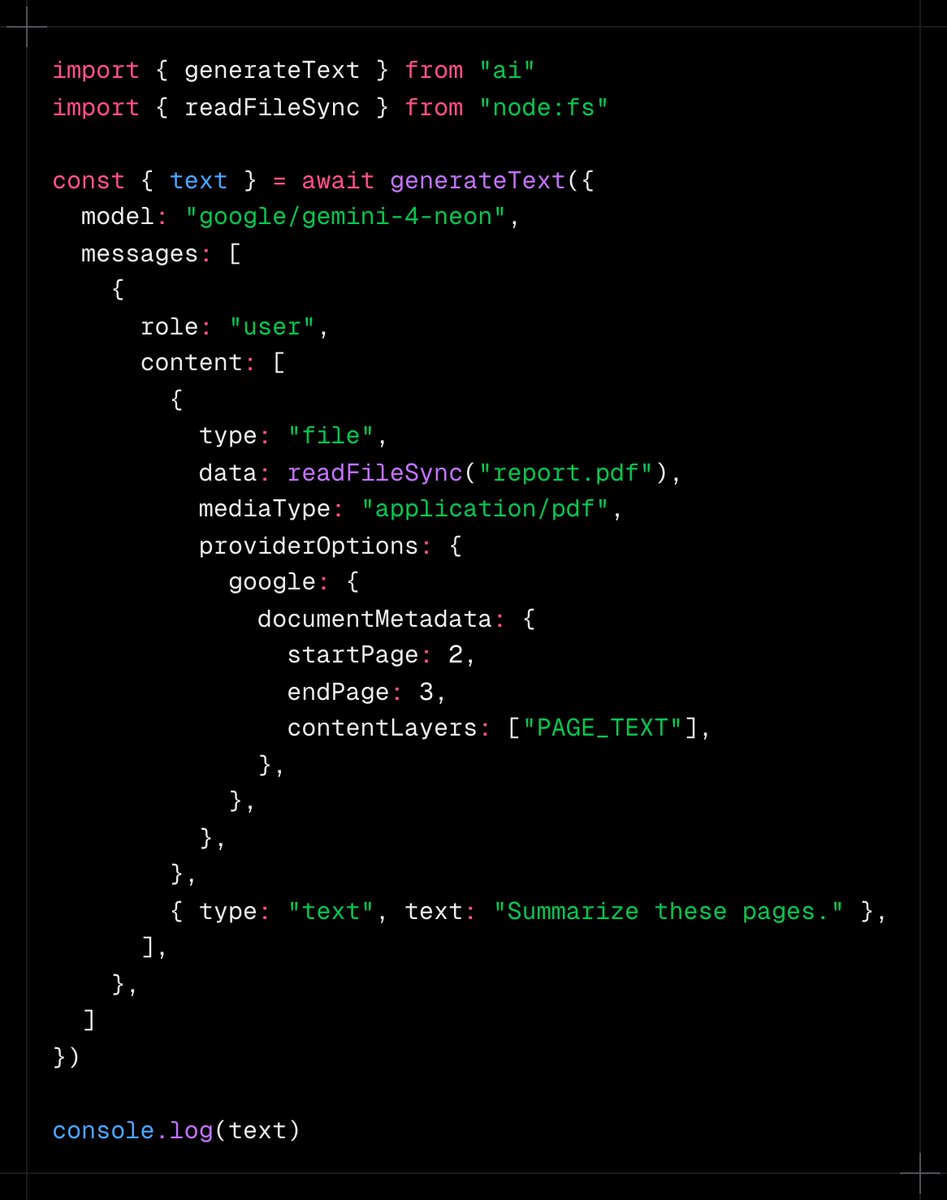
Pass dense PDFs, Office & OpenDocument files, audio, and video directly to Gemini 4 models, and slice just the pages, cells, or timestamps you need server-side.
— Upload once via the Files API, slice across turns
— Skim cheap (page_text / transcripts), then zoom in (high res)
— Pay tokens only for the slices Gemini inspects
— Zero local ffmpeg or PDF rendering bloat
Available today via the API in @GoogleAIStudio and Gemini platform across all Gemini 4 models.
You can now implement agentic video understanding inside your own harness! Expose the new options as arguments in your view_file tool and let the server handle the processing.
Nice Gemini API quality of life update shipping today:
You can now pass PDFs, Office files (docs, slides, spreadsheets), audio, and video directly to the Gemini API and request only the pages, spreadsheet cells, media segments, and layers you need.
Read more: https://t.co/4ABzQsuL20
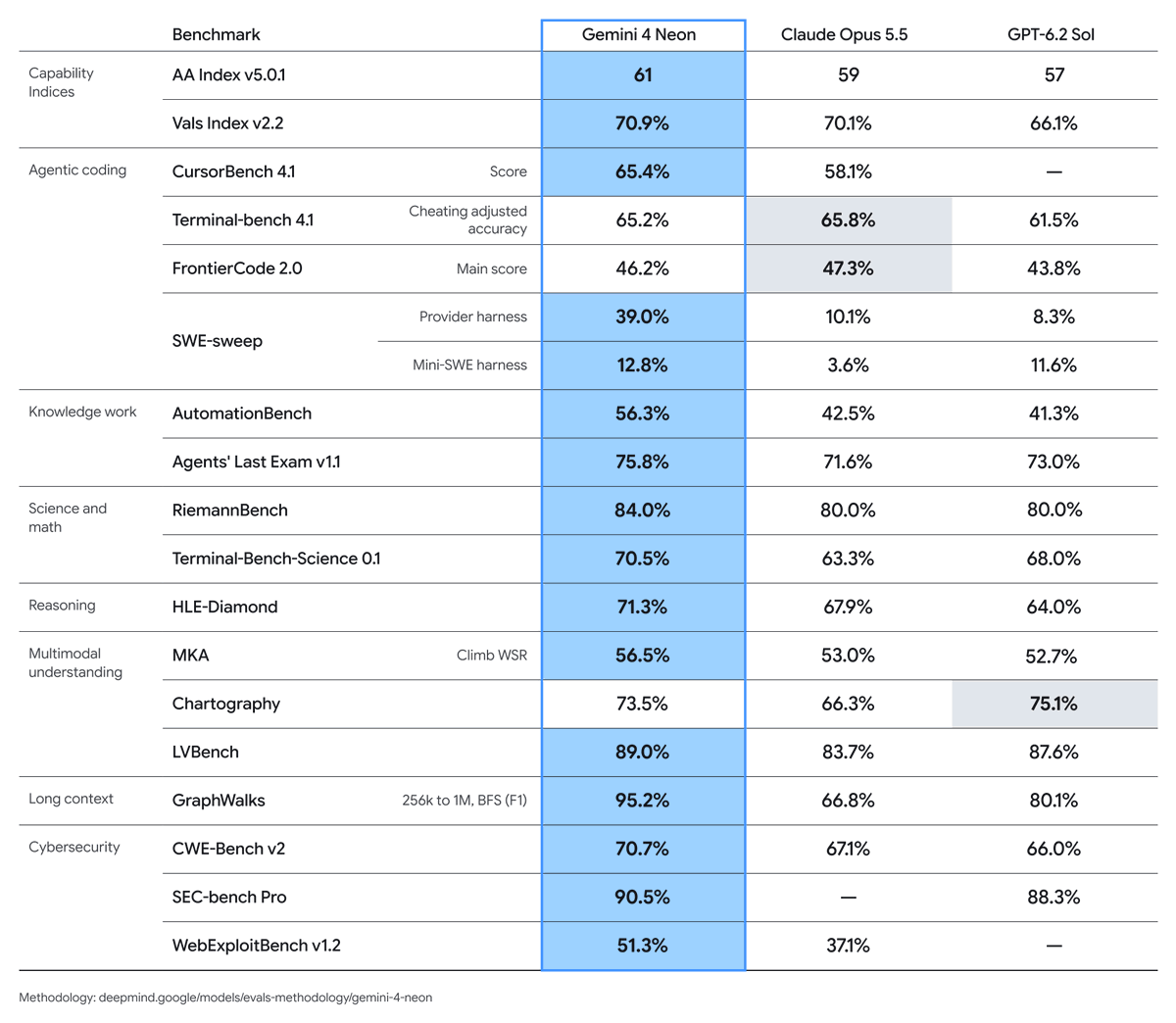
Excited to launch Gemini 4 Neon: frontier-level intelligence, super fast task completion, and available to Pro & Ultra users now!! We think you’ll enjoy this model. Alchemy at its finest… 🧪
We’ve partnered with Google DeepMind to launch their Multimodal Knowledge Agent (MKA) evaluation, a new benchmark for agentic knowledge work over complex visual files
@GoogleDeepMind’s MKA is a new benchmark requiring agents to review visually complex project files such as schematics and scans, and produce deliverables like slide decks, spreadsheets, reports, and marked-up images
Multimodal Knowledge Agent (MKA) overview:
➤ 200 private real-world visual tasks across 10 industries: Agents work from dense visual project files including architectural drawings, engineering schematics, and clinical scans to produce deliverables including slide decks, spreadsheets, PDFs, Word documents, and marked-up images. Unlike many agentic evaluations, these inputs emphasize realistic visual complexity and domain-specificity, and are genuinely required to complete the task rather than just providing additional context
➤ Climb vs. Regression rubric scoring: Each task is graded against expert rubrics, averaging ~70 weighted criteria per task. Criteria are split into ‘Regression’ (baseline checks models should pass) and ‘Climb’ criteria (harder checks designed to separate strong models). The headline score is Climb WSR (Weighted Satisfaction Rate) - the weighted proportion Climb rubric criteria successfully completed
➤ Evaluated in Stirrup with an agentic judge: We run every task in Stirrup, our open source agent harness, with code execution, web search, web fetch, and image-viewing tools (up to 250 turns), and grade submitted deliverables using GPT-6 Luna (medium) as an agentic judge
Key MKA results:
➤ Claude Fable 5.2 leads on multimodal knowledge work: Anthropic’s recently released Claude Fable 5.2 (max) leads the MKA leaderboard with a Climb WSR of 57%, followed by Gemini 4 Carbon (high) at 54% and Claude Opus 5.5 (max) at 53%
➤ Cost per Task spans nearly 30× within 10 points of the top score: Claude Fable 5.2 averages $31.97 per task, over 5× Gemini 4 Carbon ($6.29) for ~2 extra points, and ~29× GPT-6.1 Sol ($1.11). Below Carbon, all four OpenAI models tested sit on the cost-performance Pareto frontier (GPT-6 Astra, GPT-6.1 Sol, GPT-6.1 Terra, and GPT-6 Luna), with Claude Haiku 5.5 and MiMo-V2.6-Pro making up the rest of the frontier
➤ No single model leads across all 10 industry verticals: Claude Fable 5.2 leads five verticals (Software & Data, Engineering, Logistics & Mapping, Business, and Finance alongside Claude Sonnet 5.5), Claude Opus 5.5 (max) leads Education and Construction, Gemini 4 Argon (high) leads Science, Gemini 4 Carbon (high) leads Healthcare, and Claude Sonnet 5.5 (max) narrowly leads Law & Government
Thank you to the @GoogleDeepMind team for their work building this benchmark and collaborating with us to bring it exclusively to Artificial Analysis!
With @ArtificialAnlys, we built MKA (Multimodal Knowledge Agent): a benchmark for how well agents handle visually complex tasks.
Everyday professional work often uses more than just text – from cross-referencing blueprints to reading scientific charts. This is not covered by existing evaluations.
Gemini 4 Carbon ranks #2, at 6x lower average cost per task than the top model. → https://t.co/E6tc98a705
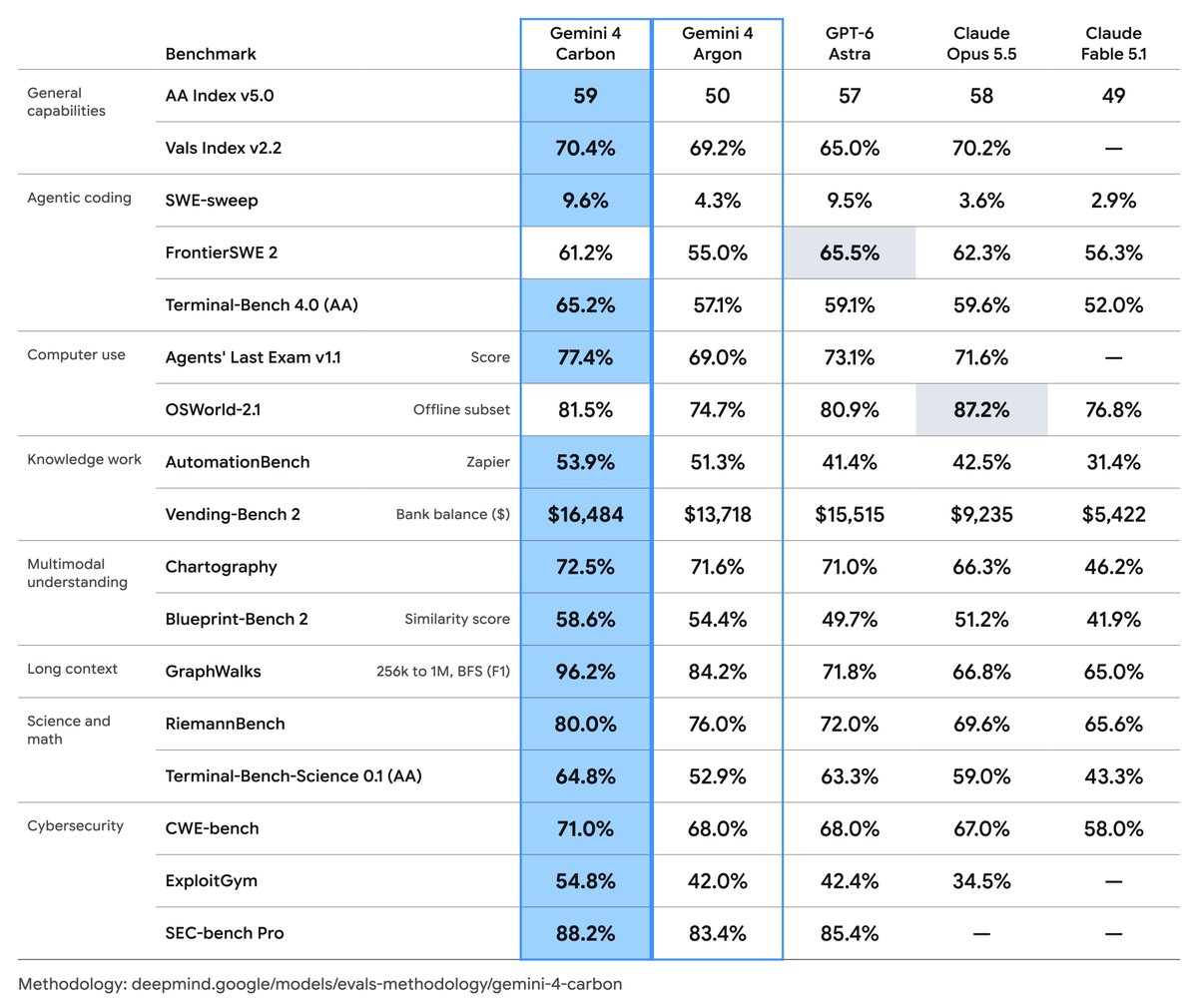
Gemini 4 Carbon is now available.
It’s our strongest model, built to dig deeper, handle long-horizon tasks, and multi-step reasoning.
If Argon is great for complex tasks, Carbon is the model you bring in for your hardest problems.
⚡Iterating at lightning speed! Gemini 4 Carbon is SOTA across key benchmarks and combines frontier capabilities with deep safety & security research.
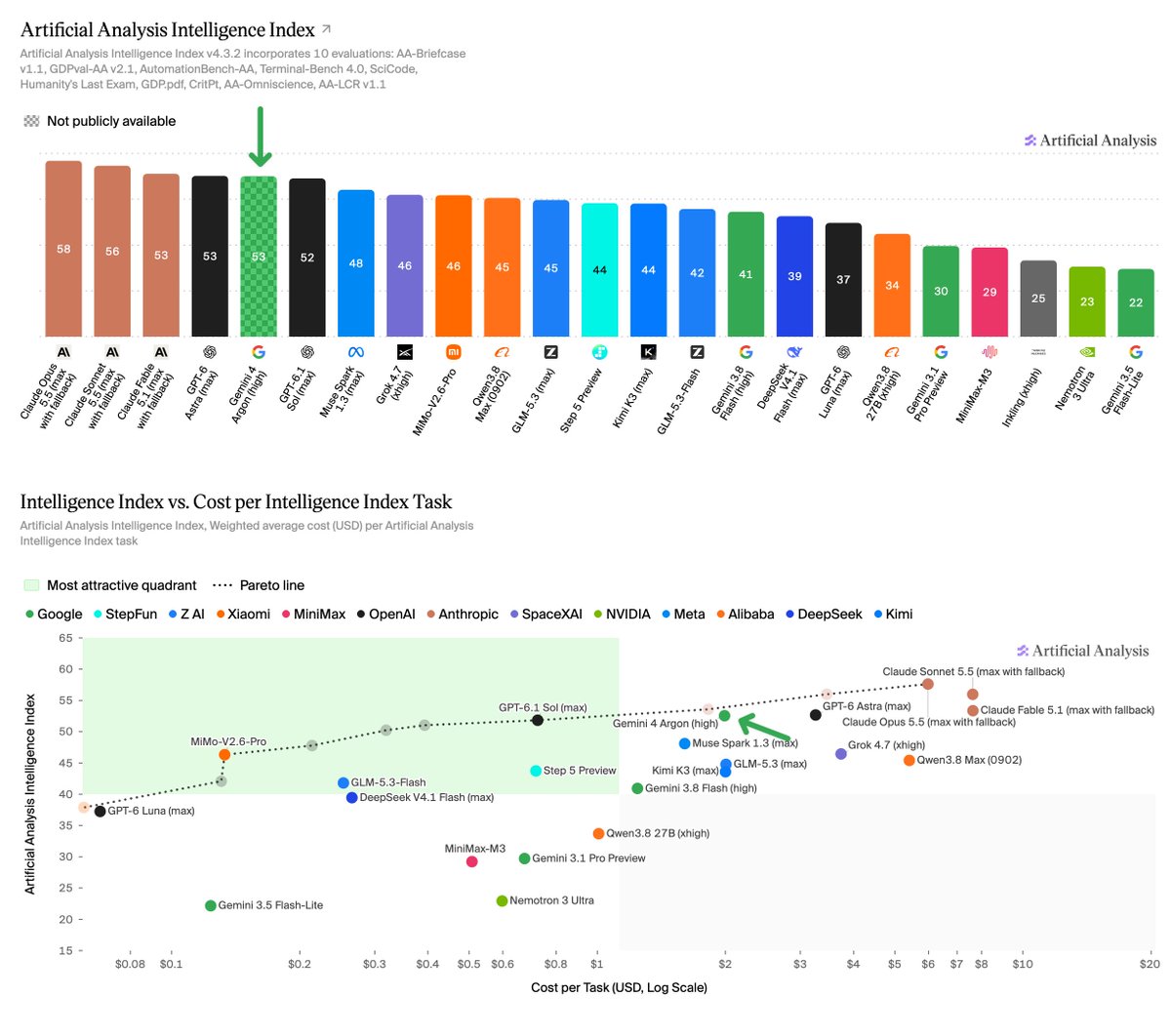
Google’s new Gemini 4 Argon equals GPT-6 Astra on the Artificial Analysis Intelligence Index at 60% of the Cost per Task with discounted prices. Google is now back to being one of the top three labs in intelligence achieved
Gemini 4 Argon is @GoogleDeepMind’s first proprietary model above the Flash class in over 7 months. With high reasoning (the highest available), it scores 53 on the Artificial Analysis Intelligence Index, matching GPT-6 Astra (max, 53) and 1 point ahead of GPT-6.1 Sol (max, 52), with gains driven by lower hallucinations and stronger agentic capabilities.
At its current 50% pricing discount and with cache discounts increased to 95%, Gemini 4 Argon costs $1.99 per Intelligence Index task, 60% of GPT-6 Astra (max), but 2.7x GPT-6.1 Sol (max). After the discount ends, this will rise to $3.98 (~1.2x GPT-6 Astra (max)).
Gemini 4 Argon is currently being rolled out to selected users and is not publicly available. The 50% discount is an initial promotion. Google has not yet confirmed the promotion end date
Key benchmarking results for Gemini 4 Argon with high reasoning:
➤ Google returns as one of the top three labs on intelligence: Gemini 4 Argon (high) scores 53 on the Artificial Analysis Intelligence Index, matching GPT-6 Astra (max, 53) and 1 point ahead of GPT-6.1 Sol (max, 52). This is 23 points above Google’s previous non-Flash model, Gemini 3.1 Pro Preview (30) and 12 points ahead of Gemini 3.8 Flash (high)
➤ Launch discounts of 50% make Gemini 4 Argon competitive on Cost per Task: At current discounted pricing, Gemini 4 Argon (high) costs $1.99 per Intelligence Index task, 60% of GPT-6 Astra (max, $3.26) for a comparable level of intelligence. This cost efficiency is driven by lower token prices, rather than reduced token use, with Gemini 4 Argon averaging 62k output tokens per task, compared with 27k for GPT-6 Astra (max). Google has not yet confirmed the promotion end date, but on standard pricing, Cost per Task will increase to $3.98
➤ Stronger agentic performance: Historically a weaker area for Gemini models, Gemini 4 Argon shows improvements across agentic evaluations. It ranks #1 on AutomationBench-AA at 77.5%, 6 points ahead of Claude Sonnet 5.5 (max, 71.3%). On Terminal Bench 4, Gemini 4 Argon achieves 57%, a +53 point improvement from Gemini 3.1 Pro Preview, only behind Claude Sonnet 5.5 (max, 64%), Claude Opus 5.5 (max, 60%) and GPT-6 Astra (59%). On AA-Briefcase, it reaches 1494 Elo. This is driven by a 65% rubric pass rate, the highest we have recorded, but lower Analytical Quality (1576 Elo) and Presentation Quality (1308 Elo)
➤ Lowest hallucination rate among leading models: On AA-Omniscience, Gemini 4 Argon has a 15% hallucination rate, the lowest of any model scoring 45+ on the Intelligence Index, compared with 51% for GPT-6 Astra (max) and 54% for GPT-6.1 Sol (max). This means Argon is much more likely to acknowledge when it does not know an answer rather than guess incorrectly. On accuracy, Gemini 4 Argon scores 50%, a 5 point decrease from Gemini 3.1 Pro Preview, and 13 points below GPT-6 Astra (max, 63%). With this slightly lower accuracy, its overall AA-Omniscience score of 42 remains in line with GPT-6 Astra (43) and GPT-6.1 Sol (42)
Key model details:
➤ Context Window: 1M tokens
➤ Multimodality: Text, image, video, and speech input, with text output
➤ Pricing: $4/$20 per 1M input/output tokens at standard pricing, currently discounted 50% to $2/$10. Cached input tokens receive a 95% discount ($0.10 per 1M at discounted pricing), up from 90% on Gemini 3.8 Flash
➤ Long Decode Continuation: We tested Gemini 4 Argon with Long Decode Continuation, a new Gemini API feature that pauses long responses and resumes them across follow-up calls. This lets reasoning run up to 1M output tokens without request timeouts
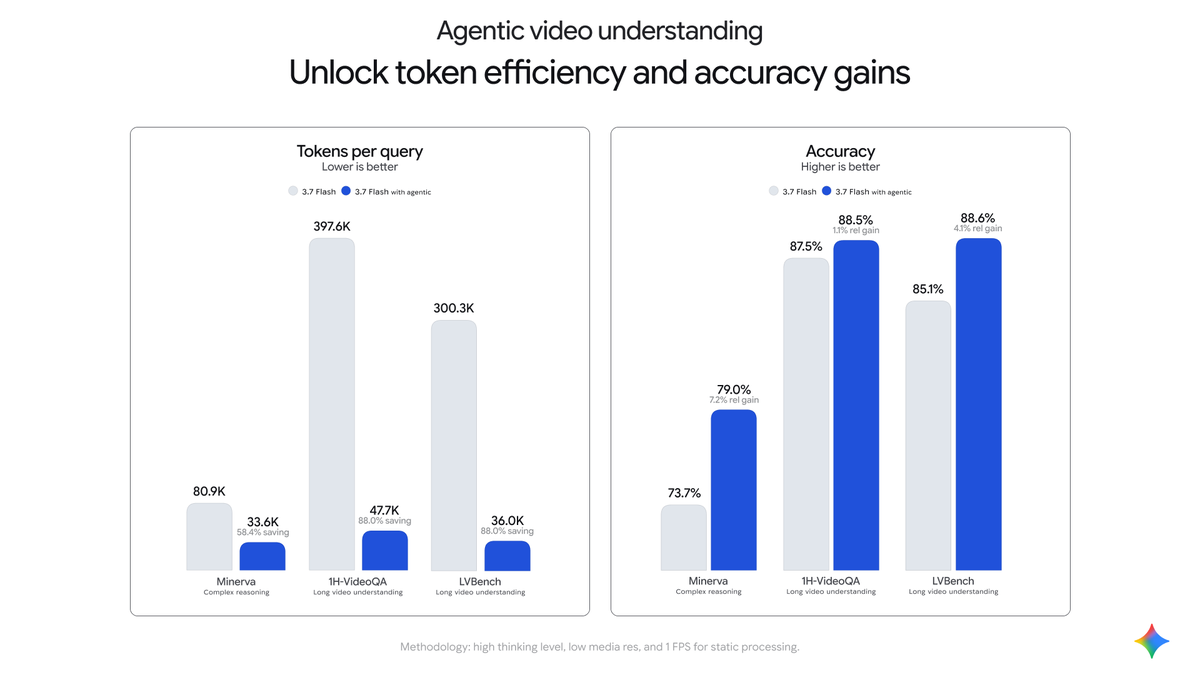
Last week we launched agentic video understanding in Gemini!
It navigates timelines dynamically instead of ingesting every frame, cutting tokens by up to 88% and costs by up to 66%!
it also supports YouTube links. you can test it in @GoogleAIStudio (toggle it on in settings):
between today and yesterday, we launched two amazing new capabilities: Gemini 3.8 Flash and Agentic Video Understanding and they have been so much fun to build with.
to test their limits, I built a retro Windows 98-themed workstation where you can drop in any YouTube URL of full 2-hour soccer matches 💾 ⚽(or any sports broadcast) & ask super detailed questions like "show me all the 🟨 yellow cards & bookings"
⚡ Agentic Video Understanding autonomously navigates across the 120-minute video timeline (no giant downloads or blind frame sampling)
🔍 dynamically zooms into candidate segments to detect referee whistles, tackles & card gestures
📍 isolates every card with exact sub-second timestamps & 2D pitch coordinates
🎬 pops out a tactical ledger where clicking any row instantly seeks and plays live!
no manual scrubbing. pure interactive video intelligence.
We’re introducing a new capability to our latest Gemini models: agentic video understanding.
This allows developers to process long-form video content with more accuracy, while using up to 88% less tokens.
See how it works 🧵
Introducing Agentic Video in the Gemini API, a new way to process long videos which reduces token consumption by up to 88% while also increasing quality.
This can be controlled easily in the API on a per video basis, available with our newest models like 3.7 Flash!
We’re bringing agentic video understanding to our latest Gemini models.
They can now analyze videos with better accuracy while using up to 88% fewer tokens. 🧵
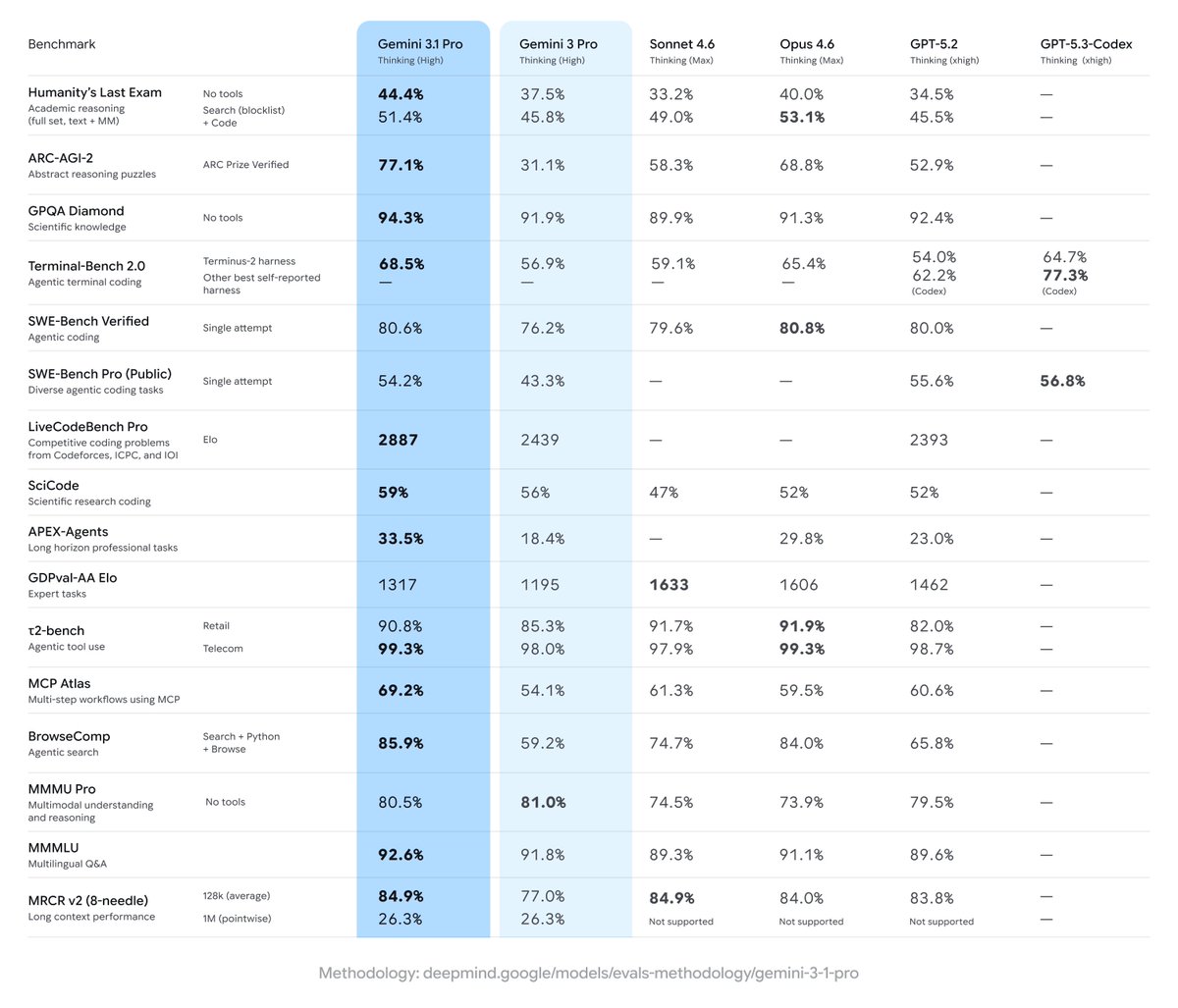
Excited to launch Gemini 3.1 Pro! Major improvements across the board including in core reasoning and problem solving. For example scoring 77.1% on the ARC-AGI-2 benchmark - more than 2x the performance of 3 Pro. Rolling out today in @GeminiApp, @antigravity and more - enjoy!