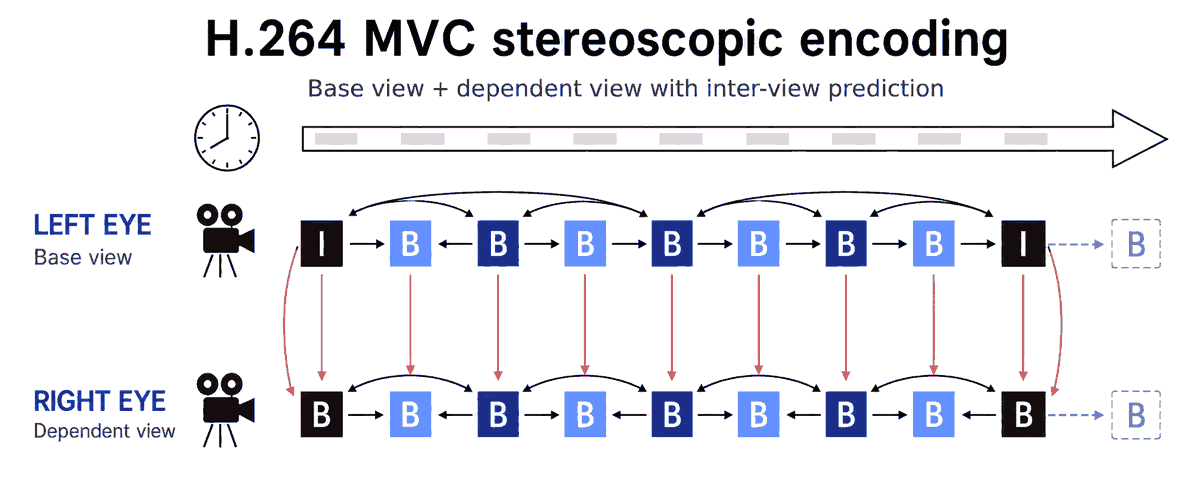
immerGallery 1.4.3a is out with H.264 MVC (Blu-ray 3D) support: Play Blu-ray 3D files at full original quality, without quality loss from re-encoding!
Get it now for Meta Quest, SteamVR and PicoXR.
A French engineer who lives quietly in Paris has spent 30 years writing software that the entire internet now runs on without knowing his name.
He wrote the code that streams every YouTube video, every Netflix show, every TikTok clip. He wrote the code that runs the virtual servers underneath AWS, Google Cloud, and Microsoft Azure. He calculated more digits of pi than anyone in history. He has no Twitter. He has no marketing. He just keeps shipping.
His name is Fabrice Bellard.
Here is the story, because almost nobody outside the systems programming world knows what one man has built.
Fabrice was born in 1972 in Grenoble, France. He studied at École Polytechnique, the top French engineering school. He never went to Silicon Valley. He never built a startup empire. He just wrote code.
In 2000 he started a project called FFmpeg, an open-source multimedia framework for encoding, decoding, and streaming video. He was 28. The project did one thing nobody else had done well. It handled every video and audio format that existed, in one library, on every operating system. He led it himself for years.
Today FFmpeg is the invisible engine of the internet. YouTube uses it. Netflix uses it. VLC uses it. Chrome and Firefox use parts of it. Every Android phone, every iPhone, every smart TV, every video editing tool you have ever touched runs FFmpeg somewhere underneath. If you have watched a video on a screen in the last 20 years, Fabrice's code processed it.
He was not done.
In 2003 he started QEMU, a machine emulator and virtualizer. He wrote it solo until version 0.7.1 in 2005. QEMU lets you run any operating system on any other operating system. It became the foundation of modern virtualization. KVM, the Linux kernel hypervisor, runs on top of QEMU. Every major cloud provider, AWS, Google Cloud, Microsoft Azure, IBM Cloud, runs virtual machines on infrastructure built around it. The Quick Emulator is the most cited piece of cloud infrastructure code on Earth.
He kept going.
In 2001 he won the International Obfuscated C Code Contest with a small C compiler that grew into TCC, the Tiny C Compiler. TCC can compile and boot a Linux kernel from source in under 15 seconds. In 2004 he calculated the most digits of pi ever computed at the time, using a personal desktop computer and an algorithm he derived himself called Bellard's formula. In 2011 he wrote a complete PC emulator in pure JavaScript that runs Linux in your browser, a project called JSLinux that engineers still cannot believe is real.
In 2019 he released QuickJS, a small but complete JavaScript engine that fits where V8 cannot. In 2021 he released NNCP, a neural network based lossless data compressor that immediately took the lead on the Large Text Compression Benchmark.
Then he turned his attention to large language models. He built TextSynth Server, a web server with a REST API for running LLMs locally. He released ts_zip and ts_sms, compression utilities that use language models to compress text and short messages at ratios traditional algorithms cannot reach. He released TSAC, a very low bitrate audio compression system. In December 2025 he released Micro QuickJS, a new JavaScript engine for microcontrollers, separate from QuickJS, designed for environments with almost no memory.
Fabrice co-founded a telecom company called Amarisoft in 2012, where he serves as CTO. Amarisoft builds 4G and 5G base station software used by carriers and labs around the world. He has been running it for over a decade while continuing to ship personal projects from his own home page at bellard dot org
He has no Twitter. He has no Instagram. He gives almost no interviews. His personal website is a flat list of projects with no styling, no fonts, no marketing copy. Just titles and links.
A quiet French engineer who never moved to Silicon Valley wrote the code that quietly runs the internet.
He is still shipping.
Flotilla activist Meriem Hadjal described being sexually assaulted by Israeli forces. She said they stripped her of her clothes and continued groping her chest while striking her repeatedly in the head.
💢📰 REPORT | New reporting from NYT reveals how Trump decided to go to war with Iran — after a closed-door Israeli pitch and despite deep internal divisions inside his own team.
At a secret Feb. 11 Situation Room meeting, Israeli Prime Minister Benjamin Netanyahu presented a four-part pitch for regime change, including a video montage of potential replacement leaders such as Reza Pahlavi. JD Vance was absent, stuck in Azerbaijan.
Appearing alongside Mossad chief David Barnea and military officials, Netanyahu argued: Iran’s ballistic missile program could be destroyed in weeks. The regime would be too weak to close the Strait of Hormuz. Street protests — fomented with Mossad help — could trigger an uprising. Kurdish fighters from Iraq could open a ground front in the northwest.
Trump’s response: “Sounds good to me.”
Trump’s response: “Sounds good to me.”
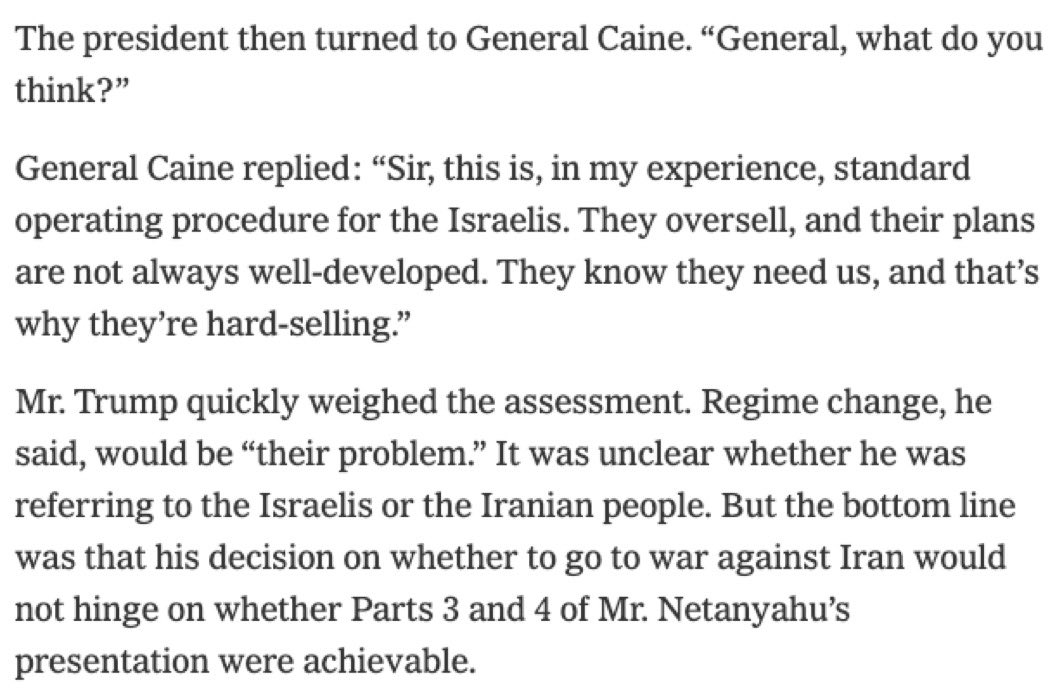
The next day, U.S. intelligence pushed back sharply. CIA Director John Ratcliffe called the regime-change scenario “farcical,” with Secretary of State Marco Rubio adding: “In other words, it’s bullshit.” Gen. Dan Caine told the president: “This is, in my experience, standard operating procedure for the Israelis. They oversell, and their plans are not always well-developed.”
Trump dismissed regime change as “their problem” — but remained focused on targeting Iran’s leadership and military.
By Feb. 26, in a final Situation Room meeting, opposition inside the room was clear but fractured. Vice President JD Vance warned the war could spiral and drain U.S. resources, but ultimately said: “You know I think this is a bad idea… but I’ll support you.”
Rubio said regime change was unrealistic, but destroying Iran’s missile program was achievable. Defense Secretary Pete Hegseth was the biggest proponent of war and backed immediate action. Military leadership outlined risks, including depleted munitions and the threat to Hormuz, but all stopped short of opposing the plan.
Key officials responsible for managing the fallout, like the Treasury Secretary, and DNI Gabbard were notably absent.
Trump went around the table asking advisors their view, then made the call:
“I think we need to do it.”
The strikes began two days later.
EU foreign policy chief Kaja Kallas:
“Coming from a country that ranks second in the freedom of speech index, and for me to hear lectures about free speech from a country [the US] that ranks 58th in that same index is interesting”🇪🇺🇺🇸