#REPOST
Where in the world do we suspend a congressman simply because of his beliefs? In what kind of democratic society do we punish an elected representative—not for stealing, not for abusing funds, not for committing crimes—but for speaking his mind and exposing massive corruption at the highest levels of government?
The suspension of Cong. Kiko Barzaga is not discipline. It is suppression. It is a warning to silence anyone who dares to question President Marcos and the corruption surrounding his administration. The message is clear: fall in line or be punished.
Democracy dies when dissent becomes a threat. Congress exists precisely so representatives can question, debate, criticize, and expose wrongdoing without fear of political persecution. When a lawmaker is punished for telling the truth, it’s no longer democracy—it’s intimidation.
If the administration truly believed in transparency and accountability, it would welcome scrutiny, not crush it. But instead of addressing billions of pesos in corruption, they choose to silence the voices pointing to it.
The real danger to the nation is not Cong. Barzaga’s words.
The real danger is a government so afraid of the truth that it must suspend those who speak it.
In moments like this, silence is complicity.
Standing with Cong. Kiko Barzaga is standing for democracy itself.
— Mike Defensor
Sana malabas ni @zaldyco_ kung paano tumira, ginastusan, nag opisina, plinano ang extraordinary rendition ni fPRRD. Isama na dyan ang mga ICC staff na hosted nila sa kanyang hotel sa Maynila. Susi kayo dyan sir.
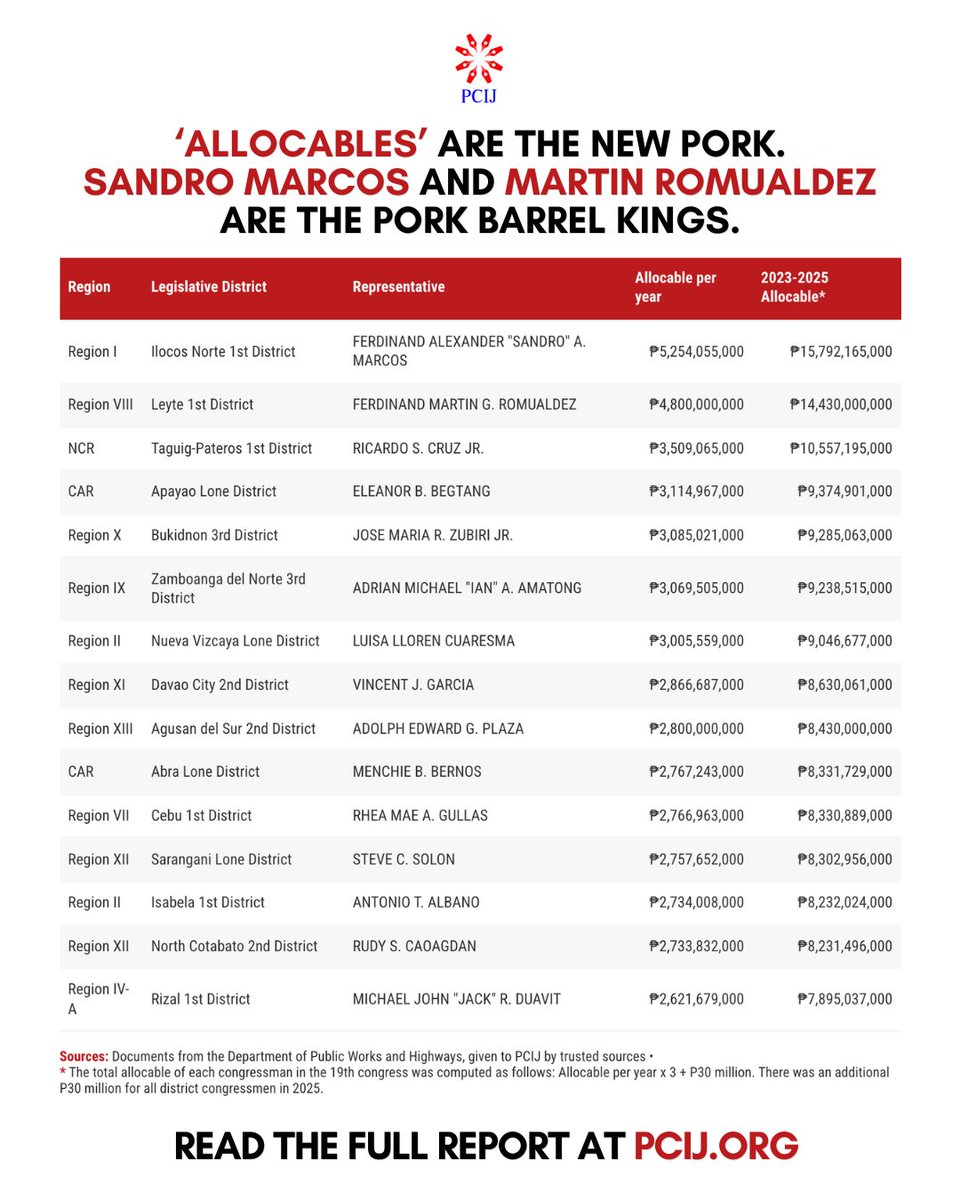
SANDRO MARCOS, MARTIN ROMUALDEZ ARE PORK BARREL KINGS
Here are the 15 legislative districts which got the highest pork allocations from the DPWH in the 19th Congress.
Discover your district's allocable here: https://t.co/Y1Oo3O81mJ
IMMEDIATE IMPACT OF THE INC RALLY ON THE MARCOS ADMINISTRATION
1/
The INC rally didn’t call for Marcos to resign —
but it still delivered the most damaging political blow to the administration so far.
Here’s the immediate effect on the ongoing crisis:
---
2/
Narrative control is gone.
For the first time, the corruption scandal wasn’t framed by the opposition or the media —
but by a powerful, bloc-voting institution with national reach.
The Palace lost its ability to dismiss the issue as “politicking.”
---
3/
The admin is now forced into real action.
INC didn’t ask for regime change —
it asked for accountability, transparency, and concrete reforms.
Symbolic responses won’t cut it anymore.
Marcos must suspend, investigate, and prosecute.
---
4/
Elite fracturing begins.
INC’s move signals:
> “We’re no longer covering for you.”
Political clans, contractors, and legislators are now hedging.
This weakens Marcos faster than any opposition rally could.
---
5/
The Palace is visibly rattled.
Contradictory statements, attempts to downplay turnout, and shifting talking points reveal panic.
When messaging collapses, it means the center of power is destabilized.
---
6/
The real fear inside Malacañang:
INC proved mass mobilization on corruption is possible.
This opens the door for teachers, civil servants, flood victims, and other churches to move next.
The admin cannot afford more rallies of this scale.
---
7/
Marcos is trapped in a no-win position.
He cannot attack INC.
He cannot ignore INC.
He cannot co-opt INC.
Any move he makes worsens the crisis.
---
8/
The rally accelerated the political timeline.
Investigations, leaks, elite realignment, and public expectations will now move faster.
The window for the Palace to contain the scandal is shrinking.
---
9/
Bottomline:
The INC rally didn’t demand Marcos’s resignation —
but it stripped his administration of control, unity, and momentum.
In Philippine politics, that’s how a crisis goes from chronic to acute.