Highly relevant!
"How should central banks respond to commodity price shocks? Optimal monetary and exchange rate frameworks for commodity-exposed economies" by Thomas Drechsel, Michael McLeay, Silvana Tenreyro, and Enrico D. Turri.
"This paper shows that the optimal monetary policy and exchange rate framework depend critically on the economy’s commodity exposure. We develop a flexible but tractable model economy with commodity exports and imports, in which international financial conditions may vary with the commodity cycle. Stabilizing domestic prices is optimal for commodity exporters, in line with standard open-economy policy prescriptions. But for economies that use commodities as inputs in production, optimal policy largely ‘looks through’ the direct and indirect effects of commodity shocks on domestic prices; this contrasts with some earlier findings and policy practice (which only ‘looks through’ the direct effect). Exchange-rate pegs or strict CPI inflation targeting perform better for commodity importers because they stabilize wages and employment, though neither policy is robustly optimal. In emerging and developing economies, where financial conditions are more tied to the commodity cycle, trade-offs are starker and implementing the optimal policy may be challenging, since it requires enough credibility to keep inflation expectations anchored amidst greater volatility in some nominal variables."
https://t.co/ZrVnmkcGLt
@lokitoelgato@adnradiochile creo que no la tiene: Inglaterra colonizó el norte de America pq el sur ya estaba tomado por otros países Europeos. Como Inglaterra dejó mejor institucionalizad ahora EEUU y Canada son desarrollados a diferencia de sud-america ... si no llegaba España quizás venia otro mejor
Highly relevant! We are sharing this article again now that it has been published.
"The Trouble with Rational Expectations in Heterogeneous Agent Models: A Challenge for Macroeconomics" by Benjamin Moll.
"The thesis of this essay is that, in heterogeneous agent macroeconomics, the assumption of rational expectations about equilibrium prices is unrealistic and should be replaced. Rational expectations imply that decision-makers forecast equilibrium prices like interest rates by forecasting cross-sectional distributions. This leads to an extreme version of the curse of dimensionality: dynamic programming problems in which the entire distribution is a state variable (the ‘Master equation’, also known as the ‘Monster equation’). Frontier computational methods struggle with these infinite-dimensional Bellman equations, making it implausible that real-world agents solve the associated decision problems. These difficulties also limit the applicability of the heterogeneous agent approach to central questions in macroeconomics—those involving aggregate risk and non-linearities such as financial crises. This troublesome feature of the rational expectations assumption poses a challenge: what should replace it? I outline three criteria for alternative approaches: (1) computational tractability, (2) consistency with empirical evidence and (3) (some) immunity to the Lucas critique. I then discuss several promising directions, including temporary equilibrium approaches, incorporating survey expectations, least-squares learning and reinforcement learning."
https://t.co/x2iNauNWm8
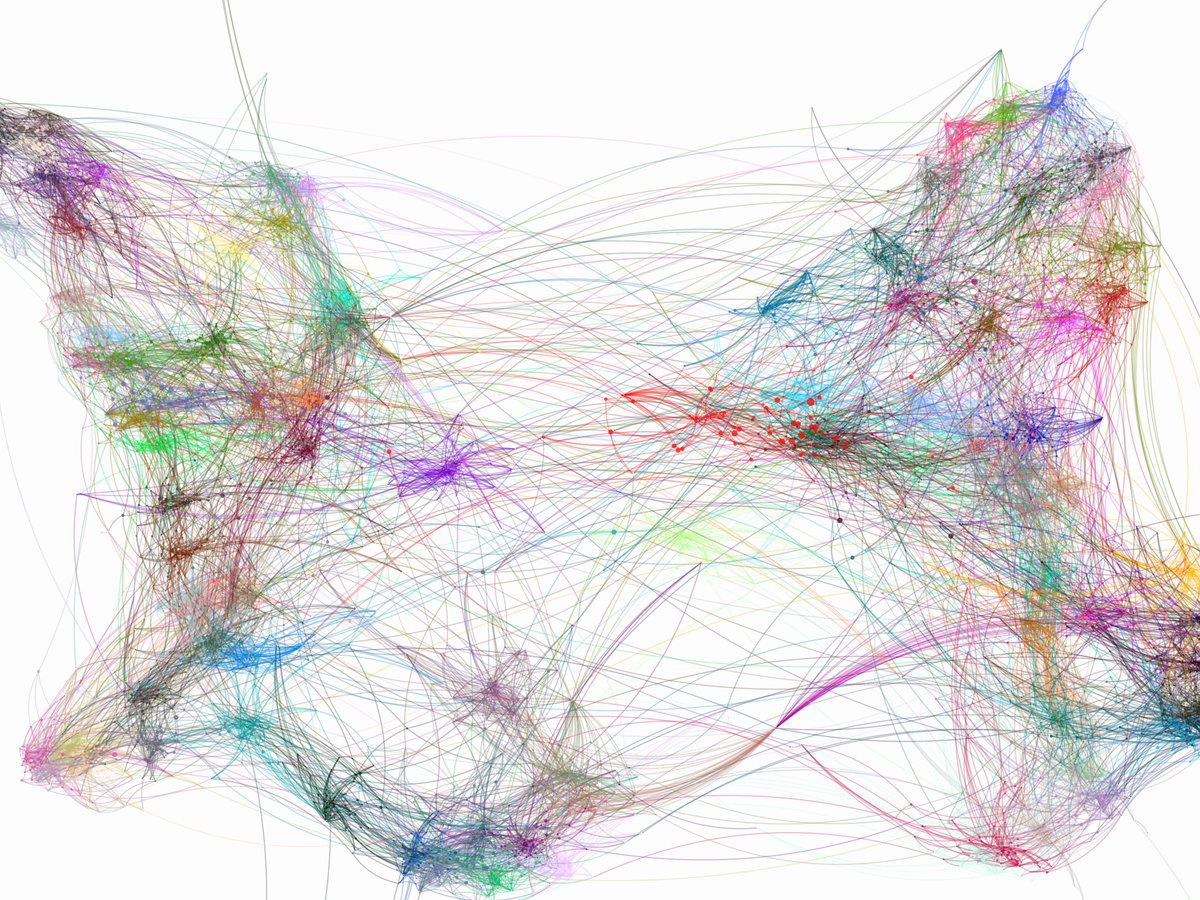
We measure spending flows between thousands of small groups of consumers and thousands of small groups of producers to study how exactly shocks propagate through an economy. It matters for understanding policy. Check it out!👇
10 books recommend by Vinod Khosla:
1) From Bacteria to Bach and Back by Daniel Dennett
"Another of my favorites this year. Long but worth every page."
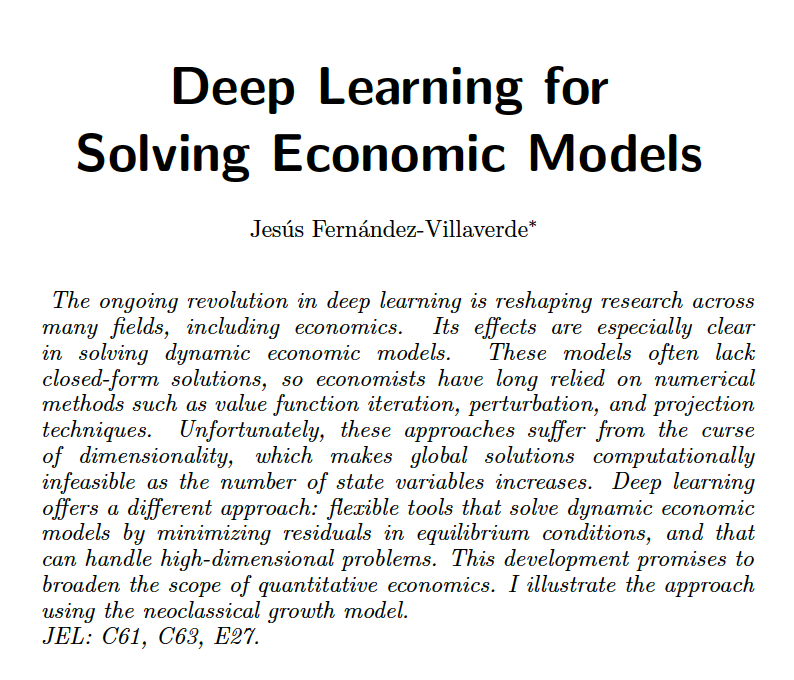
I am very happy that my survey paper, "Deep Learning for Solving Economic Models," is forthcoming in the Journal of Economic Literature (pending final replication checks, which should be quick).
The paper benefited greatly from the editor, David Romer, five referees, and many friends who read earlier versions. I believe the result is a solid introduction to the field, though in 48 pages, there is only so much one can do. So, I created a companion webpage:
https://t.co/zZpOLFXpDk
where you can find the paper, the code, and some slide decks with my teaching material. My plan is to expand the slides over time, adding new material and updating them as new results appear. I will probably do a thorough revision once the spring semester is over.
Those who follow my feed know that I think deep learning is the most fundamental change to computational economics in the last 40 years. I am by now convinced it is more important than the development of Markov chain Monte Carlo methods in the early 1990s or the introduction of projection and perturbation methods in the 1980s. To find a comparable shift, one would probably need to go back to Richard Bellman's invention of value function iteration in 1957.
More pointedly, we need to redesign the Ph.D. in economics. Not at the margin. From the ground up. Economists can either fully embrace the deep learning revolution or become irrelevant, as has already happened, I would dare say, to some fields in academia that refused to accept reality.
Finally, let me apologize to everyone working in this area whom I could not cite. Space was a binding constraint.
And yes, this post was written with the considerable help of AI. There is nothing I am prouder of than the fact that AI is now an integral part of every step I take in my professional life.
I want to take a moment to defend calibration. A common critique of macro by non-macro people centers on the supposed lack of scientific rigor associated with calibration of models. 1/10
The observed decline in labor’s share of corporate output, in conjunction with relatively weak corporate investment, generates a persistent rise in the ratio of corporate valuation relative to corporate earnings, from Andrew Atkeson, @Jonheathcote, and @fab_perri https://t.co/cNQee1CpqR
LLM responses to preference-based tasks become increasingly human-like as models become more advanced or larger, whereas the opposite pattern emerges for belief-based tasks, from Pietro Bini, Lin William Cong, Xing Huang, and @lawrence_j_jin https://t.co/sXuGr8tdLr
AI valuations can be both rational and fragile: necessary to sustain the investment boom along an optimistic path, yet vulnerable to confidence reversals, from Ricardo J. Caballero https://t.co/pbD9kM56kg
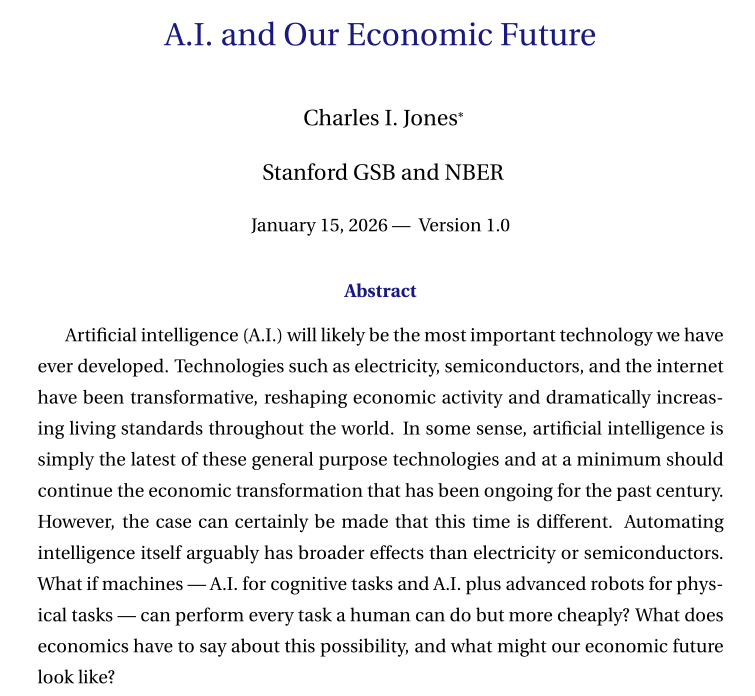
"AI and Our Economic Future" New paper in preparation for the Journal of Economic Perspectives ==> accessible to a broad audience. https://t.co/eV46ATgV3k
A few things that might be of use for my Microeconomics of AI book.
Download book: https://t.co/JRixMWmbem
Chat with the book on NotebookLM: https://t.co/I2KrEQjkMH
Download Slides: https://t.co/h4DyK1UU5S
@PimentelAldo@MayraDo57466678 Pq durante muchos años estuvo bajo políticas afines a la ideología comunista en lo social y económico (que claramente fallaron), de hecho su historia reciente demuestra que la lucha contra el capitalismo de la izquierda ha estado errónea en términos de bienestar social
@PimentelAldo@MayraDo57466678 China implementó el sistema capitalista y logró una reducción histórica de su pobreza. Los mismos chinos reconocieron que el capitalismo era el sistema más efectivo en comparación a lo que ellos mismos tenían implementado antes (políticas tipo izquierda latinoamericana)
A guide for students of economics: Ten statements that demonstrate that someone does not understand modern economics or what an equilibrium is, and that you can safely ignore everything else they say.
1. “Equilibrium means the economy is stable or at rest.”
Many assume that an equilibrium is a peaceful state with no forces at play. Instead, an equilibrium is just an arrangement of actions and expectations over time that are mutually consistent. It can be locally unstable, explosive, or fragile. Nothing in the definition of equilibrium implies stability.
2. “Equilibrium implies optimality or social efficiency.”
Equilibrium is often conflated with efficiency, but equilibrium merely reflects decentralized consistency, not welfare maximization. Market power, externalities, incomplete markets, nominal rigidities, and frictions routinely produce inefficient equilibria. I often teach a first-year macro graduate course, and not a single one of the equilibria I define is efficient.
3. “Equilibrium is a unique outcome.”
Many often expect models to have one equilibrium. In reality, multiple equilibria arise naturally in dynamic, strategic, and incomplete-market environments. Models of coordination failures, self-fulfilling expectations, bubbles, overlapping generations, and liquidity traps all hinge on the existence of equilibrium multiplicity.
4. “Equilibrium requires perfect foresight or perfect information.”
Equilibrium does not assume agents know the future. In fact, equilibria are often stochastic. The definition of equilibrium only requires that beliefs are consistent with the (perceived) stochastic laws of motion implied by the model. Bayesian learning, noisy signals, ambiguity, and subjective uncertainty all fit well within an equilibrium framework, provided beliefs converge to an internally consistent (but possibly incorrect) distribution.
Bonus point: equilibria are compatible with agents having diverging beliefs that never converge to a single Dirac distribution.
5. “Real economies are rarely in equilibrium, so the concept is unrealistic.”
Equilibrium is not meant to describe the daily state of the world. It is a conceptual device used to understand the outcome of our models under the assumptions we make. Also, see point 1 above.
6. “Equilibrium requires agents to be fully rational in a psychological sense.”
Equilibrium only assumes internal consistency: agents optimize given preferences and constraints. It does not assume realism about human cognition. We can and do define equilibria in models with behavioral biases, bounded rationality, inattention, or rule-of-thumb behavior. We only need to ensure that the resulting actions and beliefs are mutually compatible.
7. “Equilibrium eliminates dynamics or learning.”
Equilibrium is sometimes misinterpreted as a static state in which nothing evolves. In fact, many equilibria are sequences of probability distributions over states driven by shocks, policy rules, and endogenous responses. Learning dynamics (Bayesian updating, adaptive rules, experience-based expectations) can occur within equilibrium if the evolution of beliefs is self-consistent.
8. “Equilibrium renders expectations unimportant.”
A common misconception is that equilibrium mechanically determines outcomes. In reality, expectations are often central: they determine investment, consumption, asset prices, and policy responses. Many equilibria differ only in their expectations. This is why communication, credibility, and forward guidance matter even in fully rational models.
9. “Equilibrium excludes policy intervention.”
Some interpret equilibrium as a laissez-faire concept. In fact, equilibrium analysis is the foundation of modern policy evaluation. Fiscal, monetary, and regulatory interventions work through equilibrium responses (prices, wages, interest rates, quantities) and must satisfy equilibrium conditions to be credible. Equilibrium is a tool for policy design, not a barrier to it.
10. “Equilibriums…”
Aequilibrium is a Latin neuter noun of the second declension, which forms a nominative plural in “a”. It is composed of aequus (equal; the same root as equality or equity) and libra (balance or scales or the name of several currencies over history).
A final thought: “equilibrium” is a term of art. Its meaning in economics differs from its use in the natural sciences or in everyday language. Terms of art are ubiquitous across academic disciplines, and the first act of intellectual diligence when one starts studying a discipline is to learn what they mean.








![KirkDBorne's tweet photo. [Download 496-page PDF eBook] Applied Causal #Inference Powered by #MachineLearning and #AI: https://t.co/NPkNAHa3ez
—————
#ML #DataScience #Algorithms #Statistics #DataScientist #PredictiveAnalytics https://t.co/fs9ZPVuOls](https://pbs.twimg.com/media/HBvXzfHXYAAd7uv.jpg)